The Quick Answer
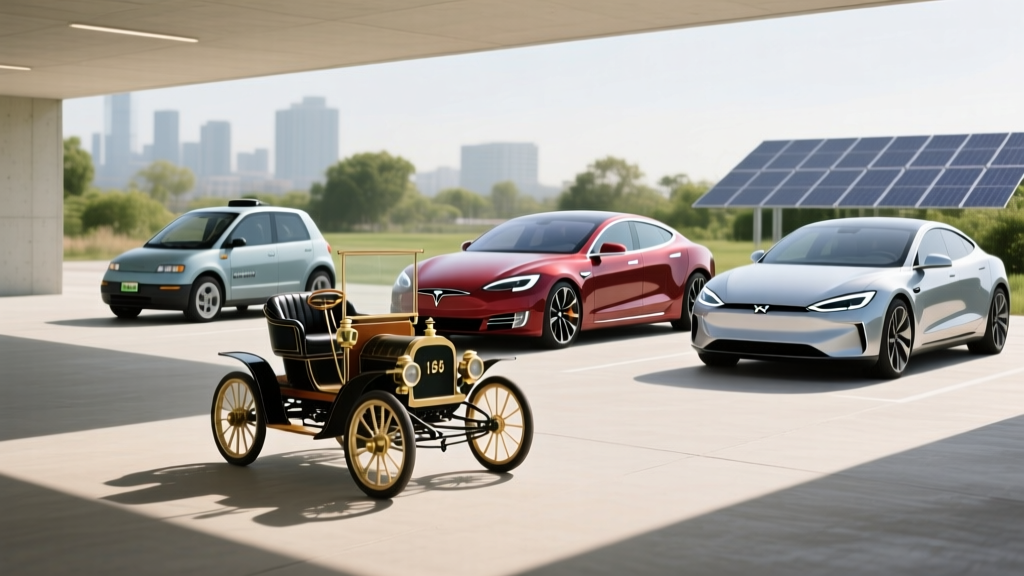
The first crude electric vehicle was built around 1832–1839 by Scottish inventor Robert Anderson, using non-rechargeable primary cells. The first practical electric car emerged in the 1880s, and by 1900, electric vehicles accounted for roughly a third of all automobiles on U.S. roads. The modern era of highway-capable, lithium-ion battery EVs began with the 2008 Tesla Roadster, followed by the mass-market 2011 Nissan Leaf and 2012 Tesla Model S.
If you've landed here searching when did the first electric car come out, you might be surprised that EVs actually predate gasoline cars. But history is only useful if it helps you make a smarter buying decision today. Below, we trace the key milestones, then translate that evolution into the concrete numbers—range, charging speed, cost, and ownership—that matter if you're considering a 2026 EV purchase.
The Origin Story: Electric Cars Before Gasoline
Between 1832 and 1839, Robert Anderson's electric carriage demonstrated that battery-powered propulsion was possible, though its non-rechargeable cells made it a novelty. In 1884, English inventor Thomas Parker built a more practical EV using rechargeable cells, and by 1890, William Morrison introduced the first successful electric car in the United States—a six-passenger wagon capable of roughly 14 mph.
By the turn of the 20th century, EVs were competitive with steam and gasoline vehicles. In 1900, approximately 28% of all cars produced in the U.S. were electric, according to the U.S. Department of Energy. They were quiet, easy to operate, and required no hand-cranking—a major advantage over early gasoline engines.
The tide turned with three developments: Henry Ford's mass-produced Model T (1908) drove gasoline car prices down, the discovery of large petroleum reserves made fuel cheap, and the electric starter (1912) eliminated the dangerous hand crank. By the 1930s, the electric passenger car had effectively vanished from American roads.
The Modern EV Timeline: From Niche to Mainstream
The EV revival began in earnest in the 1990s. The 1996 GM EV1 proved that a purpose-built electric car was technically viable, though GM ultimately recalled and destroyed most units. The 2008 Tesla Roadster was the watershed moment: a highway-capable sports car with a lithium-ion battery pack delivering an EPA-rated 244 miles of range—unprecedented at the time.
The 2011 Nissan Leaf brought EVs to the mass market at roughly $32,780 (before incentives), with an EPA range of 73 miles. The 2012 Tesla Model S shattered range expectations with up to 265 EPA miles and proved that an EV could serve as a primary vehicle. Since then, the progression has been rapid:
- 2017: Chevrolet Bolt EV delivers 238 EPA miles for under $37,000
- 2018: Tesla Model 3 ramps production, mainstreaming long-range EVs
- 2022: Ford F-150 Lightning proves EVs can handle truck duty
- 2024–2025: The industry broadly adopts the NACS charging standard, unlocking Tesla Supercharger access for non-Tesla vehicles
- 2026: Multiple models exceed 300+ EPA miles, and average DC fast-charge speeds have climbed to 200–350 kW peak
What Today's EVs Actually Deliver: 2026 Numbers
History is interesting, but what matters to a buyer in 2026 is what's on the showroom floor. Here's a snapshot of current-generation specs across popular segments:
| 2026 Model | EPA Range | Battery (kWh Usable) | Peak DC Fast Charge | 10–80% Time | Base MSRP |
|---|---|---|---|---|---|
| Tesla Model Y (Long Range) | 320 mi | 75 kWh (NMC) | 250 kW | ~25 min | $44,990 |
| Hyundai Ioniq 5 (Long Range) | 305 mi | 77.4 kWh (NMC) | 240 kW | ~18 min | $46,500 |
| Chevrolet Equinox EV (3RS) | 315 mi | 85 kWh (NMC) | 150 kW | ~30 min | $38,900 |
| Ford Mustang Mach-E (ER) | 320 mi | 91 kWh (NMC) | 150 kW | ~35 min | $45,995 |
| Tesla Model 3 (Long Range) | 341 mi | 75 kWh (NMC) | 250 kW | ~25 min | $42,490 |
Real-world caveat: EPA range is measured under mixed city/highway conditions at moderate temperatures. Expect 10–20% less range on sustained highway driving at 75+ mph, and 20–30% loss in freezing weather without preconditioning. A 320-mile EPA Model Y might deliver 250–270 miles on a 70°F highway trip and as low as 220 miles at 20°F.
EV vs. Gas vs. Hybrid: Real Cost Comparison
The most common question from first-time EV buyers isn't about history—it's whether an EV actually saves money. Here's a 5-year cost breakdown comparing a 2026 EV (Tesla Model Y LR), a comparable gas SUV (Toyota RAV4 AWD), and a hybrid (Toyota RAV4 Hybrid), assuming 15,000 miles/year and national average energy prices:
| Cost Category (5 Years) | 2026 Tesla Model Y LR | 2026 RAV4 AWD (Gas) | 2026 RAV4 Hybrid |
|---|---|---|---|
| Purchase Price (MSRP) | $44,990 | $33,000 | $36,000 |
| Fed. Tax Credit (§30D) | –$7,500* | $0 | $0 |
| Fuel/Energy (75,000 mi) | $3,750 (home L2 avg) | $9,375 (28 MPG, $3.50/gal) | $6,563 (40 MPG, $3.50/gal) |
| Maintenance | $1,200 | $3,000 | $2,800 |
| Insurance (est. avg) | $9,500 | $7,000 | $7,200 |
| 5-Year Total (pre-depreciation) | $51,940 | $52,375 | $52,563 |
*§30D credit eligibility depends on MSRP caps ($55,000 for SUVs), buyer income limits ($150K single / $300K joint), battery sourcing requirements, and point-of-sale transfer rules. Verify current-year requirements at IRS.gov before relying on this figure.
The EV achieves rough cost parity within five years despite a higher sticker price, primarily through fuel and maintenance savings. The advantage grows the longer you hold the vehicle, since EV motors have far fewer wear components than internal combustion engines—no oil changes, spark plugs, timing belts, or exhaust systems.
Real-World Ownership: What First-Time Buyers Must Know
Knowing when the first electric car came out won't prepare you for the practical realities of ownership. Here's what actually determines whether an EV works for your life:
Home Charging Access Is the Deciding Factor
Over 80% of EV charging happens at home. If you have a garage or driveway where a Level 2 charger (240V, 7–11.5 kW) can be installed, an EV is exceptionally convenient—you wake up every morning with a full "tank." A typical Level 2 installation costs $800–$2,500 including equipment, electrician labor, and permits, though a panel upgrade from 100A to 200A service can add $1,500–$3,000 if your home's electrical panel is at capacity.
If you cannot charge at home (apartment living, street parking, no outlet access), EV ownership becomes significantly harder. You'd rely on public DC fast charging at $0.35–$0.55/kWh, pushing your per-mile cost from roughly $0.05 (home L2) to $0.12–$0.18—narrowing or eliminating the fuel savings over gas.
Climate Matters More Than You Think
Lithium-ion batteries lose efficiency in cold weather. At 20°F, expect 20–30% range reduction due to increased cabin heating demand and reduced battery chemistry efficiency. Vehicles with a heat pump (standard on Tesla, Hyundai Ioniq 5, and many 2026 models) recover some of this loss—typically 5–10 percentage points—by extracting ambient heat rather than generating it resistively.
Hot climates accelerate long-term battery degradation, though modern thermal management systems have reduced this concern substantially. Most 2026 EVs carry an 8-year / 100,000-mile battery warranty guaranteeing at least 70% capacity retention, per fueleconomy.gov and manufacturer specifications.
Driving Patterns: Range Reality Check
If your daily commute is under 60 miles round-trip, virtually any 2026 EV covers your needs multiple times over without charging. The challenge arises on road trips. A 300-mile EPA range means planning a 15–25 minute DC fast-charge stop every 200–250 highway miles. Charging infrastructure has expanded significantly—Tesla's Supercharger network alone exceeds 30,000 stalls in North America, and with the NACS adapter, Ford, GM, Rivian, and other brands now access it.
Common EV Misconceptions vs. Facts
| Myth | Fact |
|---|---|
| "EVs are a new, unproven technology." | Electric cars have existed since the 1830s. Modern lithium-ion EVs have been in mass production since 2011, with billions of real-world miles logged. Battery packs routinely exceed 150,000 miles with under 10% degradation. |
| "EV batteries need replacing every few years." | Current NMC and LFP packs are designed for the life of the vehicle. Most manufacturers warrant batteries for 8 years/100,000 miles at ≥70% capacity. Real-world data shows average degradation of 5–8% over 100,000 miles. |
| "EVs are worse for the environment because of electricity generation." | Even on a coal-heavy grid, an EV produces fewer lifetime emissions than a comparable gas car. On the increasingly renewable U.S. grid, the advantage is substantial—typically 60–70% fewer lifecycle emissions per mile, per EPA and DOE analyses. |
| "Charging takes too long." | Home Level 2 charging adds ~30–44 miles per hour overnight. On road trips, 2026 EVs with 200+ kW capability add 150–200 miles in 15–20 minutes—roughly a rest-stop break. |
| "The grid can't handle mass EV adoption." | Most charging occurs overnight during off-peak hours when grid capacity is underutilized. Managed charging and V2G (vehicle-to-grid) technology further ease demand. Grid upgrades are ongoing but not a near-term barrier. |
Decision Framework: Is a 2026 EV Right for You?
Choose a Battery EV (BEV) If:
- You have reliable home or workplace Level 2 charging access
- Your daily driving is under 150 miles (covers 95%+ of U.S. drivers)
- You want the lowest per-mile operating cost and minimal maintenance
- You qualify for the §30D federal tax credit (up to $7,500) or state incentives
- You take road trips fewer than 4–6 times per year and can plan charge stops
Choose a Plug-In Hybrid (PHEV) If:
- You lack reliable home charging but want some electric-only driving (typically 25–45 miles)
- You frequently drive 300+ miles in rural areas with sparse charging infrastructure
- You want electric commuting with gas flexibility for long trips—zero range anxiety
- Models like the Toyota RAV4 Prime (42 mi electric, 38 MPG combined) or Jeep Wrangler 4xe (22 mi electric) fit your needs
Stick With a Hybrid (HEV) or Gas Vehicle If:
- You have no home or workplace charging and limited public charging access
- You regularly tow heavy loads over long distances in cold climates
- Your budget is strictly under $28,000 and you cannot access used-EV credits
- You drive over 300 highway miles daily (commercial/long-haul use)
Frequently Asked Questions
Who invented the first electric car?
There is no single inventor. Robert Anderson (Scotland, ~1832–1839) built the earliest known electric carriage. Thomas Parker (England, 1884) built a more practical version with rechargeable cells. William Morrison (Iowa, ~1890) created the first commercially viable electric car in the U.S.
Why did electric cars disappear in the early 1900s?
Three factors converged: cheap gasoline from newly discovered petroleum reserves, the mass-produced Ford Model T (1908) lowering gas-car prices, and the electric starter motor (1912) eliminating the dangerous hand crank. Gasoline cars became cheaper, longer-range, and easier to refuel, and the EV market collapsed by the mid-1930s.
When did electric cars become practical for everyday use?
The 2011 Nissan Leaf (73 EPA miles) was the first modern mass-market EV, but the 2017 Chevrolet Bolt EV (238 miles) and 2018 Tesla Model 3 (310 miles) were the first to offer enough range and charging speed to serve as a primary vehicle for most households without compromise.
How far have EVs come since the first electric car?
Robert Anderson's 1830s carriage traveled a few miles at walking speed with non-rechargeable cells. A 2026 Tesla Model 3 Long Range delivers 341 EPA miles, charges at 250 kW (adding ~175 miles in 15 minutes), accelerates to 60 mph in 4.2 seconds, and costs roughly $0.05/mile to fuel at home—a roughly 200-year arc of engineering progress.
Are today's EV batteries better than early EV batteries?
Enormously. Early 20th-century EVs used heavy lead-acid batteries with ~30 Wh/kg energy density. Modern lithium-ion packs achieve 250–300 Wh/kg, and LFP (lithium iron phosphate) chemistry—used in many 2026 standard-range models—offers longer cycle life and lower cost, albeit with slightly lower energy density than NMC.
What should I check before buying my first EV in 2026?
Confirm your home electrical panel can support a Level 2 charger (50A circuit recommended), verify §30D tax credit eligibility for your specific VIN at IRS.gov, check the vehicle's EPA range against your longest typical trip, confirm the charging connector (NACS is now the dominant standard), and review the battery warranty terms (8 yr/100K mi at ≥70% capacity is the industry baseline).
The question of when did the first electric car come out leads to a surprising answer: nearly two centuries ago. But the real story is the exponential improvement in battery chemistry, charging speed, and affordability that has made EVs a practical choice for millions of drivers today. Whether you choose a BEV, PHEV, or stick with a hybrid depends on your charging access, driving patterns, and budget—not the technology's age.