Quick Answer: Who Created the First Electric Car?
The first crude electric vehicle is widely credited to Robert Anderson, a Scottish inventor who built a battery-powered carriage between 1832 and 1839. These early cells were non-rechargeable, making the invention a novelty rather than a practical vehicle. The first practical electric car using rechargeable batteries emerged in the 1880s–1890s, with key contributions from Thomas Parker (London, 1884) and William Morrison (Des Moines, Iowa, 1890–1891). By 1900, electric cars actually outsold gasoline vehicles in the U.S. before cheap oil and the electric starter reversed the trend.
That 19th-century origin story matters to modern buyers because the core engineering challenge — storing enough electrical energy onboard to be practical — remained unsolved for over a century. Today's lithium-ion and LFP battery packs finally close that loop. But whether a 2026 EV makes financial and logistical sense for you depends on concrete numbers: range, charging speed, electricity cost, and tax-credit eligibility. Let's connect the history to a present-day buying decision.
From Morrison's Wagon to the Modern EV: What Actually Changed
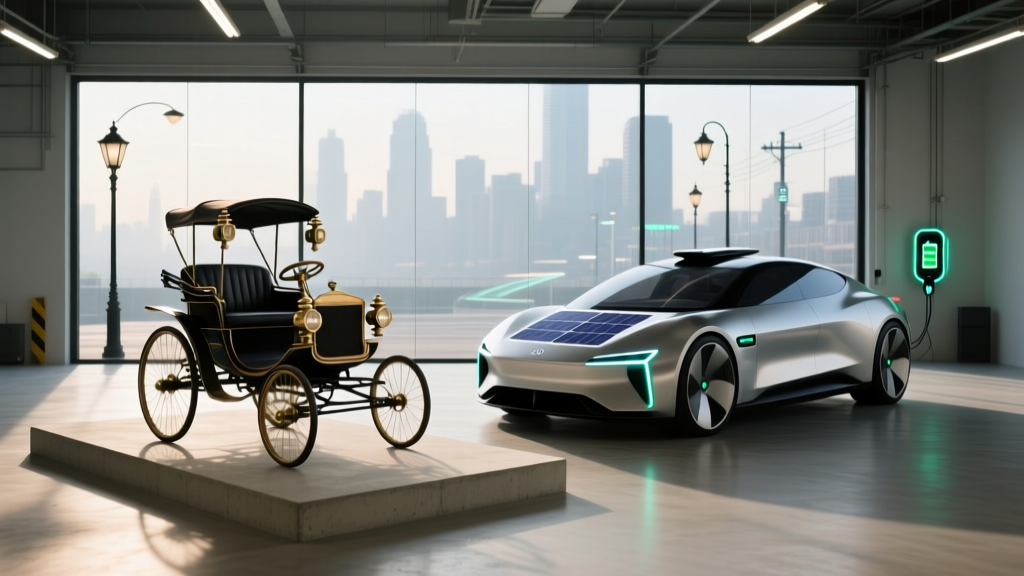
William Morrison's 1891 wagon delivered roughly 4 hp, a top speed around 12 mph, and an estimated range of ~50 miles on a single charge that took many hours. Fast-forward to a 2026 benchmark like the Hyundai Ioniq 6 SE Long Range: 320 hp, a 0–60 mph time of 5.1 seconds, and an EPA-estimated 361 miles of range from a 77.4 kWh battery pack, with a peak DC charge rate of 235 kW (10–80% in roughly 18 minutes on a capable charger).
| Spec | 1891 Morrison EV | 2026 Hyundai Ioniq 6 SE LR | 2026 Toyota Camry LE (Gas Baseline) |
|---|---|---|---|
| Horsepower | ~4 hp | 320 hp | 208 hp |
| 0–60 mph | N/A | 5.1 sec | 7.6 sec |
| Range / Tank | ~50 mi | 361 mi (EPA) | ~510 mi |
| Energy Store | Lead-acid cells | 77.4 kWh NMC Li-ion | 13.2 gal gasoline |
| "Refuel" Time | Many hours | ~18 min (10–80% DC) | ~5 min |
| Base MSRP | N/A | $42,750 | $29,995 |
The gap between 1891 and today isn't just power — it's energy density. Modern NMC (nickel manganese cobalt) packs store roughly 250–300 Wh/kg at the cell level, versus lead-acid's ~40 Wh/kg. That's why today's EVs can credibly replace gas cars for most drivers, not just city runabouts.
The Real-World Cost Picture: EV vs Gas in 2026
History is interesting, but the question that matters now is: what does ownership actually cost? The sticker price of an EV is typically higher than a comparable gas car, but fuel and maintenance math can close the gap — sometimes within 3–4 years.
| Cost Category | 2026 Hyundai Ioniq 6 SE | 2026 Toyota Camry LE |
|---|---|---|
| Purchase (MSRP) | $42,750 | $29,995 |
| Federal §30D Credit (if eligible) | −$7,500 | $0 |
| Effective Purchase | $35,250 | $29,995 |
| Fuel / Electricity (5 yr) | $4,650 (home L2 @ $0.16/kWh) | $9,750 (28 MPG @ $3.64/gal) |
| Maintenance (5 yr) | $1,800 | $3,900 |
| Insurance (5 yr avg) | $10,200 | $8,400 |
| Total 5-Yr Cost | $51,900 | $52,045 |
Source data cross-referenced with fueleconomy.gov efficiency figures. The Ioniq 6's real advantage is maintenance: no oil changes, no spark plugs, far less brake wear thanks to regenerative braking. Insurance, however, runs 15–25% higher on average for EVs — a cost many shoppers underestimate.
Critical caveat on the §30D credit: Under current IRS rules, eligibility hinges on buyer income caps ($150k single / $300k joint), vehicle MSRP caps ($55k cars / $80k SUVs/trucks), and battery critical-mineral + component sourcing requirements that tighten yearly. Always verify your specific VIN on the IRS Clean Vehicle Provisions page before counting on the credit. Point-of-sale transfer is available at participating dealers.
Real-World Range and Charging: Where Stickers Meet Streets
Anderson's 1830s carriage couldn't be recharged at all. Morrison's 1891 wagon needed overnight charging. Today's EVs charge far faster — but not as fast as marketing implies. Here's the honest breakdown for a typical 2026 midsize EV with a 75–80 kWh pack:
- Level 1 (120V, ~1.4 kW): ~3–5 miles of range per hour. A full recharge takes 2+ days. Fine for low-mileage PHEVs, painful for a BEV.
- Level 2 (240V, 7.7–11.5 kW): ~25–40 miles per hour. Overnight recharge in 7–10 hours. The home-charging sweet spot.
- DC Fast Charging (50–350 kW peak): 10–80% in 18–40 minutes on a capable station. Note the word peak — charge curves taper sharply above 80% to protect the battery. A "250 kW" rating is typically sustained for only a few minutes at low state of charge.
EPA Sticker vs. Reality: A 2026 EV rated at 320 miles EPA typically delivers 260–290 miles at sustained 75 mph highway speeds, and 220–250 miles in sub-freezing weather without a heat pump. Cold saps battery chemistry efficiency and cabin heating is a major load. If your commute is 90 miles round-trip in Minnesota winter, a 250-mile EPA car will feel tight — aim for 300+.
Home Charging Access: The Make-or-Break Question
This is where many first-time EV buyers miscalculate. Roughly 70–80% of EV charging happens at home, according to DOE surveys. If you have a garage or dedicated parking spot with access to a 240V circuit, EV ownership is transformative: you "refuel" while sleeping for the equivalent of $1.00–$1.50 per gallon of gasoline.
If you don't — apartment dwellers, street parkers, condo owners without HOA charger approval — you'll rely on public DC fast charging at $0.35–$0.55/kWh, which erases most of the fuel-cost advantage and adds 20–40 minutes per session. Before buying a BEV, honestly answer:
- Can I install a Level 2 charger (NACS or J1772/CCS) at my primary parking spot?
- What is the electrical panel capacity? A 200-amp panel usually handles a 48-amp EVSE; older 100-amp homes may need a $1,500–$3,500 panel upgrade.
- Does my workplace or regular route have reliable charging?
If the answer to #1 is no, a plug-in hybrid (PHEV) like the Toyota RAV4 Prime (42 miles electric-only, then 38 MPG gas) often fits better than a full BEV.
Common EV Misconceptions, Corrected with Data
| Myth | Fact (2026 Data) |
|---|---|
| "EV batteries need replacing every few years." | Federal warranty mandate is 8 years/100,000 miles minimum for capacity retention (typically ≥70%). Real-world degradation averages 1.5–2.3% per year for liquid-cooled NMC packs. A 2018 Tesla Model 3 fleet study showed ~88% capacity at 100k miles. |
| "EVs are worse for the environment because of electricity generation." | Even on coal-heavy U.S. grids, EPA/DOE lifecycle analyses show EVs emit 50–70% less CO₂ over 150,000 miles than comparable gas cars. On cleaner grids (CA, NY, PNW), the gap widens to 70–80%. |
| "You can't take an EV on a road trip." | Tesla Supercharger, Electrify America, and the expanding NACS-compatible networks cover every major U.S. corridor. A 1,000-mile trip adds ~90–120 minutes of charging vs. a gas car — real, but manageable. |
| "Autopilot / FSD means the car drives itself." | All consumer systems (Tesla FSD Supervised, GM Super Cruise, Ford BlueCruise) are SAE Level 2 — the driver must remain attentive and hands-on or eyes-on at all times. True driverless operation (Level 4) currently exists only in geofenced robotaxi services like Waymo in select cities. |
| "The first electric car was a Tesla." | Tesla's Roadster debuted in 2008 — roughly 175 years after Anderson's carriage and 117 years after Morrison's practical EV. Tesla's real contribution was proving lithium-ion BEVs could be desirable and viable at scale. |
Decision Framework: Is a 2026 EV Right for You?
Choose a battery-electric vehicle (BEV) if:
- You can install Level 2 home charging.
- Your daily driving is under 100 miles round-trip.
- You qualify for the §30D credit or a state incentive (check IRS.gov and DSIRE).
- You want the lowest per-mile fuel cost and minimal maintenance.
Choose a plug-in hybrid (PHEV) if:
- Home charging is uncertain or shared.
- You frequently drive 300+ miles in a day with no reliable en-route charging.
- You want electric-only commuting (~30–45 mi) without range anxiety.
Stick with a hybrid (HEV) or gas car if:
- You live in an apartment without charging access and your route has DCFC deserts.
- Your budget is sub-$28,000 and you need maximum cargo/towing flexibility today.
- You regularly tow heavy loads in cold climates, where EV range drops 30–40%.
What First-Time EV Buyers Should Know Before Signing
- kW vs kWh is non-negotiable: kW measures power (charge speed); kWh measures energy (battery capacity). A 77 kWh battery charging at 150 kW is like a 15-gallon tank filling at 3 gallons per minute.
- Precondition the battery before DC fast charging — most EVs do this automatically when you navigate to a charger. A cold pack charges at a fraction of peak rate.
- LFP vs NMC chemistry: LFP (lithium iron phosphate) packs, common in base-trim Teslas and some Ford/Hyundai models, tolerate daily 100% charging and have longer cycle life but lower energy density and worse cold performance. NMC offers more range per kWh but prefers 20–80% daily use.
- Connector transition: As of 2026, most new EVs are adopting NACS (Tesla's connector). CCS1 vehicles can use adapters at Superchargers, but verify compatibility and peak rate — adapters often cap at 150 kW.
- Verify the tax credit per VIN. Battery sourcing rules change annually. A model that qualified in 2025 may not in 2026.
FAQ: First Electric Car History + 2026 Buying Questions
Who invented the first practical electric car?
Robert Anderson built the earliest known electric carriage around 1832–1839, but with non-rechargeable cells. William Morrison's 1890–1891 six-passenger wagon in Iowa is widely recognized as the first practical rechargeable EV in the United States.
Why did electric cars disappear in the early 1900s?
Three factors: cheap Texas oil, Henry Ford's mass-produced Model T ($850 vs. $1,750+ for an electric), and the 1912 electric starter that eliminated hand-cranking gas engines. By 1930, EVs had essentially vanished from the U.S. market.
How much does it cost to charge an EV at home in 2026?
At the U.S. average residential rate of ~$0.16/kWh, fully recharging a 75 kWh battery (≈280 miles) costs about $12 — equivalent to roughly $1.20 per gallon of gasoline. Public DC fast charging runs $0.35–$0.55/kWh, or $3.50–$5.50 per gallon-equivalent.
Do EV batteries really last 10+ years?
Yes, in most cases. Federal law mandates 8 years/100,000 miles of battery warranty coverage (capacity above a stated threshold, usually 70%). Real-world data from Tesla, Nissan, and Chevrolet fleets shows average degradation of 1.5–2.3% per year, meaning ~80–85% capacity at 10 years for liquid-cooled packs.
Is a used EV a good deal?
Potentially — the federal used-EV credit offers 30% of the sale price up to $4,000 on vehicles priced at $25,000 or less, subject to income caps. Always request a battery State of Health (SoH) report before purchasing; avoid packs below 85% SoH unless priced accordingly.
Should I wait for solid-state batteries?
Solid-state packs promise higher energy density and faster charging, but commercial availability in mainstream vehicles remains limited to select 2026–2027 models (Toyota, Nissan prototypes) at premium pricing. For most buyers, today's NMC and LFP packs are mature, reliable, and warranty-backed — waiting 3–5 years for broad solid-state adoption rarely pencils out against current incentives.
The thread from Robert Anderson's 1830s carriage to a 2026 Ioniq 6 or Tesla Model Y is longer than most shoppers realize — and the engineering problems that stumped inventors for 150 years are now genuinely solved. The remaining question isn't whether electric cars work; it's whether your home, your commute, and your budget align with one today.