The Quick Answer
The first crude electric vehicle was built around 1834–1835 by American blacksmith Thomas Davenport, who created a small battery-powered model car. The first practical, passenger-carrying electric car is widely credited to Robert Anderson of Scotland, circa 1832–1839. However, the first production electric car sold to consumers appeared in the 1890s, when EVs briefly outsold gasoline and steam vehicles. By 1900, roughly one-third of all cars on American roads were electric.
If you're researching EV history because you're considering buying one today, you're not alone. Understanding where electric cars came from — and why they disappeared for a century — helps explain the real-world trade-offs modern buyers face in 2026. Below, we connect that history to today's concrete ownership numbers: EPA ranges, charging costs, tax credits, and the decision framework that actually matters.
Why Early Electric Cars Won — Then Lost — the Market
Between 1895 and 1910, electric cars were the preferred choice for urban drivers. They were quiet, required no hand-cranking to start, and produced no exhaust. Models like the Baker Electric and Detroit Electric offered 50–80 miles of range on lead-acid batteries — perfectly adequate for city errands on unpaved roads.
Three factors killed the early EV:
- Range and infrastructure: Gasoline cars could refuel anywhere and travel farther as road networks expanded beyond cities.
- The electric starter (1912): Cadillac's invention eliminated the dangerous hand-crank, removing a major EV advantage.
- Mass production: Ford's Model T undercut EV prices dramatically. By 1912, a gasoline car cost roughly $650 versus $1,750 for an electric equivalent.
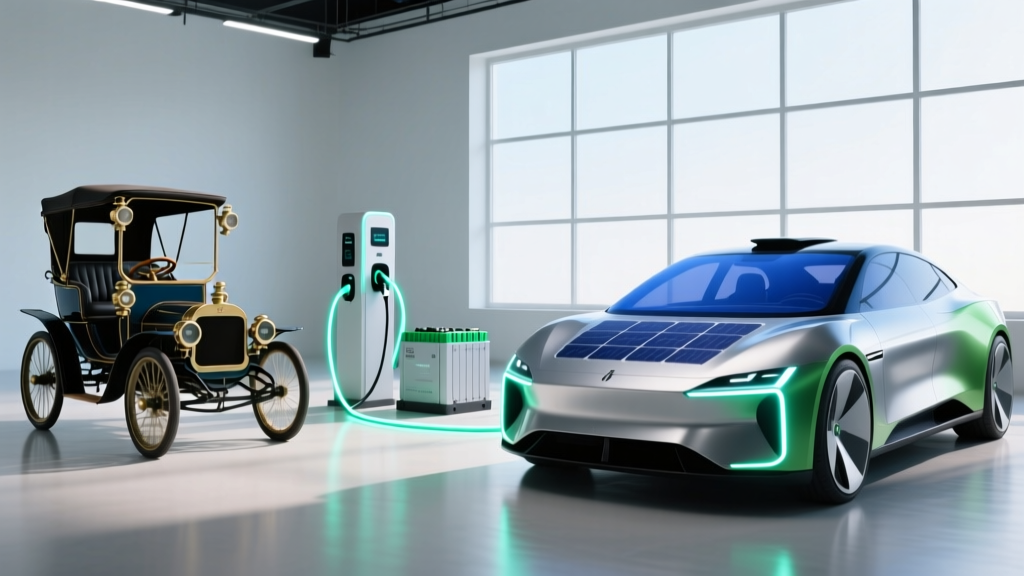
The parallel to 2026 is instructive. Today's EVs overcome those same historical barriers with lithium-ion batteries (250–400+ mile EPA ranges), a growing DC fast-charging network, and federal tax credits that narrow the price gap. But new trade-offs have replaced the old ones.
How Today's EVs Compare: The Numbers That Matter
History is interesting, but you're here to decide whether an electric vehicle makes financial and practical sense right now. Let's compare a representative 2026 EV, a plug-in hybrid (PHEV), and a conventional gasoline vehicle across the metrics that drive ownership cost.
| Metric | BEV (e.g., Hyundai Ioniq 5 SEL) | PHEV (e.g., Toyota RAV4 Prime) | Gasoline (e.g., Honda CR-V EX) |
|---|---|---|---|
| Base MSRP | $45,500 | $43,690 | $35,400 |
| EPA Range / MPGe | 318 mi / 114 MPGe | 42 mi electric + 38 MPG gas | 30 MPG combined |
| Battery / Fuel Tank | 84 kWh usable (NMC) | 18.1 kWh + 14.5 gal tank | 15.1 gal tank |
| 0–60 mph | 5.1 sec (225 kW / 302 hp) | 5.7 sec (302 hp combined) | 7.8 sec (190 hp) |
| Max DC Fast Charge | 240 kW (10–80% in ~18 min) | N/A (Level 2 only, ~2.5 hrs) | N/A |
| Fed. Tax Credit (§30D) | Up to $7,500 (eligibility varies) | Up to $7,500 (eligibility varies) | $0 |
| Battery/Powertrain Warranty | 10 yr / 100,000 mi | 10 yr / 150,000 mi (hybrid system) | 5 yr / 60,000 mi |
Real-world range caveat: The Ioniq 5's EPA 318-mile rating assumes mixed driving at moderate temperatures. Expect roughly 250–275 miles on sustained highway driving at 70+ mph, and potentially 200–230 miles in sub-30°F cold weather without preconditioning. The RAV4 Prime's 42-mile electric-only range covers most daily commutes, but longer trips rely entirely on gasoline.
Real Costs and Savings: A 5-Year Ownership Breakdown
Upfront price tells only part of the story. The following table models 5-year / 75,000-mile ownership costs for a buyer in a state with average electricity rates ($0.16/kWh) and gasoline at $3.40/gallon. We assume home Level 2 charging for the BEV, 80% electric / 20% gas driving for the PHEV, and standard maintenance schedules.
| Cost Category | BEV (Ioniq 5) | PHEV (RAV4 Prime) | Gasoline (CR-V) |
|---|---|---|---|
| Purchase Price (after est. $7,500 credit) | $38,000 | $36,190 | $35,400 |
| Fuel / Electricity | $4,050 | $5,280 | $8,500 |
| Maintenance (oil, filters, brakes, fluids) | $1,200 | $2,800 | $3,500 |
| Insurance (avg. premium, 5 yrs) | $9,500 | $8,800 | $8,000 |
| Estimated Depreciation | $18,000 | $16,500 | $14,200 |
| 5-Year Total | $70,750 | $69,570 | $69,600 |
Key takeaways:
- Fuel savings are real but vary by region. At $0.16/kWh, the BEV costs roughly $0.054/mile to "fuel." At $3.40/gallon and 30 MPG, the gas car costs $0.113/mile. That's a $4,450 fuel savings over 75,000 miles for the BEV.
- Maintenance savings favor BEVs. No oil changes, no transmission fluid, and regenerative braking extends pad life significantly. Expect to spend roughly 65% less on routine maintenance versus a gas car.
- Insurance is higher for EVs. Collision repair costs and battery replacement risk drive premiums 10–20% higher on average. Get quotes before buying.
- Depreciation remains the wildcard. EV resale values have been volatile. Battery health concerns and rapid model-year improvements can accelerate depreciation. PHEVs tend to hold value more predictably.
Sources: EPA efficiency data from fueleconomy.gov; IRS §30D tax credit rules at irs.gov.
First-Time EV Buyer Misconceptions: Myth vs. Fact
| Common Myth | The Data-Driven Fact |
|---|---|
| "EV batteries need replacing every few years." | Modern NMC and LFP batteries are warrantied for 8–10 years / 100,000+ miles at 70% capacity retention. Real-world degradation data shows most packs retain 85–92% capacity after 100,000 miles. Full replacement costs $8,000–$18,000 but is rarely needed within normal ownership. |
| "You can't road-trip in an EV." | With DC fast chargers peaking at 150–350 kW along major interstates, a 10–80% charge takes 15–25 minutes at compatible stations. Plan stops around charging, not the other way around. The Tesla Supercharger and Electrify America networks cover most US highway corridors. |
| "EVs are worse in cold weather." | Cold reduces range by 15–30% depending on severity and whether you use cabin heat. However, EVs with heat pumps (standard on many 2026 models) recover much of that loss. Preconditioning while plugged in mitigates the effect almost entirely. |
| "The $7,500 tax credit applies to everyone." | The §30D credit has income caps ($150K single / $300K joint AGI), MSRP caps ($55K cars / $80K SUVs and trucks), and critical-mineral and battery-component sourcing requirements that change annually. Many vehicles qualify for a partial credit or none at all. Check fueleconomy.gov for current eligibility before purchasing. |
| "I need a Tesla to use Superchargers." | As of 2026, most major automakers (Ford, GM, Rivian, Hyundai, Kia, and others) have adopted the NACS (North American Charging Standard) connector or include adapters, granting access to Tesla's Supercharger network. CCS remains available on Electrify America and other networks. |
Real-World Ownership Considerations Before You Buy
The history of EVs teaches one lesson above all: infrastructure determines practicality. In 1910, the lack of rural electricity doomed the electric car. In 2026, your personal charging infrastructure is the single biggest factor in EV satisfaction.
Home Charging Access
If you can install a Level 2 (240V) home charger, an EV becomes dramatically more convenient and affordable. A typical Level 2 installation (40-amp circuit, 9.6 kW output) costs $800–$2,500 including equipment, electrician labor, and permitting — more if your panel needs an upgrade to 200 amps. At this rate, you'll add roughly 30–40 miles of range per hour of charging, waking to a full battery every morning.
If you cannot charge at home (apartment, street parking, HOA restrictions), an EV is still viable but requires discipline: you'll rely on workplace charging, public Level 2 stations, or weekly DC fast-charging sessions. Factor in the time and potentially higher per-kWh costs ($0.30–$0.50/kWh at public DC stations versus $0.16 at home).
Climate and Driving Patterns
- Warm-climate, city/suburban drivers: You'll see the closest-to-EPA range and lowest operating costs. An EV is the strongest choice here.
- Cold-climate drivers (sustained sub-20°F winters): Budget for 20–30% winter range loss. Prioritize models with heat pumps and battery preconditioning. A PHEV may be the safer bet if you regularly drive 200+ miles in deep cold.
- Frequent long-distance travelers: If you drive 300+ miles weekly on highways, a PHEV eliminates charging logistics entirely on road trips while still offering electric-only commuting. A BEV works if you plan around DC fast-charging corridors.
- Towing and heavy hauling: Towing cuts EV range by 30–50%. A PHEV or heavy-duty gas/diesel remains more practical for regular towing duty.
Your Decision Framework: Which Electrified Vehicle Fits?
If–Then EV Decision Guide
- IF you have reliable home Level 2 charging access AND your daily commute is under 80 miles round-trip AND you rarely drive more than 250 miles in a single day → Choose a BEV. You'll maximize fuel savings, minimize maintenance, and the EPA range of most 2026 models (250–350+ miles) covers your needs with margin.
- IF you can charge at home BUT you frequently take 300+ mile road trips, live in extreme cold, or tow regularly → Choose a PHEV. You get electric-only commuting (30–50 miles) with gasoline freedom for long hauls. No charging-station dependency.
- IF you cannot install home charging AND you have no reliable workplace or public Level 2 access → Wait on a BEV. A PHEV or efficient HEV (standard hybrid) is the more practical choice until your charging access improves.
- IF you're buying primarily for the tax credit → Verify eligibility first. Confirm the vehicle's §30D qualification on fueleconomy.gov, check your AGI against income caps, and consider the point-of-sale transfer option to apply the credit at the dealership rather than waiting for tax filing.
- IF you want the lowest total cost of ownership over 5+ years → Run the numbers for your specific situation. Use the cost table above as a template, plugging in your local electricity rate, gasoline price, insurance quotes, and annual mileage. The break-even point versus a gas car typically occurs between years 3 and 5 for most BEV buyers who charge at home.
From 1834 to 2026: What History Teaches Today's Buyer
Robert Anderson's crude electric carriage in the 1830s faced the same fundamental challenge you face today: energy storage versus energy density. Lead-acid batteries couldn't compete with gasoline's portability in 1910. Lithium-ion batteries — at roughly 250 Wh/kg energy density in 2026 cells — have narrowed that gap enough to make EVs practical for most drivers, most of the time.
The question is no longer "when was the first electric car made" but rather "is the 2026 electric car the right one for me." The answer depends entirely on your charging access, driving patterns, climate, and budget. The data above gives you the framework to decide.
Frequently Asked Questions
Who invented the first electric car?
Multiple inventors contributed. Robert Anderson (Scotland, ~1832–1839) built the first known electric carriage. Thomas Davenport (USA, ~1834) created a small electric model car. The first practical production electric cars emerged in the 1890s from manufacturers like William Morrison and companies such as Baker Electric and Detroit Electric.
Why did electric cars disappear for nearly 100 years?
Three factors: the discovery of cheap Texas crude oil, the invention of the electric starter (1912) that eliminated hand-cranking of gas engines, and Ford's mass-production Model T that undercut EV prices by 60%+. Rural America lacked electrical infrastructure, while gasoline could be transported and stored anywhere.
How much does it cost to charge an EV at home in 2026?
At the US average residential rate of roughly $0.16/kWh, fully charging an 84 kWh battery (like the Ioniq 5) from 10% to 100% costs approximately $12–$14. That provides around 280–300 real-world miles, or about $0.04–$0.05 per mile — roughly half the per-mile fuel cost of a 30 MPG gasoline car at $3.40/gallon.
Do I qualify for the $7,500 federal EV tax credit?
It depends on three factors: (1) your adjusted gross income (must be under $150K single / $225K head of household / $300K joint), (2) the vehicle's MSRP (under $55K for cars, $80K for SUVs/trucks/vans), and (3) the vehicle's battery component and critical-mineral sourcing, which must meet annually increasing thresholds. Many vehicles qualify for a partial credit ($3,750) or none at all. Check the latest list at fueleconomy.gov and consult a tax professional.
How long do EV batteries actually last?
Federal law requires manufacturers to warranty EV batteries for at least 8 years / 100,000 miles (10 years / 150,000 miles in CARB states). The warranty guarantees the battery will retain at least 70% of original capacity. Real-world data from high-mileage EVs shows most NMC batteries retain 85–92% capacity at 100,000 miles, and LFP batteries (used in some Tesla, Ford, and BYD models) often degrade even more slowly due to superior cycle life.
Is a plug-in hybrid (PHEV) a better choice than a full EV?
For some buyers, yes. A PHEV gives you 30–50 miles of electric-only range for daily commuting with a gasoline engine for longer trips — eliminating range anxiety and charging-infrastructure dependence. The trade-off: you maintain two powertrains (oil changes, engine maintenance), and the electric range is limited. If you have home charging and drive under 100 miles daily, a BEV typically offers lower total operating costs. If you regularly exceed that or lack home charging, a PHEV is the more flexible bridge.