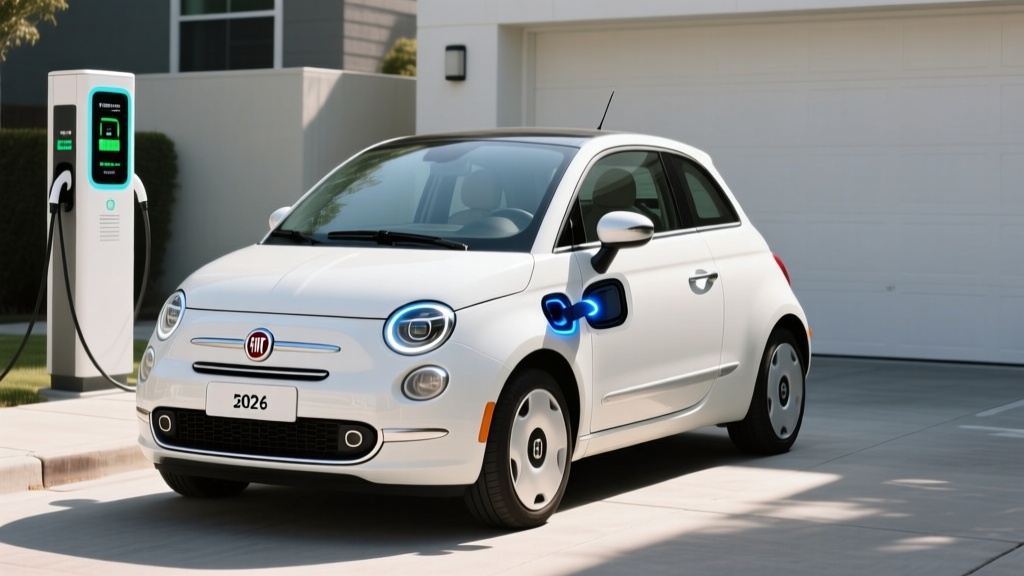
If you've been tempted by a Fiat 500 electric lease, you're not alone. The 2026 Fiat 500e returns to the U.S. market as one of the most affordable and stylish urban EVs available, with an MSRP starting around $36,000 (before incentives) and lease offers that can undercut many gasoline subcompacts. But lease math is different from purchase math, and the real question isn't just the monthly payment — it's the total cost to own, charge, insure, and eventually sell or return the car.
This guide runs the numbers on a 2026 Fiat 500e lease versus purchase, breaks down five-year ownership costs, explains which federal and state incentives actually apply, and gives you the exact $/mile math to decide if the 500e is a financial win for your commute.
2026 Fiat 500e Quick Specs: What You're Leasing
| Spec | 2026 Fiat 500e (La Prima / Red trim) |
|---|---|
| EPA range | 149 miles (42 kWh usable, NMC) |
| Real-world highway / cold | ~120-130 mi highway; ~100-115 mi in freezing temps |
| Battery chemistry | NMC (nickel manganese cobalt) |
| DC fast charge (peak) | 85 kW, 10-80% in ~35 min |
| Level 2 AC charge | 11 kW onboard, ~4.5 hours 0-100% |
| Motor output | 118 hp / 162 lb-ft torque |
| 0-60 mph | ~8.5 seconds |
| EPA efficiency | 116 MPGe combined (29 kWh/100 mi) |
| Base MSRP | ~$36,000 (Red) / ~$39,500 (La Prima) |
| Battery warranty | 8 years / 100,000 miles (≥70% capacity) |
Fiat 500e Lease vs Buy: Which Math Wins?
A typical 2026 Fiat 500e lease runs 36 months at 10,000 miles/year, with advertised offers (depending on region and dealer) in the $299-$399/month range after applicable incentives are applied at signing. Leasing has two structural advantages for the 500e specifically:
- Lease cash stacking: Stellantis frequently layers lease cash on top of the federal credit passed through as a cap-cost reduction, dropping effective monthly costs below comparable gas cars.
- Depreciation bypass: You never absorb the 500e's resale-value risk, which matters because subcompact EVs have historically depreciated faster than the EV average (more on this below).
Buying, on the other hand, lets you capture the full federal tax credit directly (if you qualify), build equity, and drive unlimited miles. A purchase at $36,000 MSRP minus a $7,500 credit (if eligible) lands around $28,500 before state rebates — strong value for a new EV.
5-Year Total Cost of Ownership Breakdown
The table below models a realistic 5-year / 60,000-mile ownership scenario for a purchased 2026 Fiat 500e Red trim, compared to a similarly priced gas subcompact (e.g., a Honda Fit-equivalent at 33 MPG combined). Assumes $3.60/gallon gas, $0.16/kWh average home electricity, and 85% home / 15% public DC charging mix.
| Category | Fiat 500e (purchase) | Gas subcompact |
|---|---|---|
| Purchase price (net of incentives) | $28,500 (after $7,500 §30D) | $25,000 |
| Energy/fuel (60k mi) | $2,784 (17,400 kWh × $0.16) | $6,545 (1,818 gal × $3.60) |
| Maintenance (5 yr) | ~$1,400 | ~$3,200 |
| Insurance (5 yr) | ~$9,800 | ~$7,500 |
| Depreciation (5 yr) | ~$14,200 | ~$9,500 |
| Total 5-yr cost | $56,684 | $51,745 |
| Cost per mile (all-in) | $0.94/mi | $0.86/mi |
The 500e trails a gas subcompact on pure TCO mainly because of insurance and depreciation. But flip the incentives (add a $2,000 state rebate, a $500 utility charger rebate, and cheap overnight electricity at $0.09/kWh) and the gap closes to under $2,000 over five years — a range where driving enjoyment, zero tailpipe emissions, and home-fueling convenience easily tip the scales.
Federal Tax Credit: §30D Eligibility Rules for 2026
The 500e is assembled in Italy (at Stellantis' Mirafiori plant), which complicates the federal credit. Under current IRS §30D rules, a new clean vehicle must meet final-assembly-in-North-America requirements to qualify for the full $7,500 credit. The 2026 Fiat 500e does NOT meet the North American final-assembly requirement, which means buyers purchasing the vehicle outright generally cannot claim the $7,500 §30D credit.
If you're buying (not leasing) and still want a federal credit, you'd need to look at the used EV credit (§25E): up to $4,000 or 30% of sale price (whichever is lower) on a 500e purchased used from a dealer for $25,000 or less — available starting in the second model year after sale.
§30D Eligibility Checklist (for qualifying North American-built EVs)
- Buyer AGI caps: $150k single / $225k HOH / $300k joint
- MSRP cap: $55,000 for sedans; $80,000 for SUVs/pickups/vans
- Battery critical-mineral and component sourcing thresholds (phased up annually)
- Final assembly in North America (VIN check at NHTSA or fueleconomy.gov)
- Point-of-sale transfer available — apply the credit at purchase, not at tax filing
- Vehicle must be new, for personal use, primarily in the U.S.
Charging Cost vs Gas: The Per-Mile Math
The 500e's 29 kWh/100 mi efficiency is among the best in its class. Here's what that translates to in dollars:
| Scenario | $/kWh or $/gal | Cost per 100 mi | Cost per mile |
|---|---|---|---|
| 500e, home L2 (national avg) | $0.16/kWh | $4.64 | $0.046 |
| 500e, home L2 (off-peak utility rate) | $0.09/kWh | $2.61 | $0.026 |
| 500e, public DC fast (Electrify America, avg) | $0.45/kWh | $13.05 | $0.131 |
| Gas subcompact, 33 MPG | $3.60/gal | $10.91 | $0.109 |
| Gas subcompact, 25 MPG (city) | $3.60/gal | $14.40 | $0.144 |
If 85% of your charging happens at home at the national average, the 500e costs roughly $0.055/mile in energy — about half what a 33-MPG gas car burns. Even heavy DC fast-charging users rarely exceed $0.10/mile blended. Over 12,000 miles/year, that's a $600-$900 annual fuel savings versus a gas subcompact.
Maintenance Savings: Fewer Parts, Less Wear
| Service item | Fiat 500e | Gas subcompact |
|---|---|---|
| Oil changes | None | 2×/yr, ~$80 each |
| Brake pads | 80k+ mi (regen braking) | 30-50k mi |
| Transmission fluid | None (single-speed) | Every 30-60k mi |
| Coolant / spark plugs | None / none | Periodic |
| Cabin air filter | Every ~20k mi | Every ~20k mi |
| Tires | Higher wear (EV torque + weight) | Standard |
| Estimated 5-yr maintenance | ~$1,400 | ~$3,200 |
The 500e saves roughly $1,800 over five years on maintenance. The one offset: EV tires wear faster due to instant torque and heavier curb weight — budget for one tire replacement in a 5-year window (~$600-$800 for a set of EV-rated rubber).
Insurance Reality: Why EVs Cost More to Insure
Expect the 500e to cost 15-30% more to insure than a comparably priced gas car. National averages put EV insurance around $1,900-$2,100/year for a clean-record driver, versus $1,400-$1,600 for a gas subcompact. Reasons:
- Repair costs: Battery-pack damage writes off the vehicle; body shops need EV-certified technicians.
- Higher MSRP baseline: Even post-incentive, the 500e's list price drives premium calculations.
- Parts scarcity: Imported EVs like the Italian-built 500e can have longer parts lead times.
Shop quotes from GEICO, Progressive, and EV-friendly carriers like Lemonade or Root before signing. Bundling home/auto and completing a defensive-driving course typically shaves 8-12%.
Depreciation & Resale: The EV Wildcard
EV depreciation has been volatile. Per iSeeCars and Kelley Blue Book data through 2025, average 5-year EV depreciation hovers around 45-55%, versus ~38% for gas cars. Subcompact EVs like the 500e tend to sit at the steeper end of that range (roughly 50-55%) because:
- Small batteries (42 kWh) age less gracefully in buyer perception than 75+ kWh packs.
- The segment is crowded with newer, longer-range rivals launching annually.
- Tesla price cuts in 2023-2024 reset used-EV expectations downward industry-wide.
This depreciation reality is exactly why a Fiat 500e lease often makes more financial sense than a purchase: you hand the car back at month 36 and let the lessor absorb the residual-value risk. If you buy, plan to keep the car 7+ years to amortize that steeper depreciation curve.
Who Should Lease the Fiat 500e?
Choose a 500e lease if: You commute under 80 miles/day, have Level 2 home charging, want to capture the $7,500 lease-pass-through credit, and prefer not to hold long-term EV depreciation risk.
Choose to buy (or pick a different EV) if: You exceed 12,000 miles/year (lease penalties add up), lack reliable home charging, or want to drive a North American-built EV that qualifies for the §30D purchase credit directly (e.g., Chevy Bolt EV/EUV, Tesla Model 3, VW ID.4).
Fiat 500e Lease & Ownership FAQ
How much does a Fiat 500e lease actually cost per month in 2026?
Advertised 36-month leases typically range $299-$399/month with $2,500-$3,999 due at signing, after lease cash and the $7,500 federal credit pass-through are applied. Exact pricing varies by region, dealer, and credit tier.
Does the Fiat 500e qualify for the $7,500 federal tax credit?
For outright purchases, no — the 500e is assembled in Italy and fails the North American final-assembly requirement under §30D. For leases, the lessor can claim the commercial clean vehicle credit (§45W) and pass savings to you as cap-cost reduction. Verify the lease quote reflects this.
What's the real-world range of the Fiat 500e?
EPA-rated 149 miles. Expect 125-135 miles on highway runs in moderate weather, and 100-115 miles in freezing temperatures with cabin heat on. City driving with regen braking often exceeds the EPA estimate.
How long does the 500e take to charge?
On a Level 2 home charger (11 kW), roughly 4.5 hours from 0-100%. On a 85 kW DC fast charger, 10-80% takes about 35 minutes. The 500e's charge curve tapers significantly above 80% SoC — don't plan road trips around 100% fills.
Are EVs more expensive to insure than gas cars?
Typically yes — 15-30% higher premiums on average, driven by repair complexity, battery replacement costs, and higher MSRP. The 500e is on the more affordable end of EV insurance due to its low power output and small size, but still expect ~$1,900-$2,100/year for a clean-record driver.
How much do I save on fuel with the 500e?
About $600-$900 per year versus a 33-MPG gas car, assuming 12,000 miles/year and mostly home charging at $0.16/kWh. Savings widen if you have access to off-peak utility rates ($0.09/kWh) or free workplace charging.
How well do EVs hold their value?
Average 5-year EV depreciation is 45-55%, versus ~38% for gas cars. The 500e, as a small-battery imported subcompact, sits at the steeper end (~50-55%). This is a primary reason leasing is the recommended financial structure for this specific model.
Can I install a Level 2 charger at home for the 500e?
Yes. The 500e uses a standard J1772/NACS connector (2026 models ship with NACS native). A 40-amp Level 2 home charger on a 240V/50A circuit costs $800-$2,200 installed (equipment + electrician + permit), with utility rebates often covering $500-$1,500 of that.
The 2026 Fiat 500e is a compelling urban EV with real style and usable daily range — but its financial case hinges on structuring the deal correctly. For most buyers, a Fiat 500e lease that captures the $7,500 commercial-credit pass-through is the lowest-risk, lowest-monthly-cost path into this car. If you buy, do so with full knowledge that the §30D purchase credit doesn't apply, depreciation will be steep, and your savings come from fuel and maintenance over a long ownership horizon.