Quick Verdict: A Stylish Urban EV With Honest Limits
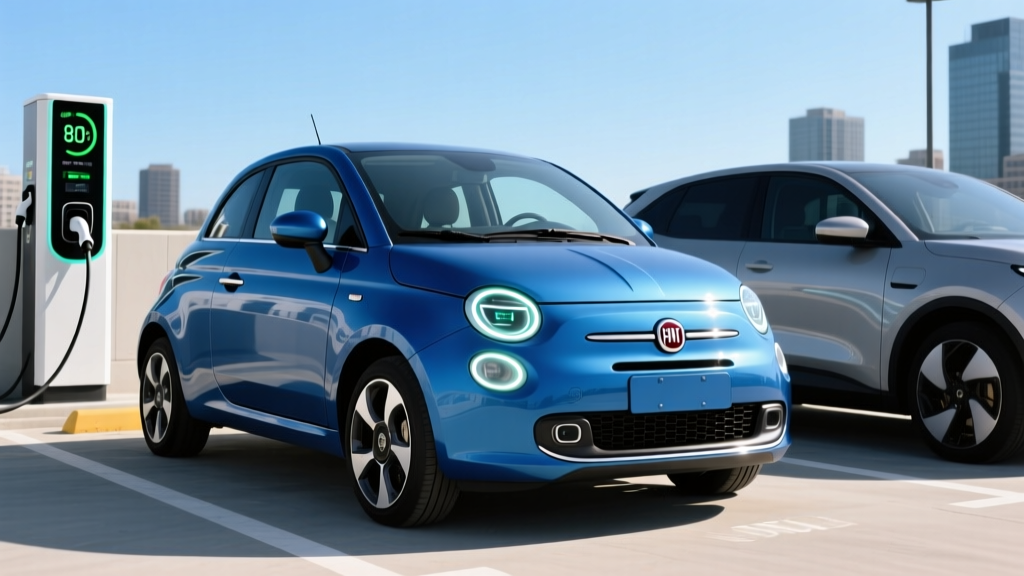
The 2026 Fiat 500e EV is an unapologetic city car. With 149 miles of EPA-estimated range, a 42 kWh battery, and a starting MSRP of $32,500, it targets urban commuters who prioritize Italian design, tight-turning agility, and affordable entry into electric mobility over long-distance capability. If your daily drive stays under 80 miles round-trip and you have access to home Level 2 charging, the 500e is one of the most charming and practical subcompact EVs available. If you need highway road-trip range or back-seat space for adults, look elsewhere.
| Spec | Value |
|---|---|
| EPA Range | 149 miles |
| Battery (usable) | 42 kWh, NMC chemistry |
| MPGe (city / hwy / combined) | 121 / 100 / 111 MPGe |
| Efficiency | 30 kWh / 100 mi |
| Max DC Fast Charge | 85 kW peak |
| 10–80% DC Fast Charge | ~35 minutes |
| Level 2 Home Charge Rate | 11 kW (~39 mi/hr) |
| Motor Output | 118 hp / 162 lb-ft torque |
| 0–60 mph | 8.6 seconds |
| Drivetrain | FWD (single motor) |
| Cargo Volume (rear seats up / folded) | 8.5 / 23.0 cu ft |
| Rear Legroom | 30.7 inches |
| Battery Warranty | 8 years / 100,000 miles |
| Base MSRP (Red Edition) | $32,500 |
| As-Tested (InspiraMe + options) | ~$37,800 |
Source: EPA fueleconomy.gov, Fiat USA press specifications.
Range and Efficiency: EPA Sticker vs. Real-World Driving
Real-World Expectation: In mixed city/highway driving at moderate temperatures, expect 125–140 miles. Sustained highway speeds above 70 mph reduce range to roughly 110–120 miles. In freezing conditions (below 32°F), plan for 95–110 miles due to battery chemistry limitations and cabin heating load.
The Fiat 500e's 42 kWh NMC (nickel-manganese-cobalt) lithium-ion battery is modest by 2026 standards, but it's appropriately sized for a 2,952-pound subcompact. The EPA's combined 111 MPGe translates to roughly 30 kWh per 100 miles — respectable efficiency that beats many larger crossovers. In our experience, city driving with frequent regenerative braking opportunities gets you closest to the EPA number. The 500e's regen is moderate rather than aggressive, so one-pedal driving is possible but not as pronounced as in a Chevrolet Bolt or Nissan Leaf.
The critical ownership insight: this car rewards routine. Plug in at home every night, and 149 miles covers the vast majority of American commutes (the EPA notes the average American drives roughly 37 miles per day). The range shortfall only surfaces on unplanned highway trips or in extreme cold without preconditioning.
Charging Speed: Home, Public, and the 85 kW Ceiling
| Charge Level | Power | Connector | Speed / Time |
|---|---|---|---|
| Level 1 (120V household) | ~1.4 kW | J1772 / NACS adapter | ~5 miles per hour (~30 hrs, 10–100%) |
| Level 2 (240V home/public) | 11 kW peak | J1772 / NACS adapter | ~39 miles per hour (~4 hrs, 10–100%) |
| DC Fast Charge | 85 kW peak | CCS1 | 10–80% in ~35 min; 0–100% in ~55 min |
The 500e's 85 kW DC fast-charging peak is the car's most debated spec. By 2026 standards — where competitors like the Hyundai Kona Electric hit 100+ kW and the Tesla Model 3 reaches 170 kW — it's modest. The practical consequence: on a road trip, you'll spend roughly 35 minutes at a DC fast charger going from 10% to 80% State of Charge (SoC). That's a full lunch stop, not a quick pit stop.
The charging curve matters here. The 500e sustains close to its 85 kW peak only between roughly 10–40% SoC. Above 60%, the rate tapers noticeably, dropping to 40–50 kW, and above 80% it slows further to protect battery health. This taper behavior is standard for NMC chemistry but means the advertised peak kW number is not a sustained rate — a common EV buyer misunderstanding.
For daily ownership, Level 2 home charging is the story. An 11 kW onboard charger means a full charge in about 4 hours on a 48-amp Level 2 home station (like a ChargePoint Home Flex or Tesla Wall Connector with J1772 adapter). That's more than adequate for overnight replenishment. The Fiat 500e ships with a CCS1 connector; NACS (Tesla Supercharger) access requires an adapter, which Fiat includes in the box for 2026 models.
Performance and Driving Dynamics
The single front-mounted electric motor produces 118 horsepower and 162 lb-ft of torque, routed to the front wheels. The 0–60 mph sprint takes 8.6 seconds — leisurely by EV standards but perfectly adequate for urban merging and highway on-ramps. Instant electric torque means the 500e feels quicker than the number suggests in the 0–30 mph city-speed range, where you'll spend most of your time.
Where the 500e genuinely shines is maneuverability. Its 107.8-inch wheelbase and tight turning circle make it effortless in parking garages and narrow city streets. The steering is light but direct, and the low center of gravity (battery pack under the floor) gives it surprisingly composed handling for a tall subcompact. Ride quality is firm — you'll feel potholes and expansion joints — but the chassis never feels crashy. Three drive modes (Normal, Range, Sherpa) adjust throttle response and regen intensity. Sherpa mode caps top speed at 56 mph and reduces HVAC output to maximize range — useful when you're cutting it close to home.
Interior, Tech, and Cargo Space
Step inside and the 500e punches above its price class. The dashboard features a 10.25-inch Uconnect 5 infotainment touchscreen with wireless Apple CarPlay and Android Auto, a 7-inch digital instrument cluster, and available wireless phone charging. Uconnect 5 is responsive, logically laid out, and among the better infotainment systems in the subcompact segment. Fiat also includes a suite of ADAS features: adaptive cruise control, lane-keeping assist, blind-spot monitoring, and automatic emergency braking. These are SAE Level 1 driver-assist features — the driver must remain fully engaged at all times.
Space is where reality sets in. The rear seats offer just 30.7 inches of legroom — tight for adults on anything beyond a short trip. Cargo volume behind the rear seats is 8.5 cubic feet (enough for a couple of grocery bags or a small suitcase). Fold the 50/50 rear seats and you get 23.0 cubic feet, which is competitive with the Mini Cooper SE but trails the Chevrolet Bolt EV's 57.2 cu ft by a wide margin. There is no front trunk (frunk).
The cabin materials are a pleasant surprise: soft-touch surfaces on the dashboard and door uppers, a leatherette-wrapped steering wheel, and Fiat's available "Seaqual" recycled-fabric upholstery give the 500e a premium feel that its MSRP doesn't fully telegraph.
Pricing, Trims, and Federal Tax Credit Eligibility
| Trim | Base MSRP | Destination | Total Before Credit |
|---|---|---|---|
| Red Edition | $32,500 | $1,595 | $34,095 |
| InspiraMe | $35,500 | $1,595 | $37,095 |
| (RED) Edition w/ Premium Pkg | $37,500 | $1,595 | $39,095 |
Federal Tax Credit: Does the 2026 Fiat 500e Qualify?
Under IRS §30D Clean Vehicle Credit rules for 2026, the Fiat 500e is potentially eligible for up to $3,750 in federal tax credits — not the full $7,500. Here's why:
- MSRP Cap: The 500e qualifies — it's classified as a passenger car, and the MSRP cap for cars is $55,000. All trims clear this.
- Buyer Income Cap: Modified adjusted gross income must not exceed $150,000 (single), $225,000 (head of household), or $300,000 (married filing jointly).
- Battery Component Sourcing: The 500e's battery is assembled in Europe. For 2026, the critical-minerals and battery-component sourcing requirements are stringent. The 500e meets the critical-minerals requirement (worth $3,750) but does NOT meet the battery-component manufacturing requirement (the other $3,750), resulting in a $3,750 total credit.
- Point-of-Sale Transfer: Eligible buyers can transfer the credit to the dealer at purchase for an immediate $3,750 price reduction — no need to wait until tax filing.
Effective price after credit: The Red Edition drops to approximately $30,345 — a compelling entry point for a well-equipped EV. However, tax credit eligibility depends on your individual situation. Consult a tax professional and verify current rules at IRS.gov before purchasing.
Ownership Costs and Warranty Coverage
Fiat backs the 500e with an 8-year / 100,000-mile battery and powertrain warranty, which covers the battery pack against defects and capacity degradation below 70% of original capacity. The bumper-to-bumper limited warranty is 4 years / 50,000 miles, and Fiat includes 2 years of scheduled maintenance and 3 years of roadside assistance.
Charging costs are low. At the national average residential electricity rate of ~$0.17/kWh (EIA data), a full 42 kWh charge costs approximately $7.14 — translating to roughly $0.051 per mile. Compare that to a 30 MPG gas car at $3.40/gallon ($0.113/mi), and the 500e saves roughly $930 per year for a driver covering 15,000 miles.
Insurance premiums for the 500e tend to be moderate — typically $1,400–$1,800 annually depending on location and driving record, per industry estimates. This is below larger, more powerful EVs but slightly above equivalent gas-powered subcompacts due to EV repair cost factors.
Pros, Cons, and Who Should Buy the Fiat 500e
Pros
- Charming Italian design inside and out — stands out in a segment of bland crossovers
- Excellent city maneuverability with a tight turning radius
- Premium interior materials and Uconnect 5 tech at a subcompact price
- Low operating cost (~$0.05/mi on home electricity)
- Standard ADAS suite including adaptive cruise and lane-keeping
- Effective price as low as ~$30,345 after $3,750 federal credit
- Wireless Apple CarPlay / Android Auto standard
Cons
- 149-mile EPA range limits road-trip practicality
- 85 kW DC fast charging is slow for 2026 — 35 min for 10–80%
- Rear seat legroom (30.7 in) is tight for adults
- Only 8.5 cu ft cargo space behind rear seats
- Only qualifies for $3,750 of the $7,500 federal credit (battery-component sourcing)
- No front trunk (frunk) for additional storage
- Firm ride quality on rough pavement
Who Is the Fiat 500e For?
Buy the 500e if: You're an urban or suburban commuter with a daily round-trip under 80 miles, you have reliable home Level 2 charging access, you value style and driving fun over cargo capacity, and you want an affordable EV with low running costs.
Look elsewhere if: You regularly drive more than 120 miles one-way, you need to carry adult rear passengers frequently, you live in a region with sparse DC fast-charging infrastructure, or you need a single-vehicle household solution for road trips. In those cases, consider the Chevrolet Bolt EV (259 mi range, more cargo) or Hyundai Kona Electric (261 mi range, faster charging).
Frequently Asked Questions
What is the real-world range of the 2026 Fiat 500e?
The EPA rates the 500e at 149 miles combined. In real-world mixed driving at moderate temperatures, expect 125–140 miles. Sustained highway driving at 70+ mph reduces this to roughly 110–120 miles. In freezing weather, plan for 95–110 miles. Preconditioning the battery while plugged in (via the Fiat app) helps mitigate cold-weather range loss.
How fast does the Fiat 500e charge at home and on DC fast chargers?
On a Level 2 home charger (240V, 48A), the 500e charges at up to 11 kW, adding roughly 39 miles of range per hour — a full charge in about 4 hours. On a DC fast charger, it peaks at 85 kW and charges from 10–80% in approximately 35 minutes. Level 1 (120V) trickle charging adds about 5 miles per hour and is best used only as a backup.
Does the 2026 Fiat 500e qualify for the $7,500 federal EV tax credit?
The 500e qualifies for $3,750 under the IRS §30D credit — it meets the critical-minerals requirement but not the battery-component manufacturing requirement for 2026. Buyers must also meet income caps ($150K single / $300K married filing jointly). The credit can be transferred to the dealer at point of sale for an immediate price reduction. Verify your eligibility at IRS.gov or with a tax professional.
Is the Fiat 500e worth buying over competitors like the Mini Cooper SE or Nissan Leaf?
The 500e offers the best combination of range (149 mi vs. Mini Cooper SE's 114 mi), interior quality, and standard tech in the subcompact EV segment. The Nissan Leaf offers more range (up to 212 mi in SV Plus trim) and more cargo space but uses the aging CHAdeMO connector and has a less refined interior. If range is your top priority, the Chevrolet Bolt EV (259 mi, ~$26,500) is a strong alternative, though it's larger and less stylish. The 500e wins on charm, city drivability, and value-after-credit.
What is the battery warranty on the Fiat 500e?
Fiat provides an 8-year / 100,000-mile warranty on the battery pack and electric powertrain components. The warranty covers defects and guarantees the battery will retain at least 70% of its original capacity during the warranty period. The bumper-to-bumper limited warranty is 4 years / 50,000 miles.
Can the Fiat 500e use Tesla Superchargers?
The 2026 Fiat 500e uses a CCS1 charge port natively. Fiat includes a NACS adapter in the box, enabling access to Tesla Supercharger stations equipped with the Magic Dock or via the adapter on V3/V4 stalls that support non-Tesla vehicles. Always check the Tesla app or Fiat's charging network map for confirmed compatible stations before traveling.