The Short Answer on the Ferrari EV Interior
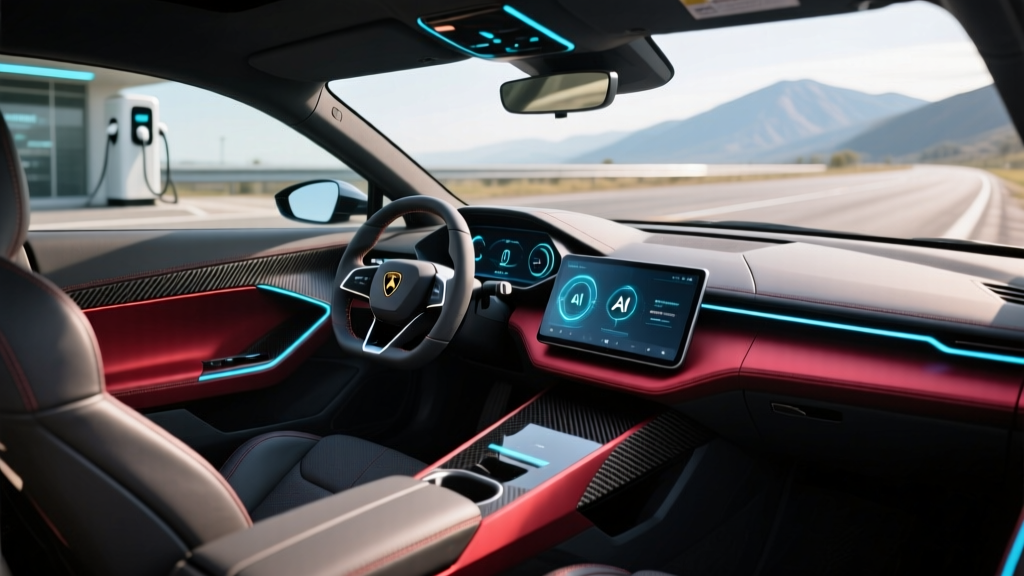
Ferrari's first all-electric vehicle — internally known as the E637 project and expected to debut in late 2025 with deliveries beginning in 2026 — will feature a cabin that blends Ferrari's traditional Italian craftsmanship with a next-generation digital cockpit. Based on confirmed teaser images and statements from Ferrari CEO Benedetto Vigna, the interior will center on a driver-focused layout with a flat-bottom steering wheel integrating key controls, a large curved digital instrument cluster, and premium materials including sustainable leather alternatives and carbon fiber trim. The EV will be built on Ferrari's new multi-technology architecture at the Maranello plant. Pricing is expected to start well above $300,000, positioning it against the Lamborghini Lanzador and high-end electric GTs. As an announced vehicle, final interior specifications remain preliminary.
What Ferrari Has Confirmed About the EV Cabin
Ferrari has been deliberately guarded about its electric future, but several concrete details about the interior have emerged through official channels and patent filings. CEO Benedetto Vigna, a former semiconductor executive, has emphasized that the EV will deliver an experience "that is uniquely Ferrari" — not simply an electric powertrain dropped into an existing chassis.
Key confirmed and strongly indicated interior elements include:
- Driver-centric cockpit: Ferrari's design philosophy has always placed the driver at the center. Expect a wraparound dashboard with controls angled toward the driver, consistent with the SF90 Stradale and 296 GTB layouts.
- Signature steering wheel: Ferrari's modern steering wheels house the Manettino drive-mode selector, engine start, and indicator controls. The EV variant is expected to evolve this with touch-capacitive surfaces and haptic feedback, replacing physical buttons where appropriate.
- Digital instrument cluster: A curved, high-resolution display behind the wheel will replace traditional gauges, likely offering configurable layouts for different drive modes (e.g., a track-focused display showing G-forces, battery temperature, and energy deployment).
- Material choices: Ferrari has signaled use of both traditional Poltrona Frau leather and new sustainable materials, including recycled aluminum trim and bio-based composites — a first for the brand.
- Infotainment system: An evolution of Ferrari's current infotainment, likely with Apple CarPlay integration, over-the-air updates, and a dedicated Ferrari connect app for preconditioning and charge monitoring.
The cabin is expected to seat two in a grand-tourer configuration, though a 2+2 layout has not been ruled out. Ferrari's patent filings suggest a center console with a gated shifter-inspired design — a nostalgic nod to the brand's manual-transmission heritage, repurposed as a drive-mode selector or media controller.
Expected Specifications and Pricing Context
While Ferrari has not released final powertrain or interior specifications, industry reporting and Ferrari's own financial guidance point to the following preliminary figures for the E637 project:
| Attribute | Expected Figure |
|---|---|
| Vehicle Type | Electric Grand Tourer (2-seat or 2+2) |
| Battery Capacity | ~120+ kWh usable (est., NMC chemistry) |
| EPA Range | ~300-350 miles (est.) |
| Peak DC Fast Charge | ~350 kW (800V architecture, est.) |
| 10-80% Charge Time | ~18-22 minutes (est.) |
| Horsepower | 1,000+ HP (quad-motor or tri-motor, est.) |
| 0-60 mph | Under 2.5 seconds (est.) |
| Base MSRP | $300,000 - $400,000+ (est.) |
| Federal Tax Credit (§30D) | Not eligible — exceeds MSRP cap |
| Production Start | Late 2025 / 2026 deliveries |
| Assembly | Maranello, Italy (new EV-dedicated line) |
Note: All figures above are estimates based on industry reporting and Ferrari's public statements. Final specifications will be confirmed at the vehicle's official unveiling.
For context on the §30D federal tax credit: the Ferrari EV will not qualify for the up-to-$7,500 credit. The IRS §30D rules impose an MSRP cap of $55,000 for sedans and $80,000 for SUVs, trucks, and vans — figures the Ferrari EV will exceed by a wide margin. At this price tier, buyers are not making purchase decisions based on federal incentives.
Ferrari EV Interior vs. Gas Supercar Cabins: What Changes?
The shift to electric fundamentally alters the interior packaging of a Ferrari. Without a mid-mounted V8 or V12 engine and transmission tunnel, the E637's cabin gains significant design freedom:
| Feature | Ferrari EV (E637) | Gas Ferrari (296 GTB) |
|---|---|---|
| Powertrain Noise | Near-silent; artificial sound design likely | V6 hybrid with prominent exhaust note |
| Front Storage (Frunk) | Expected — battery pack under floor | None — engine mid-mounted |
| Center Console Height | Lower, more open — no transmission tunnel | Tall console housing drivetrain |
| Cabin Heat | Heat pump; no engine waste heat | Engine heat bleeds into cabin |
| Instant Torque Feel | Immediate, no downshift lag | 8-speed DCT with perceptible shifts |
| Regen Braking Controls | Steering wheel or paddle-mounted | Traditional brake pedal feel |
| Weight Distribution Display | Real-time battery/axle split | Not applicable |
| Preconditioning | Remote cabin cooling/heating via app | Engine must run for climate |
The most dramatic interior difference will be acoustic. Ferrari has filed patents for an "emotional sound system" that uses the vehicle's structure to transmit synthesized frequencies through the seat and chassis — designed to replicate the visceral sensation of a V12 without the emissions. Whether this resonates with traditional Ferrari buyers remains the central question.
Real-World Ownership Costs: Ferrari EV vs. Gas Equivalent
At the ultra-luxury tier, cost-per-mile analysis shifts from fuel savings to maintenance, insurance, and depreciation. Here's a realistic 5-year ownership comparison between the expected Ferrari EV and a gas-powered equivalent like the 296 GTB (MSRP ~$350,000):
| Cost Category | Ferrari EV (Est.) | Ferrari 296 GTB (Gas/Hybrid) |
|---|---|---|
| Purchase Price | $350,000 | $350,000 |
| Energy/Fuel (50k mi) | $4,500 (home + public DC) | $14,000 (premium 93 octane, 17 MPG avg) |
| Scheduled Maintenance | $3,000 (cabin filter, brake fluid, tires) | $12,000 (annual service, belts, fluids) |
| Brake Replacement | $0-2,000 (regen preserves pads) | $6,000-8,000 (carbon-ceramic rotors) |
| Insurance (5 years) | $45,000 ($9,000/yr est.) | $40,000 ($8,000/yr est.) |
| Tires (50k miles) | $8,000 (heavy EV = faster wear) | $6,000 |
| Estimated Depreciation | $140,000 (40%, uncertain for first EV) | $120,000 (34%, proven market) |
| Total 5-Year Cost | ~$550,500 | ~$550,000 |
The numbers are remarkably close. The Ferrari EV saves significantly on fuel and maintenance, but those savings are offset by higher insurance premiums (EVs at this tier carry battery-replacement risk in collision claims), faster tire wear due to greater vehicle weight, and potentially steeper depreciation given the unproven resale market for a first-generation Ferrari EV.
Common Misconceptions About the Ferrari EV
| Myth | Fact |
|---|---|
| "Ferrari will never build an EV — it betrays the brand." | Ferrari confirmed its first EV in 2022 and is investing over €4.4 billion in electrification through 2026, including a new dedicated EV assembly line at Maranello. |
| "The EV will sound like nothing — no soul." | Ferrari has patented structural audio transmission systems designed to create an emotional acoustic experience. Expect a bespoke sound signature, not silence. |
| "It will qualify for the $7,500 tax credit." | The §30D credit has an MSRP cap of $55,000 (sedans) or $80,000 (SUVs/trucks). The Ferrari EV will far exceed these limits and is ineligible. |
| "Electric means no maintenance." | EVs still require tire rotations, brake fluid flushes, cabin air filter replacement, coolant system service, and software updates. At Ferrari's tier, dealer service visits remain part of ownership. |
| "Home charging is all I'll need." | A Level 2 home charger (7-11 kW) will fully replenish a ~120 kWh battery overnight (11-16 hours). But for road trips, you'll rely on public DC fast charging at 350 kW stations — and ultra-high-power chargers are still sparse outside major corridors. |
| "The battery will need replacing in 5 years." | Modern NMC batteries with active thermal management are engineered for 200,000+ miles before reaching 70-80% capacity. Ferrari is expected to offer an 8-year/100,000-mile battery warranty at minimum, consistent with industry standards. |
Charging Reality for a High-Performance Ferrari EV
With an estimated 120+ kWh battery and 800V architecture, the Ferrari EV should support some of the fastest charging in the industry. But real-world charging involves nuances that spec sheets don't capture:
- Peak vs. sustained charge rate: A 350 kW peak rate is typically sustained only between 10-40% State of Charge (SoC). Above 60%, the charge curve tapers significantly to protect battery cells. Expect the 10-80% charge to take approximately 18-22 minutes, not a linear calculation of battery size divided by peak kW.
- Preconditioning is essential: The battery must be thermally preconditioned (heated to ~30-35°C) before fast charging. Ferrari's navigation system is expected to automatically initiate preconditioning when a DC fast charger is set as the destination — arriving cold can cut charge speeds in half.
- Connector: In North America, the Ferrari EV is expected to use the NACS (North American Charging Standard) connector, aligning with Tesla's Supercharger network and the broader industry shift. In Europe, CCS2 will be standard.
- Home charging: A Level 2 home charger (48-amp circuit on a 60-amp breaker) delivering ~11.5 kW will add roughly 30-35 miles of range per hour. A full charge from 10% to 100% will take approximately 11-13 hours — feasible overnight for most owners.
- Charging cost: At the national average of $0.16/kWh for home electricity, fully charging a 120 kWh battery costs roughly $19. At public DC fast chargers ($0.35-$0.50/kWh), the same fill costs $42-$60.
For a Ferrari owner, public charging infrastructure quality matters. Networks like Electrify America and Tesla Supercharger offer 350 kW chargers on major highways, but reliability varies. According to J.D. Power's EV charging satisfaction studies, Tesla's Supercharger network consistently outperforms third-party networks on uptime and ease of use.
Decision Framework: Should You Wait for the Ferrari EV?
Choose the Ferrari EV (when available) if:
- You want a grand tourer with instant torque, silent highway cruising, and minimal scheduled maintenance.
- You have reliable Level 2 home charging and primarily drive in urban/suburban environments with occasional road trips.
- You value being an early adopter of Ferrari's electric era and accept first-generation risk (potential software bugs, unproven resale value).
- You want access to low-emission zones in European cities that increasingly restrict internal-combustion vehicles.
Stick with a Gas/Hybrid Ferrari (296 GTB, SF90, Purosangue) if:
- The exhaust note and mechanical engagement of a Ferrari V6/V8/V12 are non-negotiable for you.
- You frequently drive in regions with sparse DC fast-charging infrastructure (rural areas, developing markets).
- Proven resale value and established collector demand matter — gas Ferraris have decades of auction data; the EV does not.
- You want a vehicle available now rather than waiting for 2026 deliveries and potential production delays.
What First-Time Ferrari EV Buyers Should Know
If you're considering Ferrari's first electric vehicle, here are the practical realities that separate brochure enthusiasm from ownership satisfaction:
- Reservation process: Ferrari allocates vehicles through its dealer network, prioritizing existing clients with purchase history. Contact your local Ferrari dealer early to express interest — walk-in availability for a first-generation EV will be essentially zero.
- Home electrical preparation: A 48-amp Level 2 charger requires a dedicated 60-amp circuit. If your electrical panel is at capacity, a panel upgrade ($1,500-$3,000) may be necessary. Consult a licensed electrician before taking delivery.
- Cold-weather range loss: In freezing temperatures (below 32°F / 0°C), expect 20-30% range reduction due to battery chemistry limitations and cabin heating demands. A 350-mile EPA estimate could deliver 245-280 miles in harsh winter conditions.
- Insurance costs: Insuring a $350,000+ electric Ferrari will be expensive. EV-specific factors include battery replacement cost in collision scenarios ($30,000-$50,000+ for a pack of this size) and limited repair network expertise. Obtain quotes before committing.
- Software updates: Ferrari's EV will receive over-the-air (OTA) updates that can modify performance characteristics, charging behavior, and interior features. This is a benefit (continuous improvement) but also means the car you take delivery of may behave differently months later.
Frequently Asked Questions
When will the Ferrari EV officially be unveiled?
Ferrari has confirmed the vehicle will debut in 2025, with first deliveries expected in 2026. The exact date of the full interior and specification reveal has not been announced. Ferrari CEO Benedetto Vigna has stated the company is "on track" with its electrification timeline.
Will the Ferrari EV interior have a traditional gear shifter?
Unlikely in the traditional sense. Ferrari's patent filings suggest a center-console controller inspired by the classic gated manual shifter design, but repurposed for drive-mode selection and media control. There is no multi-speed transmission in an EV — the single-speed reduction gear requires no driver input.
How does the Ferrari EV compare to the Lamborghini Lanzador?
Both are electric grand tourers from Italian supercar marques, expected in the 2026-2028 timeframe. Lamborghini's Lanzador is a 2+2 GT with an estimated 1,300+ HP and a starting price above $300,000. The Ferrari EV is expected to prioritize driving engagement and acoustic experience, while Lamborghini leans into brute performance. Neither will qualify for federal tax credits due to MSRP caps.
Can I charge a Ferrari EV at a Tesla Supercharger?
Very likely, yes. With the industry-wide adoption of the NACS connector in North America, Ferrari's EV is expected to use the NACS port, granting access to Tesla's Supercharger network — the most extensive and reliable DC fast-charging network in the US, with over 25,000 stalls as of 2025, according to the U.S. Department of Energy's AFDC.
What battery chemistry will the Ferrari EV use?
Ferrari has not confirmed the chemistry, but NMC (nickel-manganese-cobalt) is the most likely choice for a high-performance application. NMC offers superior energy density compared to LFP (lithium iron phosphate), which is critical for a GT car targeting 300+ miles of range with 1,000+ HP. LFP is heavier and better suited to high-volume, lower-cost vehicles.
Will the Ferrari EV have autonomous driving features?
Expect SAE Level 2 driver-assistance features — adaptive cruise control, lane-keeping assist, and possibly a hands-on highway driving system similar to Ferrari's current ADAS suite. Ferrari has not indicated plans for Level 3 or Level 4 autonomy. The brand emphasizes driver engagement, making full self-driving philosophically inconsistent with its positioning.