The Quick Answer: What Is the Ferrari Electric SUV?
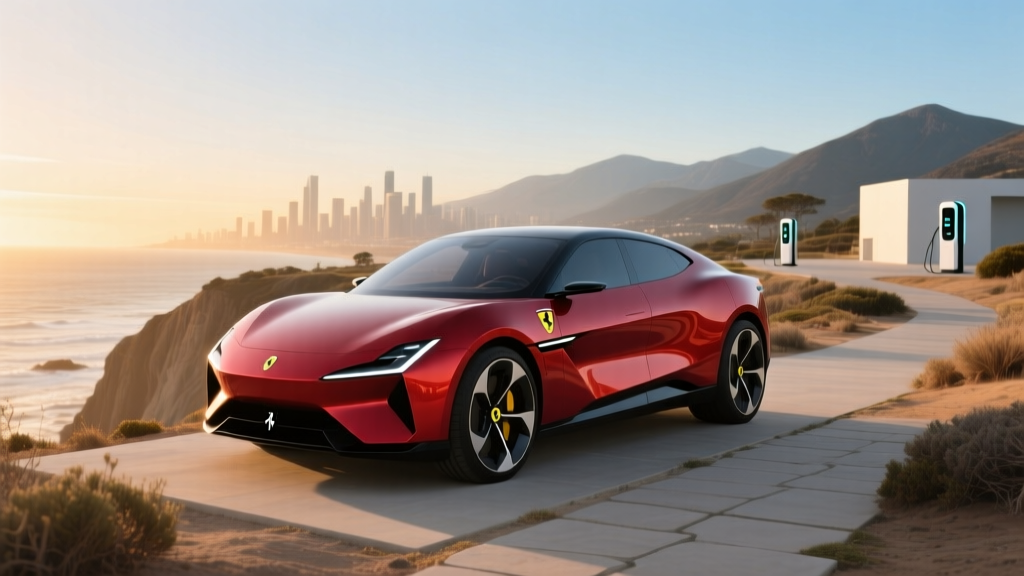
The Ferrari electric SUV—internally codenamed Luce (Italian for "light")—is Ferrari's first fully electric vehicle, expected to debut in late 2025 with deliveries beginning in 2026. Based on confirmed statements from Ferrari CEO Benedetto Vigna and spy-shot analysis, the Luce will be a four-door, high-performance luxury GT crossover built on Ferrari's new EV-dedicated platform at the Maranello factory. Expected pricing starts above $350,000, with a targeted EPA range of approximately 300-350 miles, a battery pack likely exceeding 100 kWh, and 0-60 mph times under 3.0 seconds. This is not a volume car—Ferrari limits annual production to preserve exclusivity, and the first allocation slots are already spoken for among existing Ferrari clients.
What We Know: Confirmed Specs and What's Still Preliminary
Ferrari has been deliberate in revealing details, but between official earnings calls, supplier leaks, and high-quality spy photography from 2024-2025 testing mules, a credible picture has emerged. Ferrari confirmed the vehicle will ride on a brand-new architecture—not a modified Purosangue platform—engineered specifically for battery-electric propulsion.
| Specification | Estimated / Confirmed | Status |
|---|---|---|
| Model Name | Luce (unconfirmed; internal codename) | Preliminary |
| Body Style | 4-door luxury GT crossover | Confirmed via spy shots |
| Platform | New EV-dedicated architecture | Confirmed (Ferrari earnings call) |
| Battery Capacity | ~100-120 kWh (usable) | Estimated |
| Battery Chemistry | Likely NMC (nickel manganese cobalt) for energy density | Estimated |
| EPA Range (Target) | 300-350 miles | Estimated |
| Peak DC Fast Charge | ~250-350 kW (800V architecture likely) | Estimated |
| 10-80% Charge Time | ~18-25 minutes (projected) | Estimated |
| 0-60 mph | Under 3.0 seconds | Estimated |
| Horsepower | 800-1,000+ hp (multi-motor AWD) | Estimated |
| Base MSRP | $350,000 - $400,000+ | Estimated |
| Production Start | 2026 | Confirmed |
Ferrari's engineering DNA suggests they will prioritize driving dynamics over outright efficiency. Expect a multi-motor all-wheel-drive layout—likely tri-motor or quad-motor—with torque vectoring across individual wheels. The 800-volt electrical architecture, now standard among high-performance EVs (see Porsche Taycan, Hyundai Ioniq 5 N, Lucid Air Sapphire), enables both the sustained power delivery and the fast charging speeds that Ferrari's clientele will demand.
Range and Charging: Real-World Expectations vs. the Sticker
If Ferrari hits the ~320-mile EPA target, that places the Luce in the same tier as the Lucid Air Grand Touring and above most performance-oriented EVs. But EPA estimates require real-world context.
- EPA estimate: ~300-350 miles (projected)
- Highway driving at 75+ mph: Expect 15-20% reduction → ~250-290 miles
- Cold weather (below 32°F): Expect 20-30% reduction → ~210-280 miles
- Aggressive/track driving: Reductions of 40%+ are common under sustained high-load conditions
For a car in this price class, most owners will garage-charge nightly and use DC fast charging only on longer tours. The projected 250-350 kW peak charge rate means a 10-80% session could take roughly 18-25 minutes at a compatible high-power charger—competitive with the Porsche Taycan and Audi e-tron GT.
One critical detail: Ferrari has not confirmed whether the Luce will use the NACS (Tesla Supercharger) connector or CCS1. Given that most luxury OEMs have committed to NACS adoption by 2025-2026, it is likely Ferrari will follow suit, granting access to Tesla's 17,000+ Supercharger network. This matters enormously for cross-country touring, where Electrify America and other CCS networks still have reliability gaps.
Ferrari Electric SUV vs. Purosangue V12: The Ownership Cost Comparison
The most natural comparison is Ferrari's own Purosangue—the V12 "FUV" (Ferrari Utility Vehicle) that starts at approximately $398,000 and is Ferrari's current four-door flagship. Here is how the Luce might stack up against it in five-year ownership costs:
| Cost Factor | Ferrari Luce (EV, Est.) | Ferrari Purosangue (V12) |
|---|---|---|
| Base MSRP | $350,000 - $400,000 | $398,000 |
| Federal Tax Credit (§30D) | $0 (MSRP cap: $80,000 for SUVs) | $0 |
| Fuel / Electricity (5 yr, 60k mi) | ~$4,200 (at $0.16/kWh) | ~$22,500 (at $4.50/gal, 13 MPG) |
| Maintenance (5 yr) | ~$3,000 - $5,000 | ~$12,000 - $18,000 |
| Insurance (5 yr, est. avg) | ~$35,000 - $50,000 | ~$30,000 - $45,000 |
| Depreciation (5 yr, est.) | Unknown (first EV; high uncertainty) | ~$80,000 - $120,000 |
| Est. 5-Year Total | ~$430,000 - $510,000 | ~$540,000 - $600,000 |
The Luce will likely save significantly on fuel and maintenance—electric drivetrains have far fewer service items than a naturally aspirated 6.5L V12. No oil changes, no spark plugs, no transmission fluid, and regenerative braking extends pad life dramatically. However, insurance on a first-of-its-kind Ferrari EV may carry a premium until actuaries have sufficient claims data. And depreciation is the wildcard: Ferrari's limited-production strategy historically supports strong resale, but the EV transition introduces uncertainty for collectors.
Who Is This Car For? A Decision Framework
Choose the Ferrari Electric SUV (Luce) if:
- You are an existing Ferrari client with allocation access and want a daily-drivable, four-seat Ferrari with near-silent grand-touring capability
- You have reliable home Level 2 charging (240V, 40-80A circuit) and typically drive under 250 miles per day
- You value instant torque delivery and low center of gravity over the emotional sound of a V12
- You want to future-proof your collection as European cities expand low-emission zones
- You accept that first-generation EV depreciation is unpredictable
Stick with the Purosangue V12 (or wait) if:
- The sound, vibration, and mechanical character of a naturally aspirated V12 are central to your Ferrari experience
- You lack reliable home charging and depend on public infrastructure in your area
- You plan to drive the car in extreme cold regularly (below 0°F), where range loss is severe
- You want proven long-term resale value backed by decades of Ferrari V12 collector demand
- You prefer to wait for a second-generation Ferrari EV with established reliability data
Real-World Ownership: What First-Time Ferrari EV Buyers Should Know
Home Charging Is Non-Negotiable
At this price point, public charging should be a convenience, not a necessity. You will need a dedicated Level 2 home charger—ideally a 60-amp circuit delivering 11.5-14.4 kW—to replenish a 100+ kWh battery overnight. Budget $1,200-$3,500 for professional installation by a licensed electrician, plus $500-$800 for a quality Level 2 unit (ChargePoint Home Flex, Tesla Wall Connector, or similar). If your home electrical panel is at capacity, a panel upgrade to 200A or 400A service can add $2,000-$5,000. Consult a licensed electrician for your specific situation.
Federal Tax Credit: Not Applicable Here
The IRS §30D Clean Vehicle Credit caps eligible SUVs at an $80,000 MSRP. The Ferrari Luce, at $350,000+, will not qualify. There is no federal purchase incentive at this price point, and state-level incentives (where they exist) typically have similar caps. Do not factor any tax credit into your purchase calculation.
Maintenance: Less, But Not Zero
EVs eliminate most powertrain maintenance, but a Ferrari will still require annual inspections, cabin air filter replacements, brake fluid checks, tire rotations, and software updates. Ferrari's scheduled maintenance programs typically bundle these for the initial ownership period, but out-of-warranty service at a Ferrari dealer will carry premium labor rates. Budget $600-$1,000 annually after the included maintenance window expires.
Insurance: Expect a Premium
Insuring a $350,000+ exotic EV with unproven repair costs will not be cheap. Early estimates suggest annual premiums of $7,000-$10,000+ depending on your driving record, location, and coverage levels. Specialized exotic-car insurers (Hagerty, Chubb, Grundy) may offer agreed-value policies that are more appropriate than standard carriers. Get quotes before committing to a purchase.
Common Misconceptions About the Ferrari Electric SUV
| Myth | Fact |
|---|---|
| "Ferrari would never build an EV—it betrays their heritage." | Ferrari CEO Benedetto Vigna has confirmed EV development since 2022. Ferrari's first EV is a business certainty, not a rumor. The company has invested in a dedicated EV assembly line at Maranello. |
| "An electric Ferrari won't feel like a real Ferrari." | EVs deliver instant torque with no turbo lag or power-band delay. Multi-motor torque vectoring can provide handling precision that mechanical differentials cannot match. The driving experience will be different—not lesser. |
| "I'll qualify for the $7,500 federal tax credit." | The §30D credit caps SUV eligibility at $80,000 MSRP. A $350,000+ Ferrari will not qualify under any scenario. |
| "The battery will need replacement in 5 years." | Modern NMC and LFP batteries are engineered for 1,000-2,000+ charge cycles with <10% degradation. Ferrari will likely offer an 8-year/100,000-mile battery warranty (industry standard for luxury EVs). Premature full-pack replacement is extremely rare. |
| "It's just a rebadged Purosangue with batteries." | Ferrari confirmed the Luce rides on an entirely new EV-specific platform, not a converted ICE architecture. This enables optimized weight distribution, a lower center of gravity, and purpose-built crash structures. |
How the Ferrari Luce Compares to Other Luxury Electric SUVs
| Vehicle | Est. Price | Est. Range | 0-60 mph | Peak DC Charge |
|---|---|---|---|---|
| Ferrari Luce (2026) | $350,000+ | ~300-350 mi | <3.0 sec | ~250-350 kW |
| Lotus Eletre R | $120,000 | 304 mi (EPA) | 2.95 sec | 350 kW |
| Lamborghini (upcoming EV GT) | $250,000+ | TBA | TBA | TBA |
| Porsche Cayenne EV (2026) | $95,000+ | ~300 mi (est.) | ~3.5 sec | ~270 kW |
| Rolls-Royce Spectre (coupe, not SUV) | $420,000 | 291 mi (EPA) | 4.4 sec | 195 kW |
The Luce occupies a unique niche: it is the only EV from a marque with Ferrari's motorsport heritage and brand cachet. The Lotus Eletre R delivers similar performance at a third of the price, but it cannot replicate the prancing badge. The upcoming Lamborghini EV (expected 2028-2029) will be the closest rival, but it is years away. For buyers who want a Ferrari and want electric, the Luce has no direct alternative in 2026.
Frequently Asked Questions
When can I actually buy the Ferrari electric SUV?
Ferrari has confirmed the EV will debut in late 2025 with customer deliveries beginning in 2026. However, initial allocation will be extremely limited and prioritized for existing Ferrari collectors and VIP clients. Walk-in purchase availability is unlikely for the first 12-24 months of production.
Will the Ferrari EV have a frunk (front trunk)?
This has not been confirmed. Given the car's performance focus and likely multi-motor layout (which may place a motor in the front axle area), frunk space may be limited or nonexistent. Cargo capacity details will emerge closer to the official reveal.
Does Ferrari's EV qualify for any incentives?
No. The federal §30D Clean Vehicle Credit has an MSRP cap of $80,000 for SUVs and $55,000 for sedans. At $350,000+, the Luce does not qualify. Some states offer additional incentives, but most also have price caps. Check your state's energy office for specifics.
What about battery degradation and warranty?
Ferrari has not published warranty terms yet. Industry standard for luxury EVs is 8 years or 100,000 miles, whichever comes first, with a capacity retention threshold of 70%. Given Ferrari's brand positioning, they may offer more generous terms to reassure first-time EV buyers in their clientele.
Will the Luce sound like a Ferrari?
Ferrari has not confirmed whether they will implement synthetic engine sound through the cabin speakers. Some EV manufacturers (BMW with IconicSounds, Hyundai with the Ioniq 5 N's simulated gear shifts and exhaust note) have pursued this route. Given Ferrari's emotional connection to engine sound, some form of auditory signature is likely, though purists may find it controversial.
How does this compare to buying a used Purosangue?
A used Purosangue (2023-2024) currently trades at or above its $398,000 MSRP due to extreme demand and limited supply. The Luce will likely face similar allocation constraints at launch. If you want a four-seat Ferrari now, the Purosangue is your only option. If you want electric and can wait, the Luce offers lower running costs and a fundamentally different driving experience.
Note: Specifications for the Ferrari Luce are based on confirmed statements, industry analysis, and estimated figures as of 2026. Final production specs, pricing, and availability will be confirmed by Ferrari at the official reveal. Always verify details with an authorized Ferrari dealer before making purchase decisions.