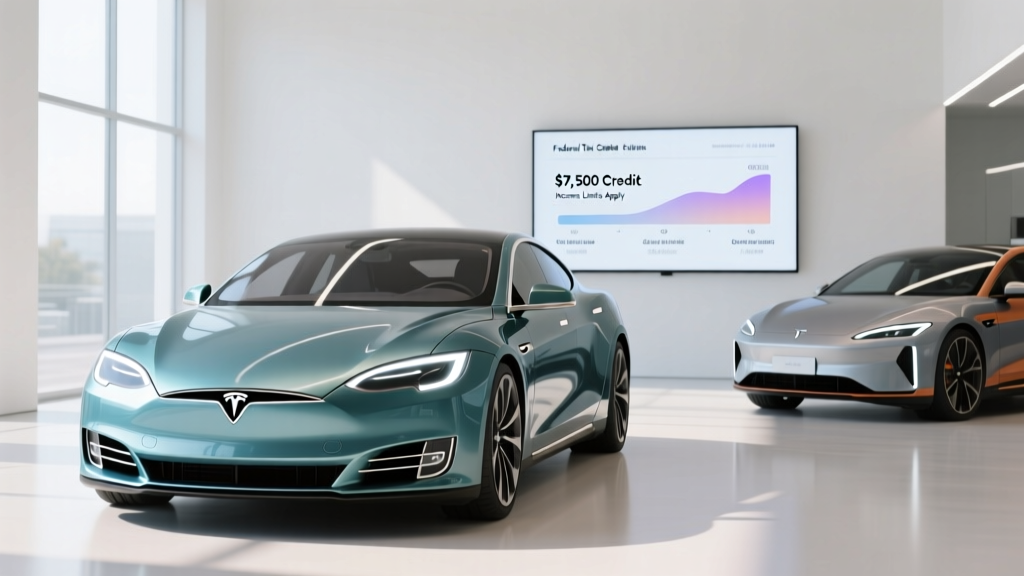
Buying an electric vehicle in 2026 means navigating a maze of incentives, tax rules, and ownership economics that look nothing like buying a gas car. The federal EV tax credit — officially known as the Clean Vehicle Credit under IRS §30D — can knock up to $7,500 off your effective purchase price. But "up to" is doing heavy lifting in that sentence. Eligibility depends on your income, the vehicle's MSRP, where its battery materials are sourced, and whether you choose a point-of-sale discount or a tax-time credit.
This guide breaks down exactly how the federal tax credit works for electric cars today, what you actually qualify for, and how EV ownership costs stack up over five years — including the expenses most buyers overlook, like higher insurance premiums and steeper depreciation curves.
How the Federal EV Tax Credit Works Under IRS §30D
The federal Clean Vehicle Credit provides up to $7,500 for qualifying new electric vehicles (BEVs and PHEVs) and up to $4,000 for qualifying used EVs. The credit is split into two halves of $3,750 each:
- $3,750 for critical minerals: A percentage of the battery's critical minerals must be extracted or processed in the U.S. or a country with a free-trade agreement, or recycled in North America. That percentage threshold has increased annually since 2023.
- $3,750 for battery components: A percentage of battery components must be manufactured or assembled in North America, with the required share also climbing each year.
Many vehicles that previously qualified for the full $7,500 now qualify for only $3,750 — or nothing at all — as sourcing thresholds tighten. The IRS maintains a list of qualifying makes and models that updates periodically. Always verify before signing a purchase agreement.
§30D Tax Credit Eligibility Checklist (2026 Rules)
- Buyer income cap: Modified AGI must not exceed $300,000 (joint filers), $225,000 (head of household), or $150,000 (single). You can use either the current year or prior year's income — whichever is lower.
- Vehicle MSRP cap: Vans, SUVs, and pickup trucks must have an MSRP at or below $80,000. Sedans and other body styles cap at $55,000.
- Battery sourcing: Critical minerals and component manufacturing/assembly must meet annual percentage thresholds per the Inflation Reduction Act schedule.
- Final assembly: The vehicle must undergo final assembly in North America (verify via the VIN decoder at NHTSA.gov).
- Vehicle type: New BEVs and qualifying PHEVs with at least 7 kWh of battery capacity. Used EV credit (up to $4,000) has separate rules including a $25,000 price cap and model-age requirements.
- Point-of-sale transfer: Since 2024, you can transfer the credit to the dealer at purchase, receiving the amount as an immediate price reduction — even if your tax liability is lower than the credit.
- One credit per vehicle, one credit per taxpayer per year.
Source: IRS Clean Vehicle Credits. Rules are subject to legislative change — always confirm with a tax professional before purchase.
Point-of-Sale vs. Tax-Time: How You Actually Get the Money
Before 2024, the EV tax credit was non-refundable — meaning you could only claim it up to the amount of federal income tax you owed that year. If your tax liability was $4,000 but the credit was $7,500, you lost $3,500 of the benefit.
The point-of-sale transfer option changed that calculus. You can now assign the credit to the dealership at signing, and the dealer reduces your purchase price by the full credit amount. The dealer then recoups it from the IRS. This works regardless of your tax liability — effectively making the credit refundable through the dealer mechanism.
Here's the practical difference:
| Method | How It Works | Best For |
|---|---|---|
| Point-of-sale transfer | Dealer reduces purchase price by credit amount at signing. You pay less upfront and finance less. | Buyers with lower tax liability; those wanting lower monthly payments |
| Tax-time credit | You claim the credit on your federal return (Form 8936) for the tax year you take delivery. | Buyers with high tax liability who prefer a refund or reduced tax bill |
5-Year Total Cost of Ownership: EV vs. Gas Car
The purchase price is only the opening chapter. To understand whether an EV actually saves money, you need to model five years of charging, insurance, maintenance, and depreciation. Below is a representative comparison using a 2026 Tesla Model Y Long Range (AWD, ~$46,000 MSRP before credit) against a comparably equipped 2026 Toyota RAV4 AWD (~$35,000 MSRP), assuming 15,000 miles per year.
| Category | Tesla Model Y LR (BEV) | Toyota RAV4 AWD (Gas) |
|---|---|---|
| Purchase price (MSRP) | $46,000 | $35,000 |
| Federal tax credit (§30D) | –$3,750* | $0 |
| Effective purchase price | $42,250 | $35,000 |
| Fuel/charging (5 years, 75k mi) | $4,050† | $9,375‡ |
| Insurance (5 years) | $12,500 | $8,750 |
| Maintenance & repairs (5 years) | $1,500 | $4,500 |
| Estimated depreciation (5 years) | $22,000 | $14,000 |
| 5-Year Total Cost | $82,300 | $71,625 |
| Cost per mile | $1.10 | $0.96 |
* Model Y qualifies for $3,750 under 2026 critical-mineral/component rules; verify at purchase. † Based on 70% home charging at $0.15/kWh and 30% DC fast charging at $0.40/kWh; Model Y efficiency ~28 kWh/100 mi (fueleconomy.gov). ‡ Based on 30 MPG combined and $3.75/gallon average.
The numbers tell a nuanced story. The EV saves substantially on fuel and maintenance — roughly $8,325 combined over five years. But higher insurance premiums (+$3,750) and steeper depreciation (+$8,000) eat most of that advantage in this comparison. The EV's total cost premium narrows to about $10,675 over five years, or roughly $0.14/mile more than the gas alternative.
Your mileage — literally — will vary. If you have access to free or cheap workplace charging, drive more than 15,000 miles per year, or live in a state with high gas prices, the EV math improves dramatically. If you drive fewer miles or rely primarily on expensive DC fast chargers, the gap widens.
Charging vs. Gas: The Per-Mile Math
Fuel savings are the EV's strongest economic argument, but the actual number depends heavily on how and where you charge.
| Charging Scenario | Rate | Cost per Mile* | vs. Gas (30 MPG @ $3.75) |
|---|---|---|---|
| Home Level 2 (national avg electricity) | $0.15/kWh | $0.042 | Saves $0.083/mi |
| Home with time-of-use (off-peak) | $0.09/kWh | $0.025 | Saves $0.10/mi |
| Public Level 2 (ChargePoint, etc.) | $0.30/kWh | $0.084 | Saves $0.041/mi |
| DC fast charging (EA, EVgo avg) | $0.40/kWh | $0.112 | Saves $0.013/mi |
| Premium DC fast (peak pricing) | $0.55/kWh | $0.154 | Costs $0.029/mi MORE |
* Assumes 28 kWh/100 mi (Model Y LR efficiency per EPA). Your vehicle's efficiency will vary.
The takeaway: home charging is where the economics work. At national-average electricity rates, you're paying roughly 4 cents per mile — about a third of what a 30 MPG gas car costs. But if you rely entirely on premium-priced DC fast chargers, you can actually exceed the cost of gasoline. Plan your charging around home and workplace access, not public fast-charging networks.
Maintenance Savings: Where EVs Actually Shine
EVs have far fewer moving parts than internal-combustion vehicles — no engine, transmission, exhaust system, fuel injectors, or timing belts. The maintenance savings are real and measurable.
| Service Item | Gas Car (5 yr / 75k mi) | EV (5 yr / 75k mi) |
|---|---|---|
| Oil changes (synthetic, ~$60 each) | $420 (7 changes) | $0 |
| Transmission fluid service | $200 | $0 |
| Brake pads & rotors | $800–$1,200 | $0–$300** |
| Spark plugs, filters, belts | $400–$600 | $0 |
| Coolant, cabin air filter, wipers | $500 | $400 |
| Tire rotation & replacement | $1,800 | $2,200*** |
| Total Estimated Maintenance | $4,120–$4,720 | $600–$900 |
** EV brake pads last significantly longer due to regenerative braking handling most deceleration. Some EV owners go 100,000+ miles on original pads. *** EVs tend to wear tires faster due to instant torque and heavier curb weight — budget for one extra tire set over 5 years.
Net maintenance savings run roughly $3,000–$4,000 over five years. The one area where EVs cost more is tires: the combination of instant torque and 500–1,000 extra pounds of battery weight accelerates tread wear. Expect to replace tires every 30,000–40,000 miles on an EV versus 40,000–50,000 on a comparable gas car.
The Insurance Reality: Why EVs Cost More to Insure
Here's the line item that catches many first-time EV buyers off guard. Insurance premiums for electric vehicles typically run 15–30% higher than for equivalent gas-powered vehicles. For our Model Y vs. RAV4 comparison, that translates to roughly $750–$1,000 more per year, or $3,750–$5,000 over five years.
Three factors drive the higher premiums:
- Higher repair costs: EV battery packs are expensive to diagnose and replace after collision damage. Even minor fender-benders can trigger battery safety inspections that add thousands to a claim.
- Specialized labor: High-voltage system repairs require certified technicians, and the labor pool is still smaller than for conventional auto body work.
- Higher vehicle values: Insurers base comprehensive and collision coverage partly on replacement cost, and EVs often carry higher MSRPs than comparable gas vehicles.
Shop quotes before buying. Insurers like GEICO, Progressive, and Tesla Insurance (where available) have become more competitive on EV rates, and the gap is narrowing as repair networks mature and EV volumes increase. But budget for the premium increase — it's not a rounding error.
Depreciation and Resale Value: The Wildcard
Depreciation is the single largest ownership cost for any vehicle, and EVs have experienced a volatile few years in this category. After strong resale values in 2021–2022, a wave of Tesla price cuts in 2023–2024 triggered a broader used-EV value correction that rippled across every brand.
As of early 2026, the depreciation picture looks like this:
- Average 5-year EV depreciation: 50–60% of original MSRP (before incentives)
- Average 5-year gas car depreciation: 38–45% of MSRP
- Best-holding EVs: Toyota bZ4X, Hyundai Ioniq 5, Porsche Taycan (45–50% depreciation)
- Worst-holding EVs: Some luxury EVs and early-range models (60–70%+)
The gap is closing as EV adoption normalizes and battery longevity data accumulates, but buyers should model EV depreciation conservatively. If you plan to sell or trade in within three years, the steeper depreciation curve may erase your fuel and maintenance savings. If you plan to keep the vehicle for 8–10 years and drive it into the ground, depreciation becomes less relevant and the operational savings compound.
State & Local Incentives Can Shift the Math Significantly
Many states, municipalities, and utilities offer additional rebates and incentives that stack on top of the federal credit. Examples include California's CVRP rebate (up to $2,000 for income-qualified buyers), Colorado's innovative EV tax credit (up to $5,000), and utility off-peak charging rebates from providers like PG&E, ConEdison, and Xcel Energy. These vary dramatically by ZIP code — check the Alternative Fuels Data Center for your state's current programs. A combined $2,000–$5,000 in state/utility incentives can materially change the 5-year cost equation.
Decision Framework: Does an EV Save You Money?
Choose an EV if:
- You can charge at home (Level 2) at residential electricity rates
- You drive 12,000+ miles per year (more miles = more fuel savings)
- You qualify for the full or partial federal tax credit
- Your state or utility offers stacking incentives
- You plan to keep the vehicle 6+ years (amortize the depreciation hit)
- You value the driving experience (instant torque, quiet cabin, one-pedal driving)
A hybrid or gas car may cost less overall if:
- You cannot charge at home or at work (relying on expensive public DC charging)
- You drive fewer than 8,000 miles per year (fuel savings don't offset higher purchase/insurance costs)
- You don't qualify for federal or state incentives (income over caps, vehicle over MSRP cap)
- You trade in vehicles every 3 years (depreciation dominates)
- You live in an area with very low gas prices and high electricity rates
Frequently Asked Questions
How much does it really cost to own an EV over 5 years?
For a mainstream EV like the Tesla Model Y or Hyundai Ioniq 5, expect a 5-year total cost of ownership between $75,000–$90,000 (including purchase price after credit, charging, insurance, maintenance, and depreciation). That's typically $5,000–$15,000 more than a comparably priced gas vehicle over the same period, though the gap narrows with high annual mileage, cheap home charging, and stacking state/utility incentives.
Do I qualify for the federal EV tax credit?
You qualify for up to $7,500 if your modified AGI is under $150,000 (single) / $300,000 (joint), the vehicle MSRP is under $55,000 (cars) or $80,000 (SUVs/trucks/vans), the vehicle meets battery critical-mineral and component sourcing requirements, and final assembly occurred in North America. Check the IRS qualifying vehicle list and consult a tax professional for your specific situation.
How much do I save on fuel and maintenance?
Typical savings run $5,000–$6,000 on fuel and $3,000–$4,000 on maintenance over five years, assuming 15,000 miles annually and primarily home charging at $0.15/kWh. Combined, that's $8,000–$10,000 in operational savings. However, higher insurance costs ($3,000–$5,000 more over 5 years) and steeper depreciation offset a significant portion of these savings.
Are EVs more expensive to insure?
Yes, typically 15–30% more than equivalent gas vehicles. The main drivers are higher repair costs (battery-related claims), specialized labor requirements, and higher vehicle replacement values. Shop multiple insurers — the gap is narrowing, and some carriers now offer competitive EV-specific policies.
How well do EVs hold their value?
Average 5-year EV depreciation runs 50–60% of MSRP, compared to 38–45% for gas vehicles. The gap has been narrowing since the 2023–2024 used-EV price correction. If resale value is a priority, favor mainstream brands with strong reliability reputations, avoid the first model year of any new EV, and plan to keep the vehicle longer to ride out the depreciation curve.
Can I get the tax credit if I lease instead of buy?
The commercial clean vehicle credit (§45W) applies to leased vehicles, and most leasing companies pass the $7,500 benefit to the lessee through lower monthly payments or a capitalized-cost reduction. This route has no MSRP cap, no income cap, and no battery-sourcing requirements — making it a workaround for vehicles that don't qualify under §30D. However, the credit technically goes to the lessor; confirm with the dealer that the savings are reflected in your lease terms.