Quick Verdict: The Fastest Tesla 0-60 Record Holder You Can Actually Buy
If you're searching for the fastest Tesla 0-60 production car currently available, the answer is the 2026 Tesla Model S Plaid. With a manufacturer-claimed 1.99-second 0-60 mph time (with rollout subtracted), tri-motor all-wheel drive producing 1,020 horsepower, and a 396-mile EPA-estimated range, the Plaid occupies a category of one: a four-door sedan that humiliates hypercars at a fraction of their price. But beyond the headline acceleration number, the Model S Plaid is also a daily-drivable luxury EV with Supercharger network access, usable cargo space, and over-the-air updates. This review breaks down every spec that matters — from real-world range and charging curves to tax-credit eligibility — so you know exactly what you're getting for the money.
| Spec | Value |
|---|---|
| EPA Range | 396 miles |
| Battery (usable) | ~100 kWh, NMC chemistry |
| Drivetrain | Tri-Motor AWD |
| Horsepower | 1,020 hp |
| 0-60 mph | 1.99 sec (w/ rollout) / ~2.1 sec (without) |
| Top Speed | 200 mph (w/ hardware update) |
| Max DC Fast Charge | 250 kW (V3 Supercharger) |
| 10-80% DC Charge | ~27 minutes |
| Level 2 Charge Rate | 11.5 kW (~41 mi/hr) |
| MPGe (combined) | 116 MPGe |
| Efficiency | 29 kWh/100 mi |
| Cargo Volume | 28 cu ft (rear seats up) / 71 cu ft (folded) |
| Frunk | ~3.1 cu ft |
| Base MSRP | $89,990 (before incentives) |
| Battery Warranty | 8 years / 150,000 miles |
Range and Efficiency: EPA Sticker vs. Real-World Miles
The Model S Plaid carries an EPA-estimated 396 miles of range on its ~100 kWh (usable) NMC battery pack. That number is among the highest of any performance EV on sale, and it's genuinely achievable in mixed suburban driving at moderate speeds with mild climate-control usage. Tesla's thermal management system — which includes a heat pump for cabin heating and active battery conditioning — helps preserve range better than many competitors in cool weather.
Real-World Range Expectations:
- Mixed suburban/city (65°F): 370–396 mi achievable
- Highway (75 mph sustained): ~310–340 mi (aerodynamic drag cuts efficiency to ~33–35 kWh/100 mi)
- Cold weather (20°F, cabin heat on): ~260–300 mi (NMC packs lose 20–30% in deep cold without preconditioning)
- Track/launch-mode driving: Range drops dramatically; expect under 200 mi equivalent
Source: EPA fueleconomy.gov
Efficiency is rated at 116 MPGe combined (29 kWh per 100 miles). For a 1,020-hp tri-motor sedan weighing roughly 4,766 lbs, that figure is remarkable. However, efficiency is highly speed-sensitive: at 80 mph on the interstate, expect consumption to rise to 33–36 kWh/100 mi, which is why highway range falls noticeably below the EPA sticker. The Plaid's carbon-sleeved rotors and aggressive regen calibration help recapture energy in stop-and-go driving, but physics always wins at sustained high speed.
Charging Speed: DC Fast, Level 2, and the Supercharger Advantage
The Model S Plaid supports up to 250 kW peak DC fast charging on Tesla V3 Superchargers. In practice, the charging curve is the key factor: the car will sustain roughly 250 kW from approximately 10% to 30% state of charge, then taper progressively through 50%, 60%, and steeply above 80%. A typical 10-80% session takes about 27 minutes at a V3 stall. On older V2 Superchargers (150 kW), plan for 38–42 minutes for the same session.
| Charge Level | Power (kW) | Miles Added per Hour | Notes |
|---|---|---|---|
| Level 1 (120V / 12A) | ~1.4 kW | ~4 mi/hr | Emergency/trickle only |
| Level 2 (240V / 48A Wall Connector) | 11.5 kW | ~41 mi/hr | Full overnight charge in ~9 hrs |
| DC Fast (V3 Supercharger) | 250 kW peak | ~750 mi/hr (at peak) | 10-80% in ~27 min; tapers above 50% |
| DC Fast (V2 Supercharger) | 150 kW peak | ~500 mi/hr (at peak) | 10-80% in ~40 min |
For home charging, Tesla's Wall Connector at 48 amps (11.5 kW) adds roughly 41 miles of range per hour. A full charge from 10% to 100% takes about 8.5–9 hours — easily overnight on a 60-amp circuit. Important: A NEMA 14-50 outlet on a 50-amp circuit delivers only 40 amps (9.6 kW), adding about 34 mi/hr. If you're buying a Plaid, budget for a hardwired Wall Connector installation to get the full 48 amps.
The Model S Plaid uses the NACS (North American Charging Standard) connector natively, which as of 2026 is the dominant DC fast-charging standard in North America, adopted by Ford, GM, Rivian, Volvo, and others. This means full, unrestricted access to the entire Tesla Supercharger network — still the most reliable and geographically comprehensive DC fast-charging system in the U.S.
Performance: Inside the Fastest Tesla 0-60 Experience
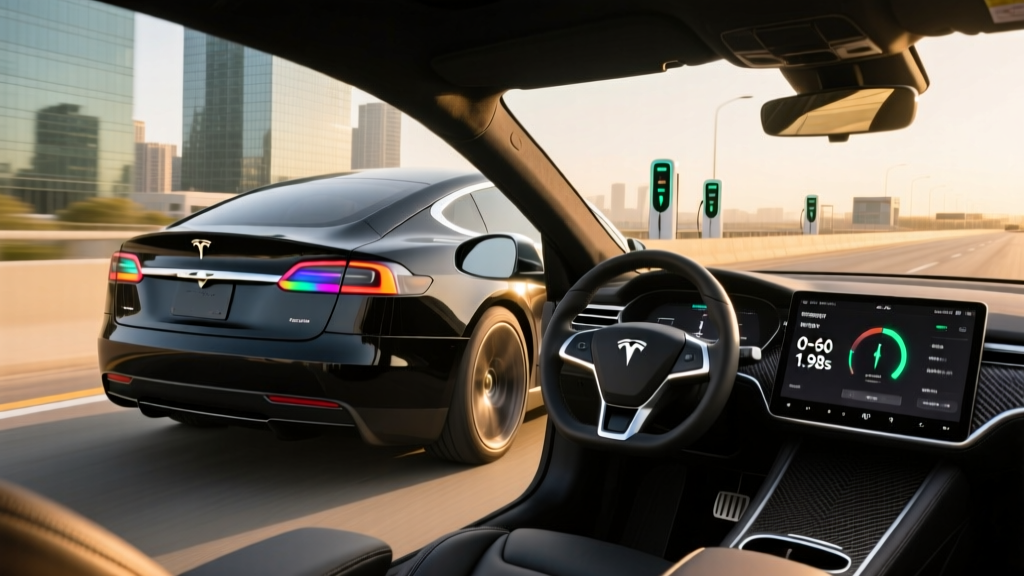
The headline number is 1.99 seconds 0-60 mph, but that figure requires context. Tesla measures this with a 1-foot rollout subtracted (a drag-racing convention that removes the initial reaction-time portion). Without rollout, independent testers (including Motor Trend and Car and Driver) have recorded 0-60 times between 2.1 and 2.3 seconds — still staggeringly fast and quicker than a Bugatti Chiron, Ferrari SF90, or any other production car at any price below seven figures.
The Plaid achieves this via three permanent-magnet synchronous/reluctance motors: one front, two rear. Combined output is 1,020 horsepower and roughly 1,050 lb-ft of torque. The carbon-sleeved rotor design allows the rear motors to spin up to 20,000+ RPM without disintegrating from centrifugal force — this is what enables the Plaid to pull hard well past 100 mph, not just off the line. Quarter-mile times hover around 9.2–9.4 seconds at 150+ mph.
Traction is managed by Tesla's torque-vectoring software, which can independently control power to each rear wheel. On a prepped surface with warm tires (Michelin Pilot Sport 4S or Pirelli P Zero), launches are violent and repeatable. On cold or wet pavement, the traction control system intervenes heavily — you will not see 1.99 seconds without ideal conditions. The Plaid also features a dedicated "Drag Strip" drive mode that preconditions the battery for maximum discharge rate and stiffens the adaptive air suspension.
Pricing, Trims, and Federal Tax Credit Eligibility
The 2026 Model S Plaid starts at $89,990 (destination included). There is no lower-output or dual-motor Model S Plaid variant — the Plaid is the only trim above the base dual-motor Model S Long Range ($74,990). Options include:
- Paint colors: Stealth Grey (free), Pearl White, Solid Black, Deep Blue, Ultra Red ($2,000–$3,000)
- Wheels: 19" Tempest (standard), 21" Arachnid ($4,500 — reduces range to ~359 mi EPA)
- Interior: All Black, Black & White, Cream (no cost)
- Yoke steering: No-cost option (replaces round wheel)
- FSD (Supervised): $8,000 one-time or $99/month subscription
| Item | Amount |
|---|---|
| Base MSRP | $89,990 |
| Federal §30D Tax Credit | $0 (exceeds MSRP cap) |
| Estimated Out-the-Door | ~$92,000–$95,000 (with destination, typical options) |
| IRS MSRP Cap for Sedans | $55,000 |
| IRS Income Cap (MFJ) | $300,000 AGI |
Tax credit reality check: The Model S Plaid does not qualify for the $7,500 federal EV tax credit under IRS §30D. The law caps eligible sedans at an MSRP of $55,000 — the Plaid's $89,990 price far exceeds this. Additionally, buyer income caps ($300,000 modified AGI for married filing jointly, $225,000 for heads of household, $150,000 for single filers) would disqualify many buyers regardless. Some states offer their own EV incentives that may apply — check your state's energy office or DMV for current programs. For the definitive federal rules, consult the IRS clean vehicle credits page.
Interior, Cargo, and Daily-Use Practicality
The Model S interior remains minimalist by luxury-sedan standards: a 17-inch center touchscreen (tilted toward the driver on refresh models), a 12.3-inch instrument cluster, and a 9.4-inch rear-seat touchscreen. Build quality on the 2026 refresh has improved substantially over earlier Model S generations — panel gaps are tighter, materials are softer, and the ventilated front seats are a welcome addition. However, compared to a Mercedes EQS or BMW i7, the cabin still feels more tech-forward than opulent.
Space is a genuine strength:
- Front legroom: 42.7 inches
- Rear legroom: 40.9 inches (class-leading for a sport sedan)
- Rear cargo (seats up): 28 cu ft (liftback design makes loading easy)
- Rear cargo (seats folded, 60/40 split): 71 cu ft
- Front trunk (frunk): ~3.1 cu ft (small but useful for cables)
The liftback hatchback design is a practicality advantage over traditional sedans like the Porsche Taycan or Lucid Air — you can load bulky items far more easily. Five adults fit comfortably, though the rear center seat is best for shorter trips due to the floor hump from the rear motor assembly below.
Technology, Driver Assistance, and Standout Features
The Model S Plaid runs Tesla's latest infotainment software, which includes native Spotify, Apple Music, Tidal, Netflix/YouTube (while parked), and a gaming computer capable of running Cyberpunk 2077 on the center screen. The 22-speaker audio system with active noise cancellation is among the best in any vehicle at this price.
Driver Assistance — SAE Level 2: Tesla's Autopilot (standard) and FSD Supervised ($8,000 / $99/mo) are SAE Level 2 driver-assistance systems. This means the driver must remain fully attentive, keep hands on the wheel (or demonstrate engagement via the cabin camera), and be prepared to take over at any moment. These are not self-driving systems. Only Level 4 services like Waymo operate without a human driver in geofenced areas. Never treat FSD as a substitute for an engaged driver.
Standout tech features:
- Adaptive air suspension: Automatically lowers at highway speed for efficiency; raises for rough roads
- Torque vectoring: Independent rear-motor control for cornering agility
- Track Mode: Adjustable stability control, cooling, and regen for closed-course driving
- Over-the-air updates: Continuous feature additions and performance improvements
- Sentry Mode / Dashcam: 360-degree recording while parked and driving
- HEPA air filtration: Bioweapon Defense Mode with hospital-grade cabin filter
Notable drawbacks: The yoke steering wheel (optional) is controversial — it works fine on highways but requires hand-over-hand for tight turns, which the yoke doesn't accommodate well. The lack of physical stalks (turn signals are buttons on the yoke) frustrates some owners. And the absence of Apple CarPlay / Android Auto remains a dealbreaker for buyers who prefer phone-mirrored interfaces.
Warranty, Battery Longevity, and Ownership Costs
Tesla covers the Model S Plaid with:
- Basic vehicle warranty: 4 years / 50,000 miles
- Battery & drive unit warranty: 8 years / 150,000 miles (whichever comes first), with a minimum 70% capacity retention guarantee over that period
The NMC battery in the Plaid is engineered for high discharge rates, and Tesla's thermal management is among the best in the industry. Data from long-term owner fleets (including Tesla's Impact Reports) suggest Model S/X packs typically retain 85–90% capacity after 150,000 miles. Replacement cost, should it ever be needed out of warranty, currently ranges from $15,000 to $22,000 depending on the service center and pack revision.
Insurance is a real ownership factor: expect premiums of $3,500–$5,500/year depending on your profile, state, and driving record. The Plaid's performance classification and Tesla's high repair costs drive rates above comparable luxury sedans. Get quotes before purchasing.
Pros
- Fastest 0-60 of any production sedan (1.99s w/ rollout)
- 396-mile EPA range — best in performance-EV class
- Full Supercharger network access (NACS native)
- Class-leading cargo space with liftback design
- Continuous OTA updates add features over time
- 1,020 hp with usable daily comfort
Cons
- $89,990+ price; no federal tax credit eligibility
- High insurance premiums ($3,500–$5,500/yr)
- Yoke steering divisive; no physical stalks
- No Apple CarPlay or Android Auto
- 21" Arachnid wheels reduce range by ~37 mi
- Interior still not at Mercedes/BMW luxury level
Competitor Check: Plaid vs. Lucid Air Sapphire vs. Taycan Turbo GT
The Model S Plaid's closest rivals in 2026 are the Lucid Air Sapphire (1,234 hp, 1.89s claimed 0-60, 427-mi EPA, ~$249,000) and the Porsche Taycan Turbo GT (1,019 hp, 2.1s 0-60, 269-mi EPA, ~$230,000). The Sapphire is technically quicker and has more range, but costs nearly three times as much. The Taycan Turbo GT offers superior chassis dynamics and build quality but sacrifices 127 miles of range and costs 2.5× more. The Plaid's value proposition is undeniable: hypercar acceleration at a fraction of the price, with the most practical charging ecosystem in North America.
Who Should Buy the Model S Plaid?
Buy the Model S Plaid if:
- You want the fastest Tesla 0-60 time in a daily-drivable four-door sedan
- You need 350+ miles of real-world range for road trips without frequent stops
- You value Supercharger network access for hassle-free long-distance travel
- You want hypercar performance with four usable seats and 28 cu ft of cargo
- You prefer OTA-updated software over traditional luxury brand heritage
Look elsewhere if:
- You need federal tax credit eligibility (consider Model 3 Performance or Model Y)
- You prioritize traditional luxury materials and dealer service (BMW i7, Mercedes EQS)
- You want a track-focused chassis over straight-line speed (Porsche Taycan Turbo GT)
- Your budget tops out around $60,000 (Tesla Model 3 Performance: 2.9s 0-60, ~$54,990)
Frequently Asked Questions
What is the real-world range of the Model S Plaid?
The EPA rates it at 396 miles. In real-world highway driving at 75 mph, expect 310–340 miles. In cold weather (below 30°F), plan for 260–300 miles. Mixed suburban driving in mild conditions can approach the EPA sticker.
How fast does the Model S Plaid charge?
Peak DC fast charging is 250 kW on a V3 Supercharger, achieving a 10-80% charge in about 27 minutes. At home on a 48-amp Wall Connector (11.5 kW), a full charge takes roughly 9 hours. The charge curve tapers significantly above 80% SoC to protect the battery.
Does the Model S Plaid qualify for the federal EV tax credit?
No. The IRS §30D credit caps sedan eligibility at $55,000 MSRP, and the Plaid starts at $89,990. Income limits ($150K single / $300K married filing jointly) and battery critical-mineral sourcing rules add further restrictions. Consult IRS.gov for current rules. Some state incentives may still apply.
Is the Model S Plaid worth buying vs. the Lucid Air Sapphire?
If budget is no object and you want the absolute quickest sedan, the Sapphire (1.89s, $249,000) edges out the Plaid. But the Plaid delivers 95% of the performance for roughly one-third the price, with better charging infrastructure and more proven long-term reliability. For nearly all buyers, the Plaid is the smarter choice.
How long will the Plaid's battery last?
Tesla warranties the battery for 8 years / 150,000 miles with a 70% capacity retention floor. Real-world fleet data suggests NMC packs in the Model S typically retain 85–90% after 150K miles. Avoiding frequent 100% charges (daily charge to 80–90% is ideal) and using battery preconditioning for DC fast charging will maximize longevity.
Can I daily-drive a 1,020-hp car?
Absolutely. In its default drive mode, the Plaid is a comfortable, quiet luxury sedan with adaptive air suspension, excellent ride quality, and usable one-pedal regenerative braking. The performance is there when you want it and invisible when you don't. Insurance costs, however, will remind you daily what you're driving.