The Short Answer: What Defines a Fast EV?
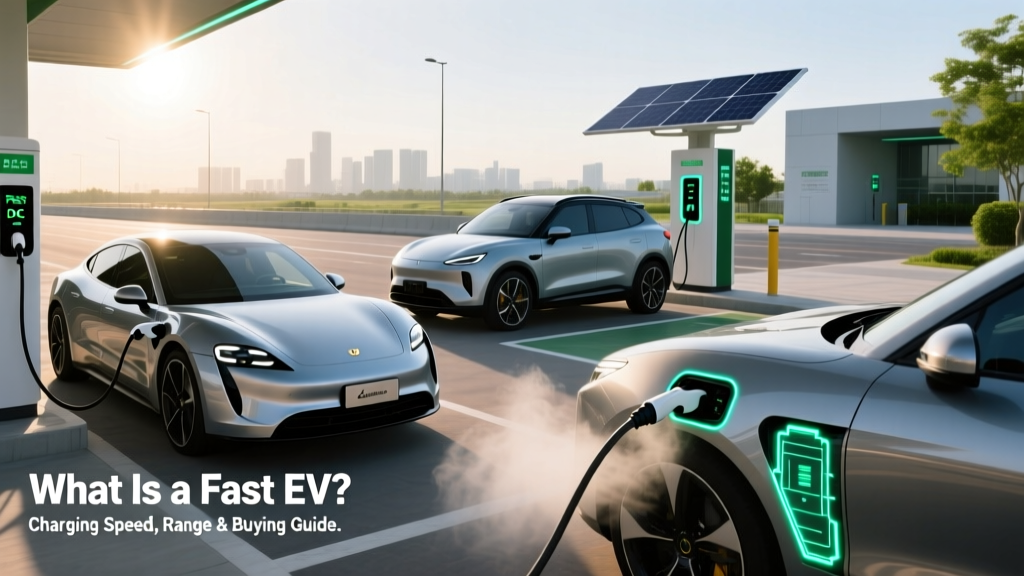
A fast EV isn't just about 0-60 mph times — it's primarily about how quickly the vehicle can replenish its battery at a DC fast charger. In 2026, a genuinely fast-charging EV peaks at 250 kW or higher on a DC fast charger, adds roughly 150-200+ miles of range in 15 minutes, and completes a 10-80% charge in under 20 minutes. Models like the Hyundai Ioniq 5 (peak 240 kW, 10-80% in ~18 min), the Porsche Taycan (peak 320 kW on 800V architecture), and the Lucid Air (peak 300+ kW) lead the pack. But peak kW is only part of the story — sustained charge rate, battery preconditioning, and real-world charger availability matter just as much.
Charging Speed vs. Acceleration: Two Different "Fast"
When shoppers search for a "fast EV," they're usually thinking about one of two things — and confusing them leads to bad purchase decisions:
| Metric | What It Measures | Why It Matters | Top 2026 Examples |
|---|---|---|---|
| DC Fast Charge Rate (kW) | How quickly the battery replenishes at a public charger | Road-trip downtime, convenience | Taycan: 320 kW peak; Ioniq 5: 240 kW; F-150 Lightning: 230 kW |
| 0-60 mph (seconds) | Acceleration performance | Merging, passing, driving feel | Model S Plaid: 1.99s; Taycan Turbo S: 2.4s; Ioniq 5 N: 3.4s |
| Level 2 Home Charge Rate (kW) | Overnight replenishment speed at home | Daily readiness, convenience | Most EVs: 7.2-11.5 kW (adds 25-45 mi/hr overnight) |
For most owners, DC fast-charge speed matters far more than 0-60 times for daily satisfaction. You'll use acceleration occasionally; you'll use charging speed every road trip. A car that does 0-60 in 3.5 seconds but takes 45 minutes to go from 10-80% will frustrate you on every long drive.
The Charging-Curve Reality: Peak kW Is Not Sustained kW
This is the single most misunderstood concept in EV buying. Manufacturers advertise a peak charge rate — say, 250 kW — but that peak is typically sustained only between roughly 10-30% State of Charge (SoC). Above 50%, the rate tapers significantly to protect battery health. Above 80%, it drops to a trickle.
Here's what a typical charge curve looks like for a modern 800V-architecture EV at a 350 kW charger:
- 10-30% SoC: ~230-250 kW (peak zone)
- 30-50% SoC: ~175-200 kW (moderate taper)
- 50-80% SoC: ~100-130 kW (significant taper)
- 80-100% SoC: ~20-50 kW (trickle — avoid unless necessary)
This is why we measure 10-80% time, not peak kW, as the true benchmark. The Hyundai Ioniq 5's 800V architecture sustains higher rates deeper into the charge, yielding an ~18-minute 10-80% session despite a 240 kW peak that's technically lower than some competitors. Meanwhile, some 400V vehicles with a 250 kW peak advertise higher numbers but taper earlier, resulting in similar or worse 10-80% times.
Preconditioning matters enormously. If you navigate to a DC fast charger using the vehicle's built-in navigation (Tesla, Rivian, Hyundai/Kia, Ford), the battery thermal management system begins warming the pack en route. Arriving at a charger with a cold battery can cut your peak charge rate by 30-50%. Always precondition.
2026 Fast-Charging EV Comparison
| Model | Battery (kWh usable) | Chemistry | EPA Range | Peak DC kW | 10-80% Time | 0-60 mph | Base MSRP |
|---|---|---|---|---|---|---|---|
| Hyundai Ioniq 5 (Long Range AWD) | 84 | NMC | 290 mi | 240 kW | ~18 min | 5.1s | $47,400 |
| Porsche Taycan (base, 2025 refresh) | 97 | NMC | 318 mi | 320 kW | ~16 min | 4.5s | $99,400 |
| Lucid Air Pure | 88 | NMC | 419 mi | 300+ kW | ~17 min | 3.8s | $77,400 |
| Kia EV6 GT-Line AWD | 84 | NMC | 282 mi | 240 kW | ~18 min | 4.5s | $52,200 |
| Tesla Model 3 Long Range AWD | 75 | NMC | 341 mi | 250 kW | ~22 min | 4.2s | $47,740 |
| Ford F-150 Lightning (Ext. Range) | 131 | NMC | 320 mi | 230 kW | ~25 min | 3.8s | $67,995 |
Sources: fueleconomy.gov, manufacturer press sites. Real-world highway range at 70-75 mph typically runs 10-15% below EPA estimates; cold weather (below 32°F) can reduce range 20-30%. Always pair EPA figures with these caveats.
Real Costs: Fast EV vs. Gas Car
Speed is exciting, but ownership economics determine whether a fast EV makes financial sense. Let's compare a 2026 Hyundai Ioniq 5 (Long Range AWD, ~$47,400) against a comparably equipped 2026 Toyota RAV4 AWD (~$35,000) over 5 years and 75,000 miles.
| Cost Category | Ioniq 5 (EV) | RAV4 AWD (Gas) | 5-Year Difference |
|---|---|---|---|
| Purchase Price (MSRP) | $47,400 | $35,000 | +$12,400 (EV) |
| Federal Tax Credit (§30D) | Up to $7,500* | $0 | -$7,500 (EV savings) |
| Effective Purchase | ~$39,900 | $35,000 | +$4,900 (EV) |
| Fuel/Energy (75k mi) | ~$3,750 (home L2)** | ~$9,375 (28 MPG avg, $3.50/gal) | -$5,625 (EV savings) |
| Maintenance | ~$1,200 | ~$3,500 | -$2,300 (EV savings) |
| Insurance (avg) | ~$9,500 | ~$7,500 | +$2,000 (EV cost) |
| 5-Year Net Cost | ~$54,350 | ~$55,375 | ~$1,025 cheaper (EV) |
*§30D eligibility depends on buyer income caps ($150k single / $300k joint), MSRP caps ($55k cars / $80k SUVs/trucks), and battery critical-mineral sourcing requirements. Verify current rules at irs.gov. Point-of-sale transfer is available at participating dealers.
**Assumes 85% home Level 2 charging at $0.14/kWh national average, 15% public DC fast charging at $0.40/kWh. Actual costs vary significantly by utility rate and charging mix. Public-only charging at $0.40-0.50/kWh raises the EV fuel cost to ~$6,500-7,500, narrowing or eliminating the fuel savings advantage.
Home Charging Access: The Make-or-Break Factor
Here's the uncomfortable truth: a fast-charging EV is only convenient if you can charge at home. Without home Level 2 charging, you're relying entirely on public infrastructure — and even the fastest-charging EV becomes an inconvenience when you're making dedicated charging trips 2-3 times per week.
Home Charging Decision Framework
- If you have a garage or dedicated parking spot with 240V access: Install a Level 2 home charger (48A / 11.5 kW). Budget $500-1,500 for equipment and $800-2,500 for electrician labor (more if a panel upgrade from 100A to 200A is needed, which can add $1,500-3,500). You'll wake up to a full battery every morning and rarely need public charging except on road trips. A fast-charging EV is an excellent choice.
- If you rent or lack dedicated parking: Check if your building has or plans EV charging. Some municipalities require workplace charging. If you must rely solely on public chargers, prioritize vehicles with the fastest 10-80% times (sub-20 min) and live near reliable DC fast-charging stations. Consider a PHEV instead if public charging access is sparse.
- If you live in an apartment with no charging and no workplace charging: A fast EV will work but will demand lifestyle adjustments — plan on 20-40 minutes of charging 1-2 times per week. Map your local Electrify America, EVgo, or Tesla Supercharger network before buying. A hybrid or PHEV may be more practical.
Common Fast-EV Misconceptions
| Myth | Fact |
|---|---|
| "A 350 kW peak means the car charges at 350 kW the whole time." | Peak rate is sustained for only a portion of the session (typically 10-30% SoC). Average rate across a 10-80% session is usually 50-70% of peak. Always check 10-80% minutes, not peak kW. |
| "Fast charging destroys the battery." | Modern battery thermal management systems actively protect the pack. Studies from NREL and real-world fleet data show that DC fast charging, when the battery is properly preconditioned, adds minimal extra degradation — typically 1-2% more over 100,000 miles vs. Level 2-only charging. The battery warranty (typically 8 years/100,000 miles, 70% capacity retention) still applies. |
| "All DC fast chargers deliver the same speed." | Charger output varies widely: 50 kW (older stations), 150 kW (common), 250 kW (Tesla V3, newer EA), and 350 kW (newest Electrify America, EVgo). A car capable of 320 kW is bottlenecked at a 150 kW station. Check the charger's rated output in your charging app before driving there. |
| "I need a 400-mile range EV for road trips." | With fast charging (sub-20-min 10-80%), a 280-320 mile EPA range is sufficient for most road trips. You stop every 200-240 real-world miles, charge for 15-20 minutes, and continue. Ultra-long range reduces stops but adds battery weight, cost, and slower charging (larger batteries take longer to fill). |
| "EVs lose all their range in winter." | Cold weather (below 32°F) reduces range 15-30% depending on severity, cabin heating use, and whether the vehicle has a heat pump. The Ioniq 5, Model 3, and Taycan all use heat pumps, which reduce the penalty to ~15-20%. Preconditioning the cabin while plugged in mitigates this further. |
Connector Compatibility: NACS vs. CCS in 2026
The North American Charging Standard (NACS), originally developed by Tesla, has become the dominant connector for 2026 model-year EVs. Ford, GM, Rivian, Hyundai/Kia, BMW, and others have adopted NACS ports on new vehicles. This means:
- NACS-equipped EVs can access Tesla Supercharger stations directly (over 25,000 stalls in North America) without an adapter — a massive reliability and coverage advantage.
- CCS1-equipped EVs (some carryover models and older inventory) require a NACS adapter for Supercharger access. Tesla and third-party adapters are available (~$150-250).
- CHAdeMO is effectively discontinued for new vehicles. Nissan has transitioned the Leaf to NACS for its next generation.
When buying a fast EV in 2026, prioritize NACS-equipped models for the broadest charging-network access. The Supercharger network consistently delivers the highest uptime and most reliable plug-and-charge experience, according to JD Power charging satisfaction surveys.
Actionable Decision Framework: Is a Fast EV Right for You?
Choose a Fast-Charging EV If:
- You have home Level 2 charging access (or can install it)
- You take road trips 3+ times per year and want minimal charging downtime
- Your daily commute is under 80 miles round-trip (easily covered overnight)
- You qualify for some or all of the §30D federal tax credit (check income and MSRP caps at irs.gov)
- You value low running costs and are willing to pay a higher upfront price
Consider a PHEV or Hybrid Instead If:
- You cannot install home charging and lack reliable workplace charging
- You live in a rural area with sparse DC fast-charging infrastructure
- You regularly tow heavy loads over long distances (towing can cut EV range 40-50%)
- Your budget is under $35,000 and you need maximum vehicle for the dollar
- You drive 300+ miles in a single stretch multiple times per month through charging-desert regions
Frequently Asked Questions
What's the fastest-charging EV you can buy in 2026?
The Porsche Taycan (2025+ refresh) leads with a peak 320 kW on 800V architecture and a ~16-minute 10-80% time. The Lotus Eletre and upcoming 800V vehicles from Chinese manufacturers push similar figures. Among mainstream-priced EVs, the Hyundai Ioniq 5 and Kia EV6 (both 800V, 240 kW peak, ~18 min 10-80%) offer the best fast-charge performance under $55,000.
Does fast charging void my battery warranty?
No. Manufacturer battery warranties (typically 8 years / 100,000 miles, guaranteeing 70% capacity retention) apply regardless of charging method. The vehicle's thermal management system regulates battery temperature during DC fast charging to prevent damage. Using reputable charging networks and enabling battery preconditioning ensures optimal charging conditions.
How much does it cost to install a home Level 2 charger?
Expect $1,300-4,000 total for a quality 48A Level 2 charger (ChargePoint Home Flex, Emporia Level 2, or Tesla Wall Connector) plus professional installation. The wide range reflects panel condition: if your home has a 200A electrical panel with spare capacity, installation runs $800-1,500. If you need a panel upgrade to 200A, add $1,500-3,500. Some utilities offer rebates of $250-750 for charger installation — check with your local provider. Always hire a licensed electrician; this is not a DIY project.
Is a fast EV practical in cold climates?
Yes, with caveats. Expect 15-30% range reduction in sustained sub-freezing temperatures. EVs with heat pumps (Ioniq 5, Model 3, Taycan, EV6) lose less range than those with resistive heaters. Best practices: precondition the cabin and battery while still plugged in, use seat/steering-wheel heaters instead of cranking cabin heat, and plan for one extra charging stop on long winter road trips. Owners in Minnesota, Canada, and Scandinavia successfully drive EVs year-round — but you must budget for the range penalty.
What's the difference between kW and kWh?
kW (kilowatts) measures power — the rate at which energy flows. Think of it like water pressure from a hose. A 250 kW charger delivers energy faster than a 50 kW charger. kWh (kilowatt-hours) measures energy — the total amount stored in the battery. Think of it like the size of the water tank. An 84 kWh battery holds more energy than a 60 kWh battery, giving more range. You need both: a large kWh battery for range, and high kW charging capability to fill it quickly.