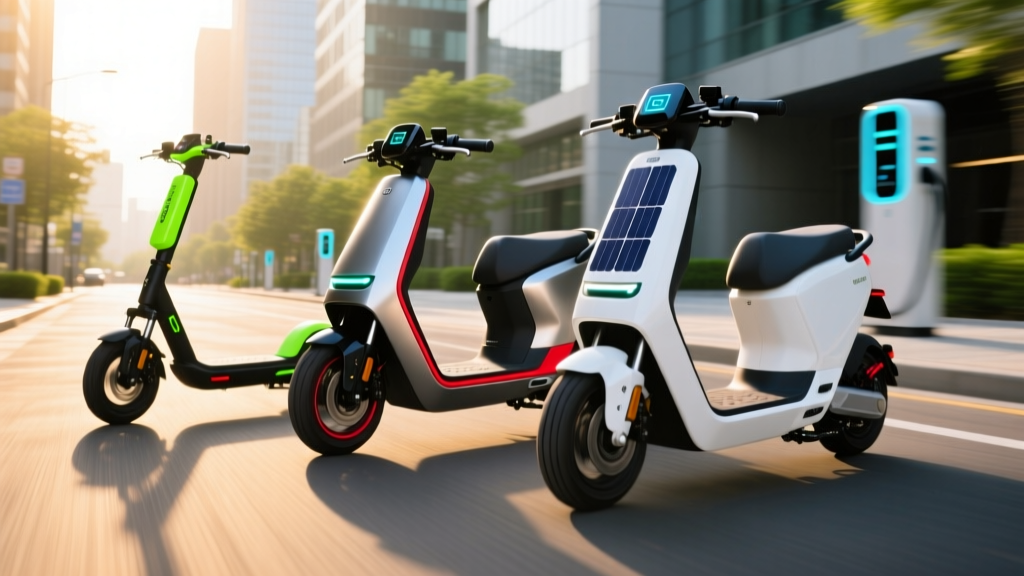
If you're researching fast electric scooters for adults, the practical reality in 2026 is this: high-performance models deliver 30–55 mph top speeds, 30–60 miles of real-world range on a 1–2 kWh battery, and charge fully on a standard 120V outlet in 4–8 hours. Expect to pay $1,200–$3,500 for a reputable dual-motor commuter scooter, with no federal EV tax credit available (the §30D credit applies only to four-wheeled vehicles meeting specific MSRP, income, and battery-sourcing rules). The real value proposition is ultra-low operating cost—roughly $0.01–$0.03 per mile in electricity versus $0.12–$0.18 per mile for a gas car in fuel alone.
Quick Answer: Who Are Fast Electric Scooters For?
Fast electric scooters (30+ mph) suit adults with commutes under 20 miles round-trip, access to secure storage and a standard outlet for charging, and a need for last-mile transit or car-replacement on short urban trips. They are not a substitute for a full EV or PHEV if you regularly drive 30+ miles, carry passengers, or face harsh winter conditions.
Where Scooters Fit in the Electrified-Vehicle Landscape
Before spending $2,000+ on a high-performance scooter, it's worth understanding where this category sits relative to other electrified options. A fast adult scooter is a micro-mobility tool—not a car replacement for most households, but a serious commuting machine for the right use case.
| Category | Typical Range | Top Speed | Price Range | Fuel/Energy Cost per Mile | Best For |
|---|---|---|---|---|---|
| Fast Electric Scooter (dual-motor) | 30–60 mi | 30–55 mph | $1,200–$3,500 | $0.01–$0.03 | Solo urban commuting, last-mile |
| E-Bike (Class 3) | 25–60 mi | 28 mph | $1,500–$4,000 | $0.01–$0.02 | Longer bike-lane commutes, cargo |
| PHEV (e.g., Toyota RAV4 Prime) | 42 mi EV + 580 mi gas | 112 mph | $44,000–$52,000 | $0.04 (EV) / $0.12 (gas) | Mixed city/highway, family hauling |
| BEV (e.g., Tesla Model Y LR) | 310 mi (EPA) | 130 mph | $44,000–$55,000 | $0.04–$0.06 | Full car replacement, road trips |
| Gas Compact (e.g., Honda Civic) | 420 mi | 125 mph | $25,000–$32,000 | $0.12–$0.18 | Budget-conscious, no charging |
The scooter wins on per-mile energy cost and parking simplicity. It loses on weather protection, cargo capacity, passenger seating, and crash protection. For households that already own a car, a fast scooter can replace 40–60% of short urban trips, cutting fuel spend meaningfully.
Performance Specs That Actually Matter
Marketing materials for electric scooters emphasize peak wattage and "max speed" in ideal conditions. As an EV analyst, I look at the numbers that govern real daily use: sustained power, usable battery capacity (kWh), and real-world range at actual commuting speeds.
Motor Power: Peak vs. Sustained
Dual-motor scooters in the 2,000W–5,000W combined peak range dominate the "fast" category. But peak wattage is a burst figure—what matters for hill-climbing and sustained 35+ mph cruising is the continuous rating, typically 40–60% of peak. A scooter rated at 2 x 1,200W peak (2,400W total) often delivers ~1,400W sustained, which handles 8–10% grades at 25 mph with a 180-lb rider.
Battery Capacity and Chemistry
Battery size on fast scooters ranges from roughly 0.7 kWh (entry performance) to 2.4 kWh (flagship models). Most use 18650 or 21700 lithium-ion cells in NMC (nickel manganese cobalt) configuration for energy density. Some newer models in 2026 are adopting LFP (lithium iron phosphate) packs, which sacrifice ~15% energy density for longer cycle life (2,000+ cycles vs. ~800 for NMC) and better thermal stability.
Key distinction: kWh (kilowatt-hours) measures energy capacity—how far you can go. kW (kilowatts) measures power—how fast you can go or charge. A 1.5 kWh battery at 30 Wh/mile efficiency yields roughly 50 miles of range. These numbers are not interchangeable.
Real-World Range vs. Advertised Range
This is where scooter marketing diverges hardest from reality. Manufacturers often quote range at 15 mph on flat ground with a 150-lb rider. Real commuting involves 25–35 mph speeds, stops, hills, and riders averaging 180–220 lbs with gear.
Range Reality Check
Advertised (ideal): 62 miles at 15 mph, 150-lb rider, flat terrain
Real-world commuting: 32–42 miles at 28–35 mph, 190-lb rider, mixed terrain
Cold-weather (35°F): 22–30 miles (lithium-ion loses 20–35% capacity below 40°F)
Rule of thumb: Expect 50–65% of advertised range at true commuting speeds.
Total Cost of Ownership: Scooter vs. Car
The financial case for a fast electric scooter rests on displacement—replacing car miles, not adding to them. Here's a five-year cost model assuming the scooter replaces 5,000 miles/year of urban driving previously done in a 30 MPG gas car.
| Cost Category | Fast E-Scooter (5 yr) | Gas Car (5,000 mi/yr) | BEV (5,000 mi/yr) |
|---|---|---|---|
| Purchase Price | $2,200 | N/A (existing vehicle) | N/A (existing vehicle) |
| Energy (electricity / gas) | $150 (5 yr at $0.15/kWh) | $4,500 ($3.50/gal, 30 MPG) | $1,250 ($0.15/kWh, 3.5 mi/kWh) |
| Maintenance | $300 (tires, brakes, tune-ups) | $2,000 (oil, filters, brakes) | $800 (tires, cabin filter, wipers) |
| Insurance | $0–$600 (optional, varies by state) | $6,000 ($1,200/yr avg) | $6,500 ($1,300/yr avg) |
| Registration / Licensing | $0–$150 (state-dependent) | $750 | $750 |
| Total 5-Year Cost | $2,800–$3,400 | $13,250+ | $9,300+ |
| Cost per Mile | $0.11–$0.14 (incl. purchase) | $0.53 | $0.37 |
The scooter's per-mile cost drops to $0.03–$0.05 after the purchase is amortized. The critical caveat: a scooter doesn't eliminate the need for a car in most households. It reduces car miles, which proportionally reduces fuel, maintenance, and potentially insurance (if you switch to low-mileage plans).
Charging Cost and Convenience
Charging a 1.5 kWh scooter battery from empty costs roughly $0.23 at the US average residential rate of $0.15/kWh. A full charge takes 5–7 hours on a standard 120V household outlet using the included charger (typically 2A–3A output, ~250–350W). Unlike full EVs, scooters don't require Level 2 home installations or panel upgrades—a significant ownership simplification.
Some 2026 flagship scooters support external fast chargers (sold separately, $150–$300) that cut charge time to 2–3 hours by pushing 5A–7A. These are still 120V units, not DC fast charging in the automotive sense.
Common Misconceptions, Corrected
| Myth | Fact |
|---|---|
| "Fast scooters qualify for the $7,500 federal EV tax credit." | They do not. The IRS §30D credit applies only to four-wheeled vehicles with a gross vehicle weight under 14,000 lbs, meeting MSRP caps ($55,000 sedans / $80,000 SUVs/trucks), buyer income limits, and battery critical-mineral sourcing requirements. Two- and three-wheeled scooters are excluded. |
| "A 60-mile range scooter can replace my 30-mile round-trip commute reliably." | At actual commuting speeds (28–35 mph), real range is 32–42 miles. With battery degradation over 2–3 years (expect 15–25% capacity loss on NMC cells), that buffer shrinks further. Plan for 60–70% of advertised range as your daily usable budget. |
| "I can ride in the rain without issues." | Most fast scooters carry IP54 or IPX5 water resistance—splash protection, not submersion. Heavy rain, puddles deeper than 2 inches, and wet leaves on roads present real traction and electrical hazards. Fenders and sealed connectors help but don't eliminate risk. |
| "Maintenance is zero because it's electric." | Tires (every 1,500–3,000 miles on pneumatic), brake pads or disc rotors (every 2,000–5,000 miles), suspension bushings, and battery health monitoring are real maintenance items. Budget $50–$80/year minimum. |
| "Higher wattage always means a better scooter." | Wattage without efficiency is just heat. A 3,000W scooter with poor motor controllers and heavy weight may deliver less real range and worse hill performance than a 2,000W model with superior regen braking and lighter construction. Look at Wh/mile efficiency, not just peak watts. |
Ownership Realities: What First-Time Buyers Need to Know
Charging Access and Storage
Unlike a full EV, a scooter charges on any standard 120V outlet—but you need secure, weather-protected storage with outlet access. Apartment dwellers face a real challenge: many buildings prohibit scooters in units (fire-code concerns around lithium batteries), and outdoor charging is unsafe. Before purchasing, confirm your storage situation. A removable battery (available on some 2026 models) solves this by letting you charge the pack indoors while the frame stays in a garage or bike room.
Legal and Licensing Requirements
Regulations for fast electric scooters vary dramatically by state and municipality. In California, scooters over 1,000W or capable of 30+ mph may require registration, a driver's license, and helmet use. New York treats e-scooters differently from e-bikes, with a 20 mph speed cap on most public paths. Texas is more permissive. Check your local DMV and municipal codes before purchasing a 40+ mph model—you may be restricted to private property or specific road classes.
Safety Equipment and Insurance
At 35+ mph, a scooter crash carries motorcycle-like injury risk. A DOT-certified full-face helmet ($80–$200), gloves, and armored jacket are not optional extras—they're baseline protective gear. Some insurers (GEICO, Progressive) now offer e-scooter policies at $10–$40/month covering theft, liability, and collision. If your scooter costs over $1,500, insurance is financially rational.
Battery Longevity and Replacement
NMC scooter batteries typically retain 70–80% of original capacity after 600–800 full charge cycles (roughly 2–4 years of daily commuting). LFP cells last longer (1,500–2,000 cycles to 80%) but are less common in the fast-scooter segment. Replacement batteries cost $300–$700 depending on capacity and cell quality. Factor this into your five-year cost if you plan to keep the scooter long-term.
Decision Framework: Is a Fast E-Scooter Right for You?
Choose a Fast Electric Scooter If:
- Your one-way commute is under 15 miles and mostly on paved roads or bike lanes
- You have secure, weather-protected storage with 120V outlet access
- You already own or have access to a car for longer trips, bad weather, and cargo needs
- You live in a climate with 7+ months of rideable weather (temps above 40°F, minimal ice)
- Your local laws permit 30+ mph scooter operation on your commuting routes
- You want to reduce car fuel spend by $600–$1,200/year on displaced urban miles
Choose a PHEV or BEV Instead If:
- Your daily driving exceeds 30 miles round-trip regularly
- You carry passengers or cargo weekly
- You live in an area with harsh winters (extended sub-30°F temps, ice, snow)
- You lack secure scooter storage or face building restrictions on lithium batteries
- You need vehicle crash protection, airbags, and all-weather capability
- You want to leverage the federal §30D tax credit (up to $7,500 for qualifying four-wheeled EVs with point-of-sale transfer in 2026)
Frequently Asked Questions
How fast do the fastest adult electric scooters actually go?
Production models in 2026 top out between 40–55 mph (GPS-verified). The Segway GT3 series, Dualtron Thunder 3, and Kaabo Wolf King GT are representative flagships. Sustained highway cruising at 35–40 mph is realistic on dual-motor models with 2,000W+ continuous output. Note that range drops sharply above 30 mph due to aerodynamic drag—riding at 40 mph can cut range by 40–50% versus 25 mph.
Can I charge a fast scooter on a regular household outlet?
Yes. All consumer fast scooters charge on standard 120V (Level 1 equivalent). A 1.5 kWh battery charges in 5–7 hours with the included charger. You do not need a Level 2 home installation, electrical panel upgrade, or dedicated circuit—a major advantage over full EVs. Some models offer optional fast chargers (5A–7A) that reduce this to 2–3 hours.
Do electric scooters qualify for any federal or state tax credits?
Not the federal §30D credit, which requires four wheels and specific MSRP/income/sourcing criteria. Some states and utilities offer micro-mobility rebates—Colorado's e-bike rebate program, for example, has included certain e-scooter categories. Check your state energy office and local utility for current incentive availability, as these change frequently.
What's the real-world range at commuting speeds?
Expect 50–65% of the manufacturer's advertised range when riding at 28–35 mph with a 180+ lb rider on mixed terrain. A scooter advertised at 60 miles typically delivers 32–40 miles in real commuting conditions. Cold weather (below 40°F) further reduces this by 20–35%. Always size your battery for your worst-case commute, not the best-case spec sheet.
How long do scooter batteries last before replacement?
NMC lithium-ion cells (most common) retain ~80% capacity after 600–800 full cycles, translating to 2–4 years of daily commuting. LFP cells last 1,500–2,000+ cycles but are heavier and less common in performance scooters. Replacement packs cost $300–$700. To maximize longevity, avoid routinely draining below 20% or charging to 100%—storing between 30–80% State of Charge extends cycle life significantly.
Are fast electric scooters street-legal?
It depends on your state and municipality. Many states classify scooters capable of 30+ mph as motor vehicles requiring registration, licensing, and insurance. Others restrict them to bike lanes with 15–20 mph speed caps regardless of the scooter's capability. Check your state DMV and local ordinances before purchasing. The NHTSA provides federal safety guidance, but enforcement is local.