If you've searched for "farting Tesla" and landed here wondering whether it's a real vehicle, a recall notice, or a bizarre internet meme — relax. It's none of those things (well, mostly). The "farting Tesla" refers to one of the most viral easter eggs Tesla has ever hidden in its cars: a feature that lets owners trigger a realistic fart sound through the vehicle's exterior pedestrian warning speaker or the interior audio system. It's absurd, it's juvenile, and it became a social-media phenomenon. But behind the gag is a genuinely impressive flagship sedan: the Tesla Model S.
This review covers what the fart-mode easter egg actually is, how to activate it, and — far more importantly — whether the 2026 Tesla Model S is still worth buying as a luxury EV. We'll break down EPA range, real-world highway and cold-weather expectations, DC fast-charging speeds, battery chemistry, pricing after federal tax credits, and how it stacks up against the Lucid Air, Mercedes EQS, and BMW i7.
What Is the "Farting Tesla" and Where Did It Come From?
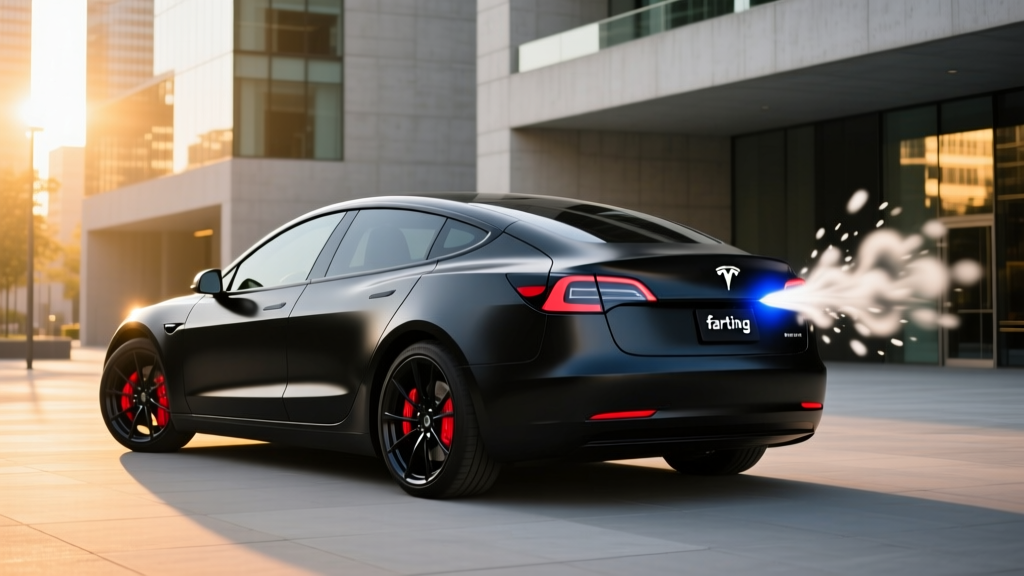
"Fart mode" is a Tesla easter egg accessible through the car's infotainment Toybox menu. Introduced via an over-the-air software update, the feature allows the driver to:
- Replace the turn-signal click sound with a fart noise inside the cabin.
- Trigger a fart sound from the exterior pedestrian-warning speaker (PWS) via the key fob or app.
- Select from a menu of fart variations with names like "Cotton Swab," "Not a Fault," and the crowd-favorite "Bentley."
The feature went viral on TikTok and YouTube around 2021-2022, with owners pranking passengers and pedestrians. Tesla hasn't removed it — as of the 2026 software build, fart mode remains in the Toybox. It's harmless fun, but it also illustrates Tesla's philosophy of shipping personality into software-defined vehicles, something legacy automakers still struggle to replicate.
2026 Tesla Model S: The Real Specs Behind the Meme
Easter eggs are entertaining, but the Model S is a serious flagship sedan competing in the $80,000–$110,000 luxury EV segment. Here's what actually matters for buyers.
| Specification | Model S Long Range | Model S Plaid |
|---|---|---|
| EPA Estimated Range | 402 miles | 359 miles |
| Usable Battery Capacity | ~100 kWh (NMC) | ~100 kWh (NMC) |
| Drivetrain | Dual-Motor AWD | Tri-Motor AWD |
| Horsepower | 670 hp | 1,020 hp |
| 0–60 mph | 3.1 seconds | 1.99 seconds |
| Top Speed | 155 mph | 200 mph |
| Peak DC Fast-Charge Rate | 250 kW | 250 kW |
| 10–80% DCFC Time | ~30 minutes | ~30 minutes |
| Level 2 Home Charge Rate | 11.5 kW (~41 mi/hr) | 11.5 kW (~41 mi/hr) |
| Efficiency (EPA Combined) | 124 MPGe (27 kWh/100 mi) | 116 MPGe (29 kWh/100 mi) |
| Cargo Volume (rear + frunk) | 28 cu ft rear + 3.1 cu ft frunk | 28 cu ft rear + 3.1 cu ft frunk |
| Rear Legroom | 35.4 inches | 35.4 inches |
| Base MSRP | $79,990 | $94,990 |
| Warranty (Battery/Drive Unit) | 8 yr / 150,000 mi | 8 yr / 150,000 mi |
Real-World Range: Highway, Cold Weather, and What the EPA Number Doesn't Tell You
- Mixed city/highway (65-70 mph, moderate climate): expect ~340–370 miles.
- Sustained 80 mph highway: drops to ~300–320 miles due to aerodynamic drag.
- Cold weather (below 32°F / 0°C): plan on 25–35% loss, yielding ~260–290 miles. The heat pump helps, but cabin and battery heating still draw from the pack.
- Mountain/terrain driving: significant elevation gain consumes energy; regen on descent recovers some but not all.
The Model S Long Range's 402-mile EPA rating (fueleconomy.gov) remains one of the highest of any production EV sold in the U.S. However, EPA test cycles are gentle compared to real interstate driving. The Model S's large frontal area and sedan shape mean aerodynamic losses scale steeply above 70 mph. On a 300-mile road trip at 80 mph in 40°F weather, preconditioning the battery before fast-charging becomes critical — without it, peak charge rates will be throttled.
The Plaid trim sacrifices ~43 miles of EPA range for tri-motor performance. Its 359-mile rating is still ample for most road trips, but real-world highway range will settle closer to 290–310 miles in ideal conditions.
Charging Speed: 250 kW Peak, but Watch the Curve
The Model S supports a peak DC fast-charge rate of 250 kW on V3 Superchargers and compatible CCS/NACS stations (Tesla opened the Supercharger network to non-Tesla EVs, but Tesla vehicles retain native NACS access). A 10–80% session takes roughly 30 minutes under optimal conditions — battery preconditioned, ambient temperature above 60°F, and a V3 or newer stall.
| Charging Level | Power (kW) | Approximate Rate |
|---|---|---|
| Level 1 (120V household) | ~1.4 kW | ~4–5 miles per hour |
| Level 2 (240V, 48A Wall Connector) | 11.5 kW | ~41 miles per hour |
| DC Fast Charge (V3 Supercharger) | Up to 250 kW | 10–80% in ~30 min |
| DC Fast Charge (V4 Supercharger) | Up to 250 kW (cable-limited on S) | 10–80% in ~30 min |
Charging curve reality check: The 250 kW peak only sustains roughly from 10% to 30% State of Charge. Above 50%, the rate tapers to ~150 kW, and above 80% it drops sharply to protect the NMC cells. For road-trip efficiency, plan stops around 10–80% rather than topping to 100%, unless your destination charger is the next stop.
At home on a Tesla Wall Connector (48A, 11.5 kW), a full overnight charge from 20% to 80% takes about 5–6 hours. Most owners who charge nightly at home rarely use more than 50% of the pack between sessions, so Level 2 is more than sufficient for daily use.
Performance: Plaid Is a Physics Argument, Long Range Is Plenty
The Model S Plaid's 1.99-second 0–60 mph time makes it one of the quickest production cars ever sold. Three independent motors (one front, two rear) with torque vectoring deliver 1,020 hp and a yoke-style steering wheel as standard. Track mode adjusts cooling, suspension, and torque distribution for circuit use.
For most buyers, the Long Range's 3.1-second 0–60 and 670 hp from dual motors is more than adequate — and the ride quality, range, and lower price make it the rational pick. Both trims feature adaptive air suspension that adjusts ride height based on speed and GPS-remembered locations (useful for steep driveways).
Interior, Tech, and Yes — Fart Mode
The Model S interior uses a 17-inch central touchscreen (landscape orientation, 2200x1300 resolution), a 12.3-inch driver instrument cluster, and a rear 8-inch passenger screen. The 22-speaker audio system with active noise cancellation is among the best in any production car. Wireless phone charging, ventilated front seats, and a panoramic glass roof are standard.
Driver assistance: Basic Autopilot (lane centering + adaptive cruise) is standard. Full Self-Driving (Supervised) is a $8,000 add-on. To be clear per SAE definitions, FSD is a Level 2 system — the driver must remain fully engaged, hands on or near the wheel, eyes on the road. It is not autonomous driving. Only Level 4 services like Waymo operate without a driver in defined zones.
And yes — the Toybox menu still includes fart mode, light show, whoopee cushion, and a holiday-themed Santa mode. These features cost nothing and receive periodic updates.
Pricing, Trims, and Federal Tax Credit Eligibility (2026)
| Trim | Base MSRP | Destination | Typical As-Tested |
|---|---|---|---|
| Model S Long Range | $79,990 | $1,990 | $85,000–$92,000 (with FSD, paint, wheels) |
| Model S Plaid | $94,990 | $1,990 | $102,000–$112,000 |
Does the Model S Qualify for the §30D Federal EV Tax Credit?
For 2026, the answer is generally no for new purchases, but with nuance:
- MSRP cap: The §30D new-vehicle credit caps at $55,000 for sedans. The Model S starts at $79,990 — well above the limit (irs.gov §30D).
- Income cap: Even if the MSRP qualified, buyer AGI must not exceed $150,000 (single) / $300,000 (joint).
- Battery sourcing: Critical-mineral and battery-component requirements further restrict eligibility.
- Used EV credit (§25E): A pre-owned Model S priced under $25,000 could qualify for up to $4,000 (30% of sale price, capped) — but finding a 2024-or-newer Model S at that price in 2026 is unlikely.
Bottom line: new Model S buyers should not expect a federal tax credit. Some states offer additional incentives (check AFDC state incentive lookup), but these vary widely.
Model S vs. Lucid Air, Mercedes EQS, and BMW i7
| Attribute | Tesla Model S LR | Lucid Air Pure | Mercedes EQS 450+ | BMW i7 eDrive50 |
|---|---|---|---|---|
| EPA Range | 402 mi | 419 mi | 390 mi | 318 mi |
| Base MSRP | $79,990 | $69,900 | $104,400 | $99,300 |
| 0–60 mph | 3.1 sec | 5.2 sec | 5.9 sec | 5.5 sec |
| Peak DCFC | 250 kW | 200 kW | 200 kW | 195 kW |
| Supercharger Access | Native | NACS adapter | NACS adapter | NACS adapter |
| ADAS | Autopilot / FSD (L2) | DreamDrive (L2) | Drive Pilot (L3 in limited zones) | Driving Assistant Pro (L2) |
| Rear Legroom | 35.4 in | 37.4 in | 41.7 in | 40.8 in |
Choose the Lucid Air if: you want class-leading range, superior rear-seat comfort, and a lower entry price — and don't mind a smaller service network.
Choose the Mercedes EQS or BMW i7 if: traditional luxury build quality, dealer service, and limousine-grade rear legroom outweigh range and performance.
Pros and Cons of the 2026 Model S
- 402-mile EPA range (Long Range) — among the highest of any EV
- Supercharger network — still the most reliable DC fast-charging ecosystem
- Plaid's 1.99s 0–60 is untouchable at the price
- Hatchback cargo (28 cu ft) + frunk beats traditional sedan trunks
- OTA updates continuously add features (including easter eggs)
- 8-year / 150,000-mile battery warranty
- No federal §30D tax credit due to MSRP cap
- Interior build quality still inconsistent vs. Mercedes/BMW
- Yoke steering (standard on Plaid) polarizes; round wheel optional
- Rear seat comfort lags Lucid Air and EQS
- FSD (Supervised) remains Level 2 despite the name and $8,000 price
- Insurance premiums run 15–25% above segment average
Who Is the Model S Actually For in 2026?
The Model S Long Range fits high-mileage commuters and road-trippers who need 300+ real-world miles and Supercharger reliability. The hatchback body makes it surprisingly practical for families with gear, though the rear seat isn't as spacious as the Lucid Air or Model X.
The Plaid is a performance enthusiast's car — buyers cross-shopping Porsche Taycan Turbo S or Rimac Nevera territory at a fraction of the price. It's also a daily driver, which is the point.
If you need three-row seating, look at the Model X or Rivian R1S. If rear-seat luxury is the priority, the EQS or i7 wins. If you want maximum range for the dollar, the Lucid Air Pure at $69,900 is the value pick.
Frequently Asked Questions
Is the farting Tesla a real model or just an easter egg?
It's an easter egg — a software feature in Tesla's Toybox menu that plays fart sounds through the cabin speakers or exterior pedestrian warning speaker. No Tesla model is nicknamed or sold as the "farting Tesla." It's a viral prank feature, not a mechanical issue.
What is the real-world range of the 2026 Model S?
The Long Range is EPA-rated at 402 miles. In mixed real-world driving, expect 340–370 miles. Sustained 80 mph highway driving drops it to ~300–320 miles. In sub-freezing weather, plan for 260–290 miles due to battery and cabin heating loads.
How fast does the Model S charge at home and on the road?
At home on a 240V / 48A Tesla Wall Connector, it charges at 11.5 kW, adding roughly 41 miles of range per hour. On a V3 Supercharger, it peaks at 250 kW and charges from 10–80% in approximately 30 minutes with a preconditioned battery.
Does the 2026 Model S qualify for the $7,500 federal EV tax credit?
No. The §30D new-vehicle credit caps sedan eligibility at $55,000 MSRP, and the Model S starts at $79,990. Buyer income caps and battery-sourcing rules impose additional restrictions. Consult a tax professional and the IRS §30D guidance for your specific situation.
Is the Model S worth buying over the Lucid Air or Mercedes EQS?
It depends on priorities. The Model S wins on Supercharger convenience, performance (especially Plaid), and cargo versatility. The Lucid Air Pure offers more range and rear-seat space for less money. The EQS and i7 deliver superior luxury and dealer service. Test-drive all three before committing.
Is Tesla FSD actually self-driving?
No. Full Self-Driving (Supervised) is an SAE Level 2 driver-assist system. The driver must remain fully engaged — hands near the wheel, eyes on the road — at all times. It does not replace the driver. True driverless operation (Level 4) is currently only available via commercial robotaxi services like Waymo in defined geographic zones.