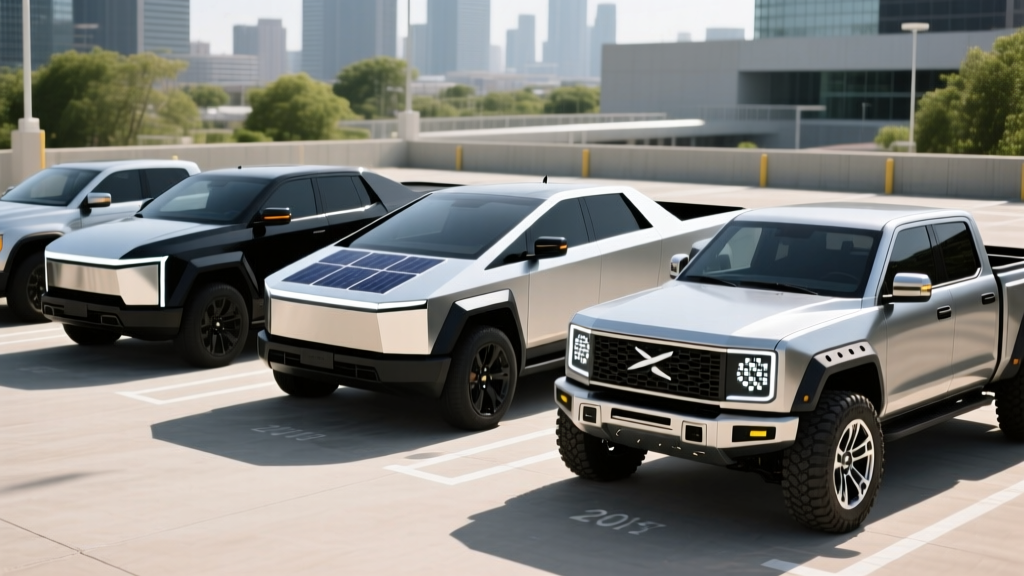
The Tesla Cybertruck's polarizing stainless-steel wedge spawned a wave of imitators. From Chinese-market micro-trucks to American startup concepts, the "fake Cybertruck" trend has produced several EVs that borrow the angular aesthetic at a fraction of the price — or, in some cases, at a premium of their own. But which of these geometric pickups actually deliver as daily drivers, and which are all style and no substance?
For this 2026 roundup, we're evaluating three of the most prominent Cybertruck-inspired electric pickups you can actually buy or pre-order in the United States: the Alpha Wolf, the Atlas Electric Pickup (by Bollinger-adjacent startup Atlas EV), and the Chinese-market JMEV GSE (exported as the "Cyber Pickup"). We'll also address why Tesla's own Cybertruck keeps getting called out in "fake" comparisons. Each vehicle is assessed on range, charging, real-world usability, pricing, and federal tax credit eligibility.
The Real Cybertruck as Baseline: 2026 Specs
Before we evaluate the imitators, here's what they're trying to match. The 2026 Tesla Cybertruck comes in three trims: Rear-Wheel Drive ($60,990), All-Wheel Drive ($79,990), and Cyberbeast ($99,990). These are post-price-cut figures that Tesla adjusted in late 2025.
| Spec | RWD | AWD | Cyberbeast |
|---|---|---|---|
| EPA Range | 250 mi | 340 mi | 320 mi |
| Battery (usable) | ~85 kWh (NMC) | ~123 kWh (NMC) | ~123 kWh (NMC) |
| 0-60 mph | 6.5 sec | 4.1 sec | 2.6 sec |
| Horsepower | 275 hp | 600 hp | 845 hp |
| Peak DC Charge | 250 kW | 250 kW | 250 kW |
| 10-80% DC Time | ~30 min | ~35 min | ~35 min |
| Towing Capacity | 7,500 lb | 11,000 lb | 11,000 lb |
| MSRP | $60,990 | $79,990 | $99,990 |
Alpha Wolf: The Budget Fake Cybertruck
Alpha Motor Corporation's Wolf pickup leans hard into the angular, retro-futuristic aesthetic. The 2026 production-spec Alpha Wolf starts at $36,000 (single-motor RWD) and tops out around $46,000 for the dual-motor Wolf Plus AWD. It's the most affordable vehicle in this comparison and the one most frequently labeled a "fake Cybertruck" in social media threads.
| Spec | Wolf (RWD) | Wolf Plus (AWD) |
|---|---|---|
| EPA Range (est.) | 250 mi | 275 mi |
| Battery | 75 kWh (NMC) | 85 kWh (NMC) |
| 0-60 mph | 7.9 sec | 5.8 sec |
| Horsepower | 225 hp | 400 hp |
| Peak DC Charge | 130 kW | 150 kW |
| 10-80% DC Time | ~38 min | ~35 min |
| Level 2 Home Rate | 11.5 kW (~37 mi/hr) | 11.5 kW (~37 mi/hr) |
| Towing Capacity | 3,500 lb | 5,000 lb |
| Cargo Bed Length | 5 ft (60 cu ft volume) | 5 ft (60 cu ft volume) |
| MSRP | $36,000 | $46,000 |
Charging reality: The Wolf's 130 kW peak charge rate is modest by 2026 standards. At an Electrify America or EVgo station, you'll see peak speeds only briefly between 15–40% State of Charge, after which the curve tapers significantly. A full 10–80% session takes roughly 38 minutes — acceptable for road trips with planned stops but noticeably slower than the competition.
Tax credit eligibility: At $36,000, the Alpha Wolf clears the IRS §30D MSRP cap for trucks ($80,000). However, battery sourcing and critical-mineral requirements remain uncertain for Alpha's supply chain. Buyers should verify current eligibility on irs.gov before assuming the full $7,500 credit applies. Income caps also apply: $150,000 single / $300,000 joint filers.
Atlas EV Pickup: The Premium Pretender
Atlas EV (no relation to the defunct Bollinger Motors) entered the market in late 2025 with a Cybertruck-inspired midsize pickup positioned as a lifestyle-adventure vehicle. The 2026 Atlas starts at $54,900 for the Standard Range AWD and climbs to $68,500 for the Extended Range Overland trim.
| Spec | Standard Range AWD | Extended Range Overland |
|---|---|---|
| EPA Range | 280 mi | 350 mi |
| Battery | 90 kWh (NMC) | 115 kWh (NMC) |
| 0-60 mph | 5.2 sec | 4.8 sec |
| Horsepower | 450 hp | 520 hp |
| Peak DC Charge | 175 kW | 200 kW |
| 10-80% DC Time | ~32 min | ~34 min |
| Level 2 Home Rate | 11.5 kW (~38 mi/hr) | 11.5 kW (~38 mi/hr) |
| Towing Capacity | 7,500 lb | 8,000 lb |
| Cargo Bed | 5.5 ft (66 cu ft) | 5.5 ft (66 cu ft) |
| Ground Clearance | 10.2 in | 11.8 in (w/ air suspension) |
| MSRP | $54,900 | $68,500 |
Where the Atlas shines: The Overland trim's air suspension and 11.8 inches of ground clearance make it genuinely capable on forest service roads — something the Cybertruck's adaptive suspension attempts but at a higher price. The 520 hp dual-motor powertrain moves the Atlas's ~5,800 lb curb weight with authority.
Charging caveat: While 200 kW peak sounds competitive, the Atlas's larger 115 kWh battery means that peak rate translates to roughly 1.74C — adequate but not exceptional. Expect the charge curve to taper sharply above 70% SoC. In practice, a 10–80% session averages 34 minutes, comparable to the Ford F-150 Lightning's extended-range pack.
JMEV GSE "Cyber Pickup": The Import Wildcard
JMEV (Jiangling Motors Electric Vehicle) began exporting the GSE to select U.S. markets in mid-2025 through independent dealerships. Priced from $28,500, it's the cheapest vehicle that visually resembles a Cybertruck — though it's considerably smaller, closer to a Honda Ridgeline in footprint and far lighter.
| Spec | Standard | Long Range |
|---|---|---|
| EPA Range | 185 mi | 230 mi |
| Battery | 55 kWh (LFP) | 72 kWh (LFP) |
| 0-60 mph | 9.2 sec | 8.1 sec |
| Horsepower | 170 hp | 201 hp |
| Peak DC Charge | 80 kW | 95 kW |
| 10-80% DC Time | ~42 min | ~45 min |
| Level 2 Home Rate | 7.2 kW (~24 mi/hr) | 7.2 kW (~24 mi/hr) |
| Towing Capacity | 1,500 lb | 2,000 lb |
| Cargo Bed | 4.5 ft (45 cu ft) | 4.5 ft (45 cu ft) |
| MSRP | $28,500 | $34,200 |
LFP battery advantage: The JMEV's lithium iron phosphate (LFP) cells offer a longer cycle life (3,000+ cycles vs ~1,500 for NMC) and better thermal stability. You can charge to 100% daily without the degradation concerns that NMC batteries carry. The trade-off is lower energy density — hence the smaller range in a physically comparable package.
Charging limitations: The GSE's 80–95 kW peak DC rate is the weakest in this comparison. At a 150 kW Electrify America stall, you'll never see anywhere close to the station's maximum output. Road trips require patience — plan for 45-minute stops every 150–170 real-world miles.
Side-by-Side: Fake Cybertruck Contenders Compared
| Attribute | Alpha Wolf Plus | Atlas EV Overland | JMEV GSE LR | Tesla Cybertruck AWD |
|---|---|---|---|---|
| Price (after est. credit) | ~$38,500 | ~$61,000 | $34,200 (no credit) | ~$72,490 |
| Real-World Highway Range | ~230 mi | ~280 mi | ~180 mi | ~270 mi |
| DC Charge 10-80% | 35 min | 34 min | 45 min | 35 min |
| 0-60 mph | 5.8 sec | 4.8 sec | 8.1 sec | 4.1 sec |
| Towing | 5,000 lb | 8,000 lb | 2,000 lb | 11,000 lb |
| Warranty (batt/PT) | 8yr/100k mi | 8yr/100k mi | 6yr/60k mi | 8yr/120k mi |
| NACS Connector | No (CCS1 + adapter) | Yes (native NACS) | No (CCS1) | Yes (native NACS) |
Charging Infrastructure: What Owners Actually Face
Connector compatibility has become a decisive factor in 2026. Tesla's NACS connector is now the de facto North American standard, with Ford, GM, Rivian, Hyundai, and others adopting it. Here's what each fake Cybertruck contender offers:
| Vehicle | Native Connector | Tesla Supercharger Access | CCS Networks (EA, EVgo) |
|---|---|---|---|
| Alpha Wolf | CCS1 | Via adapter (included) | Native |
| Atlas EV | NACS | Native | Via adapter (sold separately, ~$250) |
| JMEV GSE | CCS1 | Via adapter (sold separately) | Native |
| Tesla Cybertruck | NACS | Native | Via Tesla CCS adapter ($175) |
Home charging setup: All four vehicles support Level 2 home charging, but the JMEV's 7.2 kW onboard charger means even a 48-amp home station won't charge it faster than ~24 miles of range per hour. The Alpha, Atlas, and Cybertruck all accept 11.5 kW, making a 48-amp Level 2 wall connector (like the ChargePoint Home Flex or Tesla Wall Connector) the sweet spot — adding roughly 37–44 miles of range per hour of charging.
Who Should Buy Which Fake Cybertruck?
Choose the Alpha Wolf If:
- You want the angular aesthetic under $40,000
- Daily commutes under 50 miles are your norm
- You rarely tow more than 3,500 lb
- You're willing to accept a startup's limited service network
Choose the Atlas EV Overland If:
- You need genuine off-road capability with EV efficiency
- Towing a boat or camper (up to 8,000 lb) is regular
- You want native Supercharger access without adapters
- $60,000+ after credit is within budget
Choose the JMEV GSE If:
- Price is your absolute top priority
- You drive less than 30 miles daily and charge at home
- You value LFP battery longevity over performance
- You accept no federal tax credit and limited dealer support
Stick With the Real Cybertruck If:
- You need 11,000 lb towing and 340-mile range
- Supercharger network reliability is non-negotiable
- Resale value and service infrastructure matter
- You can absorb a $72,000+ effective price
Pros and Cons at a Glance
Pros Across Fake Cybertruck Contenders
- Alpha Wolf: Lowest price point, decent bed utility, LFP option rumored for 2027
- Atlas Overland: Air suspension, strong tow rating, native NACS, qualifies for §30D
- JMEV GSE: Ultra-affordable, LFP longevity, compact for urban parking
- All three undercut the Cybertruck significantly on price
Cons Across Fake Cybertruck Contenders
- Alpha Wolf: Startup risk, unproven long-term reliability, slow DC charging
- Atlas Overland: New brand with thin service network, heavy = lower efficiency
- JMEV GSE: No tax credit, weak performance, limited range, sparse parts network
- None match Tesla's Supercharger seamlessness or OTA update cadence
- Resale value is an unknown for all three startups
Frequently Asked Questions
What is the real-world range of these fake Cybertruck EVs?
Real-world highway range at 70–75 mph falls 15–25% below EPA estimates for all of these pickups due to aerodynamic drag and weight. The Atlas Overland delivers roughly 280 real-world highway miles; the Alpha Wolf Plus around 230; the JMEV GSE Long Range about 180. In sub-freezing temperatures, expect an additional 20–30% loss unless the vehicle has a heat pump (standard on the Atlas and Cybertruck, not confirmed on the Alpha or JMEV).
How fast do they charge on DC fast chargers and at home?
DC fast charging (10–80%): Atlas ~34 min, Alpha Wolf Plus ~35 min, JMEV GSE ~45 min, Tesla Cybertruck ~35 min. Home Level 2 charging on a 48-amp circuit: the Atlas, Alpha, and Cybertruck add roughly 37–44 miles per hour; the JMEV adds only ~24 miles per hour due to its smaller 7.2 kW onboard charger.
Do these fake Cybertruck EVs qualify for the $7,500 federal tax credit?
The Atlas EV Pickup qualifies for the full $7,500 under §30D (truck MSRP cap $80k, North American battery sourcing). The Alpha Wolf likely qualifies on price but battery sourcing documentation is pending — check IRS.gov before purchasing. The JMEV GSE does not qualify due to Chinese-sourced battery cells and critical minerals. All buyers must also meet income caps: $150k single, $225k head of household, $300k joint.
Is the Alpha Wolf or Atlas worth buying over the real Cybertruck?
If you need maximum towing (11,000 lb), longest range (340 EPA mi), and the most robust charging network, the Cybertruck AWD still wins — but at $72,000+ after the credit. The Atlas Overland at ~$61,000 after credit is a compelling alternative for off-road-focused buyers who don't need Cyberbeast performance. The Alpha Wolf makes sense only for budget-conscious urban commuters who rarely road-trip.
What's the battery warranty on each?
Alpha and Atlas both offer 8-year/100,000-mile battery and powertrain warranties, matching the industry standard. JMEV provides only 6-year/60,000-mile coverage — a significant gap. Tesla covers the Cybertruck battery for 8 years/120,000 miles with a minimum 70% capacity retention threshold.
Will these startups still be around to honor their warranties?
This is the elephant in the room. Alpha Motor and Atlas EV are early-stage companies with limited production volumes. Unlike Tesla, Ford, or GM, they lack extensive dealer networks and proven long-term financial stability. Buyers should weigh the savings against the risk of orphaned vehicles if a startup folds — a fate that befell Bollinger Motors, Lordstown Motors, and Fisker Inc. within the past few years.