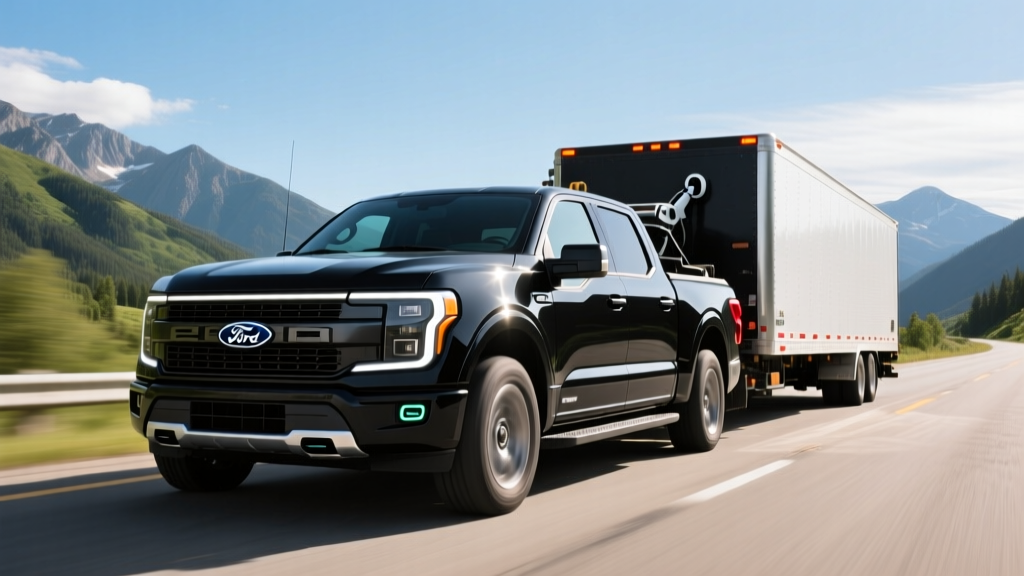
The Ford F-150 Lightning proved that a full-size electric pickup can haul, tow, and serve as a daily driver. But for truck buyers, the critical question remains: what happens to range when you hook up a trailer? Ford rates the Lightning to tow up to 10,000 pounds (with the Max Trailer Tow Package and Extended Range battery), but towing is the single biggest range-killer for any electric vehicle. In this review, we break down the F-150 Lightning's real-world towing performance, efficiency loss under load, charging logistics on the road, and whether it makes sense as a tow rig in 2026.
F-150 Lightning Towing at a Glance: Core Specs
| Spec | Value |
|---|---|
| EPA Range (Extended Range) | 320 miles |
| EPA Range (Standard Range) | 240 miles |
| Battery Capacity (Extended Range) | 131 kWh usable (NMC) |
| Battery Capacity (Standard Range) | 98 kWh usable (NMC) |
| Max Towing Capacity | 10,000 lbs (Extended Range w/ Max Tow Pkg) |
| Max Towing (Standard Range) | 7,700 lbs |
| Max Payload | 2,235 lbs |
| Horsepower | 580 hp (Extended Range) / 563 hp (Standard Range) |
| Torque | 775 lb-ft |
| 0–60 mph | ~3.8 seconds (Extended Range) |
| Drivetrain | Dual-motor AWD |
| MPGe (Combined) | 70 MPGe (Extended Range) |
| Efficiency | 48 kWh/100 mi |
| Max DC Fast Charge | 150 kW (peak) |
| 10–80% DC Charge Time | ~41 minutes (Extended Range) |
| Level 2 Home Charge Rate | 19.2 kW (80A) / ~30 mi/hr |
| Battery Warranty | 8 years / 100,000 miles |
| Base MSRP (Pro Standard Range) | ~$54,995 |
| As-Tested (Lariat Extended Range) | ~$78,000–$85,000 |
The Towing Range Reality: What Actually Happens
The Extended Range F-150 Lightning carries an EPA estimate of 320 miles. In real-world driving without a trailer, expect roughly 270–290 miles at highway speeds (70–75 mph), and potentially 240–260 miles in cold weather (below 32°F) due to battery resistance and cabin heating demands. The Standard Range model's 240-mile EPA figure translates to roughly 200–215 miles in real-world highway use.
Now, add a trailer. Towing is where the Lightning's energy consumption spikes dramatically. Based on owner reports, independent testing, and Ford's own onboard range calculator behavior:
- Light trailer (3,000–4,000 lbs, e.g., small boat or utility trailer): Expect range to drop to roughly 180–220 miles (Extended Range). Efficiency falls to approximately 70–85 kWh/100 mi.
- Medium trailer (5,000–7,000 lbs, e.g., travel trailer or car hauler): Range drops to approximately 130–170 miles. Efficiency hovers around 90–110 kWh/100 mi.
- Heavy trailer (8,000–10,000 lbs, e.g., large camper or equipment trailer): Range falls to 100–140 miles. Efficiency can exceed 120 kWh/100 mi depending on trailer aerodynamics and terrain.
The physics are straightforward: a boxy travel trailer at highway speed creates enormous aerodynamic drag, and the Lightning must push both its own 6,500+ lb curb weight and the trailer's mass. Regenerative braking helps recapture some energy on downhill grades and in stop-and-go traffic, but on flat or uphill interstate stretches, consumption is relentless.
Key insight: The Lightning's onboard towing calculator (part of Ford's intelligent range estimation) learns from your driving and trailer profile to give increasingly accurate range predictions. When you first hook up, the estimate may seem optimistic or pessimistic — give it 20–30 miles of driving to calibrate. This system is one of the Lightning's strongest towing assets, far more useful than a static percentage-based guess.
Charging While Towing: The Logistics Challenge
Towing range is only half the equation. The other half is how quickly you can replenish that energy on the road — and whether the charging infrastructure can accommodate a truck with a trailer attached.
| Charging Level | Power | Miles Added per Hour | Notes |
|---|---|---|---|
| Level 1 (120V household) | ~1.4 kW | ~3 mi/hr | Emergency/trickle only |
| Level 2 (240V, 32A mobile) | 7.7 kW | ~13 mi/hr | Included mobile charger |
| Level 2 (240V, 80A Wall Connector) | 19.2 kW | ~30 mi/hr | Requires hardwired 100A circuit |
| DC Fast Charge (peak) | 150 kW | — | 10–80% in ~41 min (Extended Range) |
| DC Fast Charge (sustained avg) | ~100–110 kW | — | Charge curve tapers significantly above 80% |
The Lightning's 150 kW peak DC fast-charge rate is adequate but not class-leading. Competitors like the Rivian R1T (up to 200+ kW on newer packs) and the Chevrolet Silverado EV (up to 350 kW on certain trims) charge significantly faster. At a 150 kW station, the Extended Range battery adds roughly 100 miles of (unloaded) range in about 20 minutes. But when towing, those 100 miles of rated range might only translate to 40–60 miles of actual towing range.
The trailer parking problem: Most DC fast-charging stations are designed for passenger cars pulling in and out of standard parking spaces. Arriving with a 20–30 foot trailer in tow means you'll often need to unhook the trailer, find a pull-through spot (still rare at most charging plazas), or occupy multiple spaces. Networks like Electrify America and Tesla Superchargers are slowly adding pull-through stalls, but as of 2026, they remain the exception, not the norm. Plan your charging stops carefully using apps like A Better Routeplanner (ABRP) and PlugShare, filtering for pull-through or oversized-vehicle-friendly stations.
Charge curve reality: The Lightning's NMC battery peaks near 150 kW only at low states of charge (roughly 10–30% SoC). By 60% SoC, charge speed drops to approximately 80–90 kW, and above 80% it slows dramatically to protect battery longevity. On a road trip towing, plan to charge from 15% to 70–75% and then get back on the road rather than waiting for the painful 80–100% taper.
Performance, Payload, and the Tow Package
The F-150 Lightning's dual-motor all-wheel-drive powertrain produces 580 horsepower and 775 lb-ft of torque (Extended Range). That torque is available instantly from zero RPM, which makes the Lightning feel remarkably confident when merging onto highways with a heavy trailer or climbing grades. The 0–60 mph time of roughly 3.8 seconds (unloaded) is sports-car territory, though obviously that figure climbs substantially with a trailer hooked up.
Ford's Max Trailer Tow Package (available on Lariat and above with Extended Range) includes:
- Upgraded rear axle ratio and cooling
- Integrated trailer brake controller
- Trailer reverse guidance (using the onboard camera system)
- Pro Trailer Hitch Assist (automates backing up to the trailer coupler)
- Extended tow mirrors
- 10,000-lb max rating (up from 7,700 lbs on Standard Range without the package)
The Lightning also offers Pro Power Onboard, which turns the truck's massive battery into a mobile generator. The available 9.6 kW system (on Lariat and Platinum trims) can power tools at a job site, run appliances during an outage, or even supply electricity to a camper trailer — eliminating the need for a separate gas generator. This feature is uniquely valuable and something no gas-powered F-150 can match at this scale.
Interior, Cargo, and Daily Livability
Inside, the Lightning shares the 14th-generation F-150's SuperCrew cab, offering generous space for five passengers:
- Front legroom: 43.9 inches
- Rear legroom: 43.6 inches
- Rear headroom: 40.4 inches
The cabin is quiet — dramatically quieter than a gas F-150, especially at highway speed and when towing, where you'd normally hear the engine working hard. Ford's SYNC 4A infotainment system runs on a 12-inch touchscreen (15.5-inch portrait screen on Lariat and above) with wireless Apple CarPlay and Android Auto.
Cargo space includes the 5.5-foot bed (with a spray-in liner on most trims) and the massive "Mega Power Frunk" — a 14.1 cubic foot front trunk where the engine bay would normally be. The frunk is lockable, weatherproof, and features a drain plug, making it ideal for gear, groceries, or even as a cooler with ice.
For ADAS, Ford's BlueCruise hands-free driving system is available on mapped divided highways (SAE Level 2 — driver monitoring is required at all times). It works well on long interstate stretches, reducing fatigue on road trips. However, BlueCruise is not designed for use while towing — the system disables when a trailer is detected. You are driving manually when a trailer is attached.
Ford BlueCruise is an SAE Level 2 system. The driver must remain attentive and keep hands available at all times. BlueCruise is disabled when towing a trailer. This is not autonomous driving — it is a supervised lane-centering and adaptive cruise system.
2026 Pricing, Trims, and Federal Tax Credit
Here's how the F-150 Lightning lineup breaks down for the current model year:
| Trim | Battery | Base MSRP | Est. After §30D Credit* |
|---|---|---|---|
| Pro | Standard Range (98 kWh) | ~$54,995 | ~$47,495 |
| XLT | Standard Range | ~$62,995 | ~$55,495 |
| Lariat | Extended Range (131 kWh) | ~$74,995 | ~$67,495 |
| Platinum | Extended Range | ~$86,995 | ~$79,495 |
*Federal tax credit estimates shown for illustration. Eligibility depends on current IRS §30D rules.
The IRS §30D federal tax credit offers up to $7,500 for qualifying new EVs, but eligibility is not automatic. Key requirements include:
- MSRP cap: Trucks and vans must have an MSRP at or below $80,000. This means the Platinum trim (MSRP ~$86,995) does not qualify. The Lariat Extended Range may qualify depending on options and final MSRP.
- Buyer income cap: Modified adjusted gross income must not exceed $150,000 (single), $225,000 (head of household), or $300,000 (joint filing).
- Battery sourcing: Critical minerals and battery components must meet escalating domestic-sourcing thresholds that tighten each year. Verify current-year compliance with your dealer.
- Point-of-sale transfer: As of 2024+, you can transfer the credit to the dealer at purchase, reducing your out-of-pocket cost immediately rather than waiting to claim it on your tax return.
Because sourcing rules and eligible VIN lists change frequently, always confirm credit eligibility with your dealer and consult a tax professional before relying on the credit in your budget. Check the latest details on irs.gov.
How It Compares: Lightning vs. Rivian R1T vs. Silverado EV
The Lightning doesn't exist in a vacuum. Here's how it stacks up against the key electric truck competitors for towing buyers:
| Spec | F-150 Lightning (Ext. Range) | Rivian R1T (Dual-Motor Max) | Silverado EV (4WT) |
|---|---|---|---|
| Max Towing | 10,000 lbs | 11,000 lbs | 10,000 lbs |
| EPA Range | 320 mi | ~352 mi (Max Pack) | ~440 mi |
| Battery (usable) | 131 kWh | ~141 kWh | ~200 kWh |
| Peak DC Charge | 150 kW | 200+ kW | 350 kW |
| Starting MSRP | ~$54,995 | ~$69,900 | ~$74,800 |
| §30D Eligible | Yes (under $80K trims) | Yes (under $80K configs) | Limited (MSRP cap) |
Bottom line: The Lightning wins on value and practicality. It's the most affordable entry point, offers Pro Power Onboard (a killer feature for work and camping), and has the broadest dealer/service network. The Rivian R1T charges faster and offers slightly more range with its Max Pack, but costs significantly more. The Silverado EV boasts impressive range and charge speed on paper, but availability is limited and pricing pushes past the tax-credit cap on most trims.
Pros and Cons: The Honest Assessment
- Best-in-class value for an electric full-size truck
- Pro Power Onboard (9.6 kW) is unmatched utility
- Massive frunk (14.1 cu ft) adds real cargo versatility
- Instant torque makes towing acceleration effortless
- Intelligent trailer range calculator learns your usage
- F-150 familiarity — easy service at any Ford dealer
- Qualifies for $7,500 federal credit on most trims
- Quiet, refined cabin even under heavy load
- Towing range drops to 100–150 mi with heavy trailers
- 150 kW peak charge rate is slow vs. newer competitors
- Few DC fast-charging stations accommodate trailers
- BlueCruise disables when towing (manual driving only)
- Cold weather compounds towing range loss significantly
- Extended Range battery adds weight, reducing payload
- Platinum trim exceeds $80K MSRP cap for tax credit
- 5.5-ft bed is shorter than some gas F-150 configurations
Who Should Buy the F-150 Lightning for Towing?
- You tow light-to-moderate loads (under 6,000 lbs) for short-to-medium distances (under 150 miles one way)
- You need a daily-driver truck that can occasionally tow, not a dedicated tow rig
- You value Pro Power Onboard for job sites, tailgating, or camping
- You have reliable home Level 2 charging and can start every trip at 100%
- You want the lowest total cost of ownership in an electric truck
- You regularly tow 7,000+ lbs over 200+ miles — the range and charging logistics become challenging
- You need to tow in extreme cold where range loss compounds
- You frequently travel routes with sparse DC fast-charging infrastructure
- You need the fastest possible charge times — consider the Silverado EV or Rivian R1T
Frequently Asked Questions
What is the real-world range when towing with the F-150 Lightning?
With a heavy trailer (8,000–10,000 lbs), expect roughly 100–140 miles from the Extended Range battery. A lighter 3,000–4,000 lb trailer yields approximately 180–220 miles. These figures vary based on trailer aerodynamics, terrain, speed, and temperature. Always start a tow trip at 100% SoC and plan charging stops conservatively.
How fast does the F-150 Lightning charge at home and on the road?
On a hardwired 80-amp Level 2 home charger (19.2 kW), the Extended Range battery gains about 30 miles of range per hour, reaching a full charge overnight in roughly 10–11 hours. On a DC fast charger, it peaks at 150 kW and charges from 10–80% in approximately 41 minutes. Sustained average speed is closer to 100–110 kW due to the charge curve taper.
Does the F-150 Lightning qualify for the federal EV tax credit?
Most trims qualify for up to $7,500 under IRS §30D, provided the truck's MSRP is at or below $80,000, the buyer meets income caps, and battery sourcing requirements are satisfied. The Platinum trim typically exceeds the MSRP cap. Always verify eligibility on irs.gov and with your dealer before purchase, as rules update annually.
Is the F-150 Lightning worth buying over the Rivian R1T or Silverado EV?
For most buyers, yes — the Lightning offers the best value, the broadest dealer network, and unique features like Pro Power Onboard. The R1T is more capable off-road and charges faster, but costs $15,000+ more. The Silverado EV has more range and faster charging but limited availability and higher pricing. If you prioritize value, daily usability, and occasional towing, the Lightning is the strongest pick.
Can I use BlueCruise while towing a trailer?
No. Ford's BlueCruise hands-free driving system automatically disables when a trailer is connected to the vehicle. You must drive manually when towing. BlueCruise is an SAE Level 2 driver-assistance system for use on mapped divided highways without a trailer.
How does cold weather affect Lightning towing range?
Cold weather (below 32°F) reduces battery efficiency by roughly 20–30% on its own. Combined with towing, you could see total range drop to 80–110 miles with a heavy trailer in freezing conditions. Preconditioning the battery while plugged in and using seat heaters instead of cabin heat can help mitigate losses.
Sources: EPA fuel economy data via fueleconomy.gov, Ford Motor Company official specifications, IRS §30D tax credit guidelines via irs.gov.