The Ford F-150 Lightning remains one of the most capable electric pickups on the market, but buyers eyeing it for work duty have one overriding question: what happens to the range when you hook up a trailer? After extensive analysis of Ford's 2026 specifications, EPA data, and real-world owner reports, we break down exactly what the Lightning delivers — on the job site, at the charger, and on your wallet.
F-150 Lightning Towing Capacity and Powertrain Specs at a Glance
Every 2026 F-150 Lightning comes standard with dual motors and all-wheel drive. Ford offers two battery packs, and the larger pack is the one you want if towing is a priority. Here are the core numbers:
| Specification | Standard Range (SRW) | Extended Range (SRW) |
|---|---|---|
| Battery Usable Capacity | 98 kWh (NMC) | 131 kWh (NMC) |
| Horsepower | 452 hp | 580 hp |
| Torque | 775 lb-ft | 775 lb-ft |
| 0-60 mph | ~3.8 sec | |
| Max Towing Capacity | 7,700 lbs | 10,000 lbs* |
| Max Payload | 2,235 lbs | 1,800 lbs |
| EPA Range | 240 miles | 320 miles |
| MPGe (Combined) | 76 MPGe | 70 MPGe |
| Drivetrain | Dual-Motor AWD | Dual-Motor AWD |
*10,000-lb max towing requires the Extended Range battery and the Max Trailer Tow Package. Standard Range trucks with the tow package max out at 7,700 lbs. Always verify your specific configuration on Ford's official F-150 Lightning spec page.
Real-World Range: What the EPA Sticker Doesn't Tell You
The F-150 Lightning's boxy aerodynamics and heavy curb weight (~6,500 lbs unloaded) work against efficiency. According to fueleconomy.gov, the Extended Range Lightning returns 70 MPGe combined, which translates to roughly 48 kWh per 100 miles — that's energy-hungry by EV standards.
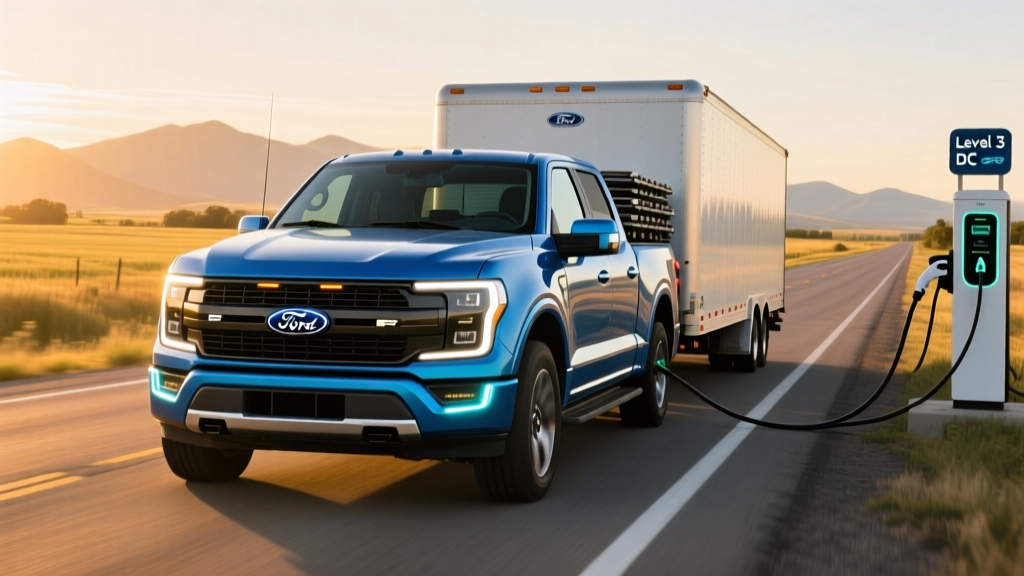
The towing reality check: When pulling a 5,000–7,000 lb trailer, real-world range drops dramatically. Multiple owner tests and automotive media evaluations show a 40–55% range reduction depending on trailer profile, weight, and terrain. That 320-mile Extended Range truck? Expect 140–180 miles of range with a heavy, boxy travel trailer. A lighter, more aerodynamic utility trailer might net you 180–200 miles. This is physics, not a flaw unique to Ford — every electric truck faces the same penalty — but it fundamentally changes how you plan road trips with a trailer in tow.
Ford's onboard range calculator and the available Smart Hitch system help by estimating trailer-adjusted range, and the built-in scale feature (available on Lariat and Platinum trims) weighs your payload to refine estimates. These tools are genuinely useful, but they can't overcome the energy demands of hauling 8,000+ lbs at highway speed.
Charging Speed: DC Fast, Home Level 2, and Infrastructure
Charging a battery this large requires patience — or the right equipment. Here's what the 2026 Lightning supports across charging levels:
| Charging Level | Standard Range (98 kWh) | Extended Range (131 kWh) |
|---|---|---|
| Level 1 (120V, 12A) | ~2 mi/hr (1.4 kW) | ~2 mi/hr (1.4 kW) |
| Level 2 (240V, 48A Mobile Charger) | ~14 mi/hr (11.5 kW) | ~14 mi/hr (11.5 kW) |
| Level 2 (240V, 80A Ford Charge Station Pro) | ~25 mi/hr (19.2 kW) | ~25 mi/hr (19.2 kW) |
| DC Fast Charge (Peak) | 150 kW peak | 150 kW peak |
| DC Fast 10-80% Time | ~41 minutes | ~41 minutes |
Charging curve reality: The Lightning's peak 150 kW rate is sustained roughly from 15% to 50% State of Charge (SoC). Above 60%, the rate tapers significantly — dropping to 80–100 kW, then further to under 50 kW past 80%. That 10-80% time of ~41 minutes assumes ideal battery temperature and a capable 150+ kW station. On a 50 kW charger, plan for over 90 minutes for the same 10-80% session on the Extended Range pack.
Home charging is where this truck shines. The available Ford Charge Station Pro delivers 19.2 kW on a 240V/80A circuit, which can fully replenish the Extended Range pack overnight (~8 hours for a full charge). This requires a 100-amp dedicated circuit and professional installation — budget $1,200–$2,500 for the electrician work on top of the ~$1,300 station cost, and ensure your home's electrical panel has sufficient capacity (many homes need a 200A service upgrade, adding $1,500–$3,000).
The Lightning also supports Pro Power Onboard, which turns the truck into a mobile generator. The base system offers 2.4 kW of output through bed and cabin outlets; the upgraded 9.6 kW version (standard on Lariat and above) can power job-site tools, a campsite, or even back up essential home circuits during an outage via Ford's Intelligent Backup Power system (requires the Charge Station Pro and a compatible transfer switch installed by a licensed electrician).
2026 Pricing, Trims, and Federal Tax Credit Eligibility
Ford restructured Lightning pricing for 2026 to remain competitive against the Rivian R1T, Chevrolet Silverado EV, and the Tesla Cybertruck. Here's the current trim breakdown:
| Trim | Battery | Base MSRP | Est. After §30D Credit |
|---|---|---|---|
| Pro (Standard Range) | 98 kWh | $52,990 | $45,490* |
| XLT (Standard Range) | 98 kWh | $59,990 | $52,490* |
| XLT (Extended Range) | 131 kWh | $69,990 | $62,490* |
| Lariat (Extended Range) | 131 kWh | $77,990 | $70,490* |
| Platinum (Extended Range) | 131 kWh | $92,990 | $85,490* |
*Tax credit estimates assume full eligibility. Actual credit depends on IRS §30D rules for 2026.
- Credit amount: Up to $7,500 ($3,750 for critical minerals + $3,750 for battery components — both must be met for full credit)
- MSRP cap: Trucks/vans/SUVs must be under $80,000 MSRP (the Platinum trim exceeds this and does NOT qualify)
- Buyer income cap: AGI must not exceed $150,000 (single), $225,000 (head of household), or $300,000 (joint filers)
- Battery sourcing: Critical minerals and battery components must meet escalating domestic/free-trade-partner thresholds per the Inflation Reduction Act
- Point-of-sale transfer: You can transfer the credit to the dealer at purchase for an immediate price reduction — no need to wait for tax filing
Verify current eligibility on the official IRS §30D page before purchasing. Battery sourcing requirements tighten annually, and a trim that qualifies in early 2026 may not qualify later if supply chains shift. Consult a tax professional for your specific situation.
Cargo Space, Interior, and Daily-Use Practicality
The Lightning uses the SuperCrew cab configuration exclusively, offering generous interior room:
- Rear legroom: 43.6 inches (best-in-class for full-size crew cabs)
- Front headroom: 40.8 inches
- Bed length: 5.5 ft (Standard Range) or 6.5 ft (Extended Range, depending on configuration)
- Bed volume: ~52.8 cu ft (5.5 ft bed) / ~62.3 cu ft (6.5 ft bed)
- Front trunk (frunk): 14.1 cu ft — lockable, drainable, and large enough for substantial gear storage or a week's groceries
- Max payload: Up to 2,235 lbs (Standard Range Pro); payload drops with Extended Range due to heavier battery
The frunk is a standout feature. With no engine under the hood, Ford created a weather-sealed, lockable compartment with 400 lbs of capacity, four electrical outlets, and a drain plug that lets you use it as a cooler for tailgating. This is genuinely useful space that gas trucks simply can't match.
Inside, the 12-inch (Pro/XLT) or 15.5-inch vertical touchscreen (Lariat/Platinum) runs Ford's SYNC 4A system with wireless Apple CarPlay, Android Auto, and over-the-air updates. The available BlueCruise hands-free driving system works on over 130,000 miles of pre-mapped divided highways — though this is an SAE Level 2 system requiring continuous driver supervision, not autonomous driving.
How the Lightning Stacks Up Against Competitors
The electric truck segment has grown considerably. Here's how the Lightning compares to its key rivals on the specs that matter to truck buyers:
| Spec | F-150 Lightning Ext. Range | Rivian R1T Dual-Motor Max | Chevy Silverado EV 4WT | Tesla Cybertruck AWD |
|---|---|---|---|---|
| Max Towing | 10,000 lbs | 11,000 lbs | 10,000 lbs | 11,000 lbs |
| EPA Range | 320 mi | 410 mi | 380 mi | 340 mi |
| Battery (usable) | 131 kWh | 149 kWh | ~200 kWh | ~123 kWh |
| DC Fast Charge Peak | 150 kW | 200+ kW | 350 kW | 250 kW |
| Starting MSRP (towable trim) | ~$69,990 | ~$89,000 | ~$74,800 | ~$79,990 |
| Bed Length | 5.5 / 6.5 ft | 4.5 ft | 5.5 ft | 6.0 ft |
The Lightning's key advantage is familiarity. It looks, drives, and works like the F-150 that has been America's best-selling truck for decades. Fleet buyers and traditional truck owners find the transition seamless. The Rivian R1T is more adventurous and tech-forward but costs significantly more and has a shorter bed. The Silverado EV offers a massive battery and faster charging but has faced limited availability and a less intuitive interface. The Cybertruck is polarizing in design and has had production and quality challenges.
For buyers whose primary need is towing under 7,000 lbs with regular home charging, the Lightning Extended Range offers the best balance of capability, price, and everyday usability. If you routinely tow near 10,000 lbs or need maximum range while towing, the Rivian R1T Max Pack or Silverado EV's larger battery may serve you better — at a premium.
Pros, Cons, and the Bottom Line
Pros
- Class-leading 10,000-lb towing (with Max Trailer Tow Package + Extended Range)
- Massive 14.1 cu-ft frunk with onboard power outlets
- Pro Power Onboard (up to 9.6 kW) for job sites and home backup
- Familiar F-150 ergonomics — minimal learning curve for truck veterans
- Competitive pricing; multiple trims eligible for $7,500 federal tax credit
- Spacious SuperCrew cabin with 43.6 inches of rear legroom
- BlueCruise hands-free highway driving on mapped roads
Cons
- Towing cuts range by 40–55% — plan carefully on road trips
- 150 kW peak DC fast charging is slow for a 131 kWh battery
- Extended Range battery adds ~800 lbs, reducing payload capacity
- Platinum trim ($92,990) exceeds the $80,000 §30D tax credit MSRP cap
- 5.5-ft bed on Standard Range is short for traditional truck users
- Efficiency of ~48 kWh/100 mi makes this an expensive truck to charge on public DC fast chargers
- Cold-weather range loss of 25–35% is significant in northern climates
Who Should Buy the F-150 Lightning?
The Lightning is ideal for: Truck owners who tow moderately (under 7,000 lbs) on day trips, have reliable home Level 2 charging, and want a work-capable EV that doubles as a comfortable daily driver. It's a strong fit for fleet operators who can charge at a depot overnight and don't need 400+ miles of tow range. The Pro Power Onboard feature alone makes it compelling for contractors and tradespeople.
Look elsewhere if: You frequently tow near max capacity on long highway trips without reliable DC fast charging along your route. The Silverado EV or Rivian R1T with larger batteries offer more tow-range buffer. If budget is tight and you rarely need a truck bed, a smaller EV crossover will cost far less to charge and own.
Frequently Asked Questions
What is the F-150 Lightning's real-world range while towing?
With a 5,000–7,000 lb trailer, expect 140–200 miles from the Extended Range model depending on trailer aerodynamics, terrain, speed, and temperature. A sleek, light boat trailer will net more range than a boxy travel trailer. Always use Ford's Smart Hitch and onboard scale to get the most accurate range estimate for your specific load.
Does the F-150 Lightning qualify for the $7,500 federal EV tax credit?
Most trims do, but eligibility depends on three factors: your income (AGI under $300,000 for joint filers), the truck's MSRP (must be under $80,000 — the Platinum trim is excluded), and battery-sourcing compliance with IRA requirements. The credit can be transferred to the dealer at point of sale for an immediate price reduction. Always verify on the fueleconomy.gov tax credit page and consult a tax professional.
How long does it take to charge the F-150 Lightning at home?
On a 240V/80A Ford Charge Station Pro (19.2 kW), the Extended Range 131 kWh battery charges from 0-100% in roughly 8 hours — ideal for overnight replenishment. On a standard 240V/48A setup (11.5 kW), plan for about 13 hours. A 120V household outlet adds only ~2 miles of range per hour and is not practical as a primary charging method for a battery this large.
Is the F-150 Lightning better for towing than the Rivian R1T?
On paper, the Rivian R1T Max Pack tows 11,000 lbs and offers 410 miles of EPA range — both higher than the Lightning. However, the R1T starts above $89,000, has a shorter 4.5-foot bed, and doesn't qualify for the full federal tax credit due to price. The Lightning offers 10,000-lb towing at a lower entry price with a more traditional truck layout, making it the more practical choice for most work-oriented truck buyers.
What is the battery warranty on the F-150 Lightning?
Ford covers the Lightning's high-voltage battery and electric powertrain for 8 years or 100,000 miles, whichever comes first. The warranty guarantees the battery will retain at least 70% of its original capacity during that period. Ford uses NMC (nickel manganese cobalt) chemistry in both battery packs — this chemistry offers high energy density but is more sensitive to extreme heat and repeated 100% charging than LFP. For maximum longevity, Ford recommends daily charging to 90% and only charging to 100% when you need full range for a trip.
Can the F-150 Lightning power my home during an outage?
Yes, with the available Ford Intelligent Backup Power system. When paired with the 80A Ford Charge Station Pro and a professionally installed home transfer switch, the Lightning's battery can supply up to 9.6 kW of continuous power to your home's essential circuits. Ford estimates this can power an average home for up to three days during an outage. The total setup (charge station, transfer switch, electrician labor) typically costs $3,500–$5,500 installed.