Quick Verdict: The Working-Class Lightning
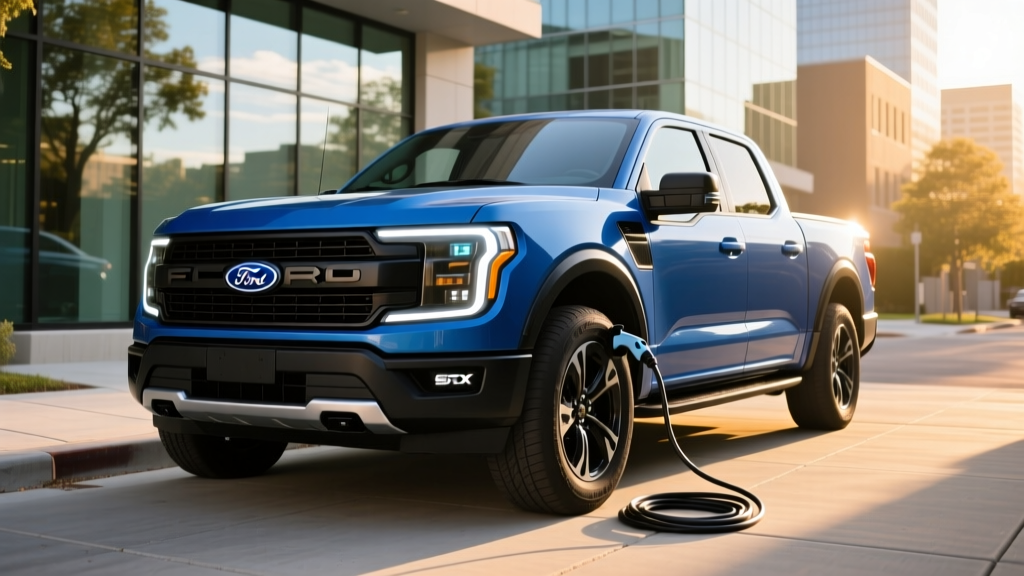
The Ford F-150 Lightning STX occupies a specific niche: it's the most affordable way into a full-size electric pickup that doesn't feel like a penalty box. At a base MSRP of $49,995 (before destination), the STX trim strips away the premium features of the Lariat and Platinum but keeps the dual-motor AWD powertrain, the Standard Range battery, and Ford's Sync 4 infotainment system. For fleet buyers, tradespeople, and budget-conscious truck shoppers, it's the Lightning that makes the most financial sense — provided your daily driving stays under 200 miles and you can charge at home.
The STX replaces the previous Pro trim as the entry point for the Lightning lineup starting with the 2025 model year, adding the STX appearance package (body-color bumpers, 20-inch wheels, blacked-out badges) that gives it a more finished look than the utilitarian Pro. But the core question remains: can a 240-mile EPA range, 563-horsepower electric truck that starts under $50K survive the real world?
Range, Battery & Real-World Efficiency
| Spec | Value |
|---|---|
| EPA Range (Standard Range Battery) | 240 miles |
| Battery Capacity (usable) | 98 kWh |
| Battery Chemistry | NMC (Nickel Manganese Cobalt) |
| EPA Efficiency | 76 MPGe combined (2.24 kWh/mile) |
| Drivetrain | Dual-motor AWD |
| Horsepower | 563 hp |
| Torque | 775 lb-ft |
| 0-60 mph | ~4.0 seconds |
| Max Towing (w/ Max Tow Pkg) | 7,700 lbs |
The 98 kWh NMC battery pack sits low in the frame, giving the Lightning a relatively low center of gravity for a full-size truck. NMC chemistry offers higher energy density than LFP (lithium iron phosphate), which keeps weight manageable — though the STX still tips the scales at around 6,000 pounds. The trade-off with NMC is that Ford recommends charging to 80% for daily use to preserve long-term battery health, reserving 100% charges for road trips. This effectively reduces your daily usable range to roughly 192 EPA miles.
According to fueleconomy.gov, the Lightning Standard Range AWD achieves 76 MPGe combined, which translates to roughly 44 kWh per 100 miles. That's on the thirsty side for an EV — blame the boxy aerodynamics and 6,000-pound curb weight — but it's competitive with the Rivian R1T Dual-Motor and significantly cheaper per mile than any gas F-150.
Charging Speed: DC Fast & Home Level 2
| Charging Level | Power | Speed / Time |
|---|---|---|
| Level 1 (120V household) | ~1.4 kW | ~2 miles per hour |
| Level 2 (240V, 32A mobile charger) | 7.7 kW | ~14 miles per hour |
| Level 2 (240V, 48A Ford Charge Station Pro) | 11.5 kW | ~21 miles per hour |
| Level 2 (240V, 80A Ford Charge Station Pro) | 19.2 kW | ~34 miles per hour |
| DC Fast Charge (peak) | 150 kW | 15%–80% in ~44 minutes |
The F-150 Lightning STX with the Standard Range battery peaks at 150 kW on a DC fast charger. That's a meaningful limitation compared to the Extended Range model, which can accept up to 210 kW. In practice, the 150 kW peak only holds briefly — the charging curve tapers significantly after 60% state of charge, which is why a 15%–80% session takes roughly 44 minutes at a capable station.
On a road trip, plan for 30–35 minute charging stops every 150–170 highway miles. The Lightning uses the CCS1 connector natively, but Ford has secured access to Tesla's Supercharger network via a Ford-provided NACS adapter (included with 2025 models). This dramatically expands your fast-charging options — Tesla's Supercharger network remains the most reliable DC fast-charging infrastructure in the U.S., with over 25,000 stalls nationwide.
For home charging, the included Ford Mobile Charger delivers 7.7 kW on a 240V/32A NEMA 14-50 outlet, adding about 14 miles of range per hour — enough to fully replenish the Standard Range battery overnight in roughly 13 hours. For faster home charging, Ford's Charge Station Pro (80A hardwired) delivers 19.2 kW and can fully charge the 98 kWh battery in about 6 hours. Installation of a hardwired Level 2 station typically runs $500–$2,000 depending on your electrical panel capacity and the distance from panel to charger location. Homes with 100-amp panels may need a $1,500–$3,000 panel upgrade to support 80A charging — consult a licensed electrician before committing to equipment.
Pricing, Tax Credits & Ownership Cost
| Item | Amount |
|---|---|
| 2025 F-150 Lightning STX Base MSRP | $49,995 |
| Destination Charge | $2,095 |
| Total Before Incentives | $52,090 |
| Federal §30D Tax Credit (if eligible) | Up to $7,500 |
| Effective Price (with full credit) | ~$44,590 |
The F-150 Lightning STX starts at $49,995, and after the $2,095 destination charge, you're looking at $52,090 before any incentives. The key question is whether you qualify for the federal EV tax credit under IRS §30D rules.
As of 2025, the F-150 Lightning qualifies for the full $7,500 federal tax credit — but only if you meet all of the following requirements:
- MSRP Cap: The vehicle MSRP must be under $80,000 for trucks. The STX easily clears this.
- Income Cap: Modified adjusted gross income must not exceed $300,000 (joint filers), $225,000 (head of household), or $150,000 (single). Check your prior-year or current-year MAGI — whichever is lower.
- Battery Sourcing: The battery must meet critical mineral and battery component requirements that phase in more strictly each year. Ford has confirmed the Lightning meets 2025 sourcing thresholds for the full credit, but this is subject to annual IRS updates.
- Point-of-Sale Transfer: You can now transfer the credit to the dealer at purchase, effectively reducing your out-of-pocket cost by $7,500 at the time of sale rather than waiting to claim it on your tax return.
With the full $7,500 credit applied, the effective price drops to roughly $44,590 — which puts the Lightning STX in direct competition with well-equipped gas F-150 XLT models once you factor in fuel savings. Over five years and 75,000 miles, the Lightning STX will save roughly $6,000–$9,000 in fuel costs compared to a 20 MPG gas F-150 (assuming $0.14/kWh home charging and $3.50/gallon gas), though insurance premiums for the Lightning tend to run 15–25% higher than the gas equivalent.
Cargo, Passenger Space & Practicality
The Lightning STX is a crew cab with a 5.5-foot bed, matching the dimensions of the F-150 SuperCrew gas model. Interior space is generous:
- Front legroom: 43.9 inches
- Rear legroom: 43.6 inches
- Bed volume: 52.8 cu ft
- Mega Power Frunk (front trunk): 14.1 cu ft, 400-lb payload capacity
- Max payload: ~2,235 lbs
- Max towing: 7,700 lbs (with optional Max Trailer Tow Package)
The frunk is a genuine differentiator. With 14.1 cubic feet of lockable, weather-sealed space and four 120V outlets, it functions as a mobile toolbox or gear locker that a gas F-150 simply can't match. The Pro Power Onboard system (standard 2.4 kW, optional 9.6 kW) turns the truck into a mobile generator — the 9.6 kW version can power most home circuits during an outage for several days, or run a full job site's worth of power tools.
One practicality note: towing with any EV significantly reduces range. Expect the Lightning STX's 240-mile range to drop to 100–130 miles when towing a 5,000+ lb trailer at highway speeds. This makes the STX a poor choice for long-distance towing but adequate for local trailer hauling.
Tech, Driver Assistance & Interior
The STX comes equipped with Ford's Sync 4 infotainment system on a 12-inch touchscreen (up from the Pro's smaller unit), wireless Apple CarPlay and Android Auto, and a 12-inch digital instrument cluster. It includes Ford Co-Pilot360 2.0, which bundles:
- Pre-Collision Assist with Automatic Emergency Braking
- Blind Spot Information System (BLIS) with trailer coverage
- Lane-Keeping System
- Rear View Camera with hitch assist
- Adaptive Cruise Control with Stop-and-Go
BlueCruise (Ford's hands-free highway driving assist) is available as part of an option package on the STX. On pre-mapped divided highways, it allows hands-off driving while monitoring driver attention via an infrared camera. It works well in practice but requires a subscription after the initial trial period (currently $75/month or $800/year after the complimentary period).
The STX interior uses cloth seating surfaces and manual-adjust front seats — cost-cutting measures that distinguish it from the Lariat's leather and power adjustments. Build quality is solid, and the cabin is remarkably quiet at highway speeds thanks to the absence of engine noise. The most common complaint from owners is the lack of physical HVAC buttons; climate controls live in the touchscreen, which requires taking your eyes off the road to adjust temperature.
Pros, Cons & Who Should Buy
Pros
- Lowest entry price into a full-size electric pickup
- 563 hp / 775 lb-ft makes it quicker than most V8 F-150s
- Mega Power Frunk adds genuine utility
- Pro Power Onboard turns it into a mobile generator
- Qualifies for full $7,500 federal tax credit (if income-eligible)
- Supercharger network access via included NACS adapter
- Quiet, smooth, low-maintenance daily driving
Cons
- 240-mile EPA range drops to ~190 highway / ~170 cold-weather
- 150 kW DC fast-charge peak is slow vs. competitors (Rivian: 200+ kW)
- Towing crushes range (100-130 miles with a heavy trailer)
- Extended Range battery not available on STX trim
- Cloth seats, manual adjustments feel budget at $50K+
- Insurance premiums 15-25% higher than gas F-150
- No physical climate controls — touchscreen-only HVAC
Who Should Buy the F-150 Lightning STX?
Choose the Lightning STX if: You need a full-size truck for daily commuting and light work, your round-trip commute is under 150 miles, you can charge at home overnight, you want to eliminate gas costs, and you value the frunk and Pro Power Onboard for job-site or outdoor use.
Look elsewhere if: You regularly tow heavy trailers over long distances, your daily driving exceeds 200 miles, you live in an apartment without charging access, or you need the Extended Range battery (requires Lariat trim or above). Consider the Rivian R1T for better DC charging speed and off-road capability, or the Chevrolet Silverado EV 4WT for a lower commercial starting price.
Battery Warranty & Long-Term Ownership
Ford covers the Lightning's battery pack with an 8-year/100,000-mile warranty that guarantees the battery will retain at least 70% of its original capacity. If degradation drops below that threshold within the warranty period, Ford will repair or replace the battery at no cost. The electric powertrain (motors, inverters) carries the same 8-year/100,000-mile coverage.
Based on data from 2022–2024 Lightning owners, average battery degradation after 50,000 miles is approximately 5–8%, which is well within the warranty buffer. NMC batteries in Ford's thermal management system have shown solid longevity, though long-term data beyond 100,000 miles is still limited. Replacement cost for the Standard Range battery, out of warranty, is estimated at $15,000–$22,000 based on current Ford parts pricing — a figure to keep in mind for second owners or those planning to keep the truck beyond the warranty window.
Frequently Asked Questions
What is the real-world range of the F-150 Lightning STX?
The EPA rates it at 240 miles, but real-world highway driving at 70 mph typically yields 190–210 miles. In cold weather (below 30°F), expect 160–180 miles. City driving with regenerative braking can match or slightly exceed the EPA estimate.
How fast does the F-150 Lightning STX charge?
On a DC fast charger, it peaks at 150 kW and charges from 15% to 80% in approximately 44 minutes. At home on a 240V/48A Level 2 charger, it adds about 21 miles per hour (full charge in ~8 hours). On a standard 120V outlet, it adds roughly 2 miles per hour.
Does the F-150 Lightning STX qualify for the $7,500 federal tax credit?
Yes, the 2025 F-150 Lightning STX currently qualifies for the full $7,500 federal EV tax credit under IRS §30D, provided your income falls below the caps ($150K single / $300K joint) and the vehicle meets current battery-sourcing requirements. The credit can be transferred to the dealer at point of sale to reduce your purchase price directly. Always verify current eligibility on the IRS website before purchasing, as sourcing rules tighten annually.
Is the F-150 Lightning STX worth buying vs. the Rivian R1T or Silverado EV?
The Lightning STX wins on value — at ~$44,590 after the tax credit, it undercuts the Rivian R1T (starting ~$70K+) by a wide margin and offers more interior space. The Rivian counters with faster DC charging (200+ kW), better off-road capability, and a more premium interior. The Chevy Silverado EV 4WT targets commercial fleets at a lower price but lacks the Lightning's frunk and refined ride. For most personal-use truck buyers, the Lightning STX offers the best balance of price, performance, and practicality.
Can I tow with the F-150 Lightning STX?
Yes, with a maximum towing capacity of 7,700 lbs (with the Max Trailer Tow Package). However, towing significantly impacts range — expect 100–130 miles of range when towing a 5,000+ lb trailer at highway speeds. The Lightning is well-suited for local trailer hauling but not for long-distance towing without frequent charging stops.
What charger connector does the F-150 Lightning STX use?
The 2025 Lightning has a native CCS1 charge port. Ford includes a NACS adapter that enables access to Tesla Supercharger stations. For home Level 2 charging, it uses the standard J1772 connector (which is integrated into the CCS1 port).