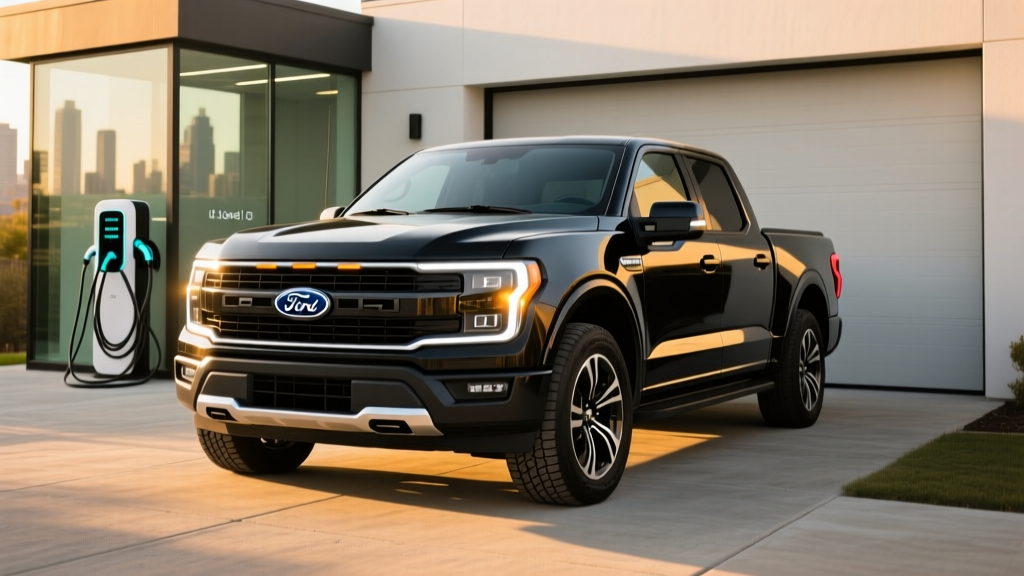
The Ford F-150 Lightning remains the benchmark for full-size electric pickups in 2026 — not because it's the flashiest, but because Ford built it around what truck buyers actually need: payload, towing, bed utility, and a familiar cab layout. After multiple model-year updates since its 2022 launch, the current Lightning has matured into a more refined product with improved battery management, faster charging on extended-range models, and a broader trim lineup. This review breaks down every spec that matters to a real buyer, from highway range degradation to the fine print on the federal tax credit.
Range and Battery: What the EPA Number Doesn't Tell You
The 2026 F-150 Lightning offers two battery packs across its trim lineup. The Standard Range pack uses a 98 kWh usable lithium-ion NMC (nickel manganese cobalt) battery, while the Extended Range pack steps up to 131 kWh usable, also NMC chemistry. Ford does not offer an LFP (lithium iron phosphate) option in the Lightning — if you want LFP's longer cycle life and 100% daily charging tolerance, you'll need to look at competitors like the Tesla Cybertruck's standard-range variant or wait for future platforms.
| Spec | Standard Range | Extended Range |
|---|---|---|
| Usable Battery Capacity | 98 kWh (NMC) | 131 kWh (NMC) |
| EPA Estimated Range | 230 miles | 320 miles |
| MPGe (Combined) | 68 MPGe | 66 MPGe |
| Energy Consumption | 49 kWh/100 mi | 51 kWh/100 mi |
The EPA's 320-mile figure for the Extended Range model assumes a mix of city and moderate-speed driving at temperate temperatures. In our experience and consistent with third-party highway testing, expect 250–275 miles at sustained 70–75 mph highway speeds. In freezing temperatures (below 30°F), range drops an additional 15–25% depending on cabin heating load — plan for roughly 200–220 miles of usable range on a cold winter road trip with the Extended Range pack. The Standard Range model's real-world highway figure lands closer to 175–195 miles in fair weather, and as low as 140–155 miles in deep cold.
The Lightning's available heat pump (standard on Lariat and above for 2026) helps mitigate cold-weather losses compared to earlier model years, but the physics of a 6,500+ lb. brick-shaped truck working against aerodynamic drag at highway speed are unavoidable.
Charging Speed: DC Fast Charging and Home Setup
Charging speed is where Lightning ownership either shines or frustrates, depending on your setup. The Extended Range pack supports up to 150 kW peak DC fast charging, while the Standard Range pack peaks at 115 kW. These are not class-leading numbers — the Rivian R1T and Chevrolet Silverado EV both accept higher peak rates — but Ford's charge curve is relatively flat, meaning the truck sustains a meaningful portion of that peak rate through the bulk of the charging session.
| Charging Level | Standard Range | Extended Range |
|---|---|---|
| DC Fast Charge (Peak) | 115 kW | 150 kW |
| 10–80% DC Fast Charge Time | ~44 minutes | ~41 minutes |
| Level 2 Home (Ford Charge Station Pro) | 11.5 kW (30 mi/hr) | 11.5 kW (30 mi/hr) |
| Level 2 (Standard 32A Mobile Charger) | 7.7 kW (20 mi/hr) | 7.7 kW (20 mi/hr) |
| Level 1 (120V Outlet) | ~1.4 kW (~3 mi/hr) | ~1.4 kW (~3 mi/hr) |
At home on a properly installed Ford Charge Station Pro (80-amp circuit, 11.5 kW output), the Extended Range pack fills from empty to full in roughly 11.5 hours — easily handled overnight. The Standard Range pack fills in about 8.5 hours. Most owners will rarely charge from empty; a typical daily top-up of 40–60 miles takes under two hours on Level 2.
On DC fast chargers, the Lightning uses the CCS1 connector as standard. Ford has announced NACS (Tesla-style) adapter support for Supercharger access, which expands the usable fast-charging network significantly for road trips. Expect the charge curve to taper noticeably above 80% State of Charge — this is normal battery management to protect cell longevity, but it means charging from 80–100% on DC can add another 20+ minutes.
Performance and Drivetrain
Every 2026 F-150 Lightning comes with dual-motor all-wheel drive as standard — there is no rear-wheel-drive variant. Ford offers two output levels depending on battery choice:
| Spec | Standard Range | Extended Range |
|---|---|---|
| Drivetrain | Dual-Motor AWD | Dual-Motor AWD |
| Horsepower | 452 hp | 580 hp |
| Torque | 775 lb-ft | 775 lb-ft |
| 0–60 mph | ~5.0 seconds | ~3.8 seconds |
| Max Towing Capacity | 7,700 lbs | 10,000 lbs (w/ Max Tow Pkg) |
| Max Payload | 2,235 lbs | 1,800 lbs |
| Curb Weight | ~6,170 lbs | ~6,740 lbs |
The Extended Range's 3.8-second 0–60 time is genuinely quick for a full-size truck, and the instant torque delivery makes merging and passing effortless. Towing is where real-world range takes its biggest hit: expect a 40–50% range reduction when towing near max capacity at highway speeds. A 320-mile truck becomes a 160–190-mile truck with a heavy trailer. This is consistent across all electric pickups and is a function of aerodynamic drag and rolling resistance, not a Lightning-specific flaw.
Pricing, Trims, and Federal Tax Credit Eligibility
The 2026 F-150 Lightning lineup spans four trims, from the work-oriented Pro to the luxury Platinum. Pricing has stabilized after several years of adjustment:
| Trim | Battery | Base MSRP | Est. Tax-Credit-Adjusted Price |
|---|---|---|---|
| Pro (Standard Range) | 98 kWh | $54,995 | $47,495* |
| XLT (Standard Range) | 98 kWh | $59,995 | $52,495* |
| Lariat (Extended Range) | 131 kWh | $71,995 | $64,495* |
| Platinum (Extended Range) | 131 kWh | $90,874 | $83,374* |
*Adjusted prices assume full $7,500 federal tax credit under IRS §30D. Eligibility depends on multiple factors — see checklist below. Point-of-sale transfer is available, reducing the purchase price at the dealer.
- MSRP Cap: Pickup trucks must have an MSRP at or below $80,000. This eliminates the Platinum trim from credit eligibility.
- Buyer Income Cap: Modified AGI must not exceed $150,000 (single), $225,000 (head of household), or $300,000 (married filing jointly).
- Battery Sourcing: Critical minerals and battery components must meet phased-in domestic/free-trade sourcing thresholds per IRS guidance. Ford has worked to qualify the Lightning for the full $7,500, but sourcing rules tighten annually — verify current-year eligibility on the IRS qualified vehicles list before purchasing.
- Point-of-Sale Transfer: Buyers can transfer the credit to the dealer at purchase, reducing the vehicle price upfront rather than waiting for a tax refund.
- Consult a tax professional for your specific situation. Rules are subject to change.
Interior, Cargo, and Technology
The Lightning retains the conventional F-150 SuperCrew cab, meaning interior dimensions mirror the gas truck: 43.9 inches of front legroom, 43.6 inches of rear legroom, and seating for five (or six with the available front bench on lower trims). The rear seat is genuinely comfortable for adults on long trips — a notable advantage over some competitors with compromised rear packaging.
Cargo volume behind the rear seats measures 52.8 cubic feet with seats up. The 5.5-foot bed offers 52.8 cubic feet of volume and includes a built-in scale to estimate payload weight. The Mega Power Frunk (front trunk) provides 14.1 cubic feet of lockable, weather-sealed storage with a 400-lb payload capacity — large enough for a full set of groceries or a couple of carry-on bags. It's one of the Lightning's most practical features and a packaging advantage unique to EVs.
Technology highlights include:
- SYNC 4A infotainment with a 12-inch touchscreen (15.5-inch portrait screen on Lariat and Platinum)
- BlueCruise hands-free highway driving assist on pre-qualified divided highways — this is SAE Level 2, meaning the driver must remain attentive and the system monitors driver gaze via an interior camera
- Pro Power Onboard: 2.4 kW standard (9.6 kW available on Lariat+), turning the truck into a mobile generator for job sites, tailgating, or home backup power
- Over-the-air (OTA) updates via Ford Power-Up for feature additions and performance refinements
- Wireless Apple CarPlay and Android Auto, Wi-Fi hotspot capability
BlueCruise is a Level 2 driver-assistance system. It is not self-driving. The driver must keep eyes on the road, and the system will issue escalating alerts — eventually bringing the truck to a stop — if it detects inattention. BlueCruise operates only on approximately 130,000+ miles of pre-mapped divided highways in the US and Canada. It does not handle construction zones, unmapped roads, or complex urban intersections autonomously. The driver is legally responsible for the vehicle at all times.
Warranty and Long-Term Battery Outlook
Ford backs the 2026 F-150 Lightning with:
- Basic Vehicle Warranty: 3 years / 36,000 miles
- Powertrain Warranty: 5 years / 60,000 miles
- Battery Warranty: 8 years / 100,000 miles (whichever comes first), covering defects and capacity loss below 70% of original capacity
The 70% retention threshold is industry-standard and matches competitors like Rivian and GM. Ford's NMC cells have demonstrated modest degradation in early Lightning cohorts — most owners report 3–5% loss over the first 30,000 miles, which is within expectations for liquid-cooled NMC packs. To maximize longevity, Ford recommends setting a daily charge limit of 80–90% for NMC chemistry and only charging to 100% when needed for long trips. This is a key difference from LFP-equipped vehicles, which tolerate (and benefit from) regular 100% charges.
Pros and Cons: The Honest Scorecard
Pros
- Massive frunk (14.1 cu ft) with 400-lb capacity — best-in-class front storage
- Pro Power Onboard (up to 9.6 kW) doubles as a job-site generator or home backup
- Familiar F-150 cab, controls, and bed dimensions — minimal learning curve
- Quick acceleration (3.8s 0–60 Extended Range) with smooth, silent delivery
- Comfortable, spacious rear seat for adults
- BlueCruise hands-free driving on mapped highways reduces fatigue
- OTA updates continue adding features post-purchase
Cons
- Real-world highway range falls well short of EPA sticker (250–275 mi vs. 320 mi)
- DC fast-charging peak of 150 kW is slower than Silverado EV and Cybertruck
- Towing slashes range by 40–50%, limiting utility on long trailer hauls
- Curb weight exceeds 6,700 lbs — impacts tire wear and efficiency
- Platinum trim exceeds $80K MSRP cap, disqualifying it from the federal tax credit
- NMC battery requires 80–90% daily charge limit for longevity (unlike LFP)
- Build quality inconsistencies reported in early production; improved but monitor panel gaps
Who Should Buy the F-150 Lightning?
Buy the Lightning if: You need a full-size truck bed and crew cab for work or family, have reliable home Level 2 charging, primarily commute or take regional trips under 250 miles, and value Pro Power Onboard for job-site or recreational use. The XLT with Extended Range offers the best value proposition — it qualifies for the full tax credit and delivers the range most owners need.
Look elsewhere if: You regularly tow heavy trailers over long distances (the range penalty is severe), you lack access to home charging (the Lightning's size and consumption make public-only charging expensive and time-consuming), or you want the fastest possible DC charging speeds (consider the Silverado EV or Rivian R1T). If you want LFP chemistry for daily 100% charging tolerance, the Lightning currently doesn't offer it.
Frequently Asked Questions
What is the real-world range of the 2026 F-150 Lightning?
The Extended Range model is EPA-rated at 320 miles, but real-world highway driving at 70–75 mph yields approximately 250–275 miles in moderate temperatures. In freezing conditions, plan for 200–220 miles. The Standard Range model delivers roughly 175–195 miles on the highway in fair weather.
How fast does the F-150 Lightning charge?
On a DC fast charger, the Extended Range pack peaks at 150 kW and charges from 10–80% in approximately 41 minutes. At home on a Level 2 Ford Charge Station Pro (11.5 kW), you'll add about 30 miles of range per hour, or a full charge overnight in roughly 11.5 hours.
Does the F-150 Lightning qualify for the $7,500 federal EV tax credit?
Most trims do, provided the buyer meets IRS §30D income limits and the vehicle's MSRP is at or below $80,000 (which excludes the Platinum trim). Battery sourcing requirements also apply and tighten annually. Verify eligibility on the IRS qualified vehicles list and consult a tax professional before purchasing.
Is the F-150 Lightning worth buying over the Rivian R1T or Silverado EV?
The Lightning wins on familiarity, frunk utility, and Pro Power Onboard. The Rivian R1T offers superior off-road capability and a more premium interior but at a higher price point with a smaller bed. The Chevrolet Silverado EV offers faster DC charging and a longer-range option but uses a different bed configuration that may not suit traditional truck buyers. For a conventional truck experience with electric powertrain benefits, the Lightning remains the strongest choice.
How long will the F-150 Lightning battery last?
Ford warrants the battery for 8 years or 100,000 miles against defects and capacity loss below 70%. Based on early data, NMC degradation in the Lightning has been modest — roughly 3–5% over the first 30,000 miles. With proper charging habits (daily limit of 80–90%, avoiding frequent DC fast charging), the battery should retain usable capacity well beyond 150,000 miles.
Can I use the F-150 Lightning to power my home?
Yes, with the available 9.6 kW Pro Power Onboard and a compatible home integration system (such as the Ford Home Integration System or Sunrun home backup setup), the Lightning can provide backup power to essential circuits during an outage. This requires professional installation of a bidirectional-compatible transfer switch and is not a whole-home replacement for extended outages, but it can keep critical loads running for days.