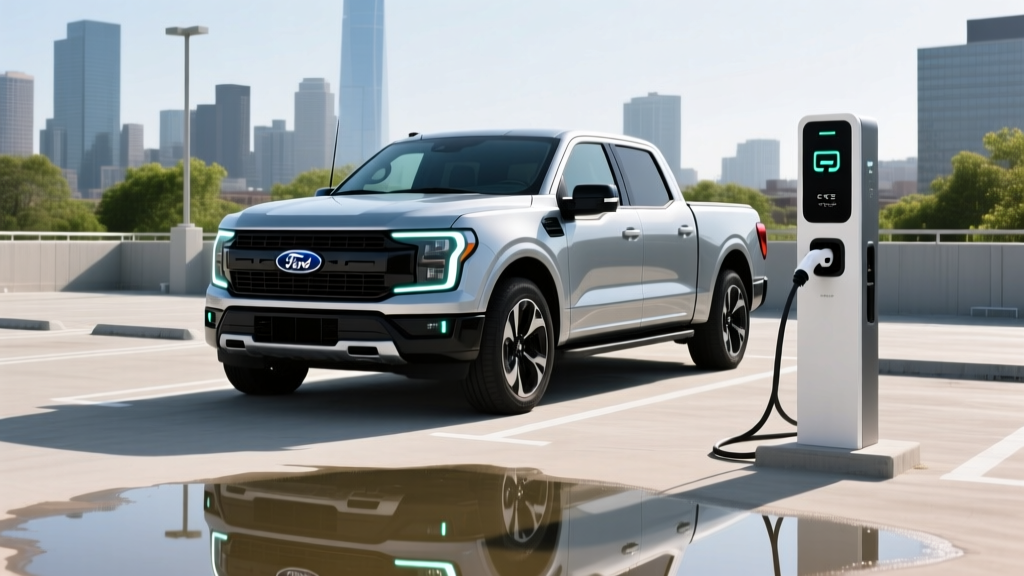
The Ford F-150 Lightning remains one of the few electric trucks that can credibly serve as both a daily driver and a working hauler. But at a starting MSRP that pushes well past $55,000, the financial math hinges on incentives. This guide breaks down every 2026 F-150 Lightning incentive available — federal, state, and utility — alongside the real-world range, charging performance, and ownership costs you need to decide whether the Lightning earns a spot in your driveway.
Ford F-150 Lightning: Quick Verdict
The 2026 F-150 Lightning is a full-size, body-on-frame electric pickup built for buyers who need truck capability without the fuel bill. It offers up to 320 miles of EPA-estimated range (Extended Range battery), a maximum towing rating of 10,000 lbs, and Ford's most advanced version of BlueCruise hands-free driving. The Lightning's biggest advantage over rivals like the Rivian R1T and Chevrolet Silverado EV is its conventional truck layout: a full crew cab, a 5.5-foot bed, and a front trunk (frunk) large enough to swallow a week's worth of groceries or a full set of power tools. Its main drawback? Efficiency. At roughly 2.0–2.2 kWh/mile, highway range drops noticeably at 75+ mph and in cold weather — a reality every EV truck buyer should plan for.
2026 F-150 Lightning Pricing and Incentives Breakdown
Understanding what you'll actually pay requires layering the MSRP, destination charge, and available incentives. Here's the 2026 lineup at a glance:
| Trim | Battery | Base MSRP | Destination | §30D Credit Eligible? | Effective Price (after max credit) |
|---|---|---|---|---|---|
| Pro | Standard Range (98 kWh usable) | $55,995 | $2,095 | Yes (if income/sourcing met) | ~$50,595 |
| XLT | Standard Range | $62,995 | $2,095 | Yes | ~$57,595 |
| Lariat | Extended Range (131 kWh usable) | $76,995 | $2,095 | Yes (MSRP under $80K truck cap) | ~$71,595 |
| Platinum | Extended Range | $96,875 | $2,095 | No (exceeds $80K MSRP cap) | $98,970 |
Key incentive rules for 2026: Under IRS §30D, the F-150 Lightning qualifies as a light-duty truck, meaning the MSRP cap is $80,000 (not the $55,000 cap for sedans). The Platinum trim exceeds that threshold and is ineligible. Buyer income caps also apply: modified adjusted gross income (MAGI) must not exceed $150,000 (single), $225,000 (head of household), or $300,000 (joint). Additionally, the battery must meet critical-mineral and component sourcing requirements that shift annually — always verify current-year eligibility on the IRS source list before purchasing.
§30D Federal Tax Credit Checklist — F-150 Lightning
- Vehicle MSRP cap: ≤ $80,000 (truck classification) — Pro, XLT, Lariat qualify; Platinum does not
- Buyer MAGI cap: $150K single / $225K HOH / $300K joint
- Battery sourcing: Must meet 2026 critical-mineral and battery-component thresholds (verify on IRS qualified vehicle list)
- Point-of-sale transfer: Available — you can apply up to $7,500 as a down-payment reduction at the dealer instead of waiting for a tax refund
- VIN requirement: Vehicle must be assembled in North America (F-150 Lightning is built in Dearborn, MI)
State and utility incentives vary widely. States like Colorado offer up to $5,000 in additional credits, while California's CVRP has been restructured. Many municipal utilities (SMUD, Austin Energy, Xcel Energy) offer $500–$1,500 rebates for EV purchase or home charger installation. Check AFDC's incentive database for your ZIP code.
EPA Range, Real-World Efficiency, and Cold-Weather Impact
The F-150 Lightning's range depends heavily on battery choice and driving conditions. Here's what the EPA says versus what you'll likely see:
Range Reality Check
EPA Estimated: 240 miles (Standard Range, 98 kWh usable) / 320 miles (Extended Range, 131 kWh usable)
Real-World Highway (70–75 mph, 65°F): Expect ~200–220 miles (Standard Range) or ~270–290 miles (Extended Range). The Lightning's boxy aerodynamics and 6,000+ lb curb weight hit efficiency hard above 65 mph.
Cold-Weather (below 30°F): Plan for 25–35% range reduction. An Extended Range Lightning that stickers at 320 miles may deliver as little as 210–230 miles in sub-freezing conditions without preconditioning.
Towing: With a 7,000-lb trailer, expect range to drop by roughly 40–50%. A 320-mile truck becomes a ~160–180-mile truck under heavy tow load.
Efficiency lands at approximately 66 MPGe combined (Standard Range) and 70 MPGe combined (Extended Range) per fueleconomy.gov, translating to roughly 48–51 kWh/100 miles. That's thirstier than a Tesla Model Y (~28 kWh/100 mi) but expected for a full-size truck.
Charging Speed: DC Fast Charging and Home Level 2
The Lightning supports CCS1 DC fast charging (with Tesla Supercharger access via the included adapter since 2024). Here's the full charging picture:
| Charging Level | Connector | Power (kW) | Speed (miles of range/hr) | Time (10–80%) |
|---|---|---|---|---|
| Level 1 (120V) | J1772 | 1.4 kW | ~3 mi/hr | ~72+ hours (full) |
| Level 2 (240V, 48A) | J1772 | 11.5 kW | ~25 mi/hr | ~10–11 hours (full) |
| Level 2 (240V, 80A) | J1772 (dual charger) | 19.2 kW | ~42 mi/hr | ~6 hours (full) |
| DC Fast Charge | CCS1 / NACS (adapter) | Peak 150 kW (Std) / 150 kW (Ext) | ~150–190 mi/hr (peak) | ~41 min (Std) / ~44 min (Ext) |
Charging-curve reality: The Lightning's DC fast-charging curve peaks at approximately 150 kW only between roughly 15–40% state of charge (SoC), then tapers to ~100 kW through 60%, and drops further to ~50 kW above 80%. The 10–80% times above reflect this taper. On a road trip, plan stops around the 20–80% sweet spot for the fastest throughput. Ford's onboard route planner and battery preconditioning (automatic when you navigate to a charger) help maximize peak-rate time.
Home charging note: The optional 80A Charge Station Pro requires a 100-amp dedicated circuit and a 200-amp (minimum) home electrical panel. Budget $1,200–$2,500 for electrician installation depending on panel proximity and local permit costs. The standard 48A Mobile Power Cord works on a NEMA 14-50 outlet (50A circuit) for ~$300–$800 installation.
Performance, Powertrain, and Towing Specs
| Spec | Standard Range | Extended Range |
|---|---|---|
| Drivetrain | Dual-motor AWD | Dual-motor AWD |
| Horsepower | 452 hp | 580 hp |
| Torque | 775 lb-ft | 775 lb-ft |
| 0–60 mph | ~4.5 seconds | ~3.8 seconds |
| Battery (usable) | 98 kWh (NMC) | 131 kWh (NMC) |
| Max Towing | 7,700 lbs | 10,000 lbs (w/ Max Trailer Tow Pkg) |
| Max Payload | 2,235 lbs | 1,800 lbs |
| EPA Range | 240 miles | 320 miles |
| MPGe (combined) | 66 MPGe | 70 MPGe |
The Extended Range model's 3.8-second 0–60 time makes it one of the quickest trucks Ford has ever sold, but the real story is the 775 lb-ft of instant torque available from zero RPM — useful for merging with a load or climbing grades. The independent rear suspension (a Lightning-exclusive change from the gas F-150's solid axle) improves on-road ride quality significantly, though it slightly limits aftermarket lift-kit options.
Pro Power Onboard is the Lightning's party trick: up to 9.6 kW of exportable 240V/120V power from the bed outlets and frunk, enough to run a job-site compressor, tailgate grill, or even back up essential home circuits during an outage (with the optional Home Integration System and transfer switch).
Cargo, Passenger Space, and Interior Tech
The Lightning retains the SuperCrew cab configuration with four full-size doors. Rear legroom measures 43.6 inches — genuinely comfortable for adults on long drives. The 5.5-foot bed offers 52.8 cu ft of volume, and the 14.1 cu ft Mega Power Frunk (front trunk) is lockable, weather-sealed, and features four 120V outlets plus two USB-C ports.
Inside, the 12-inch (Pro/XLT) or 15.5-inch (Lariat/Platinum) portrait touchscreen runs Ford's SYNC 4A with wireless Apple CarPlay and Android Auto. The Platinum adds a 12-inch digital cluster, BlueCruise 1.5 (hands-free on divided highways with driver monitoring), and a 14-speaker B&O audio system. Physical knobs for climate and volume persist — a welcome choice for gloved work-site use.
Notable drawback: The Lightning does not offer a third row, and the rear seat doesn't fold flat into the floor like some competitors. Cargo flexibility is good but not class-leading for family use.
Battery Warranty, Degradation, and Long-Term Ownership
Ford covers the Lightning's high-voltage battery for 8 years or 100,000 miles (whichever comes first) with a capacity-retention threshold of 70%. The electric powertrain components (motors, inverters) share the same 8-year/100,000-mile warranty. The bumper-to-bumper limited warranty is 3 years/36,000 miles.
The Lightning uses NMC (nickel manganese cobalt) chemistry in both battery packs. NMC offers higher energy density than LFP — necessary for a 6,000-lb truck — but is more sensitive to sustained 100% SoC storage. Ford recommends daily charging to 80–90% and reserving 100% for road trips. Real-world fleet data from commercial Lightning users (via Ford Pro telematics) suggests approximately 5–8% degradation over the first 60,000 miles, which is consistent with liquid-cooled NMC packs in this class.
Battery replacement cost: Out of warranty, a full Lightning battery replacement currently runs $15,000–$22,000 depending on pack size and labor. However, module-level repairs (replacing individual degraded sections) are increasingly available and cost significantly less.
How the Lightning Stacks Up Against Competitors
The electric truck segment has matured. Here's how the Lightning compares to its three primary rivals on the metrics that matter:
| Spec | Ford F-150 Lightning (Ext.) | Rivian R1T (Dual Max) | Chevy Silverado EV (4WT) | Tesla Cybertruck (AWD) |
|---|---|---|---|---|
| EPA Range | 320 mi | 410 mi | 390 mi | 340 mi |
| Starting MSRP | $55,995 | $69,900 | $55,900 (WT) | $79,990 |
| §30D Credit Eligible | Yes (select trims) | Yes (select trims) | Yes (select trims) | Yes (select trims) |
| Max Towing | 10,000 lbs | 11,000 lbs | 12,500 lbs | 11,000 lbs |
| 0–60 mph | 3.8 sec | 3.5 sec | ~5.5 sec | 4.1 sec |
| DC Fast Charge (peak) | 150 kW | 200+ kW | 350 kW (Ultium) | 250 kW |
| Bed Length | 5.5 ft | 4.5 ft | 5.11 ft | 6.0 ft |
The Lightning's edge is familiarity: it looks, drives, and works like a conventional F-150. The Rivian R1T is more adventure-oriented with a shorter bed and higher price. The Silverado EV offers superior DC charging speeds (350 kW on Ultium) and a longer range, but the work-truck WT trim is fleet-focused and the consumer RST trims push past $80K. The Cybertruck has polarizing styling, stainless-steel panels that resist dents but complicate body repair, and limited service-center density.
Who Should Buy the F-150 Lightning?
Choose the Lightning if: You want a no-surprises electric truck that fits into a conventional truck buyer's life — standard F-150 bed accessories, familiar dealer service network, Pro Power Onboard for job sites, and eligibility for the full $7,500 federal credit on XLT and Lariat trims.
Look elsewhere if: Maximum range is your priority (Rivian R1T Max Pack at 410 mi), you need 350-kW ultra-fast DC charging (Silverado EV), or you want the most avant-garde tech and styling (Cybertruck).
Pros and Cons
Pros
- Conventional truck layout with a massive 14.1 cu ft frunk
- Pro Power Onboard (up to 9.6 kW) for job sites and home backup
- Ford dealer network — 600+ service points nationwide
- Quick: 3.8-second 0–60 on Extended Range
- §30D tax credit eligible on Pro, XLT, and Lariat trims
- BlueCruise hands-free driving on 130,000+ miles of divided highway
- Comfortable independent rear suspension ride quality
Cons
- DC fast charging peaks at only 150 kW — slower than Silverado EV and Cybertruck
- Real-world highway range drops to ~270 mi (Ext.) at 75 mph
- Cold-weather range loss of 25–35% is significant in northern states
- Platinum trim exceeds $80K MSRP cap — no federal credit
- Heavy: 6,300–6,800 lb curb weight increases tire wear and energy cost
- Towing cuts range roughly in half
Frequently Asked Questions
Does the 2026 F-150 Lightning qualify for the $7,500 federal EV tax credit?
Yes — but only on the Pro, XLT, and Lariat trims, which stay under the $80,000 MSRP cap for trucks. The Platinum trim is ineligible. You must also meet income limits ($150K single / $300K joint) and the vehicle's battery must satisfy 2026 critical-mineral and component sourcing thresholds. Verify your specific VIN on the IRS qualified-vehicle list before purchase. The credit can be applied at point of sale as a down-payment reduction.
What is the real-world range of the F-150 Lightning?
The Extended Range model's EPA estimate is 320 miles, but expect roughly 270–290 miles in real-world highway driving at 70–75 mph in moderate temperatures. In cold weather (below 30°F), plan for 210–230 miles. The Standard Range model stickers at 240 EPA miles and delivers approximately 200–220 real-world highway miles.
How fast does the F-150 Lightning charge at home and on the road?
At home on a 48A Level 2 charger, the Lightning adds roughly 25 miles of range per hour, fully charging overnight in 10–11 hours. On an 80A circuit (optional dual onboard charger), that jumps to ~42 mi/hr. On DC fast chargers, it peaks at 150 kW, achieving a 10–80% charge in approximately 41–44 minutes depending on pack size — adequate for road trips but slower than the Silverado EV's 350-kW capability.
Is the F-150 Lightning worth buying versus the Rivian R1T or Silverado EV?
For traditional truck buyers who prioritize dealer service access, job-site power export, and a familiar form factor, the Lightning is the strongest choice — especially with the $7,500 credit bringing an XLT near $57,000. If you prioritize maximum range (410 mi on the R1T Max) or ultra-fast DC charging (350 kW on the Silverado EV), those competitors have clear advantages. Test-drive all three and compare real incentives in your state.
What state incentives are available beyond the federal credit?
State incentives vary significantly. Colorado offers up to $5,000, some northeastern states provide $2,500–$4,000 through utility programs, and many municipal utilities offer $500–$1,500 purchase or charger-installation rebates. These stack with the federal §30D credit. Check the Alternative Fuels Data Center for your specific state and ZIP code.
How long will the Lightning's battery last?
Ford warranties the battery for 8 years/100,000 miles at 70% capacity retention. Early fleet data suggests 5–8% degradation over 60,000 miles with proper charging habits (daily charge to 80–90%, avoid prolonged 100% storage). Most owners should expect well over 150,000 miles before the battery approaches the warranty threshold.