The F-150 Lightning Frunk Is the Truck's Best Trick
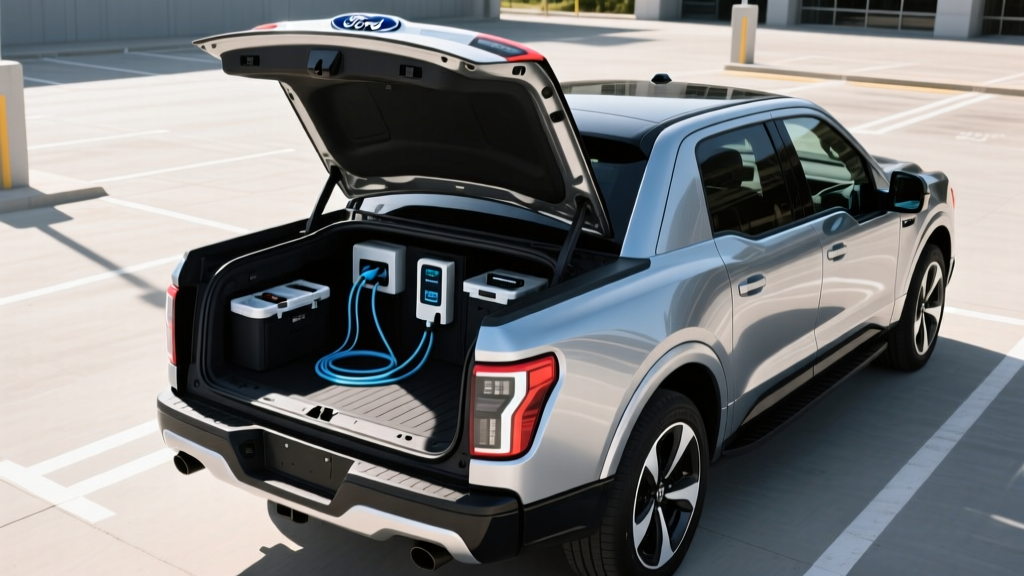
The F-150 Lightning frunk — Ford's Mega Power Frunk — is the single feature that most clearly separates this electric pickup from every gas truck on the road. With 14.1 cubic feet of lockable, drainable, weather-sealed storage under the hood, it replaces the engine bay with what is effectively a second trunk that happens to sit at the front of a full-size pickup. It opens via the key fob, the FordPass app, or the grille badge button, and it includes four 120V outlets, two USB-C ports, and LED lighting.
But a clever storage compartment doesn't matter if the truck underneath can't deliver on range, charging speed, and work capability. We've spent time with the current-generation F-150 Lightning lineup to evaluate the full package — from the entry-level Pro to the Platinum — with exact numbers on efficiency, charging curves, real-world range, and federal tax credit eligibility under IRS §30D rules.
Range, Battery, and Real-World Efficiency
The F-150 Lightning offers two battery packs across its trims, both using NMC (nickel manganese cobalt) lithium-ion chemistry — a choice that prioritizes energy density over the longer cycle life you'd get from LFP cells.
| Battery Pack | Usable Capacity | EPA Range | Availability | MPGe (Combined) |
|---|---|---|---|---|
| Standard Range | 98 kWh | 240 miles | Pro, XLT | 68 MPGe |
| Extended Range | 131 kWh | 320 miles | XLT (opt), Lariat, Platinum | 66 MPGe |
The Lightning's efficiency is hampered by its 6,500+ lb curb weight and brick-wall aerodynamics. Compared to the Rivian R1T (dual-motor, 328 miles EPA from a ~128.9 kWh pack) or the Chevrolet Silverado EV (4WT at 460 miles from a ~200 kWh pack), the Lightning sits in the middle — adequate for most daily driving and moderate road trips, but not class-leading.
Charging Speed: DC Fast, Level 2, and Home Setup
Charging a full-size truck battery is a patience game, and the Lightning's peak DC fast-charge rate of 150 kW is the truck's most commonly cited limitation. While competitors like the Silverado EV push 350 kW and the R1T reaches 220 kW on newer models, the Lightning's charging curve is more conservative.
| Charging Level | Power / Rate | Time / Speed | Notes |
|---|---|---|---|
| Level 1 (120V) | ~1.4 kW | ~2-3 miles/hr | Emergency use only |
| Level 2 (240V, 48A) | 11.5 kW | ~19 miles/hr; 10-100% in ~10 hr (Std) / ~13 hr (Ext) | Standard home charging |
| Level 2 (240V, 80A) | 19.2 kW | ~30 miles/hr; 15-100% in ~8 hr (Ext) | Requires optional 80A charger + 100A circuit |
| DC Fast Charge | 150 kW peak | 15-80% in ~41 min (Std) / ~45 min (Ext) | Sustained rate ~90-110 kW after 60% SoC |
The DC fast-charging curve is where real-world experience matters. The Lightning peaks at 150 kW only briefly between roughly 15-40% State of Charge (SoC). Beyond 60%, the rate tapers significantly, dropping to 80-90 kW, and then to under 50 kW above 85%. This means an 80-100% top-off on a road trip takes disproportionately long. For highway travel, plan stops around the 15-80% window and you'll minimize time at the charger.
At home, the standard 11.5 kW Level 2 rate is perfectly adequate for overnight replenishment. Most owners will plug in at 20-30% SoC and wake up to a full battery. The optional 19.2 kW onboard charger requires a dedicated 100-amp circuit and compatible Ford Charge Station Pro — worth the investment if you drive 100+ miles daily or use the truck for worksite power and need rapid overnight recovery.
Performance and Drivetrain
Every F-150 Lightning comes with a dual-motor all-wheel-drive powertrain — there's no rear-wheel-drive option. The two motors (one front, one rear) deliver instant torque and eliminate the mechanical complexity of a traditional 4WD transfer case.
| Spec | Standard Range | Extended Range |
|---|---|---|
| Horsepower | 452 hp | 580 hp |
| Torque | 775 lb-ft | 775 lb-ft |
| 0-60 mph | ~4.5 seconds | ~3.8 seconds |
| Drivetrain | AWD (dual-motor) | AWD (dual-motor) |
| Max Towing | 7,700 lbs | 10,000 lbs |
| Max Payload | 2,235 lbs | 1,803 lbs |
| Curb Weight | ~6,171 lbs | ~6,768 lbs |
The Extended Range's 3.8-second 0-60 time makes it one of the quickest production pickups ever sold, and the instant torque delivery is startling in a vehicle this size. The Standard Range is hardly slow at 4.5 seconds — quicker than most V-8 F-150s of the previous generation.
Towing is where the Lightning's range limitations become acute. Max towing is 10,000 lbs (Extended Range with Max Trailer Tow Package), but expect range to drop to 100-130 miles when pulling a heavy load at highway speed. The onboard trailer scale and Pro Trailer Hitch Assist are genuinely useful, and the truck's regenerative braking handles trailer weight well on descents. For daily towing under 3,000 lbs, range impact is manageable. For long-distance heavy towing, a diesel or hybrid remains the pragmatic choice.
The Frunk in Detail: Dimensions, Features, and Practical Use
The F-150 Lightning frunk (officially the Mega Power Frunk) offers 14.1 cubic feet of sealed, lockable storage. To put that in context, it's roughly equivalent to the trunk of a midsize sedan — and far more versatile because of its shape and accessibility.
Key frunk specifications and features:
- Volume: 14.1 cubic feet
- Max payload capacity: 400 lbs
- Opening mechanism: Key fob, FordPass app, grille badge button, or interior switch
- Power outlets: Four 120V/20A outlets, two USB-C ports
- Lighting: LED strip illumination
- Drainage: Floor drain plug (washable interior)
- Weather sealing: Gasket-sealed lid, water-resistant
The frunk's four 120V outlets are powered by the truck's onboard Pro Power Onboard system (2.4 kW standard, 9.6 kW available on Lariat/Platinum). This transforms the frunk into a mobile worksite power station — plug in a miter saw, charge power tool batteries, or run a small refrigerator for tailgating. The drain plug means you can load it with ice for beverages and drain the meltwater afterward.
Practical limitations: the frunk lid opens forward (clamshell style), which is convenient but means you can't easily access it in tight nose-in parking spots. The floor is relatively high compared to a sedan trunk, so loading heavy items requires a lift. And while 400 lbs of payload sounds generous, that weight counts against the truck's total payload capacity — load the frunk to max and your bed payload decreases accordingly.
Interior, Tech, and Driver Assistance
The Lightning's cabin is shared heavily with the gas F-150, which means a spacious, functional interior with excellent rear-seat legroom (43.6 inches) and a wide bench that fits three adults across. The Platinum trim swaps the traditional shifter for a fold-away work surface and adds premium materials, but lower trims use hard plastics that feel utilitarian at this price point.
Infotainment: The standard 12-inch touchscreen (upgraded to a 15.5-inch portrait screen on Lariat and Platinum) runs Ford's SYNC 4 system with wireless Apple CarPlay and Android Auto, built-in navigation, and over-the-air update capability. The interface is responsive but not as polished as Tesla's or Rivian's. Physical knobs for climate and volume are retained — a welcome choice for truck buyers who wear gloves.
Driver Assistance (SAE Level 2): Ford Co-Pilot360 is standard across all trims and includes automatic emergency braking, blind-spot monitoring with trailer coverage, lane-keeping assist, and adaptive cruise control with stop-and-go. The available Ford Co-Pilot360 Assist 2.0 adds evasive steering assist and intersection assist.
Blue Cruise: Available on Lariat and standard on Platinum, Blue Cruise is Ford's hands-free highway driving system. It works well on well-marked interstates and handles curves and speed adjustments smoothly. However, construction zones, faded lane markings, and complex interchanges still require immediate driver takeover. It's a genuine fatigue reducer on long highway drives but not a replacement for an alert driver.
Pricing, Trims, and Federal Tax Credit Eligibility
The F-150 Lightning's pricing has shifted considerably since its 2022 launch. Here's where the lineup stands for the current model year:
| Trim | Battery | MSRP (before dest.) | Est. Tax-Credit Adjusted* |
|---|---|---|---|
| Pro (Standard Range) | 98 kWh | $54,995 | Varies by eligibility |
| XLT (Standard Range) | 98 kWh | $59,995 | Varies by eligibility |
| XLT (Extended Range) | 131 kWh | $69,995 | Varies by eligibility |
| Lariat (Extended Range) | 131 kWh | $77,495 | Varies by eligibility |
| Platinum (Extended Range) | 131 kWh | $96,874 | Varies by eligibility |
*Destination charge adds approximately $2,095. Prices reflect Ford's current MSRP structure; dealer markups or discounts may apply.
- MSRP Cap: Vans, SUVs, and pickup trucks qualify up to an $80,000 MSRP ceiling. This means the Platinum trim ($96,874) does NOT qualify, while Pro, XLT, and Lariat trims fall under the cap.
- Income Cap: Modified adjusted gross income must not exceed $150,000 (single), $225,000 (head of household), or $300,000 (married filing jointly).
- Battery Sourcing: The credit amount (up to $7,500) depends on meeting critical-mineral and battery-component sourcing requirements set by the IRS. Ford has worked to qualify for the full credit on US-built Lightnings, but sourcing rules are subject to change. Verify current eligibility at IRS.gov before purchasing.
- Point-of-Sale Transfer: Eligible buyers can transfer the credit to the dealer at purchase, reducing the vehicle price upfront rather than waiting for a tax refund.
Consult a tax professional for your specific situation. State and local incentives may stack on top — check AFDC.energy.gov for your jurisdiction.
Warranty and Long-Term Ownership
Ford backs the Lightning with its standard EV warranty package, which is competitive with other mainstream automakers but falls short of Hyundai/Kia's industry-leading coverage.
| Component | Coverage |
|---|---|
| Basic (bumper-to-bumper) | 3 years / 36,000 miles |
| Powertrain | 5 years / 60,000 miles |
| Battery (high-voltage) | 8 years / 100,000 miles |
| Battery capacity retention | ≥70% of original capacity within warranty period |
| Corrosion (perforation) | 5 years / unlimited miles |
The 70% capacity retention threshold is standard for the industry. Real-world data from early Lightning owners (2022-2023 model years) suggests degradation has been modest so far — typically 3-6% loss after 30,000-50,000 miles, consistent with NMC chemistry managed by an active liquid thermal management system. Long-term replacement cost for the Extended Range pack is estimated in the $15,000-$25,000 range based on current Ford parts pricing, though this is expected to decline as battery costs continue to fall.
Who Should Buy the F-150 Lightning (And Who Shouldn't)
Choose the Lightning If:
- You need a full-size truck bed and genuine work capability (payload, Pro Power Onboard)
- The frunk is a priority — secure, powered front storage is unmatched in the segment
- Most of your driving is under 200 miles/day with overnight home charging
- You want Blue Cruise hands-free highway capability
- You value Ford's dealer network for service in rural or suburban areas
Look Elsewhere If:
- You regularly tow heavy trailers over long distances (range drops drastically)
- Fast DC charging is critical — Silverado EV charges at 350 kW vs. Lightning's 150 kW
- You need more than 320 miles of EPA range without a trailer
- You want an independent rear suspension or air suspension (Rivian R1T offers both)
- Budget is tight — even the Pro trim starts near $55K before incentives
Pros and Cons at a Glance
Pros
- 14.1 cu ft powered, drainable frunk — best in class
- Pro Power Onboard (up to 9.6 kW) turns the truck into a mobile generator
- 3.8-sec 0-60 on Extended Range — sports-car acceleration in a full-size truck
- Generous rear-seat space (43.6" legroom) and crew-cab comfort
- Blue Cruise hands-free driving on 130K+ miles of highway
- Ford's nationwide dealer network for service and parts
Cons
- 150 kW peak DC charging is slow for the class
- 320-mile max EPA range (Extended Range) trails Silverado EV's 460 miles
- Towing cuts range roughly in half — 100-130 mi with heavy trailer
- Platinum trim exceeds $80K MSRP cap, losing federal tax credit eligibility
- Heavy curb weight (6,768 lbs) hurts efficiency — 51 kWh/100 mi
- SYNC 4 infotainment lags behind Tesla/Rivian in responsiveness
Frequently Asked Questions
What is the real-world range of the F-150 Lightning?
The EPA rates the Standard Range pack at 240 miles and the Extended Range at 320 miles. In real-world highway driving at 70-75 mph, expect approximately 200-215 miles (Standard) and 265-285 miles (Extended). Cold weather below 30°F reduces these figures by 20-30%. Towing a trailer cuts range roughly in half.
How fast does the F-150 Lightning charge?
On a DC fast charger, the Lightning peaks at 150 kW and charges from 15-80% in approximately 41 minutes (Standard Range) or 45 minutes (Extended Range). At home on a 240V Level 2 charger at 11.5 kW, expect roughly 19 miles of range per hour — a full overnight charge for most drivers. The optional 19.2 kW onboard charger reduces home charge time further but requires a 100-amp electrical circuit.
How much does the F-150 Lightning cost after tax credits?
The Pro trim starts at $54,995 MSRP. If you qualify for the full $7,500 federal tax credit under IRS §30D (meeting income, MSRP, and battery-sourcing requirements), the effective price drops to approximately $47,495 plus destination and dealer fees. The XLT and Lariat trims also fall under the $80,000 truck MSRP cap. The Platinum at $96,874 exceeds the cap and does not qualify for the federal credit.
Does the F-150 Lightning qualify for the federal EV tax credit?
The Pro, XLT, and Lariat trims qualify for up to $7,500 under §30D, provided the buyer meets income caps ($150K single / $300K joint) and the vehicle meets current-year battery sourcing requirements. The Platinum trim exceeds the $80,000 MSRP cap for trucks and is ineligible. Always verify current eligibility on the IRS qualified vehicles list before purchasing, as sourcing rules change periodically.
Is the F-150 Lightning worth buying vs. the Silverado EV and Rivian R1T?
The Lightning wins on frunk utility, Pro Power Onboard, and Ford's dealer network. The Silverado EV (starting ~$57,000 for the 4WT) offers significantly more range (up to 460 miles EPA) and 350 kW DC charging but has a smaller frunk and less established service network. The Rivian R1T (starting ~$75,000) is more refined with air suspension and better off-road capability but costs more and has a smaller bed. For work-focused buyers who need onboard power and front storage, the Lightning remains the strongest choice.
How big is the F-150 Lightning frunk compared to competitors?
The Lightning's 14.1 cu ft frunk is the largest in any production electric truck. The Rivian R1T offers a smaller front trunk (approximately 11 cu ft), and the Chevrolet Silverado EV's eTrunk provides roughly 10.7 cu ft. The Lightning's frunk also stands apart with its four 120V power outlets, drain plug, and 400-lb payload rating.