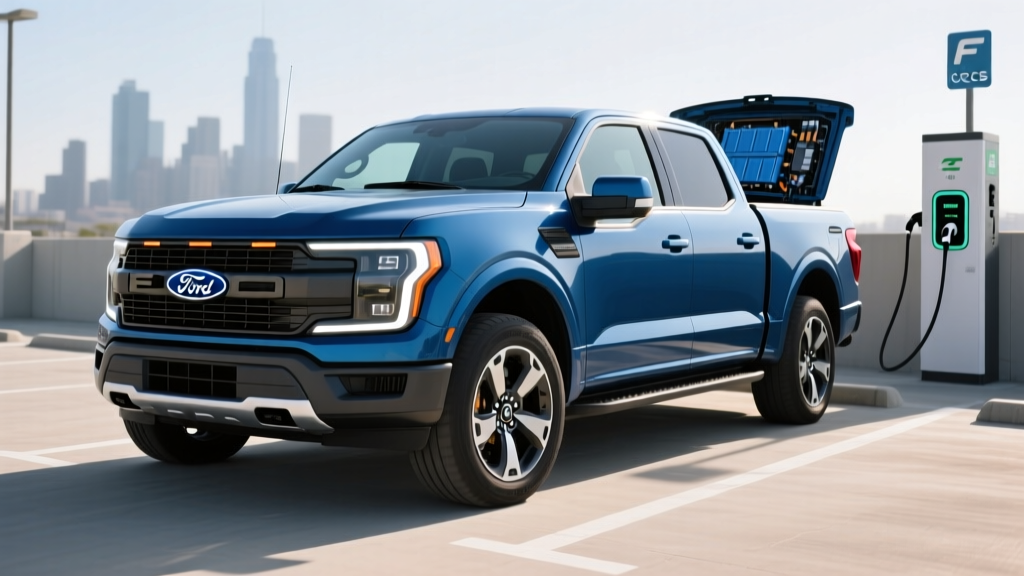
Searches for the 03 Ford F150 bolt pattern often come from truck owners swapping wheels, sizing up aftermarket rims, or cross-shopping legacy F-150 hardware with the electric F-150 Lightning. The 2003 F-150 used a 5×135 mm (5-lug, 135 mm circle) bolt pattern — a format shared with many 1997–2003 F-150s and some early Lincoln Navigators. The modern F-150 Lightning, however, moved to a 6×135 mm bolt pattern, which means those older 5-lug wheels will not mount directly to Ford's electric truck without adapters (and adapters are not recommended for a 6,500-lb EV with instant torque).
This review covers the 2026 Ford F-150 Lightning end-to-end — range, charging curve, battery chemistry, tax credit math, towing reality, and how wheel fitment works if you're migrating from a classic F-150 platform. If you landed here on a bolt-pattern query, the short answer is above. If you're evaluating the Lightning as a purchase, the data below is what actually matters.
2026 F-150 Lightning At a Glance
| Spec | Standard Range | Extended Range |
|---|---|---|
| EPA Range | ~240 miles | ~320 miles |
| Battery (usable) | ~98 kWh (NMC) | ~131 kWh (NMC) |
| Peak DC Fast Charge | 150 kW | 150 kW |
| 10-80% DCFC Time | ~44 min | ~41 min |
| Level 2 Home Charge | 19.2 kW (~30 mi/hr) | 19.2 kW (~30 mi/hr) |
| Drivetrain | Dual-motor AWD | Dual-motor AWD |
| Horsepower | 452 hp | 580 hp |
| Torque | 775 lb-ft | 775 lb-ft |
| 0-60 mph | ~4.8 sec | ~3.8 sec |
| Max Towing | 7,700 lb | 10,000 lb |
| MPGe (combined) | ~68 MPGe | ~66 MPGe |
| Bolt Pattern | 6×135 mm (not 5×135) | |
Range Reality: EPA vs. Highway vs. January
EPA sticker: 240 mi (Standard Range) / 320 mi (Extended Range)
Real-world highway (70-75 mph, 70°F): Expect ~200-220 mi on Standard Range, ~260-285 mi on Extended Range. The Lightning's boxy aerodynamics and 6,000+ lb curb weight punish highway efficiency more than city driving, where regen braking recovers energy.
Cold weather (20°F, highway): Plan on 25-35% range loss. An Extended Range pack that stickers at 320 mi can drop to ~210-240 mi in sustained winter highway use. Preconditioning while plugged in recovers some of this.
Under load (towing 7,000 lb trailer): Range roughly halves. Extended Range towing drops to ~140-170 mi depending on grade and speed.
The Lightning uses nickel-manganese-cobalt (NMC) chemistry in both packs. NMC delivers higher energy density than LFP (lithium iron phosphate), which is why Ford can fit 131 usable kWh into the Extended Range pack — but it also means Ford recommends charging to 80% for daily use and reserving 100% for trips. LFP packs (like those in some Tesla Model Y trims) tolerate 100% daily charges better, but pack less range per pound.
Charging Speed: The Curve, Not the Peak
| Charging Level | Power | Miles Added/Hour | Notes |
|---|---|---|---|
| Level 1 (120V household) | ~1.4 kW | ~2-3 mi/hr | Emergency/trickle only |
| Level 2 (240V, 48A) | 11.5 kW | ~19 mi/hr | Typical home charger |
| Level 2 (240V, 80A) | 19.2 kW | ~30 mi/hr | Ford Charge Station Pro; requires 100A circuit |
| DC Fast (peak) | 150 kW | ~200+ mi/hr (brief) | Only from ~15-55% SoC |
| DC Fast (350 kW stall) | Capped at 150 kW | — | Truck limits draw; faster stall doesn't help |
The Lightning's DC fast-charge ceiling is 150 kW — competitive with the Rivian R1T but behind the Tesla Cybertruck's ~250 kW peak and the GMC Sierra EV's 350 kW capability. On a 10-80% session, expect roughly 41 minutes for the Extended Range pack. The charge curve tapers sharply above 80% SoC, so the last 20% can take as long as the first 70%. On road trips, plan stops around 15-80% for time efficiency.
For home charging, the Ford Charge Station Pro (19.2 kW, 80-amp) requires a licensed electrician to install a 100-amp dedicated circuit. Most homes will need a panel assessment — older 100-amp service panels may need upgrading to 200-amp before the charger can be added. Budget $1,200-$2,500 for a straightforward install, or $3,500-$5,000+ if a panel upgrade is required. Always confirm final specs with a licensed electrician.
Performance, Towing, and Drivetrain
Every F-150 Lightning ships with dual-motor all-wheel drive. The Extended Range model's 580 hp and 775 lb-ft of torque deliver a 3.8-second 0-60 mph time — sports-car territory in a body-on-frame truck. The Standard Range version is no slouch at 4.8 seconds.
Towing capacity maxes at 10,000 lb (Extended Range with Max Trailer Tow Package) and 7,700 lb on Standard Range. Real-world towing range, as noted above, is the Lightning's most honest limitation. Ford's Pro Power Onboard system turns the truck into a mobile generator — 2.4 kW standard, 9.6 kW optional — with bed and cabin outlets that can run tools, campsite gear, or a home backup circuit during outages.
On the bolt-pattern question specifically: the Lightning's 6×135 mm pattern and ~170 mm center bore mean wheel swaps require F-150-specific 6-lug wheels rated for the truck's gross axle weight. The 2003 F-150's 5×135 pattern is physically incompatible. Aftermarket 6×135 wheels from brands like Fuel, Method, and Black Rhino are widely available in load ratings appropriate for the Lightning's mass.
Pricing, Trims, and Federal Tax Credit Eligibility
| Trim | Base MSRP (est.) | §30D Credit | Effective Price* |
|---|---|---|---|
| Pro (Standard Range) | ~$52,000 | Up to $7,500 | ~$44,500 |
| XLT (Standard Range) | ~$57,000 | Up to $7,500 | ~$49,500 |
| Lariat (Extended Range) | ~$72,000 | Up to $7,500 | ~$64,500 |
| Platinum (Extended Range) | ~$92,000 | Up to $7,500 | ~$84,500 |
*Effective price assumes full §30D eligibility. Actual credit depends on battery component and critical-mineral sourcing requirements, buyer income caps ($150K single / $300K joint AGI), and the $80,000 MSRP cap for trucks/vans/SUVs per IRS §30D rules. The credit can be transferred to the dealer at point of sale as an immediate discount. Confirm eligibility with a tax professional before purchase.
The F-150 Lightning qualifies as a truck under §30D, so the MSRP cap is $80,000 — meaning the Lariat Extended Range and most trims clear the threshold, but a fully optioned Platinum can exceed it and lose credit eligibility. Battery sourcing requirements remain a moving target; as of the 2026 tax year, vehicles must meet both critical-mineral and battery-component thresholds to claim the full $7,500, with partial credits ($3,750) available for meeting only one prong. Check fueleconomy.gov for the latest per-model credit status.
Interior, Tech, and Driver Assistance
The Lightning's cabin mirrors the gas F-150's architecture, which means generous space: ~52 inches of front legroom, ~43 inches rear, and a 5.5-foot bed with ~52 cu ft of volume. The front trunk ("frunk") adds 14.1 cu ft of lockable, drainable storage — useful for gear that would otherwise eat bed space.
Infotainment runs Ford's SYNC 4 on a 12-inch touchscreen (15.5-inch portrait screen on Lariat and Platinum). Wireless Apple CarPlay and Android Auto are standard. The available BlueCruise system offers hands-free highway driving on pre-mapped divided highways — but it remains an SAE Level 2 driver-assist system. You must keep eyes on the road; a driver-monitoring camera enforces attention. BlueCruise is not self-driving, and it disengages in construction zones, unmapped roads, and poor weather.
Notable drawbacks: the Lightning's ride quality is firm when unloaded (a function of supporting 6,500+ lb and 10,000-lb tow capacity). Rear-seat cushion height is lower than some competitors. And the 150 kW DC charge ceiling, while adequate, is starting to look dated as 250-350 kW trucks arrive.
Warranty and Long-Term Ownership
Ford covers the Lightning's battery and electric powertrain for 8 years or 100,000 miles, whichever comes first, with a capacity-retention threshold of 70% State of Health (SoH). If the pack degrades below 70% within that window, Ford will repair or replace it. The bumper-to-bumper warranty is 3 years/36,000 miles.
Out-of-warranty battery replacement on the Extended Range pack has been quoted in the $20,000-$30,000 range based on early service data — a figure worth factoring into 10+ year ownership plans. NMC packs typically see 10-15% degradation over the first 100,000 miles under normal use, with the curve flattening afterward. Avoid habitual DC fast-charging and routine 100% SoC storage to maximize longevity.
Lightning vs. the Electric Truck Field
Against the Tesla Cybertruck: the Cybertruck offers faster DC charging (~250 kW), a stainless-steel exoskeleton, and more polarizing styling. The Lightning counters with a conventional truck form factor, a usable frunk, and Ford's dealer network for service. If you need a truck that looks and works like a truck, the Lightning wins on familiarity.
Against the Rivian R1T: Rivian offers more adventurous off-road capability (quad-motor options, tank turns) and a more premium interior, at a higher starting price. The Lightning undercuts on cost and offers Pro Power Onboard, which Rivian lacks. For worksite or job-site use, the Lightning's utility package is harder to beat.
Against the GMC Sierra EV: GM's entry boasts 350 kW DC charging and up to 400 miles of range on the top pack, but at significantly higher prices and with limited initial availability. The Lightning remains the volume-play electric truck with the widest trim and price spread.
Pros
- Pro Power Onboard (up to 9.6 kW) — best-in-class mobile power
- 14.1 cu ft frunk with drain — unique utility
- Strong tow rating (10,000 lb) with integrated trailer tech
- Familiar F-150 cabin and controls
- Ford dealer network for service and warranty work
- §30D tax credit eligible on most trims under $80K MSRP
Cons
- 150 kW DC charge ceiling trails newer rivals
- Towing slashes range by ~50%
- Firm unloaded ride quality
- Extended Range trims can exceed $80K MSRP cap
- BlueCruise is Level 2 only — not autonomous
- 6×135 bolt pattern means no legacy 5-lug wheel swaps
Who the F-150 Lightning Is For
Buy the Lightning if: you need a full-size truck for work, towing, or family use and want electric operating costs; you'll charge at home most nights; you value Pro Power Onboard for job sites or camping; you want a truck that doesn't require relearning what a truck looks like.
Skip it if: your daily commute involves heavy towing with no mid-route charging; you want the fastest possible DC charging; you prefer the premium-adventure positioning of a Rivian R1T; or your home electrical service can't support Level 2 charging without a costly panel upgrade.
Frequently Asked Questions
What is the bolt pattern on a 2003 Ford F-150, and does it fit the Lightning?
The 2003 F-150 uses a 5×135 mm bolt pattern (5 lugs on a 135 mm circle). The F-150 Lightning uses a 6×135 mm pattern. They are not cross-compatible without adapters, and adapters are strongly discouraged on a 6,500-lb EV producing 775 lb-ft of torque. Source 6×135 wheels rated for the Lightning's axle weight.
What is the real-world range of the F-150 Lightning?
EPA rates the Extended Range at ~320 miles and Standard Range at ~240 miles. Real-world highway driving at 70-75 mph yields roughly 260-285 mi (Extended) and 200-220 mi (Standard). Cold weather and towing reduce range further — plan conservatively.
How fast does the Lightning charge at home and on the road?
At home on a 19.2 kW Ford Charge Station Pro (80A circuit), the Lightning adds roughly 30 miles of range per hour. On DC fast chargers, it peaks at 150 kW and charges 10-80% in about 41 minutes (Extended Range). It cannot take advantage of 350 kW stalls.
Does the F-150 Lightning qualify for the $7,500 federal tax credit?
Most trims do, provided the buyer's AGI is under $150K (single) or $300K (joint), the truck's MSRP stays at or below $80,000, and the battery meets critical-mineral and component-sourcing thresholds. The credit can transfer to the dealer as a point-of-sale discount. Confirm current-year eligibility on irs.gov and with a tax professional.
Is the Lightning better than the Cybertruck or Rivian R1T?
It depends on use case. The Lightning wins on worksite utility (Pro Power Onboard), dealer service access, and price breadth. The Cybertruck charges faster. The R1T offers more off-road capability and a premium cabin. None is universally "best" — match the truck to your primary use.
How long will the Lightning's battery last?
Ford warrants the battery for 8 years/100,000 miles at 70% State of Health. NMC chemistry typically degrades 10-15% in the first 100,000 miles, then flattens. Avoid habitual 100% charges and excessive DC fast-charging to extend life. Out-of-warranty replacement runs $20,000-$30,000 for the Extended Range pack.