If you've landed here searching for the 2019 F-150 bolt pattern, you're likely cross-shopping wheels, spacers, or accessories between a gas-era F-150 and Ford's electric truck. The short answer: the 2019 F-150 uses a 6×135 mm (6×5.31 in) bolt pattern with a 14 mm × 1.5 thread pitch and an 87.1 mm center bore. The 2026 Ford F-150 Lightning shares that same 6×135 bolt pattern, making wheel swaps between late-model gas F-150s and the Lightning straightforward — provided you account for offset, load rating, and the Lightning's significantly heavier curb weight.
But bolt compatibility is only the beginning. Below is a full, data-driven review of the 2026 F-150 Lightning — range, charging, pricing, tax-credit eligibility, and how it stacks up against the Rivian R1T and Chevrolet Silverado EV.
Bolt Pattern & Wheel Compatibility: Gas F-150 vs Lightning
Owners moving from a 2015–2020 gas F-150 to the Lightning will find the lug pattern identical. Here is the full wheel spec comparison:
| Spec | 2019 F-150 (Gas) | 2026 F-150 Lightning |
|---|---|---|
| Bolt Pattern | 6×135 mm | 6×135 mm |
| Thread Size | M14 × 1.5 | M14 × 1.5 |
| Center Bore | 87.1 mm | 87.1 mm |
| Stock Wheel Sizes | 17"–22" | 18"–22" |
| Curb Weight (approx.) | 4,500–5,200 lbs | 6,000–6,800 lbs |
Critical note for wheel swaps: While the bolt pattern matches, the Lightning weighs 1,200–1,600 lbs more than its gas counterpart. Any aftermarket wheel must carry an adequate load rating — Ford specifies a minimum of 1,500 lbs per corner for the Lightning. Lightweight forged wheels rated only for gas-truck duty may crack under the Lightning's mass, especially when towing or hauling.
2026 F-150 Lightning: Quick Spec Overview
| Spec | Standard Range (Pro/XLT) | Extended Range (Lariat/Platinum) |
|---|---|---|
| EPA Range | 240 mi | 320 mi |
| Battery Usable Capacity | 98 kWh (NMC) | 131 kWh (NMC) |
| Drivetrain | Dual-Motor AWD | Dual-Motor AWD |
| Horsepower | 452 hp | 580 hp |
| Torque | 775 lb-ft | 775 lb-ft |
| 0–60 mph | ~4.5 sec | ~3.8 sec |
| Max DC Fast Charge | 150 kW | 150 kW |
| 10–80% DC Time | ~36 min | ~41 min |
| Level 2 Home Charge (max) | 19.2 kW (80A) | 19.2 kW (80A) |
| MPGe (combined) | 68 MPGe | 66 MPGe |
| Towing Capacity (max) | 7,700 lbs | 10,000 lbs |
| Payload (max) | 2,235 lbs | 1,952 lbs |
| Bolt Pattern | 6×135 mm | 6×135 mm |
Source: fueleconomy.gov and Ford Motor Company.
Range & Efficiency: EPA Sticker vs Real-World Driving
EPA Estimated Range: 240 mi (Standard) / 320 mi (Extended)
Real-World Expectation: Highway driving at 70–75 mph typically yields 200–220 mi (Standard) or 260–285 mi (Extended). In freezing temperatures (below 32°F), expect a 20–30% reduction — bringing the Extended Range battery down to roughly 210–240 mi on a full charge. The Lightning's resistive cabin heater is a notable energy draw in cold weather compared to competitors with heat pumps.
Efficiency lands at roughly 47–49 kWh per 100 miles for the Extended Range model in mixed driving. That's thirstier than a Tesla Model Y (~28 kWh/100mi) but competitive for a 6,500-lb electric truck. If you frequently tow, plan for range to drop by 40–50% — a 320-mile truck towing a 5,000-lb trailer at highway speed may deliver as little as 150–170 miles before needing a charge.
Charging: DC Fast, Level 2, and Home Setup
| Level | Power (kW) | Miles of Range Added | Notes |
|---|---|---|---|
| Level 1 (120V, 12A) | ~1.4 kW | ~3 mi/hr | Emergency/trickle only |
| Level 2 (240V, 48A) | 11.5 kW | ~23 mi/hr | Standard home charger |
| Level 2 (240V, 80A) | 19.2 kW | ~38 mi/hr | Ford Charge Station Pro; requires 100A circuit |
| DC Fast (CCS) | 150 kW peak | ~150–190 mi in 20 min | Tapers significantly above 80% SoC |
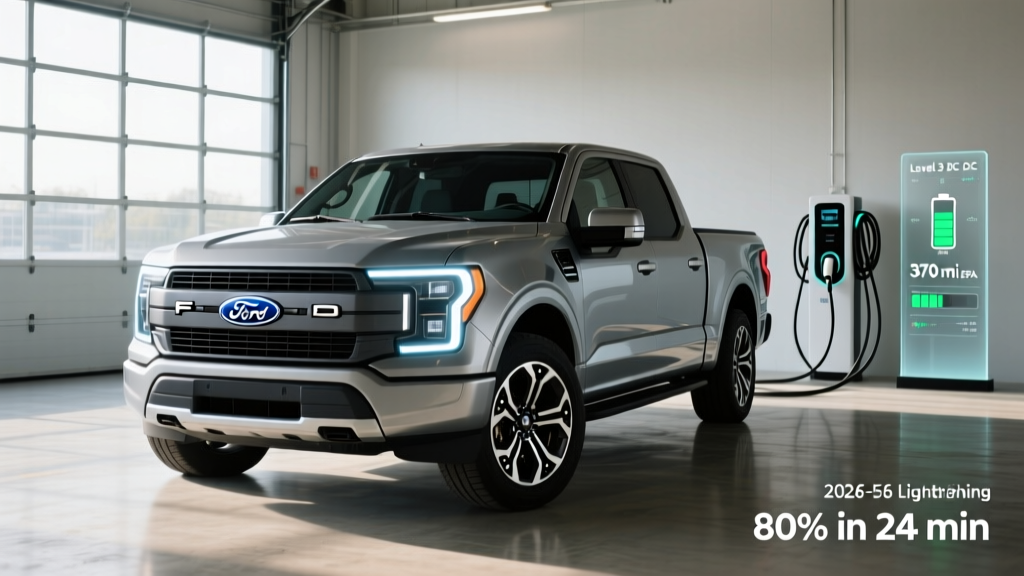
The Lightning's DC fast-charging architecture tops out at 150 kW — adequate but not class-leading. The Chevrolet Silverado EV with its Ultium platform can accept over 350 kW on compatible chargers. At 150 kW, the Lightning's Extended Range battery charges from 10–80% in approximately 41 minutes, though the charge curve tapers hard above 80%, adding another 20+ minutes to reach full. For road trips, plan stops around the 10–80% window and avoid charging to 100% unless necessary.
At home, the Ford Charge Station Pro (80A, $1,299 hardware) delivers a full overnight charge for either battery. Installation typically runs $1,500–$3,500 depending on whether your panel needs an upgrade to support the 100-amp dedicated circuit. A more common 48-amp Level 2 unit (like the ChargePoint Home Flex) on a 60A circuit will fully recharge the Standard Range battery overnight and the Extended Range in about 13 hours.
Performance, Capability & Towing
The dual-motor AWD powertrain delivers instant torque from standstill — the Extended Range model's 3.8-second 0–60 mph time makes it the quickest F-150 Ford has ever produced. Standard Range models hit 60 mph in roughly 4.5 seconds, which is still quicker than any gas V8 F-150 from the previous generation.
Towing capacity maxes at 10,000 lbs (Extended Range, with Max Trailer Tow Package). Payload peaks at 2,235 lbs on Standard Range Pro trims. The Lightning's low center of gravity (battery pack under the floor) gives it a planted feel when loaded, though the added weight means longer braking distances — plan accordingly when towing downhill.
The front trunk ("Mega Power Frunk") offers 14.1 cu ft of lockable, drainable storage with 400 lbs of payload capacity — a genuine differentiator versus gas trucks. The bed is 5.5 ft (standard) with a width of 50.6 in between the wheel wells, matching the gas F-150.
Pricing, Trims & Federal Tax Credit
| Trim | Base MSRP | §30D Credit (if eligible) | Effective Price |
|---|---|---|---|
| Pro (Standard Range) | $54,995 | Up to $7,500 | ~$47,495 |
| XLT (Standard Range) | $59,995 | Up to $7,500 | ~$52,495 |
| Lariat (Extended Range) | $72,995 | Up to $7,500 | ~$65,495 |
| Platinum (Extended Range) | $96,874 | Up to $7,500 | ~$89,374 |
Federal tax credit (§30D) caveats: Eligibility for the full $7,500 credit depends on three IRS requirements that change periodically:
- MSRP cap: Trucks/vans/SUVs must have an MSRP at or below $80,000. The Platinum trim exceeds this and is ineligible.
- Buyer income cap: Modified AGI must not exceed $150,000 (single), $225,000 (head of household), or $300,000 (joint).
- Battery sourcing: A percentage of critical minerals and battery components must be sourced from the U.S. or FTA partners — rules tighten annually. Verify current-year compliance on IRS.gov.
- Point-of-sale transfer: As of 2024+, eligible buyers can transfer the credit to the dealer at purchase, reducing the out-of-pocket price immediately rather than waiting for tax filing.
Always confirm eligibility with a tax professional before purchase — battery-sourcing requirements have disqualified several models in prior years mid-cycle.
Tech, Interior & Driver Assistance
The Lightning's cabin mirrors the gas F-150 with a few EV-specific upgrades. The available 15.5-inch portrait touchscreen (SYNC 4A) handles navigation, Apple CarPlay/Android Auto (wireless), and charge management. The digital gauge cluster includes real-time range estimation, regen-braking feedback, and one-pedal driving toggles.
Ford's BlueCruise (SAE Level 2) hands-free driving system is available on divided highways. This is not self-driving — the driver must remain attentive, and an infrared camera monitors eye engagement. BlueCruise works well on long interstate hauls but disengages on undivided roads, construction zones, and poor-weather lane markings.
SAE Automation Level: BlueCruise is Level 2 — the driver must remain engaged and ready to take over at any time. This is not a Level 4 driverless system like Waymo.
Pro Power Onboard is a standout feature: the Lightning can export up to 9.6 kW of AC power through bed outlets and the frunk, enough to run power tools at a job site or power essential home circuits during an outage (with the Ford Home Integration System and transfer switch installed by a licensed electrician).
Pros, Cons & Ownership Verdict
Pros
- 6×135 bolt pattern shared with 2015–2025 gas F-150s — easy wheel interchange
- 14.1 cu-ft Mega Power Frunk with 400-lb capacity
- Pro Power Onboard (up to 9.6 kW V2L/V2H)
- 3.8-sec 0–60 (Extended Range) — quickest F-150 ever
- Available hands-free BlueCruise on mapped highways
- 19.2 kW Level 2 home charging (with 80A station)
Cons
- 150 kW peak DC charging — slower than Silverado EV / Hyundai Ioniq 5
- No heat pump — cold-weather range loss is significant (20–30%)
- Extended Range battery adds ~800 lbs, reducing payload
- Towing cuts range by 40–50% — not ideal for long-distance heavy towing
- Platinum trim exceeds $80K MSRP cap — no federal tax credit
- Rear passenger legroom (38.9 in) trails some competitors
Who Should Buy the F-150 Lightning?
Choose the F-150 Lightning if:
- You need a full-size truck bed and frunk for work or weekend hauling
- You can charge at home nightly and most daily trips are under 200 miles
- You value Pro Power Onboard for job-site tools or home backup
- You already own 6×135 wheels from a gas F-150 and want to reuse them
Look elsewhere if:
- You frequently tow over 5,000 lbs on long highway routes (consider diesel or PHEV)
- You live in a very cold climate and can't tolerate 20–30% range loss
- You need 350 kW DC fast charging for frequent 400+ mile road trips (Silverado EV or Rivian R1T)
Warranty Coverage
Ford covers the Lightning's battery and electric powertrain for 8 years or 100,000 miles, whichever comes first. The battery warranty guarantees retention of at least 70% of original capacity during that period. The basic bumper-to-bumper warranty is 3 years / 36,000 miles. These terms are standard for the segment and match the Ford EV warranty documentation.
Frequently Asked Questions
What is the bolt pattern on a 2019 F-150?
The 2019 Ford F-150 uses a 6×135 mm (6×5.31 in) bolt pattern with M14 × 1.5 lug nuts and an 87.1 mm center bore. This is the same pattern used on the 2026 F-150 Lightning.
Will 2019 F-150 wheels fit the F-150 Lightning?
Bolt pattern and center bore are identical, so physically they will mount. However, the Lightning is 1,200–1,600 lbs heavier. Verify the wheel's load rating meets Ford's Lightning specification (minimum ~1,500 lbs per corner). Also confirm offset and brake clearance — the Lightning's larger brakes may not clear all gas-truck wheels.
What is the real-world range of the F-150 Lightning?
The EPA rates the Extended Range at 320 miles and Standard Range at 240 miles. Real-world highway driving yields roughly 260–285 mi (Extended) and 200–220 mi (Standard). Cold weather below freezing can reduce range by 20–30%.
How fast does the F-150 Lightning charge?
DC fast charging peaks at 150 kW, delivering a 10–80% charge in approximately 36–41 minutes depending on battery size. At home, the available 80A Ford Charge Station Pro adds up to 38 miles of range per hour.
Does the F-150 Lightning qualify for the federal EV tax credit?
Trims with an MSRP at or below $80,000 (Pro, XLT, Lariat) may qualify for up to $7,500 under IRS §30D, subject to buyer income limits and battery-sourcing rules. The Platinum trim exceeds the MSRP cap and is ineligible. Always verify current rules at IRS.gov.
Is the F-150 Lightning worth buying over the Rivian R1T or Silverado EV?
The Lightning wins on frunk space, V2L capability, and familiar F-150 ergonomics. The Rivian R1T offers more range (up to 410 mi with Max Pack), faster charging, and a more refined interior — but starts significantly higher. The Silverado EV offers faster DC charging (350 kW) and greater range, but availability and pricing vary. For work-truck buyers who need Pro Power Onboard and tax-credit-eligible pricing, the Lightning remains the pragmatic choice.