The Quick Answer: What Is an EV Vehicle Motor?
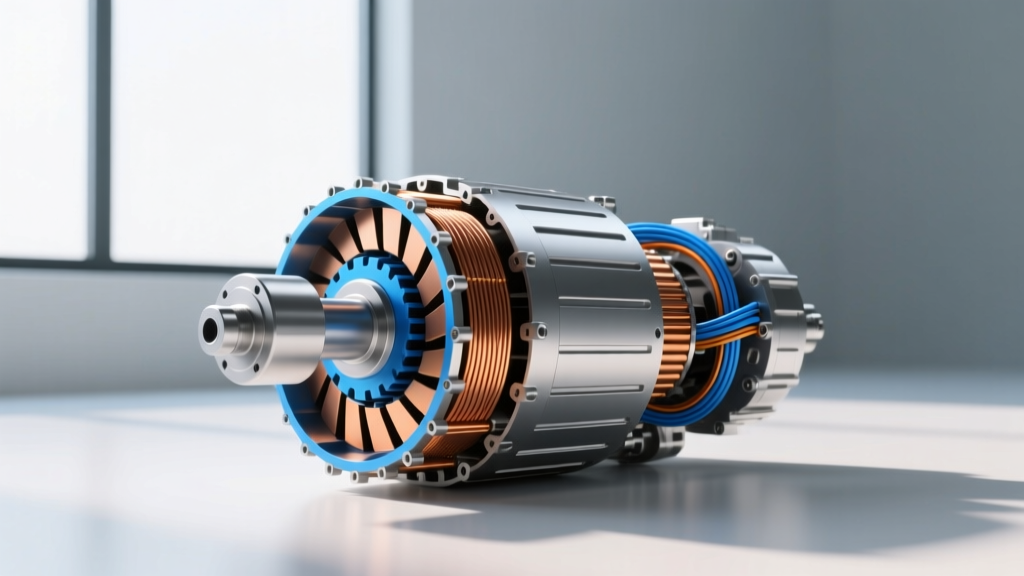
An EV vehicle motor converts electrical energy from the battery into mechanical rotation to drive the wheels — without combustion, exhaust, or a multi-speed transmission. Unlike a gas engine with hundreds of moving parts, a typical EV motor has just one: the rotor. Most modern EVs use either a permanent magnet synchronous motor (PMSM) or an AC induction motor (ACIM), delivering 85–97% energy conversion efficiency compared to roughly 20–35% for an internal combustion engine. Motor type directly affects your vehicle's efficiency (miles per kWh), regenerative braking strength, highway-range behavior, and ultimately what you pay at purchase and over time.
How an EV Vehicle Motor Actually Works
At the simplest level, an EV motor uses electromagnetic force to spin a shaft. The battery pack stores energy in kilowatt-hours (kWh) — a measure of total energy capacity. The motor's power is rated in kilowatts (kW) — a measure of how fast it can use or deliver that energy at any given moment. Confusing kW and kWh is the most common EV mistake: think of kWh as the size of the fuel tank and kW as the size of the engine.
When you press the accelerator, the inverter converts DC power from the battery into precisely timed AC current that creates a rotating magnetic field inside the motor. This field pushes the rotor, which turns the axle and the wheels. When you lift off the accelerator, the process reverses: the motor becomes a generator, converting kinetic energy back into electricity and sending it to the battery. That's regenerative braking, and it's why EVs recover energy that gas cars simply waste as brake heat.
According to the U.S. Department of Energy, electric drivetrains convert roughly 77% of grid electricity into wheel energy, versus only 12–30% of gasoline energy in a conventional car.
AC Induction vs Permanent Magnet: The Two Main EV Motor Types
Not all EV motors are identical. The two dominant designs each carry trade-offs that influence efficiency, cost, and real-world driving feel.
| Attribute | Permanent Magnet Synchronous (PMSM) | AC Induction Motor (ACIM) |
|---|---|---|
| Efficiency (typical) | 93–97% | 85–92% |
| Regenerative braking strength | Stronger — magnets always active | Good but requires energizing the rotor |
| City / stop-and-go efficiency | Superior | Slightly lower |
| Highway / sustained high-RPM | Good, but back-EMF limits top-end | Strong at sustained high speed |
| Raw material concern | Uses neodymium/rare-earth magnets | No rare-earth metals in rotor |
| Cost to manufacture | Higher (magnet cost) | Lower (copper/aluminum rotor) |
| Examples in production | Tesla Model 3/Y (rear), Hyundai Ioniq 5, Ford Mustang Mach-E, Chevrolet Equinox EV | Older Tesla Model S/X front motor, some heavy-duty applications |
The industry has shifted decisively toward PMSM designs because most daily driving involves low-to-moderate speeds where their efficiency edge matters most. However, some manufacturers pair both types in dual-motor AWD configurations — a PMSM on one axle for efficiency and an ACIM on the other that can freewheel when not needed, eliminating drag losses.
Motor Type and Real-World Range: What the Numbers Show
Motor efficiency shows up directly in your miles-per-kWh figure, which is the EV equivalent of MPG. A more efficient motor extracts more distance from the same battery size, which means either more range or a smaller (cheaper, lighter) battery delivering the same range.
| Vehicle (2025/2026) | Motor Type | Battery (kWh usable) | EPA Range | Efficiency (mi/kWh) | Combined MPGe |
|---|---|---|---|---|---|
| Hyundai Ioniq 5 RWD | PMSM (rear) | 77.4 | 303 mi | 3.9 | 114 |
| Tesla Model 3 RWD | PMSM (rear) | 57.5 | 272 mi | 4.7 | 132 |
| Ford Mustang Mach-E Select RWD | PMSM (rear) | 70.0 | 250 mi | 3.6 | 101 |
| Toyota bZ4X FWD | PMSM (front) | 64.0 | 252 mi | 3.9 | 114 |
Source: fueleconomy.gov. Real-world highway range is typically 10–15% below EPA combined; cold weather (below 30°F) can cut range 20–35% regardless of motor type.
Notice the Tesla Model 3's efficiency advantage — partly due to its motor/inverter tuning and partly from aero and weight. That efficiency edge lets Tesla deliver comparable range with a smaller, lighter battery, which reduces cost and curb weight.
EV Motor vs Gas Engine vs Hybrid: Cost and Efficiency Compared
The motor is where an EV's fundamental cost and efficiency advantages originate. Here's how the three powertrains stack up on a per-mile basis.
| Metric | BEV (PMSM motor) | Hybrid (HEV) | Gas Car (ICE) |
|---|---|---|---|
| Drivetrain efficiency | 85–97% (motor) | 35–45% combined | 20–35% |
| Energy cost per mile (avg US) | $0.04–0.06 (home charging) | $0.10–0.13 | $0.14–0.18 |
| Moving parts in drivetrain | ~20 | 200+ | 200+ |
| Routine maintenance (5 yr) | $500–900 | $2,000–3,000 | $2,500–4,000 |
| Oil changes needed | None | Yes, every 5–10k mi | Yes, every 5–10k mi |
| Transmission | Single-speed reduction gear | eCVT / multi-speed | 6–10 speed automatic |
Over five years and 75,000 miles, a BEV owner typically saves $3,000–5,000 in fuel and maintenance versus a comparable gas car, per data from fueleconomy.gov and AAA's Your Driving Costs studies. Hybrids split the difference — better efficiency than gas, but they still carry an engine, transmission, and exhaust system that can fail.
What Motor Type Means for Ownership: A Buyer's Decision Framework
Choose a PMSM-equipped EV if:
- You drive mostly city and suburban routes (the efficiency advantage compounds in stop-and-go).
- You want the strongest regenerative braking for one-pedal driving feel.
- Range-per-kWh is a priority because you regularly drive near the edge of the battery.
- You're buying a mainstream 2025/2026 model — most now use PMSM.
An ACIM or dual-motor (PMSM + ACIM) setup may suit you if:
- You need AWD with a motor that can fully disconnect to reduce drag on dry pavement.
- You frequently drive sustained highway speeds above 80 mph where induction motors tolerate heat well.
- Rare-earth supply chain concerns influence your purchase values.
Motor type should NOT be your only filter. Also weigh:
- Battery chemistry (LFP for longevity and daily 100% charging; NMC for energy density and range).
- DC fast-charge speed (10–80% in under 25 minutes is the current benchmark).
- Home charging access — without Level 2 at home, an EV's cost and convenience advantages shrink substantially.
- Federal §30D tax credit eligibility, which for 2026 still offers up to $7,500 but with MSRP caps ($55,000 sedans / $80,000 SUVs and trucks), buyer income limits, and battery-sourcing requirements. Check the IRS clean vehicle credit page before committing.
Common Misconceptions About EV Motors
| Myth | Fact |
|---|---|
| "EV motors wear out like gas engines." | EV motors have one moving part (the rotor) on bearings. Failures are rare; the motor itself often outlasts the car. Battery degradation is the real longevity concern. |
| "More horsepower always means a better motor." | Peak HP is less relevant than sustained power and efficiency. A 250 kW motor that delivers 4.5 mi/kWh beats a 400 kW motor that delivers 2.8 mi/kWh for daily commuting. |
| "Dual motors are always faster and better." | Dual motors add AWD and power but reduce efficiency by 5–10% and add weight/cost. RWD single-motor is the efficiency king for most buyers. |
| "EV motors need regular service." | No oil, no spark plugs, no timing belts. Coolant loops and reduction-gear fluid are checked at long intervals — typically every 40,000–80,000 miles. |
| "Regenerative braking eliminates brake wear entirely." | It drastically reduces wear (many EVs go 80,000+ miles on original pads), but friction brakes are still required and must be maintained. |
First-Time EV Buyer Essentials: Beyond the Motor
The motor is the heart of the drivetrain, but a satisfying EV purchase depends on the surrounding ecosystem. Here's what to verify before signing:
- Home charging feasibility: A Level 2 home charger (7.7–11.5 kW, 240V) adds 25–45 miles of range per hour and costs $800–2,500 installed including panel evaluation. Without home charging, public DC fast-charging at $0.30–0.50/kWh erases most of the fuel-cost advantage versus gas.
- Realistic range planning: Take the EPA figure and subtract 15% for highway driving, another 20–30% for sustained sub-30°F weather. A 300-mile EPA rating realistically means 200–220 miles of usable winter highway range before you need to stop.
- Charging speed matters more than peak range: A vehicle that charges at 250 kW (10–80% in ~18 minutes) is more road-trip-friendly than one at 150 kW (~30 minutes), even if the latter has 20 more miles of EPA range.
- Battery warranty: Federal law requires 8 years / 100,000 miles minimum for EV battery packs; most manufacturers guarantee 70% capacity retention over that term.
- Insurance: EV premiums run 10–25% higher than comparable gas models due to repair costs and battery replacement exposure. Get a quote before purchase.
Frequently Asked Questions
Do EV motors lose power over time?
Minimal power loss over the vehicle's life. The motor itself is not the wear item — the battery is. Expect 10–15% battery capacity loss over 100,000 miles depending on chemistry, charging habits, and climate. LFP batteries typically degrade slower than NMC.
Can an EV motor handle towing?
Yes, but towing cuts range dramatically — often 40–55% — because aerodynamic drag rises with speed and weight. A truck rated for 350 miles EPA may deliver only 160–190 miles towing a 5,000-lb trailer at 65 mph. Motor torque is excellent for towing; range is the limiting factor.
Why do some EVs use two different motor types?
Dual-motor setups sometimes pair a PMSM on one axle for everyday efficiency with an ACIM on the other that can be fully de-energized when AWD isn't needed. This eliminates the drag penalty of a permanently engaged second motor and improves highway efficiency.
Is a single-motor or dual-motor EV better for me?
If you live in a mild climate and rarely encounter snow or unpaved roads, single-motor RWD delivers the best efficiency and lowest price. Choose dual-motor AWD if you need traction in snow, plan to tow, or want sub-4-second 0–60 performance — and accept 5–10% lower efficiency and a $3,000–6,000 price premium.
Does the motor type affect eligibility for the federal tax credit?
No. The §30D credit is based on battery sourcing, critical minerals, vehicle MSRP caps, and buyer income — not motor type. However, motor efficiency indirectly matters: a more efficient motor may allow a smaller battery that keeps MSRP under the credit cap.