The Quick Answer on EV Van Conversions
An EV van conversion typically costs $20,000–$60,000+ for the powertrain swap alone (on top of a donor van that runs $5,000–$25,000), delivers 80–200 miles of real-world range depending on battery size and build weight, and requires reliable access to Level 2 or DC fast charging. The payoff is dramatically lower fuel and maintenance cost — but only if your driving pattern fits the range envelope and you can charge at home or at your overnight stops. For most van-lifers covering 50–100 miles per day with a home base, an EV conversion makes financial and practical sense. For cross-country boondockers chasing remote BLM land, a diesel Sprinter remains the pragmatic choice in 2026.
What an EV Van Conversion Actually Involves
An EV van conversion replaces the internal-combustion powertrain of a donor van — typically a Ford E-Series, Chevrolet Express, Mercedes Sprinter, or older VW Transporter — with an electric motor, motor controller, high-voltage battery pack, and associated wiring, cooling, and charging hardware. Unlike a factory-built electric van such as the Ford E-Transit (126 miles EPA, 68 kWh usable, starting around $47,000 before incentives), a conversion lets you pick your exact donor chassis, roof height, and wheelbase, then size the battery to your needs.
The core components of a typical conversion include:
- Electric motor: 80–200 kW (107–268 hp), often salvaged from a wrecked Tesla, Nissan Leaf, or Chevrolet Bolt
- Motor controller/inverter: matched to the motor, typically 100–400 kW rated
- Battery pack: 40–150 kWh usable, built from salvaged OEM modules (Tesla, Leaf, Bolt) or new LFP prismatic cells
- Battery Management System (BMS): monitors cell voltage, temperature, and State of Health (SoH)
- Onboard charger: 3.3–19.2 kW for Level 1/Level 2 AC charging
- DC-DC converter: steps high-voltage down to 12V for lights, appliances, and van systems
- Thermal management: liquid cooling or heating for battery longevity and fast-charge capability
- Instrumentation: SoC display, kWh/mile consumption readout, regen braking controls
Professional conversion shops such as EV West, Zelectric, and smaller regional builders handle the engineering, fabrication, and DOT compliance. DIY conversions are possible for those with high-voltage electrical experience, but mistakes carry serious safety risk — lithium battery fires are extremely difficult to extinguish, and improper high-voltage wiring can be lethal.
EV Van Conversion Cost Breakdown: What You Will Actually Spend
The total investment for an EV van conversion spans the donor vehicle, parts, labor, and ongoing operating costs. Here is a realistic 2026 breakdown based on current shop quotes and component pricing:
| Cost Category | Budget DIY | Mid-Range Shop | Premium Build |
|---|---|---|---|
| Donor van (E-Series, Express, Sprinter) | $5,000–$10,000 | $12,000–$20,000 | $18,000–$30,000 |
| Battery pack (salvaged OEM modules) | $4,000–$8,000 (40–60 kWh) | $10,000–$18,000 (60–100 kWh) | $18,000–$35,000 (100–150 kWh, new LFP) |
| Motor + controller | $2,500–$5,000 | $5,000–$10,000 | $8,000–$15,000 |
| Charger, BMS, DC-DC, wiring, cooling | $2,000–$4,000 | $4,000–$7,000 | $6,000–$12,000 |
| Fabrication & engineering labor | $0 (your time) | $10,000–$20,000 | $20,000–$45,000 |
| Interior build-out (insulation, bed, kitchen) | $3,000–$8,000 | $8,000–$20,000 | $20,000–$50,000+ |
| Registration, inspection, DOT compliance | $500–$1,500 | $1,000–$2,500 | $1,500–$3,000 |
| Total | $17,000–$36,500 | $50,000–$97,500 | $91,500–$190,000+ |
For context, a comparable diesel Sprinter van conversion (used chassis + professional build-out) typically runs $60,000–$150,000 total. The EV route shifts cost from fuel and maintenance into the upfront battery and drivetrain investment.
Range Reality: What to Expect From a Converted EV Van
Range is the single most consequential spec in any EV van conversion, and it is heavily influenced by battery size, vehicle weight, aerodynamics, and driving conditions. Vans are heavy (6,000–9,000 lbs loaded) and aerodynamically blunt, which means efficiency typically falls between 1.5–3.0 kWh per mile — far worse than a sedan's 0.25–0.35 kWh/mile.
| Battery Size | Est. Real-World Range (70°F, 60 mph) | Est. Cold-Weather Range (25°F, highway) | Comparable Gas/Diesel Range |
|---|---|---|---|
| 40 kWh usable | 80–110 miles | 55–75 miles | 25-gal tank @ 15 mpg = 375 miles |
| 60 kWh usable | 120–170 miles | 85–120 miles | 25-gal tank @ 15 mpg = 375 miles |
| 100 kWh usable | 200–280 miles | 140–200 miles | 25-gal tank @ 15 mpg = 375 miles |
| 150 kWh usable | 300–400 miles | 210–290 miles | 25-gal tank @ 15 mpg = 375 miles |
Real-world caveats: These figures assume a 7,000–8,000 lb loaded van at steady highway speeds. Mountain driving, towing, headwinds, and roof racks can reduce range by an additional 10–25%. Cold weather is the biggest range killer — lithium batteries lose efficiency below 40°F, and cabin heating draws 2–5 kW continuously. A heat pump helps but does not eliminate the penalty.
For perspective, the factory-built Ford E-Transit achieves 126 EPA miles from 68 kWh usable in a relatively light, aerodynamic cargo van body. A heavier, boxier conversion van with the same battery would deliver noticeably less.
Charging a Converted EV Van: Home, Public, and Off-Grid
Charging logistics are where most EV van conversions succeed or fail. Unlike a Tesla Model Y that slips into any Supercharger stall, a converted van may face physical clearance issues, connector compatibility challenges, and long charge times due to large battery packs.
Home Charging (Level 2)
A 40-amp, 240V Level 2 circuit (9.6 kW) is the practical minimum for daily van charging. At 2.0 kWh/mile consumption, that adds roughly 4.8 miles of range per hour — meaning a full charge of a 100 kWh pack takes about 10–11 hours. Most conversion owners charge overnight and wake to a full battery.
Home Level 2 installation costs $800–$2,500 for a quality EVSE (ChargePoint Home Flex, Emporia Level 2, or Wallbox Pulsar Plus) plus electrician labor, assuming your panel has capacity. A 200-amp panel upgrade — sometimes needed for larger homes running simultaneous high-draw appliances — adds $1,500–$3,500. Always consult a licensed electrician for final specs and permitting.
Public DC Fast Charging
Most conversion shops install a CCS1 connector for compatibility with Electrify America, EVgo, and other major US networks. Some builders opt for NACS (Tesla's connector) for Supercharger access, though adapter solutions (such as the Ford-approved NACS-to-CCS adapter) also bridge the gap. Peak DC charge rates for conversions typically range from 50–150 kW, constrained by the BMS programming and battery chemistry.
A 100 kWh pack charging at 80 kW average (realistic sustained rate, not peak) adds roughly 40 miles of range per 10 minutes. Expect a 10–80% charge in 45–90 minutes depending on pack size and charge rate. The charge curve tapers significantly above 80% SoC — that last 20% can take as long as the first 80%.
Off-Grid and Boondocking
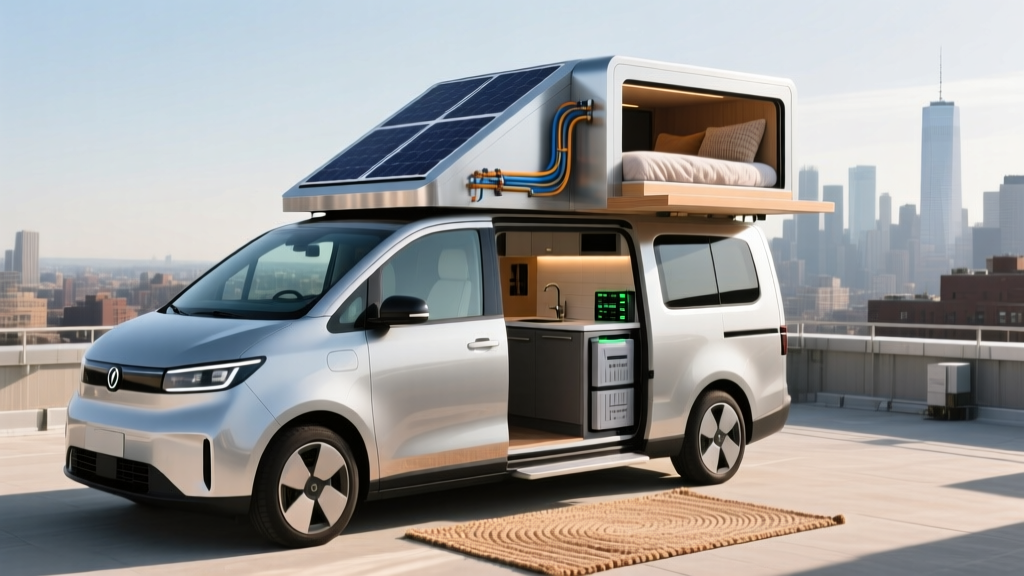
This is where EV conversions face a genuine limitation. A diesel van can carry 25+ gallons of fuel and refill in 5 minutes at any station, even in remote areas. An EV van with a 100 kWh battery carries the equivalent of about 3 gallons of gasoline in energy terms. Solar panels on a van roof (typically 200–400W) generate roughly 1–2 kWh per day — enough to run lights and a fridge, but negligible for recharging the traction battery. For off-grid camping, plan your route around charging infrastructure or accept limited range.
Operating Costs: EV Van vs. Gas/Diesel Van
The strongest argument for an EV van conversion is the operating-cost advantage. Electricity is cheaper than gasoline or diesel per mile, and electric drivetrains eliminate oil changes, transmission service, exhaust repairs, and most brake wear (thanks to regenerative braking).
| Cost Category | EV Van (100 kWh, home charging) | Gas Van (15 mpg) |
|---|---|---|
| Fuel / electricity | $1,800–$2,400 (at $0.15–$0.20/kWh) | $2,880 (at $3.60/gal, 15 mpg) |
| Maintenance (oil, filters, belts, brakes) | $200–$500 | $1,200–$2,000 |
| Insurance | $1,800–$3,000 (specialty/conversion) | $1,400–$2,200 |
| Tires (heavier EV = faster wear) | $600–$1,000 | $500–$800 |
| Annual total | $4,400–$6,900 | $5,980–$7,880 |
Over five years, the EV van saves roughly $5,000–$10,000 in operating costs — but only partially offsets the higher upfront conversion investment. The break-even point depends heavily on your local electricity rates, annual mileage, and how much public DC fast charging you rely on (which costs $0.30–$0.50/kWh, narrowing the fuel savings).
Tax credit note: Converted vehicles generally do not qualify for the federal §30D new EV tax credit because the credit requires the vehicle to be manufactured by an OEM with specific battery-sourcing and critical-minerals compliance. However, some state and local incentive programs may apply — check your state energy office or Alternative Fuels Data Center for current offerings.
Common EV Van Conversion Myths vs. Facts
| Myth | Fact |
|---|---|
| "You can convert any van for under $10,000" | A safe, road-worthy conversion with adequate range (60+ kWh) costs $20,000+ in parts alone, before labor. Sub-$10K builds typically use degraded battery packs with under 40 miles of range. |
| "EV vans have no range — you'll be stranded" | With a 100 kWh pack, expect 200–280 real-world miles. That covers most daily driving. Planning is required for road trips, just as with any EV. |
| "The battery will die in 3 years and cost $30,000 to replace" | Properly managed lithium packs (kept between 20–80% SoC, thermally managed) typically lose 10–20% capacity over 8–10 years. Salvaged Tesla modules often have 80%+ SoH remaining at 100,000+ miles. |
| "You can solar-charge the van while parked off-grid" | 400W of roof solar generates ~1.5 kWh/day in good sun — about 0.75 miles of range. Solar is excellent for house batteries (lights, fridge, devices) but not for the traction pack. |
| "EV conversions are not street-legal" | Most states allow EV conversions with proper documentation, brake certification, and lighting compliance. California, Oregon, and Washington have well-established conversion registration pathways. Check your state DMV requirements before starting. |
| "An EV van can tow a trailer just fine" | Towing cuts range by 30–50%. A van getting 200 miles solo may manage only 100–140 miles towing 3,000 lbs. Possible, but plan accordingly. |
Decision Framework: Should You Convert a Van to Electric?
Choose an EV Van Conversion If:
- You drive under 150 miles per day on most days and have predictable routes
- You have reliable home Level 2 charging (garage, driveway, or dedicated parking with 240V access)
- You value quiet operation, zero tailpipe emissions, and minimal maintenance
- You enjoy the engineering challenge or want to support a specialized conversion shop
- You primarily travel in regions with good public charging infrastructure (West Coast, Northeast, major metro corridors)
- Your total budget is $50,000–$100,000+ and you view this as a long-term investment (8+ years)
Stick With Gas or Diesel If:
- You regularly drive 200+ miles between stops in areas with sparse charging
- You boondock off-grid for days or weeks at a time with no charging access
- You need to tow heavy loads (boats, trailers, other vehicles) over long distances
- You live in extreme cold climates (consistent sub-20°F winters) where range loss is severe
- Your budget is under $40,000 total — a used gas van with basic build is more achievable
- You want a warranty-backed, dealership-serviceable vehicle with no custom-engineering risk
Consider a Factory Electric Van Instead:
- The Ford E-Transit (126 mi EPA, ~$47K MSRP) works for urban delivery routes and light camper builds where range needs are modest
- The Mercedes eSprinter (up to ~200 mi EPA in 2026, ~$75K MSRP) offers more range and a proper Sprinter chassis for camper conversion, though at a premium price
- Factory EVs come with full OEM warranties, dealer service networks, and proven software — trade-offs include less customization and higher base pricing
First-Time EV Van Buyer: What to Know Before You Start
If you are seriously considering an EV van conversion, these practical steps will save you time and money:
- Audit your driving pattern first. Track your actual daily mileage for 30 days. If 90% of your days fall under 120 miles, an EV van fits. If you regularly exceed 200 miles, reconsider.
- Confirm home charging access. Before buying anything, have an electrician assess your panel capacity and quote a 240V/40A circuit installation. Budget $1,000–$3,000.
- Choose your donor van strategically. Ford E-Series and Chevrolet Express vans are the most conversion-friendly due to parts availability, simple chassis layouts, and active conversion-shop support. Sprinters are popular but more complex electronically.
- Size the battery for your worst day, not your average day. If you occasionally need 180 miles of range, spec a 100 kWh pack — not a 60 kWh pack you hope will be enough.
- Budget for insurance early. Specialty conversion vehicles often require agreed-value policies from insurers like Hagerty, Grund, or specialized RV carriers. Get quotes before committing to the build.
- Understand registration requirements in your state. Some states require a brake certification, weight inspection, or specific high-voltage safety labeling for converted vehicles.
- Plan for battery longevity. Install thermal management (heating and cooling), program your BMS to limit charge to 80–90% for daily use, and avoid frequent DC fast charging above 100 kW if your pack chemistry is NMC. LFP cells tolerate 100% SoC and fast charging better, making them the preferred choice for 2026 conversions.
Frequently Asked Questions
How long does an EV van conversion take?
Professional shops typically quote 4–8 months from deposit to delivery, depending on backlog and build complexity. DIY conversions take 6–18 months of part-time work for most builders. Rushing high-voltage work is dangerous — allow adequate time for proper fabrication and testing.
Can I use Tesla battery modules in my van conversion?
Yes. Salvaged Tesla Model S and Model 3 battery modules are among the most popular choices for conversions due to their energy density and availability. A full Model S pack provides roughly 85–100 kWh usable. However, Tesla's BMS protocol is proprietary, so most builders use an aftermarket BMS (such as Orion or SimpBMS) to manage the modules. Expect to pay $120–$200 per kWh for quality used Tesla modules in 2026.
What is the difference between LFP and NMC batteries for a van conversion?
NMC (nickel manganese cobalt) offers higher energy density — more kWh per pound — which matters in a heavy van where weight directly impacts range. LFP (lithium iron phosphate) is heavier per kWh but lasts longer (3,000–5,000 cycles vs. 1,000–2,000 for NMC), tolerates 100% SoC without degradation concern, and is safer (much lower thermal runaway risk). For a van conversion where space is less constrained than in a sedan, LFP is increasingly the preferred choice in 2026.
Will an EV van conversion qualify for any tax credits or incentives?
The federal §30D new-vehicle credit does not apply to aftermarket conversions. However, the Alternative Fuels Data Center tracks state and utility incentives that may cover a portion of EV conversion costs or home charger installation. Some states offer sales tax exemptions on EV conversion parts. Check your state's energy office for current programs, as these change frequently.
How does an EV van handle in snow and cold weather?
Electric motors deliver instant torque, which is excellent for traction in snow — often better than a diesel van's turbo-lag-prone power delivery. The main cold-weather concern is range loss: expect 25–40% reduction at 20°F due to battery chemistry slowdown and cabin heating draw. A heat pump and battery preheating system are strongly recommended for cold-climate van lifers.
Is it cheaper to convert a van or buy a factory electric van?
It depends on your needs. A Ford E-Transit starts around $47,000 with 126 miles of range and a full OEM warranty — cheaper than most professional conversions. But if you need a high-roof extended-wheelbase Sprinter with 200+ miles of range and a custom camper interior, a conversion or an eSprinter (~$75,000+) are your options, and costs converge in the $80,000–$120,000 range. Conversions offer more customization; factory vans offer warranty and service simplicity.