Quick Answer: Is an EV Truck Conversion Worth It?
An EV truck conversion replaces a gasoline or diesel powertrain with an electric motor, battery pack, and controller on an existing pickup truck chassis. In 2026, a professional conversion typically costs $25,000–$80,000 on top of the donor vehicle price, delivers 80–200 miles of real-world range depending on battery size (40–100+ kWh), and adds 2,000–4,000 lbs of battery weight. Most conversions use CCS1 or J1772 charging at 6.6–19.2 kW Level 2; DC fast charging is rare and expensive to add. Conversions make sense for fleet operators, classic truck restorations, and enthusiasts who want a specific vintage chassis electrified — but for daily drivers seeking a modern EV truck, a factory-built Ford F-150 Lightning, Rivian R1T, or Chevrolet Silverado EV will deliver more range, faster charging, full safety systems, and warranty coverage for a comparable or lower total investment.
What Is an EV Truck Conversion and How Does It Work?
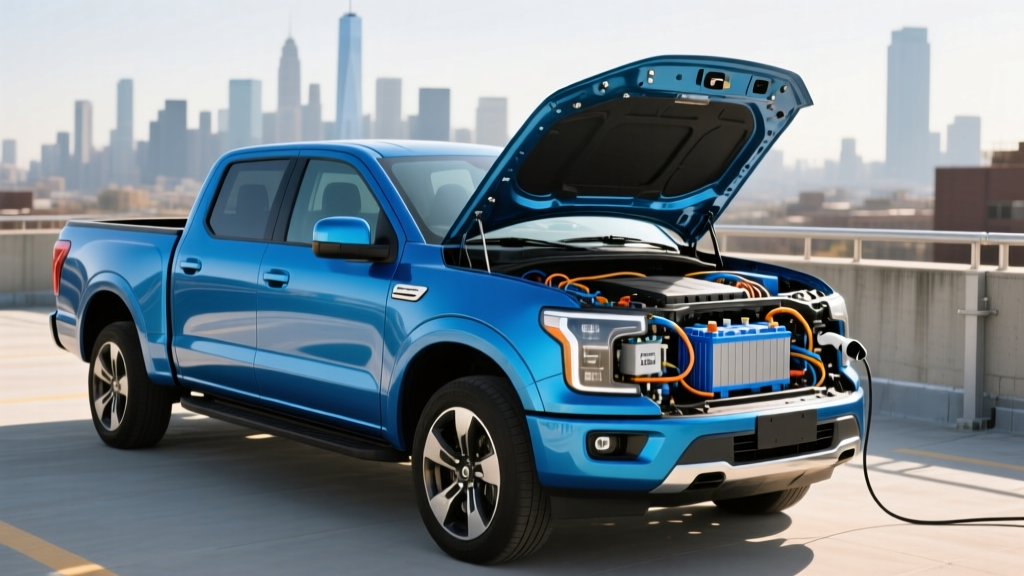
An EV truck conversion strips the internal combustion engine, fuel tank, exhaust system, and transmission from a donor pickup and replaces them with an electric motor, inverter/controller, battery modules, onboard charger, and thermal management system. The original chassis, suspension, brakes, and body remain — though suspension upgrades are often needed to handle the added battery mass.
Conversion shops and DIY builders typically source components from a few well-established suppliers: NetGain or HPEVS for AC induction or permanent magnet motors, OpenInverter or EV West for motor controllers, and salvaged or new lithium battery modules (often repurposed Tesla, Nissan LEAF, or Chevy Volt packs). The result is a functional electric pickup, but one that lacks the integrated engineering, crash testing, and software optimization of a factory EV.
The two main conversion approaches are:
- Direct-drive motor to existing transmission: The electric motor is coupled to the truck's original manual or automatic transmission. Simpler to build, but the transmission adds weight, parasitic loss, and maintenance.
- Direct-drive with no transmission: The motor connects directly to the differential or axle. More efficient and fewer moving parts, but requires a motor with a wide torque/RPM band and careful gearing selection.
EV Truck Conversion Cost Breakdown: What You'll Actually Spend
The sticker shock on conversions is real. Here is a realistic 2026 cost breakdown for a mid-range professional conversion on a common donor truck (e.g., 1990s–2010s Ford Ranger, Chevrolet S-10, or Toyota Tacoma):
| Component / Service | Budget Build | Mid-Range Build | High-End Build |
|---|---|---|---|
| Donor vehicle | $3,000–$6,000 | $5,000–$12,000 | $10,000–$25,000 |
| Electric motor + controller | $3,500–$6,000 | $6,000–$10,000 | $10,000–$18,000 |
| Battery pack (40–100 kWh) | $6,000–$12,000 | $12,000–$25,000 | $25,000–$40,000 |
| BMS + wiring + safety systems | $2,000–$4,000 | $4,000–$7,000 | $7,000–$12,000 |
| Onboard charger + charge port (CCS/J1772) | $1,500–$3,000 | $3,000–$5,000 | $5,000–$9,000 |
| Thermal management (cooling/heating) | $1,000–$2,000 | $2,000–$5,000 | $5,000–$8,000 |
| Suspension / brake upgrades | $1,500–$3,000 | $3,000–$5,000 | $5,000–$8,000 |
| Labor (professional shop, 200–600 hrs) | $15,000–$25,000 | $20,000–$35,000 | $30,000–$50,000 |
| Engineering, fabrication, testing | $2,000–$5,000 | $5,000–$10,000 | $10,000–$20,000 |
| Total estimated cost | $35,500–$66,000 | $60,000–$114,000 | $107,000–$190,000 |
For comparison, a 2026 Ford F-150 Lightning XLT starts at approximately $54,995 MSRP before any incentives, with 240 miles of EPA range, 150 kW DC fast charging capability, a full factory warranty, and modern ADAS features. A Rivian R1T Dual-Motor Standard starts around $69,900 with 270 miles EPA range. Even after a conversion's lower operating costs, the upfront investment is difficult to recoup through fuel savings alone unless the truck sees very high annual mileage.
Range, Charging, and Performance: What to Expect from a Converted Truck
Range is the single most variable outcome in a conversion, because it depends entirely on battery capacity, vehicle weight, aerodynamics, and driving conditions. Pickup trucks are aerodynamically poor — most have a drag coefficient (Cd) of 0.40–0.45, compared to 0.29–0.33 for a purpose-built EV like the F-150 Lightning or Rivian R1T. That drag penalty hits hard at highway speeds.
Real-World Range Expectations for Converted Trucks
| Battery Size | Estimated City Range | Estimated Highway Range (70 mph) | Cold Weather (20°F) Range |
|---|---|---|---|
| 40 kWh | 70–90 mi | 50–65 mi | 45–60 mi |
| 60 kWh | 110–140 mi | 75–100 mi | 65–90 mi |
| 80 kWh | 150–180 mi | 100–130 mi | 90–120 mi |
| 100 kWh | 190–220 mi | 130–160 mi | 115–145 mi |
Note: Converted trucks typically lack heat pumps and advanced thermal management, so cold-weather range loss of 25–40% is common. Factory EV trucks with heat pumps (F-150 Lightning, Rivian R1T) typically lose 15–25% in similar conditions.
Charging Speeds
Most conversions use a Level 2 onboard charger rated at 6.6 kW or 7.2 kW, meaning a full charge from a 240V home outlet takes roughly 8–14 hours for a 60–80 kWh pack. Some higher-budget builds install dual chargers or a 19.2 kW unit, cutting that to 4–6 hours.
DC fast charging (Level 3) is technically possible but adds $5,000–$15,000 in hardware (CCS1 or CHAdeMO inlet, DC-DC contactors, high-voltage cabling, and compatible BMS communication). Even when included, most conversions peak at 50–75 kW on DCFC, compared to 150–200+ kW on factory trucks. That means a 10–80% charge on a conversion might take 45–60 minutes versus 18–30 minutes on a Lightning or R1T.
Performance
Electric motors deliver instant torque, so even modest conversions feel punchy around town. A typical mid-range build with a 150–250 kW (200–335 hp) motor will hit 0–60 mph in 6–9 seconds — competitive with many stock V6 and V8 pickups. However, sustained high-speed performance and towing capacity are limited by motor thermal management and battery discharge rates (C-rate). Most conversions are not rated or tested for towing, and attempting to tow heavy loads can rapidly deplete the battery and overheat components.
EV Truck Conversion vs. Factory EV Truck vs. Gas Truck
To put the conversion decision in perspective, here is a data-driven comparison across three realistic options for someone wanting an electric or efficient pickup:
| Metric | EV Conversion (Mid-Range Build) | 2026 Ford F-150 Lightning XLT | 2026 Ford F-150 XL Gas (3.3L V6) |
|---|---|---|---|
| Total upfront cost | $60,000–$114,000 | ~$54,995 MSRP | ~$38,995 MSRP |
| EPA range / equivalent | No EPA rating; est. 100–180 mi | 240 mi (EPA) | ~480 mi (18-gal tank, 22 mpg combined) |
| Real-world highway range | 75–130 mi | ~200–215 mi | ~430 mi |
| Charging / fueling time | 6–14 hrs (L2); 45–60 min (DCFC) | ~10 hrs (L2); ~25 min (10–80% DCFC at 150 kW) | 5 min (gas station) |
| Energy/fuel cost per mile | $0.04–$0.06 (home L2 at $0.14/kWh) | $0.04–$0.06 (home L2 at $0.14/kWh) | $0.15–$0.18 (at $3.40/gal, 22 mpg) |
| Annual fuel/energy (15K mi) | $600–$900 | $600–$900 | $2,250–$2,700 |
| Maintenance (annual est.) | $200–$500 | $300–$500 | $800–$1,200 |
| Warranty | None (shop-dependent) | 3 yr/36K mi bumper; 8 yr/100K mi battery | 3 yr/36K mi bumper; 5 yr/60K mi powertrain |
| Safety ratings (NHTSA/IIHS) | Not crash-tested post-conversion | NHTSA 5-star; IIHS Top Safety Pick | NHTSA 5-star; IIHS Top Safety Pick |
| Federal tax credit (§30D) | Not eligible | Up to $7,500 (subject to income, MSRP caps, battery sourcing — see IRS §30D rules) | Not eligible |
| ADAS features | None (stock donor brakes/steering) | Ford Co-Pilot360 (Level 2): AEB, lane-keep, adaptive cruise | Ford Co-Pilot360 (Level 2) |
The per-mile energy savings of a conversion versus gas are genuine — roughly $0.10–$0.14/mile — but at 15,000 miles/year, that's only $1,500–$2,100 in annual savings. A conversion that costs $40,000 more than a comparable gas truck would take 19–27 years to break even on fuel alone. The math improves for fleet vehicles with higher annual mileage or for builds where the donor truck was already owned and the conversion serves a specific purpose (classic restoration, off-grid solar integration, or commercial short-route duty).
Federal Tax Credits, Registration, and Legal Considerations
One of the biggest misconceptions about EV truck conversions is that they qualify for the federal §30D clean vehicle tax credit. They do not. The credit applies only to new vehicles manufactured by an OEM that meet specific battery sourcing, critical mineral, MSRP cap ($80,000 for trucks), and buyer income requirements. A conversion is not a "new clean vehicle" under IRS definitions.
Some states offer separate incentives for EV conversions or for registering a converted EV, but these vary widely and change frequently. Check your state's energy or DMV website for current programs.
Registration and Inspection
Registering a converted EV requires re-titling the vehicle in most states, often as a "specially constructed" or "rebuilt" vehicle. Requirements vary, but generally include:
- A state inspection verifying the electric drivetrain is safely installed
- Updated vehicle weight documentation (battery mass can push a half-ton truck into heavier registration classes)
- Proof that all original safety equipment (lights, mirrors, seatbelts, windshield wipers) remains functional
- Emissions testing exemption paperwork (most states waive emissions for EVs, but you must apply for the exemption)
Insurance
Insuring a converted EV is more complex and often more expensive than a factory vehicle. Many mainstream insurers will not write comprehensive/collision coverage on a conversion because there is no established book value. Specialty insurers (Hagerty, Grundy) may offer agreed-value policies, particularly for classic truck conversions. Budget 20–40% more for insurance compared to a stock donor vehicle.
Common EV Truck Conversion Myths vs. Facts
| Myth | Fact |
|---|---|
| "Conversions are cheaper than buying a factory EV truck." | A professional mid-range conversion costs $60,000–$114,000 total (donor + build). A 2026 F-150 Lightning XLT starts at ~$54,995 with warranty, 240 mi range, and DC fast charging. Conversions are costlier for most buyers. |
| "I can charge a conversion at any DC fast charger." | Most conversions have Level 2 (6.6–19.2 kW) charging only. Adding DCFC requires $5,000–$15,000 in additional hardware and still typically peaks at 50–75 kW, not the 150+ kW of factory trucks. |
| "Conversions qualify for the $7,500 federal tax credit." | They do not. §30D applies only to new OEM-manufactured clean vehicles meeting battery sourcing and MSRP caps. Check IRS guidelines for details. |
| "A conversion will have the same range as a factory EV truck." | Factory trucks are aerodynamically optimized (Cd ~0.30–0.33) with heat pumps and advanced thermal management. Conversions use boxy donor bodies (Cd ~0.40–0.45) and typically lack heat pumps, resulting in 30–50% less range for the same battery size. |
| "I can tow as much with a conversion as the original truck." | Most conversions are not tow-rated. The added battery weight reduces payload, and sustained towing at highway speeds can overheat motors and deplete batteries in 30–50 miles. Factory EV trucks like the Lightning are rated for 7,700–10,000 lbs towing with integrated trailer brake controllers. |
| "A DIY conversion is easy and cheap." | DIY builds can reduce labor costs to $5,000–$15,000 in parts, but require high-voltage electrical skills, fabrication ability, and hundreds of hours. Incorrect wiring or battery management can cause fires. Budget DIY builds still total $25,000–$40,000 when including all components. |
Who Should Consider an EV Truck Conversion (and Who Shouldn't)
Decision Framework: Is a Conversion Right for You?
Choose an EV truck conversion if:
- You have a specific classic or vintage truck (e.g., 1960s–1990s Ford F-100, Chevy C10, Toyota Land Cruiser) that you want to preserve and modernize
- You are a fleet operator with predictable short routes (under 80 miles/day), depot charging, and high annual mileage where fuel savings compound quickly
- You have advanced electrical and fabrication skills and want a DIY project with a known donor platform
- You live in a region with robust home charging access and mild climate (less range loss from cold weather)
- You value uniqueness and customization over warranty, safety ratings, and resale value
Choose a factory EV truck (F-150 Lightning, Rivian R1T, Silverado EV) if:
- You need 200+ miles of reliable daily range with DC fast charging for road trips
- You want NHTSA crash-test ratings, IIHS safety awards, and modern ADAS (automatic emergency braking, lane-keeping, blind-spot monitoring)
- You want eligibility for the federal §30D tax credit (up to $7,500, subject to IRS income and sourcing rules)
- You need a factory towing rating and integrated trailer systems
- You want warranty coverage, dealer service, and predictable resale value
- Your total budget is under $60,000
Choose a gas or hybrid truck if:
- You regularly tow heavy loads (8,000+ lbs) over long distances
- You lack reliable home or depot charging access
- You drive in extreme cold climates where EV range loss exceeds 30%
- You need maximum range in remote areas with sparse charging infrastructure
Real-World Ownership Considerations for Converted EV Trucks
Home Charging Access Is Essential
Without a dedicated Level 2 (240V, 30–50 amp) home charging circuit, owning a converted EV truck is impractical. Public charging networks (Electrify America, EVgo, ChargePoint) are designed for CCS1 or NACS-equipped factory vehicles — and many stations will not communicate properly with aftermarket charge controllers. Budget $800–$2,500 for a home Level 2 charger installation (equipment plus electrician), and potentially $2,000–$5,000 more if your electrical panel needs a 200-amp upgrade.
Climate Matters More Than You Think
Converted trucks typically lack the sophisticated battery thermal management systems found in factory EVs. In sub-freezing temperatures, expect 25–40% range loss compared to 15–25% for a factory truck with a heat pump. Battery charging speeds also slow dramatically in cold weather without preconditioning — a feature rarely implemented in conversions. If you live in the upper Midwest, Mountain West, or Northeast, factor this into your range calculations.
Resale Value and Longevity
Factory EV trucks benefit from established depreciation curves and battery warranty coverage (typically 8 years/100,000 miles). Converted trucks have no standardized resale market, and the battery pack's state of health (SoH) is a major unknown for future buyers. Repurposed battery modules from salvaged vehicles may already have 50,000–100,000 miles of degradation. Plan to own a conversion long-term — flipping one is unlikely to recover your investment.
Maintenance and Support
The good news: EVs have far fewer moving parts than gas trucks. No oil changes, no spark plugs, no transmission fluid (in direct-drive builds), and regenerative braking extends brake pad life significantly. The bad news: when something does go wrong — a BMS fault, a motor controller failure, a coolant leak in the battery pack — you are dependent on the conversion shop or your own diagnostic skills. There is no dealer service department to fall back on.
Frequently Asked Questions
How long does an EV truck conversion take?
A professional conversion typically takes 3–8 months from start to finish, depending on shop workload, parts availability, and build complexity. DIY builds can stretch to 12–24 months for builders working part-time.
Can I convert any truck to electric?
Technically, yes — but lighter, simpler trucks are better candidates. Popular donor vehicles include the Ford Ranger (1990s–2011), Chevrolet S-10, Toyota Tacoma (1st/2nd gen), and classic Ford F-100/C10 pickups. Heavy-duty trucks (F-250/350, Ram 2500) require larger motors and more battery capacity, increasing cost substantially.
What battery chemistry is used in conversions?
Most conversions use NMC (nickel manganese cobalt) lithium-ion modules salvaged from Tesla, Nissan LEAF, or Chevy Volt packs. Some builders use new LFP (lithium iron phosphate) cells from suppliers like EVE or CATL. LFP offers longer cycle life (3,000–5,000 cycles vs. 1,000–2,000 for NMC) and better thermal stability, but lower energy density — meaning more weight for the same kWh capacity.
Is a converted EV truck safe in a crash?
This is a critical concern. Converted trucks have not been crash-tested by NHTSA or IIHS after modification. The battery pack placement, high-voltage cable routing, and structural integrity of the conversion all affect crash safety. Factory EV trucks undergo extensive crash testing and include engineered crumple zones, battery armor, and automatic high-voltage disconnect. If safety is a top priority, a factory EV is the clear choice.
Can I use solar panels to charge a converted EV truck?
Yes, but indirectly. You cannot charge directly from panels to the truck at practical speeds. Instead, solar panels feed your home electrical system or a stationary battery (like a Tesla Powerwall), and the truck charges from your home Level 2 circuit. A typical 10 kW residential solar array produces roughly 35–45 kWh/day in summer — enough to replenish a moderate conversion battery overnight, depending on your local solar irradiance.
What's the most affordable way to get an electric truck in 2026?
For most buyers, a factory EV truck is the most cost-effective path. The 2026 Ford F-150 Lightning XLT at ~$54,995 (potentially $47,495 after the $7,500 federal credit, if eligible) offers 240 miles EPA range, DC fast charging, full warranty, and safety features that no conversion can match. Used Lightning and Rivian R1T models from 2022–2024 can be found in the $35,000–$50,000 range and may qualify for the used clean vehicle credit (up to $4,000 or 30% of sale price, with income caps).