Quick Answer: Can Electric Trucks Tow Travel Trailers?
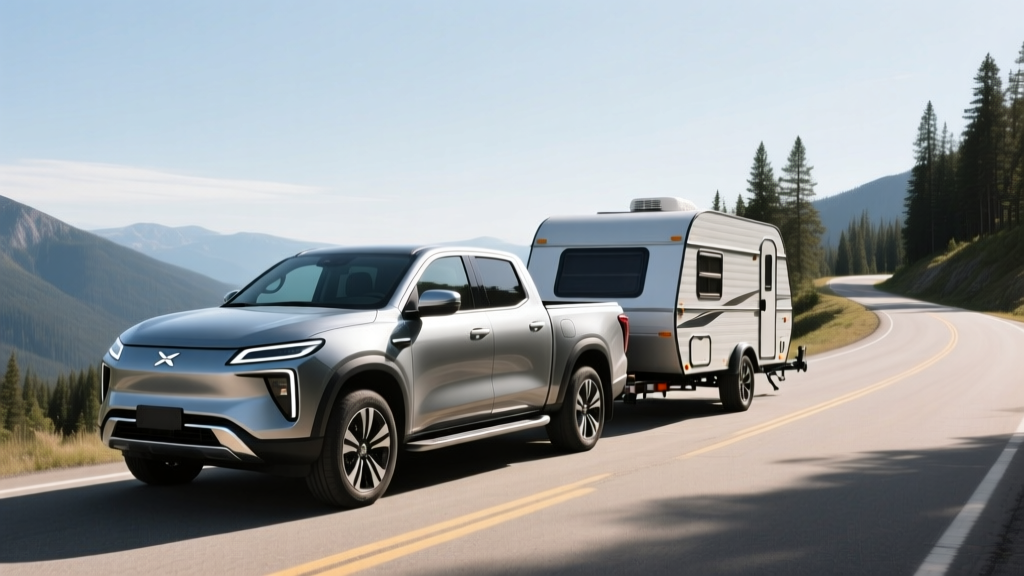
Yes, but with major caveats. Current electric trucks like the Ford F-150 Lightning, Rivian R1T, and Chevrolet Silverado EV can physically tow travel trailers weighing 5,000-10,000 pounds. However, expect 50-70% range reduction when towing. A truck with 320 miles EPA range drops to 100-160 miles while pulling a 6,000-lb trailer. DC fast charging every 90-120 minutes is mandatory on road trips, and not all chargers support easy trailer access.
The Reality of EV Travel Trailers in 2026
Search for "EV travel trailers" and you'll find concept renderings and prototypes from companies like Lightship, Airstream (with Thor), and Pebble. These aren't conventional trailers with batteries—they're electrically motorized travel trailers designed to reduce tow-vehicle range loss by 30-50%. As of early 2026, most remain in pre-production or limited beta testing.
What you can buy today are conventional travel trailers (Airstream, Jayco, Grand Design) towed by electric trucks. The math works differently than gas rigs, and the ownership experience demands planning that internal combustion engine (ICE) truck owners never face.
Electric Truck Towing Capacity vs. Gas Trucks
Electric trucks match or exceed gas truck towing ratings, but efficiency tells the real story:
| Vehicle | Max Tow Rating | Range (No Trailer) | Range (6,000-lb Trailer) | Fuel/Energy Cost (300 mi) |
|---|---|---|---|---|
| Ford F-150 Lightning Extended Range | 10,000 lbs | 320 mi (EPA) | 110-140 mi (real-world) | $35-$55 (DC fast charging) |
| Ford F-150 Gas (3.5L EcoBoost) | 14,000 lbs | 480 mi (24 gal × 20 mpg) | 280-320 mi (towing 12-14 mpg) | $90-$120 (gasoline) |
| Rivian R1T Dual-Motor Max Pack | 11,000 lbs | 410 mi (EPA) | 140-180 mi (real-world) | $45-$70 (DC fast charging) |
| Chevrolet Silverado EV 4WT | 10,000 lbs | 440 mi (EPA) | 150-190 mi (real-world) | $50-$75 (DC fast charging) |
Key takeaway: Electric trucks cost 40-60% less per mile to tow with, but you'll stop 2-3x more often. A 500-mile trip in a gas truck might require one fuel stop; the same trip in an EV truck demands 3-4 charging sessions of 30-45 minutes each.
Real-World Towing Range: Why EPA Numbers Lie
EPA range estimates assume flat terrain, 65 mph speeds, no cargo, and 72°F weather. Towing shatters those assumptions:
- Aerodynamic drag: A travel trailer creates 2-3x the wind resistance of a bare truck. Drag increases exponentially with speed—towing at 75 mph cuts range 20-30% vs. 65 mph.
- Weight: Every 1,000 lbs of trailer weight reduces efficiency by 8-12%. A 6,500-lb loaded trailer is common for a 25-foot travel trailer.
- Regenerative braking limits: EVs recapture energy on deceleration, but heavy trailers overwhelm regen systems. Downhill sections that'd recharge an unladen truck still consume energy when towing.
- Cold weather: Battery chemistry slows below 40°F. Expect an additional 15-25% range loss in winter towing conditions on top of the towing penalty.
Real-world test: A 2025 Ford F-150 Lightning Extended Range (131 kWh usable battery) towing a 5,800-lb Airstream Bambi achieved 1.8-2.1 kWh/mile on a flat interstate at 65 mph in 70°F weather. That translates to 125-140 miles before hitting a 10% state of charge buffer—far below the 320-mile EPA sticker.
Charging Logistics: The Hidden Pain Point
Most DC fast chargers aren't designed for vehicles with trailers:
- Pull-through sites: Only 15-20% of Electrify America, EVgo, and Tesla Supercharger locations offer pull-through stalls where you can charge without unhitching. The rest require backing in or disconnecting the trailer.
- Charge speed: The F-150 Lightning peaks at 210 kW but sustains 130-150 kW from 10-80%, taking 38-44 minutes. The Rivian R1T Gen 2 charges at 200 kW peak, 10-80% in ~35 minutes.
- Charger accessibility: Tight urban charging stations, bollards, and short cables make trailer hookup physically impossible at many locations.
Before any road trip, map your route using A Better Routeplanner (ABRP) or PlugShare, filtering for "pull-through" or "trailer-friendly" stations. Expect 30-45 minute stops every 90-120 miles.
Cost Breakdown: EV vs Gas Towing Ownership
| Cost Category | F-150 Lightning (EV) | F-150 Gas (3.5L EcoBoost) |
|---|---|---|
| Purchase price (base MSRP) | $69,995 | $55,000 |
| Federal tax credit (§30D) | -$7,500* | $0 |
| Fuel/energy (5 years, 25,000 mi towing) | $3,500-$5,000 | $8,500-$11,000 |
| Maintenance (5 years) | $800-$1,200 | $2,500-$3,500 |
| Insurance (5 years) | $9,000-$12,000 | $7,000-$9,500 |
| Total 5-year cost | $75,795-$81,195 | $73,000-$79,000 |
*§30D tax credit eligibility requires MSRP under $80,000 for trucks, buyer income under $300,000 (joint), and battery sourcing compliance. Verify current-year rules at IRS.gov before purchase.
EV trucks save $5,000-$8,000 in fuel and maintenance over five years, but higher purchase price and insurance premiums (15-25% more for EVs) offset most savings. The break-even point is 4-6 years for high-mileage tow rigs.
Motorized EV Travel Trailers: The 2026 Landscape
These upcoming trailers integrate electric motors and batteries to assist the tow vehicle:
- Lightship L1 (announced, deliveries expected late 2026): 80 kWh battery, solar roof, claims "near-zero range impact" on tow vehicle. Starting MSRP ~$125,000.
- Airstream e-stream concept (with Thor Industries): Prototype shown, no production date or pricing confirmed.
- Pebble Flow (announced): Self-propelling capability for campsite maneuvering, 45 kWh battery. Pre-orders open, production timeline TBD.
These aim to solve the range problem by using trailer batteries to power the trailer's wheels in sync with the truck, reducing drag on the tow vehicle. If they deliver on promises, expect 20-30% less range loss vs. conventional trailers. But until independent testing validates claims and production scales, treat them as speculative.
Decision Framework: Should You Tow with an EV?
Choose an Electric Truck for Towing If:
- You tow less than 3,000 miles per year (weekend trips, not cross-country hauls)
- You have home Level 2 charging (240V, 40-80 amp) to refuel overnight for $0.10-$0.15/kWh
- Your typical trips are under 200 miles one-way, or you're willing to stop every 90-120 minutes
- You value instant torque for trailer launches and hill climbs (EV trucks excel here)
- You want lower per-mile energy costs and less maintenance (no transmission fluid, spark plugs, or exhaust systems)
Stick with a Gas/Diesel Truck If:
- You tow frequently over 300 miles (full-time RVers, long-distance boat haulers)
- You lack reliable home charging access (apartment dwellers, street parking)
- You tow in extreme cold (below 20°F) where EV range penalties compound
- You need maximum payload and tow ratings (gas trucks still lead at 14,000+ lbs)
- You can't tolerate 30-45 minute charging stops every 1.5-2 hours
Common EV Towing Misconceptions
| Myth | Fact |
|---|---|
| "EVs can't tow heavy trailers." | Electric trucks match gas truck tow ratings (10,000-11,000 lbs). The issue is range, not capability. |
| "Charging takes too long." | 10-80% DC fast charges take 35-45 minutes—similar to a sit-down meal. But you'll do it 2-3x more often than gassing up. |
| "Regenerative braking recharges the battery downhill." | Regen helps, but a 6,000-lb trailer's momentum overwhelms most systems. You'll still net-consume energy on most downgrades. |
| "EV towing is cheaper than gas." | Per-mile energy costs 40-60% less, but higher purchase price, insurance, and charging-desert risks offset savings for many buyers. |
| "All charging stations work with trailers." | Only 15-20% of DC fast chargers offer pull-through access. Plan routes carefully or risk unhitching at every stop. |
First-Time EV Truck Buyer Checklist
If you're considering an electric truck for towing, verify these before purchase:
- Home charging access: Can you install a Level 2 charger (240V, 60-80 amp circuit)? Expect $800-$2,500 for equipment and electrician work. Without it, towing becomes impractical.
- Electrical panel capacity: Older homes may need a 200-amp service upgrade ($1,500-$4,000) to support a high-power Level 2 charger.
- Typical towing routes: Map your common trips. If they exceed 150 miles one-way, identify pull-through DC fast chargers along the way.
- Climate: If you regularly tow in sub-40°F weather, budget an extra 20% range loss beyond the towing penalty.
- Trailer weight: Weigh your loaded trailer at a CAT scale. Tongue weight, cargo, water, and propane add 1,000-2,000 lbs beyond dry weight.
- Tax credit eligibility: Confirm your income, the truck's MSRP, and battery sourcing meet current §30D requirements. Rules change annually.
The Bottom Line on EV Travel Trailers
Electric trucks can tow travel trailers today, but the experience demands route planning, charging patience, and acceptance of 50-70% range loss. For weekend warriors with home charging and trips under 200 miles, EVs offer lower operating costs and superior towing performance. For full-time RVers or long-haul towing, gas and diesel trucks remain the pragmatic choice until charging infrastructure catches up.
Motorized EV trailers like the Lightship L1 promise to bridge the gap, but production timelines and real-world validation remain uncertain in 2026. Until then, treat "EV travel trailer" searches as a mix of conventional trailer + electric truck combinations and speculative prototypes.
Can I tow a 7,000-pound trailer with an F-150 Lightning?
Yes—the Lightning's max tow rating is 10,000 lbs (Extended Range model). But expect real-world range to drop from 320 miles to 90-120 miles while towing at highway speeds. You'll need to DC fast charge every 75-100 miles on road trips.
Do EV travel trailers exist yet?
Not in production as of early 2026. Lightship, Pebble, and Airstream/Thor have announced motorized electric trailers with 2026-2027 target dates, but none are available for retail purchase. You can currently tow conventional trailers with electric trucks.
How much does it cost to charge an electric truck while towing?
DC fast charging costs $0.35-$0.55/kWh on public networks. A 131 kWh Lightning battery charged from 10-80% costs $35-$55. Towing 300 miles might require 2-3 charges, totaling $70-$165. The same trip in a gas truck burning 12 mpg costs $90-$120 in fuel.
Will towing damage my EV's battery?
No—towing doesn't harm the battery beyond normal degradation. However, frequent DC fast charging (which towing necessitates) accelerates long-term wear. Expect 10-15% battery capacity loss over 100,000 miles if you DC fast charge 80%+ of the time.
What's the best electric truck for towing in 2026?
The Rivian R1T Max Pack (149 kWh, 410-mile EPA range) offers the longest real-world towing range at 140-180 miles with a 6,000-lb trailer. The F-150 Lightning Extended Range provides the best value at $69,995 MSRP before tax credits. The Chevy Silverado EV 4WT balances range (440 mi EPA) and price (~$75,000).