Quick Answer: Do EVs Have a Transmission?
Most electric vehicles use a single-speed reduction gearbox rather than a multi-gear transmission. Because electric motors deliver maximum torque from 0 RPM and operate efficiently across a wide speed range (typically 0–10,000+ RPM), there's no need for the 6-, 8-, or 10-speed automatic transmissions found in gas cars. This single-speed unit reduces the motor's high rotational speed to usable wheel speed via a fixed gear ratio (usually around 8:1 to 12:1). The result: fewer moving parts, no gear hunting, and dramatically lower drivetrain maintenance over the vehicle's life.
Why Electric Motors Don't Need Multiple Gears
Internal combustion engines have a narrow power band. A typical gas engine produces useful torque only between roughly 1,500 and 5,500 RPM, requiring multiple gear ratios to keep the engine in that sweet spot as vehicle speed changes. Shift too early and the engine lugs; shift too late and you waste fuel.
Electric motors operate on entirely different physics. A permanent-magnet synchronous motor (the type used in most EVs from Tesla, Hyundai, Ford, and BMW) produces peak torque at 0 RPM and sustains it through the mid-range before transitioning to a constant-power region at higher speeds. This means:
- 0–60 mph acceleration happens in a single, uninterrupted pull — no shift interruptions
- Highway cruising at 75 mph still falls within the motor's efficient operating range
- Regenerative braking works seamlessly through the same single gear ratio, recapturing energy back into the battery pack
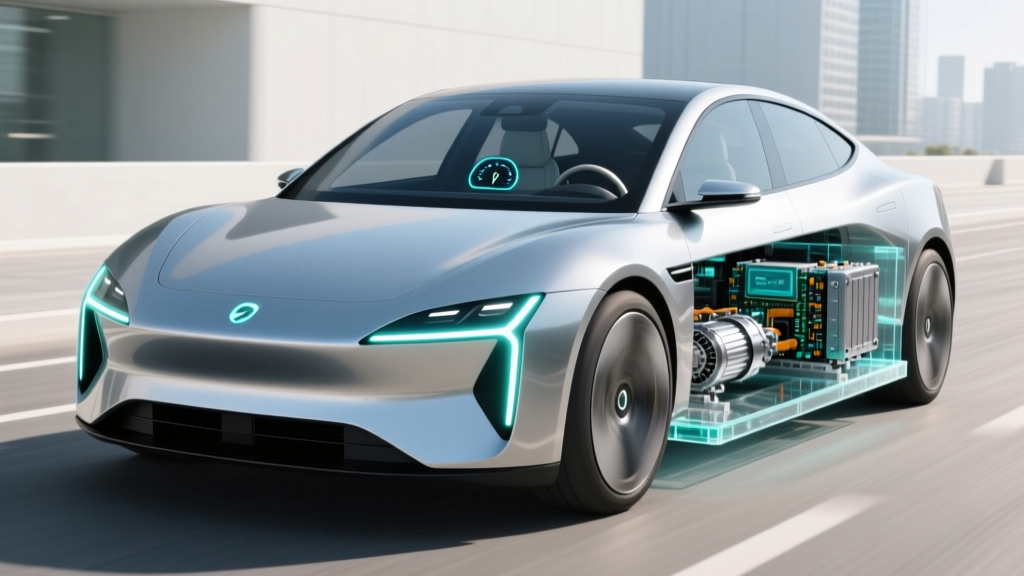
The single-speed reduction gearbox sits between the motor and the differential (or is integrated into a single housing called an electric drive unit, or EDU). It contains far fewer components than a conventional automatic transmission — typically just a pair of helical gears, bearings, and seals bathed in gear oil.
EV Transmission vs. Gas Car Transmission: By the Numbers
The simplicity of an EV drivetrain translates directly into cost and maintenance differences. Here's how the two compare across key ownership metrics:
| Metric | EV (Single-Speed Gearbox) | Gas Car (Multi-Speed Automatic) |
|---|---|---|
| Gear ratios | 1 (fixed reduction) | 6–10 speeds |
| Moving parts in gearbox | ~15–20 | 200+ |
| Transmission fluid changes | Every 60,000–100,000 mi (some sealed for life) | Every 30,000–60,000 mi |
| Avg. fluid service cost | $150–$300 | $200–$450 |
| Transmission replacement cost | $3,000–$6,000 (reduction gear unit) | $4,000–$8,000+ |
| Expected lifespan | 200,000+ mi (typically outlasts the vehicle) | 120,000–180,000 mi before major service |
| Shift interruption during acceleration | None | 100–400 ms per shift |
According to fueleconomy.gov, EVs have significantly fewer drivetrain components subject to wear compared to internal combustion vehicles. The reduction gearbox is one of the most reliable components in an EV — failures are rare and typically related to manufacturing defects caught under warranty rather than wear-related breakdowns.
The Exceptions: EVs That Do Use Multi-Speed Gearboxes
While single-speed is the overwhelming standard, a handful of EVs have used two-speed transmissions for specific engineering reasons:
- Porsche Taycan: Uses a two-speed transmission on the rear axle only. First gear provides explosive launch acceleration (0-60 in 2.6 seconds for the Turbo S), while second gear optimizes highway efficiency and top speed (161 mph). The front axle uses a conventional single-speed unit.
- Audi e-tron GT: Shares the Taycan's J1 platform and the same two-speed rear axle arrangement.
- Original Tesla Roadster (2008): Initially designed with a two-speed gearbox, but reliability issues led Tesla to replace it with a single-speed unit — a decision that shaped the entire industry's approach.
For context, the Taycan's two-speed setup adds complexity and cost but delivers measurable performance benefits: its EPA range of 246 miles (2025 Performance Battery Plus) is competitive despite the added hardware weight. For 95% of EV buyers, though, the single-speed gearbox provides all the performance and efficiency needed.
Real-World Ownership Costs: Drivetrain Maintenance Compared
The EV transmission story is really a maintenance-cost story. Here's a realistic 5-year / 75,000-mile drivetrain maintenance comparison between a typical EV (e.g., 2026 Hyundai Ioniq 5, $42,600 MSRP) and a comparable gas crossover (e.g., 2026 Toyota RAV4, $31,900 MSRP):
| Maintenance Item (75K Miles) | EV Cost | Gas Car Cost |
|---|---|---|
| Transmission/gearbox fluid service | $0–$300 (1 service or sealed) | $400–$900 (2 services) |
| Engine oil changes | $0 (no engine) | $450–$750 (10–15 changes) |
| Brake pad replacement | $0–$200 (regen saves pads) | $400–$800 (2 sets) |
| Spark plugs / ignition | $0 | $200–$400 |
| Timing belt / chain | $0 | $500–$1,200 (if equipped) |
| Coolant flush | $150–$250 | $150–$300 |
| Total drivetrain-related maintenance | $150–$750 | $2,100–$4,350 |
The U.S. Department of Energy has estimated that EV maintenance costs run approximately $0.061 per mile compared to $0.101 per mile for gasoline vehicles — a savings of roughly $3,000 over 75,000 miles, with drivetrain simplicity being a major contributor.
However, this savings must be weighed against higher EV purchase prices (though narrowing), potentially higher insurance premiums (typically 10–25% more for EVs), and the reality that battery replacement outside warranty — while rare — can cost $8,000–$20,000 depending on pack size and chemistry.
Common EV Transmission Myths — Addressed with Facts
| Myth | Fact |
|---|---|
| "EVs have no transmission at all" | They have a single-speed reduction gearbox. It's simpler, but it's still a transmission — it transmits power from motor to wheels at a reduced ratio. |
| "EV gearboxes need frequent fluid changes" | Most are sealed or require service only every 60K–100K miles. Some manufacturers (like Tesla) specify no routine gearbox fluid change at all. |
| "Without a transmission, EVs can't go fast" | The Lucid Air Sapphire hits 200 mph with single-speed gearboxes. The motor's wide RPM range eliminates the need for multiple gears at high speed. |
| "EV drivetrains wear out faster because of instant torque" | Modern EV gearboxes are engineered for peak motor torque. The Tesla Model S Plaid's gearbox handles 1,020 lb-ft without issue. Wear is minimal because there are no clutch packs or torque converters to degrade. |
| "If the gearbox fails, the whole EV is totaled" | Reduction gear units are serviceable and replaceable, typically $3,000–$6,000 — comparable to a gas car transmission job, and covered under the 5-year/60,000-mile powertrain warranty on most EVs. |
How the EV Drivetrain Affects Your Daily Driving Experience
The single-speed transmission fundamentally shapes how an EV feels on the road — and understanding this helps set realistic expectations for first-time EV buyers:
Instant, linear acceleration: Without shift interruptions, EVs pull smoothly and continuously. A 2026 Tesla Model 3 Long Range (346 miles EPA, $42,490 MSRP) hits 0-60 in 4.9 seconds, but the feeling is quicker than the number suggests because there's no pause between gears. In city driving, this makes merging and gap-taking effortless.
One-pedal driving capability: When you lift off the accelerator, the motor reverses its function and becomes a generator, sending energy back through the same single-speed gearbox into the battery. This regenerative braking can decelerate the car at up to 0.3g — enough to come to a complete stop without touching the brake pedal in most traffic situations. This is why EV brake pads often last 100,000+ miles.
Highway efficiency trade-off: A fixed gear ratio means the motor operates at whatever RPM corresponds to your road speed. At 80 mph, most EV motors spin at 8,000–10,000 RPM — still within their efficient range, but not at peak efficiency. This is why EV range drops noticeably at sustained highway speeds (expect 15–25% less than the EPA combined estimate at 75+ mph). A multi-speed transmission could theoretically help here, but the efficiency gain (estimated 2–5%) isn't worth the added weight, cost, and complexity for most vehicles.
Cold-weather reality: The gearbox itself is largely unaffected by cold temperatures, but the battery it draws power from is not. Expect 20–30% range reduction in sub-freezing conditions due to increased battery internal resistance and cabin heating loads. Preconditioning the battery (warming it while plugged in) mitigates this and also protects the gear oil from thickening in extreme cold below -20°F.
Decision Framework: What EV Drivetrain Knowledge Means for Your Purchase
Use This Framework When Shopping
- If you prioritize low maintenance costs: The single-speed EV gearbox is a major advantage. Budget $200–$500 over 5 years for all drivetrain-related maintenance vs. $2,000–$4,000+ for a gas car.
- If you tow frequently: High sustained torque loads generate gearbox heat. Look for EVs with active drivetrain cooling (e.g., Ford F-150 Lightning, Rivian R1T). Check the owner's manual for towing-specific fluid change intervals.
- If you track or performance-drive: The Porsche Taycan's two-speed rear axle is the exception that proves the rule — it offers measurably better launch and top-speed performance. For normal driving, single-speed is optimal.
- If you're buying used: The reduction gearbox is one of the least concerning components. Focus your inspection on battery State of Health (SoH), charging system, and suspension. Ask for a gearbox fluid inspection if the vehicle has 80,000+ miles.
- If you live in an apartment without home charging: The drivetrain simplicity still saves you money, but your bigger concern is charging access. Prioritize EVs with fast DC charging (250+ kW peak) and reliable public networks near you. Consider a PHEV as a bridge.
Frequently Asked Questions
Do Tesla vehicles have a transmission?
Yes — all Tesla models (Model 3, Model Y, Model S, Model X) use a single-speed reduction gearbox. The Model S and Model X use a single-speed unit on each axle (dual-motor models have two gearboxes). Tesla has never used a multi-speed transmission in production since abandoning the two-speed concept in the original Roadster in 2008.
Can I shift gears in an EV like a manual car?
No. There are no gears to shift — the single fixed ratio handles all speeds from 0 to the vehicle's top speed. Some EVs offer selectable drive modes (e.g., Chill, Sport, Track) that change throttle mapping and regen intensity, but these don't alter the gear ratio.
Does the EV gearbox need to be replaced like a gas car transmission?
Rarely. Single-speed reduction gearboxes have no clutch packs, torque converters, or bands to wear out. With proper fluid maintenance (if specified), they typically outlast 200,000 miles. Under the IRS §30D tax credit rules, EVs must carry a battery warranty of at least 8 years/100,000 miles, and most manufacturers bundle the drive unit under a 5-year/60,000-mile or 8-year/100,000-mile powertrain warranty.
Why don't all EVs use two-speed transmissions for better efficiency?
The efficiency gain is marginal (2–5% at highway speeds) while adding 30–60 pounds of weight, $500–$1,500 in manufacturing cost, and additional failure points. For most buyers, optimizing battery chemistry (e.g., LFP for longevity, NMC for energy density) and aerodynamic design delivers better range-per-dollar returns than a second gear ratio.
Is an EV's drivetrain covered under warranty?
Yes. The electric motor and reduction gearbox are classified as powertrain components. Federal law requires EV manufacturers to provide a minimum 8-year/100,000-mile warranty on the battery, and most extend comparable coverage to the drive unit. Check your specific manufacturer's powertrain warranty terms — Hyundai, for example, covers the drive unit for 10 years/100,000 miles on the Ioniq 5.