The Real Math Behind Buying an EV in 2026
Every EV shopper eventually lands on the same question: after the credits, fuel savings, and higher insurance premiums, what does this actually cost me? The sticker price is just the opening move. A $45,000 electric crossover might net you $37,500 after the federal credit and a utility rebate — or it might net you nothing if your income exceeds the cap or the battery fails the sourcing test. Meanwhile, you'll save roughly $4,000 on fuel over five years but pay $1,800 more in insurance.
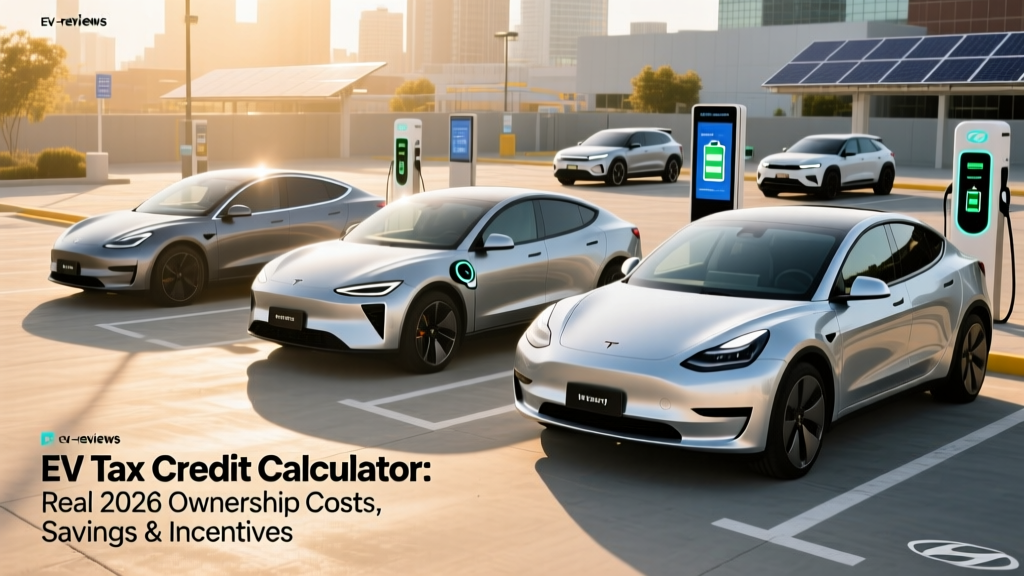
This guide functions as an EV tax credit calculator and total-cost-of-ownership framework. We'll walk through every line item — purchase price, incentives, fuel, maintenance, insurance, and depreciation — using concrete numbers from the IRS, fueleconomy.gov, and current industry data. By the end, you'll know exactly how to build your own cost comparison for any EV you're considering.
IRS §30D Federal Tax Credit: Who Actually Qualifies in 2026
The federal clean vehicle credit under Internal Revenue Code §30D offers up to $7,500 for qualifying new EVs and up to $4,000 for qualifying used EVs (§25E). But "up to" is doing heavy lifting. The credit is now a stack of two $3,750 halves — one for critical minerals sourcing, one for battery component manufacturing — and a vehicle can earn $0, $3,750, or the full $7,500 depending on its supply chain.
§30D New EV Credit Requirements (2026)
- Income caps (modified AGI): $300,000 joint filers / $225,000 head of household / $150,000 single filers — applies to the tax year of purchase or the prior year, whichever is lower
- MSRP caps: $80,000 for vans, SUVs, and pickups; $55,000 for sedans and other body styles
- Battery sourcing: $3,750 requires a threshold percentage of critical minerals extracted or processed in the U.S. or a free-trade-agreement partner; the other $3,750 requires battery components manufactured or assembled in North America — thresholds tighten annually
- Foreign entity of concern (FEOC) restriction: Vehicles with battery components from a FEOC (effectively, certain Chinese suppliers) are disqualified — this restriction expanded to critical minerals in 2025
- Point-of-sale transfer: Buyers can transfer the credit to the dealer at purchase, receiving the amount as an immediate price reduction rather than waiting to claim it on their tax return
- Final assembly: Vehicle must undergo final assembly in North America — verify via the VIN decoder at fueleconomy.gov
The FEOC restriction has materially shrunk the qualifying vehicle list since 2024. Several popular models that once earned the full $7,500 now earn $3,750 or $0 as manufacturers restructure supply chains. Always verify eligibility for the specific model year and trim you're buying — a mid-year battery supplier change can flip eligibility. The IRS maintains a qualified vehicles list, but your dealer's point-of-sale attestation is the mechanism that actually applies the discount at purchase.
5-Year Total Cost of Ownership: EV vs. Gas Baseline
To compare honestly, we need a like-for-like scenario. Below, a mid-size electric SUV (representative of a 2026 Hyundai Ioniq 5 or Tesla Model Y Long Range) is pitted against a comparable gas-powered crossover (think Toyota RAV4 AWD). Both are driven 12,000 miles per year for five years (60,000 miles total).
| Category | EV (Mid-Size SUV) | Gas Crossover | EV Advantage |
|---|---|---|---|
| Base MSRP | $47,000 | $35,000 | –$12,000 |
| Federal tax credit (§30D) | –$7,500 | $0 | +$7,500 |
| State/utility rebates (avg.) | –$1,500 | $0 | +$1,500 |
| Net purchase cost | $38,000 | $35,000 | –$3,000 |
| Fuel / electricity (5 yrs) | $4,320 | $10,500 | +$6,180 |
| Maintenance (5 yrs) | $2,100 | $4,500 | +$2,400 |
| Insurance (5 yrs) | $11,400 | $9,600 | –$1,800 |
| Depreciation (5 yrs) | $19,000 | $14,000 | –$5,000 |
| Total 5-Year Cost | $74,820 | $73,600 | –$1,220 |
The numbers tell a nuanced story. The EV's fuel and maintenance savings — roughly $8,580 combined over five years — are substantial and real. But they're nearly offset by higher depreciation ($5,000 more) and insurance premiums ($1,800 more). In this scenario, the EV costs about $1,220 more over five years, but that gap closes or reverses with a few variables: a lower negotiated price, a full $7,500 credit, cheaper home charging, or a model with stronger resale value.
Fuel Cost Per Mile: The EV's Biggest Advantage
This is where electrification delivers its most tangible payoff. The math depends on two numbers: your electricity rate and the vehicle's efficiency.
Cost-Per-Mile Breakdown
EV (3.5 miles/kWh, $0.16/kWh national average):
- Home charging: $0.16 ÷ 3.5 = $0.046 per mile
- Public DC fast charging (avg. $0.40/kWh): $0.40 ÷ 3.5 = $0.114 per mile
- Blended (80% home / 20% public): $0.059 per mile
Gas crossover (28 MPG combined, $3.50/gallon):
- $3.50 ÷ 28 = $0.125 per mile
At 12,000 miles per year, the home-charging EV spends $552 annually on electricity versus $1,500 on gasoline. That's $948 in annual fuel savings — and it widens if gas prices rise or you have access to off-peak utility rates below $0.10/kWh. If you rely entirely on public DC fast charging, the advantage narrows to about $132 per year, which is why home charging access is the single biggest economic variable in EV ownership.
One caveat: efficiency drops in cold weather. An EV rated at 3.5 mi/kWh may deliver 2.8–3.0 mi/kWh in sustained sub-30°F conditions due to cabin heating demands and battery thermal losses. That raises your winter cost-per-mile by 15–20% — still below gasoline, but not as dramatic as the EPA sticker suggests.
Maintenance Savings: Where EVs Quietly Win
EVs eliminate entire maintenance categories. No engine oil, no transmission fluid, no spark plugs, no timing belts, no exhaust system. Regenerative braking dramatically reduces brake pad wear — many EV owners report original brake pads at 60,000+ miles because regen handles the majority of deceleration.
| Service Item | EV Cost | Gas Vehicle Cost |
|---|---|---|
| Oil changes (5–8 over 5 yrs) | $0 | $400–$640 |
| Transmission fluid | $0 | $150–$250 |
| Brake pads (1–2 replacements) | $0–$200 | $400–$700 |
| Engine air filter | $0 | $100–$150 |
| Cabin air filter (both) | $150–$250 | $150–$250 |
| Tire rotation & replacement | $1,200–$1,600 | $1,000–$1,400 |
| Coolant / misc. fluids | $100–$200 | $200–$400 |
| Estimated Total | $1,450–$2,250 | $2,400–$3,790 |
The one area where EVs cost more: tires. Electric vehicles are heavier (battery mass adds 500–1,000 lbs versus a gas equivalent) and deliver instant torque, both of which accelerate tread wear. Budget for one extra set of tires over five years compared to a gas vehicle — roughly $200–$400 more.
The Insurance Reality: Why EVs Cost More to Insure
EV insurance premiums run 15–25% higher than comparable gas vehicles on average. For a $47,000 EV, expect annual premiums of $2,000–$2,500 versus $1,600–$2,000 for a similarly priced gas crossover, depending on your driving record, location, and coverage levels.
The reasons are structural, not arbitrary:
- Higher repair costs: Battery packs are expensive to replace if damaged, and even minor collision damage near the battery enclosure can trigger a total-write-off protocol at some insurers
- Specialized labor: High-voltage system repairs require certified technicians, and fewer shops have that certification
- Parts availability: EV-specific body panels, sensors, and battery modules can have longer lead times
- Higher vehicle MSRP: Insurers price premiums partly on replacement cost, and EVs still carry a price premium in many segments
Some insurers now offer EV-specific policies with battery coverage riders or usage-based discounts. It's worth quoting at least three carriers — the spread between the cheapest and most expensive quote for the same EV can exceed $800 per year.
Depreciation: The EV Wildcard
This is where the five-year math gets complicated. EVs have experienced steeper depreciation than gas vehicles in recent years, driven by three factors:
- Tesla price cuts: Aggressive new-vehicle price reductions in 2023–2024 cratered used values across the entire EV market — when a new Model Y drops $8,000 overnight, every used Model Y (and its competitors) drops too
- Battery health uncertainty: Used buyers discount for unknown battery degradation, even though most modern LFP and NMC packs retain 85–92% capacity at 100,000 miles
- Rapid tech obsolescence: Newer models charge faster, go farther, and offer better software — a 2022 EV with 250-mile range and 100 kW charging looks dated against 2026 models offering 350+ miles and 250+ kW
According to iSeeCars data, the average 5-year depreciation for EVs hovers around 45–55% versus 38–42% for gas vehicles. However, this varies enormously by model. The Porsche Taycan and Mercedes EQS have seen brutal 55–65% drops, while the Toyota bZ4X and well-equipped Tesla Model Y have held closer to 40–45%. If resale value is a priority, choose models with strong brand loyalty and proven battery longevity data.
State, Local, and Utility Incentives
Beyond the federal §30D credit, dozens of states and utilities offer additional incentives — but they vary wildly by jurisdiction and change frequently:
- California: CVRP rebate up to $7,000 for income-qualified buyers; additional $1,500–$4,500 for low-income applicants scrapping an older vehicle
- Colorado: State tax credit of up to $5,000 for new EVs (through 2028)
- Utility rebates: Many utilities offer $300–$1,500 for Level 2 home charger purchase and installation, plus off-peak charging rates 30–50% below standard
- HVAC/charging bundles: Some utilities combine EV charger rebates with panel-upgrade assistance, offsetting the $1,500–$3,000 cost of a 200-amp service upgrade
Check your state energy office and local utility for current programs — these change annually and often have application deadlines or funding caps. Your tax professional can advise on stacking state credits with the federal §30D credit.
Building Your Own EV Tax Credit Calculator
No online calculator captures your specific situation perfectly. Here's a framework to build your own comparison:
- Start with MSRP for the exact trim you want — options and packages push you toward the MSRP cap
- Subtract the federal credit ($0, $3,750, or $7,500) — verify the specific model year qualifies on the IRS qualified vehicles list
- Subtract state/utility incentives — check your state energy office and utility websites
- Subtract the point-of-sale transfer amount from your out-of-pocket or financed price
- Calculate 5-year fuel cost: (annual miles ÷ mi/kWh) × $/kWh — use your actual utility rate, not the national average
- Add insurance: Get real quotes before purchase — don't rely on averages
- Estimate depreciation: Use recent used-listing data for the same model at similar mileage
- Compare to your current or alternative gas vehicle using the same framework
The EV wins on operating cost in nearly every scenario where home charging is available. The question is whether the purchase-price gap (even after incentives) and higher insurance/depreciation can be overcome by five years of $0.05/mile driving. For high-mileage drivers (15,000+ miles/year), the answer is almost always yes. For low-mileage drivers under 8,000 miles/year, a hybrid or PHEV may pencil out better.
Frequently Asked Questions
How much does it really cost to own an EV over 5 years?
For a mid-size electric SUV at $47,000 MSRP with the full $7,500 federal credit, expect a 5-year total cost of approximately $70,000–$78,000 including purchase, fuel, insurance, maintenance, and depreciation. That's within $1,000–$3,000 of a comparably equipped gas crossover — but the cost distribution is different (lower operating costs, higher insurance and depreciation).
Do I qualify for the $7,500 federal EV tax credit?
Three tests must all pass: (1) your modified adjusted gross income is below $150K single / $225K HOH / $300K joint, (2) the vehicle MSRP is under $55K (sedans) or $80K (SUVs/trucks/vans), and (3) the vehicle's battery meets critical-minerals and component-sourcing thresholds that tighten each year. Verify the specific model on the IRS qualified vehicles list and confirm with your tax professional. The point-of-sale transfer lets you receive the credit as an immediate price reduction at the dealer.
How much do I save on fuel and maintenance?
At 12,000 miles/year with home charging at $0.16/kWh, expect to save $800–$1,000 annually on fuel versus a 28 MPG gas vehicle. Maintenance savings add another $400–$600 per year from eliminated oil changes, reduced brake wear, and fewer fluid services. Combined, that's $1,200–$1,600 in annual operating savings — or $6,000–$8,000 over five years.
Are EVs more expensive to insure?
Yes, typically 15–25% more than comparable gas vehicles. Higher repair costs, specialized labor requirements, and elevated MSRP all contribute. Get quotes from at least three insurers before purchasing — the spread can be $800+ per year between carriers for the same vehicle.
How well do EVs hold their value?
Average 5-year EV depreciation is 45–55%, steeper than the 38–42% typical for gas vehicles. However, this varies significantly by model. Vehicles from brands with strong reliability reputations and proven battery longevity depreciate less. Rapid price cuts on new EVs and fast-moving technology remain the primary depreciation headwinds.
Can I combine the federal credit with state incentives?
In most cases, yes — state rebates and utility incentives stack on top of the federal §30D credit. However, some state programs have their own income or vehicle-price caps. Consult your state energy office and a tax professional to confirm stacking rules for your specific situation.