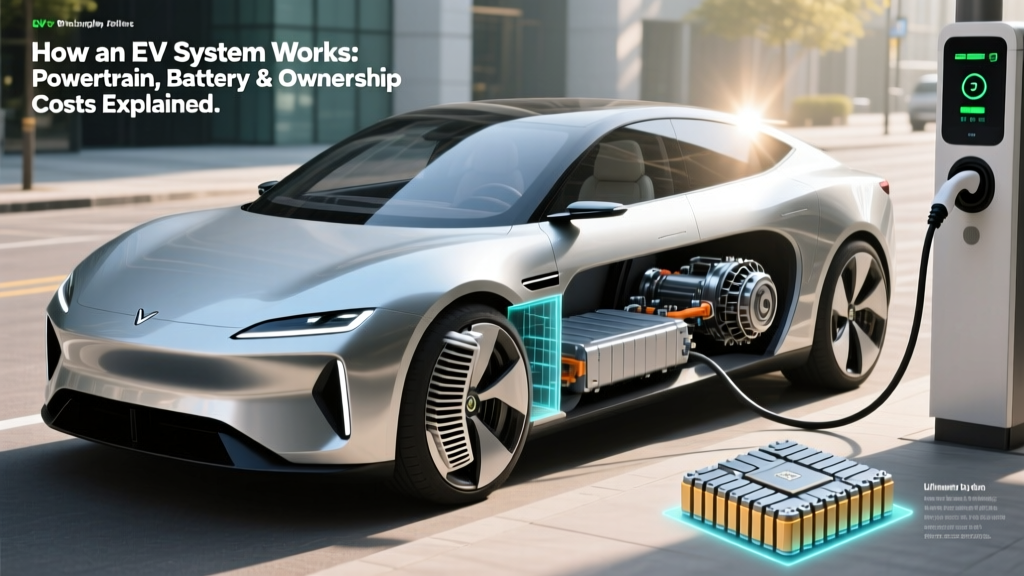
The term EV system refers to the integrated electric powertrain that propels a battery-electric vehicle: the high-voltage traction battery, the electric motor(s), the power electronics (inverter and onboard charger), and the thermal management system that keeps everything operating efficiently. Unlike a gas car's hundreds of moving engine parts, an EV system converts stored electrical energy (measured in kWh, kilowatt-hours) into motion via electromagnetic force, with typical drivetrain efficiency of 85–95% compared to a gasoline engine's 20–35%.
Quick Answer
An EV system replaces the internal combustion engine, transmission, and fuel tank with a lithium-based battery pack (typically 50–100 kWh usable), one or two electric motors producing instant torque, and a single-speed reduction gear. The result: fewer fluids to change, no exhaust system, regenerative braking that recaptures energy, and fueling costs roughly 50–70% lower per mile than gasoline — provided you have access to home or workplace charging.
The Core Components of an EV System
Understanding the EV system matters because each component directly affects your real-world range, charging speed, and long-term ownership costs. Here's what's under the floor and behind the panels:
- Traction battery pack: The largest and most expensive component. Most 2026 EVs use either NMC (nickel-manganese-cobalt) chemistry for higher energy density or LFP (lithium iron phosphate) for lower cost and longer cycle life. Usable capacities range from ~50 kWh (compact models) to ~100+ kWh (full-size trucks and SUVs).
- Electric motor(s): Permanent-magnet synchronous or induction motors. A single front or rear motor handles most daily driving; dual-motor AWD configurations add a second for traction and performance. Output ranges from ~150 hp to 800+ hp.
- Inverter: Converts the battery's DC (direct current) to the AC (alternating current) the motor needs. Also manages regen braking, converting AC back to DC.
- Onboard charger: Converts AC power from your home Level 2 charger to DC for the battery. Typical rates: 7.2 kW (single-phase) to 19.2 kW (higher-end models).
- Thermal management: Liquid cooling/heating loops keep the battery in its optimal 20–40°C window. A heat pump (standard on many 2026 models) dramatically improves cold-weather efficiency by scavenging ambient heat instead of using resistive heating.
- DC-DC converter: Steps down high-voltage DC to 12V to run lights, infotainment, and accessory systems.
EV System vs. Gasoline Powertrain: By the Numbers
The fundamental advantage of an EV system is efficiency. The U.S. Department of Energy tracks this through fueleconomy.gov, where EVs convert roughly 77% of grid electricity to wheel power, while gas vehicles convert only 12–30% of gasoline energy to forward motion.
| Metric | BEV (Battery Electric) | Gasoline Vehicle |
|---|---|---|
| Drivetrain efficiency | 85–95% | 20–35% |
| Energy cost per mile (US avg) | $0.04–$0.06 (home charging) | $0.12–$0.16 (at $3.40/gal, 28 MPG) |
| Moving powertrain parts | ~20 | ~200+ |
| Routine fluid changes | Coolant, brake fluid, washer | Oil, transmission, coolant, brake, washer |
| Regenerative braking | Yes — extends brake pad life to 100k+ mi | No |
| Tailpipe emissions | None | CO₂, NOₓ, particulates |
| Cold-weather range loss | 15–30% at 20°F | Minimal MPG impact |
A practical example: driving 12,000 miles per year in a midsize EV with an efficiency rating of 28 kWh/100 mi and home electricity at $0.14/kWh costs roughly $470 annually in energy. A comparable 28 MPG gas car at $3.40/gallon costs about $1,457. That's nearly $1,000/year in fuel savings before any maintenance differences.
Real-World Ownership Costs: The Full Picture
Fuel savings are real, but a complete EV system ownership picture requires examining purchase price, insurance, charging infrastructure, maintenance, and depreciation. Here's a 5-year breakdown comparing a representative 2026 EV sedan (~$42,000 MSRP) against a comparably equipped gas sedan (~$32,000 MSRP):
| Category | EV ($42k MSRP) | Gas Sedan ($32k MSRP) |
|---|---|---|
| Purchase price (after incentives) | $34,500* | $32,000 |
| Fuel / energy (5 years) | $2,350 | $7,285 |
| Maintenance (5 years) | $1,500 | $3,800 |
| Insurance (5 years) | $9,500 | $7,500 |
| Home charger install (one-time) | $1,200 | $0 |
| Depreciation (est. 5-yr) | $18,000 | $14,500 |
| Total 5-year cost | $67,050 | $65,085 |
*Assumes $7,500 federal §30D point-of-sale credit for eligible buyers and vehicles. Check current IRS clean vehicle credit rules for income caps ($150k single / $300k joint), MSRP limits ($55k cars / $80k SUVs and trucks), and battery sourcing requirements.
The EV narrows the gap primarily through energy and maintenance savings, but higher insurance premiums (typically 15–25% above comparable gas models due to repair costs and battery replacement risk) and steeper early depreciation partially offset those gains. Your actual numbers depend heavily on local electricity rates, driving volume, and whether you qualify for the full federal credit plus any state incentives.
What First-Time EV Buyers Must Know About the EV System
If you're transitioning from a gas car, the EV system introduces several practical differences that affect daily life:
Charging Access Is Your #1 Consideration
Roughly 80% of EV charging happens at home. If you have a garage or driveway with access to a 240V circuit (NEMA 14-50 outlet or hardwired Level 2 station), you'll wake up every morning with a "full tank." A typical Level 2 charger delivering 7.2 kW adds about 25–30 miles of range per hour — more than enough to replenish a daily commute overnight. If you live in an apartment without charging access or rely solely on public DC fast chargers, EV ownership becomes significantly less convenient and more expensive (public DCFC rates of $0.35–$0.55/kWh can exceed gasoline per-mile costs).
kW vs. kWh: The Most Common Confusion
kW (kilowatts) measures power — how fast energy flows. Think of it as the width of the hose. kWh (kilowatt-hours) measures energy — how much is stored or consumed. Think of it as the size of the tank. A 75 kWh battery charged at 11 kW takes roughly 7 hours from empty. A DC fast charger delivering 150 kW can refill that same battery from 10–80% in about 25 minutes — but peak rate is only sustained at low states of charge. Above 80%, the charge curve tapers significantly to protect battery health.
Cold Weather Reduces Range — Plan for It
Lithium-ion batteries are chemically less efficient in cold temperatures, and cabin heating draws significant power. At 20°F, expect 15–30% range reduction depending on whether the vehicle has a heat pump. An EPA-rated 300-mile EV might deliver 210–255 real-world miles in deep winter. Preconditioning the battery while plugged in (warming it using grid power before departure) mitigates this substantially.
Battery Degradation Is Slower Than You Think
Modern EV battery packs are engineered for longevity. Industry data shows average degradation of roughly 1–2% per year under normal use, meaning a 2026 EV should retain approximately 85–90% of original capacity after 8 years. Federal warranty requirements mandate that EV batteries carry at least 8 years / 100,000 miles of coverage against defects and excessive capacity loss (typically defined as dropping below 70% state of health). Many manufacturers exceed this baseline.
Common EV System Misconceptions — Fact-Checked
| Myth | Fact |
|---|---|
| "EV batteries need replacing every few years like a phone." | EV battery packs are actively cooled and managed. Most retain 85%+ capacity after 8 years. Full replacement costs $8,000–$20,000 but is rarely needed within the vehicle's useful life. |
| "EVs are worse for the environment because of battery mining." | Lifecycle analyses from Argonne National Lab and the ICCT show EVs produce fewer total emissions than gas cars over their lifetime in every U.S. grid region, even accounting for battery manufacturing. The grid is also getting cleaner each year. |
| "You can't take an EV on a road trip." | With 250+ mile EPA ranges and DC fast charging adding 150–200 miles in 15–20 minutes, road trips are practical — though they require route planning through networks like Tesla Supercharger, Electrify America, or EVgo. Rural charging gaps remain in parts of the Mountain West and Great Plains. |
| "EVs cost more to insure because they're unsafe." | EVs earn top IIHS and NHTSA safety ratings. Higher insurance premiums reflect repair costs (specialized labor, battery handling protocols, and sensor recalibration), not crash safety deficiencies. |
| "The power grid can't handle everyone switching to EVs." | Most charging occurs overnight during off-peak hours when grid capacity is underutilized. Managed charging and time-of-use rates distribute load. The challenge is localized — specific neighborhood transformers may need upgrades as EV density increases. |
Decision Framework: Is an EV System Right for You?
If / Then Guide
- If you can install a Level 2 charger at home AND drive under 250 miles/day → A BEV is likely your best option. You'll save $800–$1,200/year on fuel, enjoy minimal maintenance, and rarely visit a public charger.
- If you lack home charging but have reliable workplace or apartment charging → A BEV can still work, but verify charging availability and pricing before committing. Public-only charging erases much of the cost advantage.
- If you regularly drive 300+ miles in a day or live in a charging desert → Consider a PHEV (plug-in hybrid) like the Toyota RAV4 Prime or a range-extended EV. You get 30–40 miles of electric commuting with gas-engine backup for long trips.
- If you live in a cold climate (sub-20°F winters) and need reliable range → Prioritize EVs with a heat pump and a battery 20% larger than your typical daily need. LFP batteries are more cold-sensitive than NMC — factor that into chemistry choice.
- If your budget is under $30,000 and you qualify for the used-EV credit → A pre-owned EV with the $4,000 §25E credit (income-capped, price-capped at $25,000) can deliver exceptional value. Verify battery state of health before purchasing.
- If you tow frequently or haul heavy loads → Expect 30–50% range reduction under load. Electric trucks like the Ford F-150 Lightning or Rivian R1T are capable, but plan charging stops accordingly.
EV System FAQ
How long does an EV battery last before it needs replacement?
Most 2026 EV battery packs are designed to last the life of the vehicle. Real-world fleet data shows average annual degradation of 1–2%, with many packs retaining 85–90% capacity at 100,000 miles. Federal law requires a minimum 8-year/100,000-mile battery warranty. Full replacements are rare and typically cost $8,000–$20,000 depending on pack size.
What's the difference between Level 1, Level 2, and DC fast charging?
Level 1 uses a standard 120V outlet and delivers ~1.4 kW — roughly 3–5 miles of range per hour. Level 2 uses 240V (like a dryer outlet) at 7.2–19.2 kW, adding 25–60 miles per hour — ideal for overnight home charging. DC fast charging bypasses the onboard charger entirely, delivering 50–350 kW directly to the battery for 10–80% charges in 15–40 minutes depending on the vehicle and station.
Do I qualify for the $7,500 federal EV tax credit?
Under current IRS §30D rules, eligibility depends on multiple factors: your modified adjusted gross income (≤$150k single, ≤$225k head of household, ≤$300k joint filers), the vehicle's MSRP (≤$55,000 for cars, ≤$80,000 for SUVs/trucks/vans), and battery component and critical mineral sourcing requirements that tighten annually. Since 2024, eligible buyers can transfer the credit to the dealer as a point-of-sale discount. Always verify current eligibility on irs.gov or consult a tax professional before purchasing.
Is an EV system really lower maintenance than a gas car?
Yes. There's no engine oil, no transmission fluid, no spark plugs, no timing belt, no exhaust system, and no emissions equipment to service. Brake pads last significantly longer due to regenerative braking. You'll still need tire rotations (EVs are heavier and have instant torque, which accelerates tire wear), cabin air filter replacements, coolant checks, and windshield washer fluid. Expect annual maintenance costs of $200–$400 versus $600–$1,200 for a gas vehicle.
What happens to the EV battery when the car is totaled or retired?
EV batteries have robust second-life applications. Degraded packs (70–80% remaining capacity) are repurposed for stationary energy storage — grid buffering, solar storage, and commercial backup power. At end of life, recycling facilities recover 95%+ of critical materials (lithium, cobalt, nickel) through hydrometallurgical processes. Companies like Redwood Materials and Li-Cycle operate large-scale recycling operations in the U.S.
Can the EV system handle extreme heat?
Modern liquid-cooled battery systems actively manage temperature in hot climates, and most EVs pre-condition the pack during DC fast charging to prevent overheating. However, sustained high ambient temperatures (above 100°F) combined with frequent DC fast charging can accelerate long-term degradation slightly. Parking in shade and using scheduled charging during cooler overnight hours help preserve battery health in hot regions.