The Quick Answer: Are EV Supercars Practical?
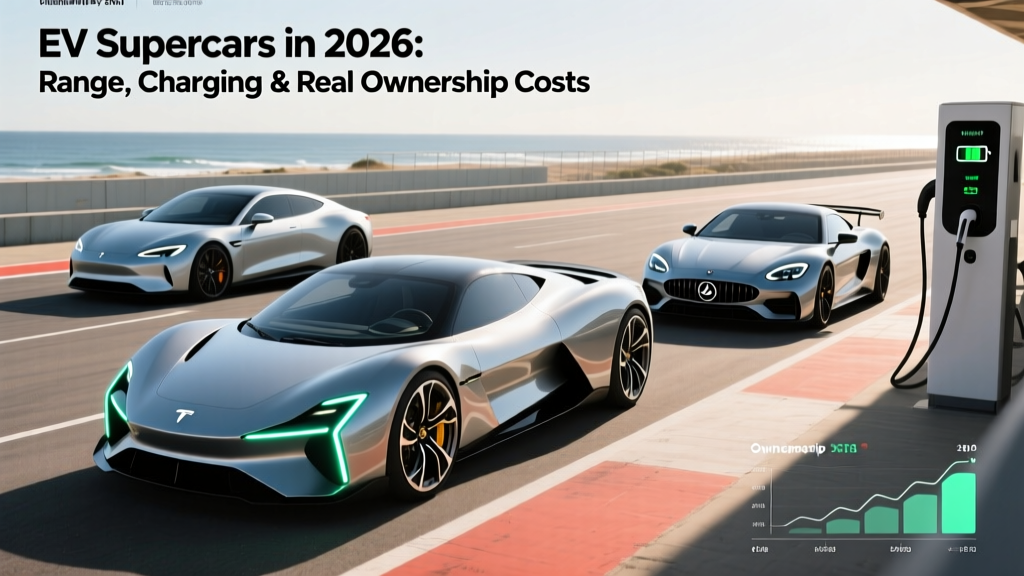
EV supercars like the Rimac Nevera (EPA-est. 287 mi range, 1,914 hp), Lotus Evija (est. 250 mi, 2,012 hp), and Pininfarina Battista (est. 300 mi, 1,900 hp) deliver unmatched straight-line performance — 0-60 mph in under 2 seconds — but they are not daily drivers. Expect 150–220 miles of real-world highway range, 350 kW peak DC fast charging (10–80% in ~18–22 minutes), and annual insurance premiums of $8,000–$15,000. These are weekend hypercars, not commuters, and ownership economics look nothing like a Tesla Model 3.
What Defines an EV Supercar in 2026?
The term "EV supercar" refers to low-volume, ultra-high-performance battery-electric vehicles prioritizing acceleration, top speed, and track capability over efficiency or practicality. Unlike mass-market EVs, these machines use high-discharge NMC (nickel manganese cobalt) battery packs engineered for sustained power delivery, not maximum energy density or cycle longevity.
The current landscape of production EV supercars includes three primary contenders, each with distinct engineering philosophies:
| Spec | Rimac Nevera | Lotus Evija | Pininfarina Battista |
|---|---|---|---|
| Base MSRP | ~$2,200,000 | ~$2,300,000 | ~$2,800,000 |
| Battery (usable) | 120 kWh, NMC | 70 kWh, NMC | 120 kWh, NMC |
| EPA Range (est.) | 287 mi | ~250 mi | ~300 mi |
| Real-World Highway Range | ~190–220 mi | ~150–180 mi | ~200–230 mi |
| Horsepower | 1,914 hp | 2,012 hp | 1,900 hp |
| 0–60 mph | 1.85 sec | ~2.0 sec | 1.86 sec |
| Top Speed | 258 mph | 217 mph | 217 mph |
| Peak DC Fast Charge | 350 kW | 350 kW | 250 kW |
| 10–80% DC Charge Time | ~19 min | ~18 min | ~22 min |
| Level 2 AC Charge Rate | 22 kW | 11 kW | 22 kW |
| Drivetrain | Quad-motor AWD | Quad-motor AWD | Quad-motor AWD |
| Curb Weight | ~4,740 lbs | ~4,160 lbs | ~4,740 lbs |
| Production Run | 150 units | 130 units | 150 units |
All three use a four-motor architecture with individual torque vectoring at each wheel. This eliminates the need for a traditional transmission and allows instantaneous torque distribution — a key advantage over internal-combustion hypercars that rely on mechanical differentials and sequential gear shifts.
Real-World Range: What the EPA Sticker Doesn't Tell You
Manufacturer-quoted range figures assume moderate speeds, temperate climates, and conservative driving. In an EV supercar, those assumptions evaporate quickly.
Range Reality Check
Rimac Nevera: EPA-estimated 287 miles. In real-world highway testing at 75–85 mph, expect 190–220 miles. Aggressive canyon driving or track sessions can drain the 120 kWh pack in under 80 miles.
Lotus Evija: The smaller 70 kWh pack means EPA-estimated ~250 miles drops to 150–180 miles at highway speeds. On a track, sustained high-power output depletes the battery in approximately 15–20 minutes of hard lapping.
Pininfarina Battista: Shares the Nevera's 120 kWh platform. EPA-estimated ~300 miles translates to 200–230 miles in real-world mixed driving, with significant range loss above 80 mph due to aerodynamic drag scaling with the square of velocity.
Cold-weather operation compounds the problem. Lithium-ion NMC cells lose roughly 15–30% of usable capacity at temperatures below 32°F, and unlike mass-market EVs, these hypercars lack the thermal preconditioning sophistication of a Tesla or Hyundai platform. Garage storage in a climate-controlled environment is effectively mandatory for owners in northern climates.
EV Supercar vs. Gas Hypercar: Performance and Cost Compared
The most common cross-shop for an EV supercar buyer is a traditional mid-engine hypercar like the Bugatti Chiron or Koenigsegg Jesko. Here's how the numbers stack up:
| Metric | Rimac Nevera (EV) | Bugatti Chiron (ICE) |
|---|---|---|
| Base Price | ~$2,200,000 | ~$3,300,000 |
| Horsepower | 1,914 hp | 1,500 hp |
| 0–60 mph | 1.85 sec | 2.4 sec |
| Top Speed | 258 mph | 261 mph |
| Energy/Fuel Cost per Fill | ~$18–$35 (120 kWh at $0.15–$0.29/kWh) | ~$180–$250 (20 gal premium at $9–$12/gal) |
| Annual Maintenance | ~$2,000–$5,000 | ~$20,000–$50,000 |
| Oil Changes per Year | 0 | 2–4 |
| Brake Pad Life | Extended (regen braking) | 5,000–10,000 mi |
| Annual Insurance (est.) | $8,000–$15,000 | $15,000–$30,000 |
The EV supercar wins decisively on acceleration, running costs, and mechanical simplicity. The gas hypercar retains advantages in top-end speed, refueling infrastructure (any gas station worldwide), and established collector-market liquidity. For context, the EPA's fueleconomy.gov database does not list hypercar-specific MPGe data, but the Nevera's estimated efficiency is approximately 2.0–2.5 kWh/mi under normal driving, translating to roughly 55–65 MPGe combined.
The Real Cost of Owning an EV Supercar
Purchase price is only the beginning. Here's a five-year ownership projection for a Rimac Nevera driven 3,000 miles per year (weekend and event use):
| Cost Category | 5-Year Total (Nevera) | 5-Year Total (Chiron) |
|---|---|---|
| Purchase Price | $2,200,000 | $3,300,000 |
| Energy/Fuel (3,000 mi/yr) | $1,500–$3,000 | $15,000–$22,500 |
| Insurance (avg.) | $55,000–$75,000 | $100,000–$150,000 |
| Maintenance & Service | $10,000–$25,000 | $100,000–$250,000 |
| Tire Replacement | $8,000–$15,000 | $12,000–$25,000 |
| Depreciation (est. 30–40%) | $660,000–$880,000 | $660,000–$1,320,000 |
| Total 5-Year Cost | ~$2,935,000–$3,200,000 | ~$4,187,000–$5,072,000 |
Several factors drive these numbers:
- Charging: At 2.2 kWh/mi and 3,000 miles annually, you consume roughly 6,600 kWh per year. Home Level 2 charging at $0.15/kWh costs ~$990/year. Public DC fast charging at $0.29–$0.48/kWh raises that to $1,900–$3,200/year.
- Maintenance: EV powertrains eliminate engine oil, transmission fluid, spark plugs, and exhaust service. Rimac recommends annual software updates and brake fluid checks. The regenerative braking system significantly extends pad and rotor life.
- Tires: The instant torque and 4,740-lb curb weight accelerate tire wear. Michelin Pilot Sport Cup 2R tires (the Nevera's OEM fitment) cost $600–$900 per corner and may last only 2,000–4,000 miles under spirited driving.
- Insurance: Specialty insurers like Hagerty or Chubb underwrite hypercars. Premiums vary dramatically by driver profile, storage conditions, and agreed-value coverage. The Insurance Information Institute notes that exotic and collector vehicles often qualify for agreed-value policies that differ from standard auto insurance.
- Depreciation: Limited-production hypercars can appreciate, but EV battery degradation introduces uncertainty. Rimac warranties the battery for 8 years with no fixed mileage cap, but long-term collector values remain unproven.
Charging Infrastructure: The Hypercar Owner's Dilemma
EV supercars can technically use any public DC fast charger, but the reality is more complicated. At 350 kW peak charge rate, the Nevera and Evija require high-power chargers to achieve advertised charge times. Most public networks — Electrify America, EVgo, ChargePoint — offer 150–350 kW stalls, but sustained peak rates depend on station load, ambient temperature, and battery preconditioning.
| Charging Level | Power (kW) | Miles Added per Hour | Typical Use Case |
|---|---|---|---|
| Level 1 (120V) | 1.4 kW | ~3–4 mi/hr | Not practical for 120 kWh pack |
| Level 2 (240V, 48A) | 11.5 kW | ~25–30 mi/hr | Overnight home charging (~10–12 hrs full) |
| Level 2 (240V, 80A) | 19.2 kW | ~45–55 mi/hr | Home with upgraded panel (~6–7 hrs full) |
| DC Fast (150 kW) | 150 kW | ~350–400 mi/hr | Public stations; 10–80% in ~30 min |
| DC Fast (350 kW) | 350 kW | ~800+ mi/hr | 10–80% in ~19 min (Nevera/Evija) |
Home charging is essential. A dedicated Level 2 home charger on a 60A or 80A circuit is the only practical daily charging solution. Installation costs range from $2,500–$6,000 depending on panel capacity, conduit runs, and local permitting. Owners without access to private garage charging will find EV supercar ownership extremely impractical.
At public 350 kW chargers, the Nevera's charge curve peaks near 350 kW from 10–40% State of Charge (SoC), then tapers progressively. The 10–80% time of ~19 minutes assumes optimal battery temperature (preconditioned to ~30–35°C) and a station delivering full rated power. In practice, expect 22–28 minutes for a 10–80% session.
Federal Tax Credits and EV Supercars: The §30D Reality
Under current IRS §30D rules, the federal clean vehicle credit offers up to $7,500 for qualifying new EVs. However, EV supercars do not qualify for several reasons:
§30D Tax Credit Requirements (2026)
- MSRP Cap: Sedans and sports cars must have an MSRP under $55,000; SUVs, trucks, and vans under $80,000. All EV supercars exceed $2 million — disqualified.
- Buyer Income Cap: Modified AGI must not exceed $150,000 (single), $225,000 (head of household), or $300,000 (joint). Many hypercar buyers exceed these thresholds.
- Battery Sourcing: Critical minerals and battery components must meet phased-in domestic/FHA-partner sourcing requirements. Rimac (Croatia), Lotus (UK/China-owned), and Pininfarina (Italy) do not meet these sourcing thresholds.
- Point-of-Sale Transfer: Even if eligible, the credit can be transferred to the dealer at purchase. Irrelevant for $2M+ vehicles.
Bottom line: EV supercar buyers should expect zero federal tax incentives. State-level incentives (California's CVRP, for example) also have MSRP caps that exclude these vehicles.
Common Misconceptions About EV Supercars
| Myth | Fact |
|---|---|
| "EV supercars are silent and boring." | Manufacturers add synthetic sound profiles. The Nevera produces a synthesized V8-inspired soundtrack through exterior speakers and cabin audio, adjustable by drive mode. |
| "The battery will need replacing in 5 years." | NMC cells in hypercar applications are engineered for high C-rate discharge, not maximum cycle life. Rimac warranties the pack for 8 years. Replacement cost, if needed, is estimated at $150,000–$250,000. |
| "You can't take them on road trips." | You can, but plan around 180–220 miles of real range and 25-minute DC fast-charge stops. The CCS connector on the Nevera works with Electrify America and most major networks. |
| "They're heavier than gas hypercars so they handle worse." | At ~4,740 lbs, the Nevera is heavier than a Chiron (~4,400 lbs), but the low center of gravity and individual wheel torque vectoring produce cornering behavior that defies the weight. Rimac's Nürburgring lap record (7:05.298 for production EVs) demonstrates this. |
| "Regenerative braking makes them unsafe on track." | All three models allow regen level adjustment, including a full "off" mode for track use. Carbon-ceramic brakes handle the thermal load independently of regen. |
Decision Framework: Should You Buy an EV Supercar?
Choose an EV Supercar If:
- You want the fastest-accelerating production vehicle available (sub-2-second 0–60)
- You have secure, climate-controlled private garage space with Level 2 charging
- Your use case is weekend drives, track days, and car events — not daily commuting
- You value cutting-edge EV powertrain technology and software-defined driving modes
- You can absorb $10,000+/year in insurance and maintenance without financial strain
Choose a Gas Hypercar Instead If:
- You plan to drive internationally where DC fast-charging infrastructure is sparse
- Collector-market liquidity and proven appreciation history matter to you
- You want the auditory and mechanical experience of a high-revving ICE engine
- Top speed (260+ mph) is a higher priority than 0–60 acceleration
Choose a High-Performance EV Sedan Instead If:
- You want daily usability with 300+ miles of range (Tesla Model S Plaid: 396 mi EPA, $89,990)
- You need four doors, cargo space, and practical ground clearance
- You want to qualify for the §30D federal tax credit ($7,500 point-of-sale)
- Your budget is under $150,000
First-Time EV Buyer? Read This Before Considering a Hypercar
If you're new to EV ownership and considering an EV supercar as your entry point, understand that these vehicles represent the most extreme end of the EV spectrum. The ownership experience differs dramatically from mainstream EVs:
- No dealer network: Rimac, Lotus, and Pininfarina operate through limited boutique distributors, not franchise dealerships. Service requires factory-trained technicians, often flown to your location or requiring vehicle transport to a regional center.
- Software updates: Like all modern EVs, these cars receive over-the-air updates, but hypercar software is more complex and bugs can have more dramatic consequences at 1,900 hp.
- Resale market: With production runs of 130–150 units globally, the secondary market is illiquid. Selling may take months and require specialist auction houses like Bring a Trailer or RM Sotheby's.
- Storage requirements: The NMC battery should be stored at 50–70% State of Charge for extended periods. Leaving the car plugged in at 100% for weeks accelerates degradation. A battery management system (BMS) maintains cell balance, but owners must follow manufacturer storage guidelines.
For most first-time EV buyers, a Tesla Model S Plaid (396 mi EPA, 1,020 hp, 0–60 in 1.99 sec, ~$89,990) or Lucid Air Sapphire (427 mi EPA, 1,234 hp, 0–60 in 1.89 sec, ~$249,000) delivers supercar-rivaling performance with daily-driver practicality, full warranty coverage, and established service networks.
Frequently Asked Questions
Can I daily-drive an EV supercar?
Technically yes, but real-world range of 150–220 miles, firm ride quality, minimal cargo space (no frunk on the Evija), and $600+ tires make it impractical. Most owners trailer these cars to events or use them for weekend drives only.
Do EV supercars qualify for any tax credits or incentives?
No. The federal §30D credit caps MSRP at $55,000 for cars and $80,000 for SUVs/trucks. All current EV supercars exceed $2 million. State incentives similarly have MSRP caps that exclude them.
What happens if the battery degrades?
Rimac, Lotus, and Pininfarina all provide battery warranties of 8 years. Rimac guarantees the pack will retain at least 70% of original capacity during the warranty period. If the pack falls below this threshold, the manufacturer will repair or replace modules at no cost. Out-of-warranty replacement is estimated at $150,000–$250,000 depending on the model.
Are EV supercars faster than gas hypercars?
In 0–60 mph acceleration, yes. The Rimac Nevera (1.85 sec) and Pininfarina Battista (1.86 sec) beat the Bugatti Chiron (2.4 sec) and Koenigsegg Jesko (~2.5 sec). In top speed, gas hypercars still hold the edge — the Chiron reaches 261 mph vs. the Nevera's 258 mph. On a road course, results vary by track layout and driver skill.
How do I charge an EV supercar at home?
Install a dedicated Level 2 charger on a 60A or 80A, 240V circuit. The Nevera and Battista accept up to 22 kW AC, while the Evija accepts 11 kW. A full home charge takes 6–12 hours depending on the model and circuit capacity. Budget $2,500–$6,000 for professional installation by a licensed electrician, including panel upgrades if needed.
Is the Rimac Nevera street-legal in the US?
Yes. The Nevera is homologated for US road use and meets NHTSA and EPA requirements. It is registered and titled like any other production vehicle, though some states may require additional inspections for vehicles exceeding certain weight or power thresholds.