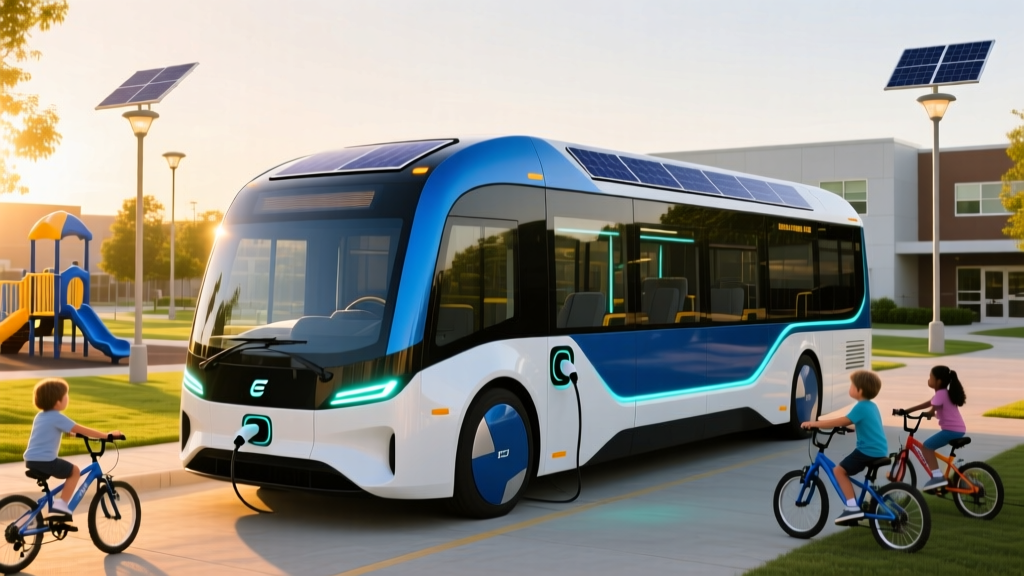
The bottom line for 2026: A new electric school bus from a major OEM (Blue Bird, IC Bus, or Thomas Built) costs roughly $230,000–$290,000 before incentives, compared with $110,000–$135,000 for a comparable diesel Type C bus. The purchase premium is significant, but districts running predictable routes of 60–120 miles per day are seeing 60–70% fuel cost reductions and 40–50% maintenance savings, with a realistic payback window of 8–12 years depending on local electricity rates, EPA Clean School Bus rebates, and depot charging infrastructure. Range is the binding constraint: expect 100–150 real-world miles on a full charge in mild weather, dropping 20–35% in cold climates.
Why Districts Are Switching to EV School Buses
School transportation is one of the most route-predictable segments in commercial trucking. The average U.S. school bus route covers 30–80 miles per day, with two peak operating windows (morning and afternoon) and long midday parking. That duty cycle aligns almost perfectly with current battery-electric capabilities — provided the district can install depot charging.
The policy tailwinds are substantial. The EPA's Clean School Bus Program, funded through the Bipartisan Infrastructure Law, has allocated $5 billion through 2026 in rebates specifically for zero-emission school buses, covering up to $345,000 per bus plus $13,000 per charger for qualifying high-needs districts. Combined with state-level programs (California's HVIP, New York's Truck Voucher Incentive, Colorado's ALT Fuels Colorado), some districts are acquiring EV buses at net costs competitive with diesel.
Health data is also a factor. The American Lung Association has linked diesel exhaust exposure near schools to elevated asthma rates in children. Zero tailpipe emissions at the bus stop and school loading zone is a tangible local benefit, even when upstream grid electricity still includes fossil generation.
2026 Electric School Bus Specs: The Big Three OEMs
Three manufacturers dominate the U.S. Type C and Type D electric school bus market. Here is how their current-production models compare on the specs that matter for fleet procurement:
| Spec | Blue Bird Vision Electric | IC Bus CE Series Electric | Thomas Built Saf-T-Liner C2 Jouley |
|---|---|---|---|
| Battery Capacity (usable) | ~155 kWh (LFP) | ~210 kWh (NMC) | ~226 kWh (NMC) |
| EPA Estimated Range | ~130 miles | ~150 miles | ~135 miles |
| Real-World Range (mild / cold) | ~115 mi / ~80–95 mi | ~130 mi / ~90–105 mi | ~120 mi / ~85–100 mi |
| Peak DC Fast Charge | ~80 kW | ~60 kW | ~60 kW |
| 10–80% Charge Time (DCFC) | ~90 min | ~120 min | ~120 min |
| Level 2 AC Charge Rate | 19.2 kW | 19.2 kW | 19.2 kW |
| Overnight L2 Charge (0–100%) | ~8 hours | ~11 hours | ~12 hours |
| Motor Output | ~250 kW (335 hp) | ~260 kW (349 hp) | ~250 kW (335 hp) |
| GVWR | ~33,000 lbs | ~33,000 lbs | ~33,000 lbs |
| Base MSRP (approx.) | $250,000–$270,000 | $260,000–$290,000 | $240,000–$265,000 |
| Battery Warranty | 8 yr / unlimited mi | 8 yr / unlimited mi | 8 yr / unlimited mi |
Chemistry note: Blue Bird has moved to LFP (lithium iron phosphate) cells, which offer longer cycle life and better thermal stability at the cost of lower energy density (heavier pack for the same kWh). IC Bus and Thomas Built still use NMC (nickel manganese cobalt), which is lighter and more energy-dense but degrades faster under high-temperature, high-SoC operation. For a bus that charges to 100% nightly and sits in a hot depot all summer, LFP's durability advantage matters.
Real-World Range: What the EPA Number Doesn't Tell You
EPA range figures for commercial vehicles are derived under idealized conditions. In fleet operations, three variables compress range significantly:
- Cold weather: Battery chemistry slows and cabin heating draws 15–25 kW continuously. Northern districts (Minnesota, New York, Colorado) report 25–35% range loss below 20°F. A bus rated for 130 EPA miles may deliver only 85–95 miles in January.
- Stop-and-go idling: Unlike highway driving, school bus routes involve frequent door openings, extended idle with HVAC running, and low-speed operation. Regenerative braking partially offsets this, but HVAC load does not.
- Topography: Hilly routes (West Virginia, Appalachian Kentucky, mountain Colorado) consume 15–25% more energy per mile than flat suburban routes.
Range planning rule of thumb: Size your route so the bus uses no more than 70% of its EPA-rated range in worst-case (cold weather) conditions. A 130-mile EPA bus should be assigned routes of 60–70 miles maximum in cold climates, or 90–100 miles in mild climates. This preserves a buffer for detours, traffic, and battery degradation over years 5–8.
Total Cost of Ownership: EV Bus vs. Diesel Bus
The upfront price gap is stark, but school buses are 12–15 year assets. Total cost of ownership (TCO) over that lifecycle is where the economics shift. Below is a modeled comparison for a single Type C bus running 12,000 miles/year over 12 years, using national average fuel and electricity prices as of early 2026:
| Cost Category | Electric Bus | Diesel Bus |
|---|---|---|
| Purchase Price (base) | $260,000 | $120,000 |
| EPA Clean School Bus Rebate | –$250,000 (qualifying district) | $0 |
| Net Acquisition Cost | $10,000 | $120,000 |
| Depot Charger + Install (1 unit) | $35,000–$55,000 | $0 |
| Fuel/Energy (12 years) | $28,000–$38,000 | $85,000–$105,000 |
| Maintenance (12 years) | $25,000–$35,000 | $55,000–$75,000 |
| Battery Replacement (if needed, yr 10+) | $40,000–$65,000 | Engine/Trans rebuild: $15,000–$25,000 |
| Insurance (12 years) | $30,000–$36,000 | $24,000–$30,000 |
| Estimated 12-Year TCO | $128,000–$239,000 | $284,000–$355,000 |
Key variables:
- Electricity rate: Commercial depot charging ranges from $0.08–$0.18/kWh depending on utility and demand charges. At $0.12/kWh and 2.5 kWh/mile, energy cost is ~$0.30/mile vs. diesel at ~$0.65–$0.80/mile.
- Demand charges: Some utilities bill commercial customers for peak power draw (kW), not just energy consumed (kWh). A depot with 10 buses charging simultaneously at 19.2 kW each can trigger demand charges of $10–$20/kW/month. Managed charging software that staggers charge sessions is essential.
- Maintenance savings: Electric drivetrains eliminate oil changes, fuel filters, DEF fluid, exhaust aftertreatment (DPF/SCR), and transmission service. Brake wear drops 50–70% due to regenerative braking. The remaining maintenance is suspension, steering, HVAC, tires, and 12V systems.
Depot Charging Infrastructure: The Real Bottleneck
The bus itself is the easy part. The charging infrastructure is where districts encounter delays, cost overruns, and utility coordination challenges.
| Component | Cost Range |
|---|---|
| Level 2 charger hardware (CCS1 or NACS) | $6,000–$12,000 |
| Electrical panel upgrade (if needed) | $5,000–$25,000 |
| Trenching, conduit, wiring (50–200 ft) | $8,000–$30,000 |
| Utility service upgrade / transformer | $0–$60,000 |
| Permitting and engineering | $2,000–$8,000 |
| Total per charger | $21,000–$135,000 |
Utility lead time is the critical path. Districts report 6–18 months between initial utility application and energized service, particularly when a new transformer or medium-voltage line extension is required. Start utility engagement before ordering buses.
DC fast charging at the depot is an option for districts running split shifts or midday top-ups. A single 60–80 kW DCFC unit costs $40,000–$80,000 (hardware only) and can add ~50 miles of range in 30 minutes. However, most school bus duty cycles are fully served by overnight Level 2 charging, which is gentler on battery health and far cheaper to install.
Funding and Incentives Available in 2026
The federal EPA Clean School Bus Program remains the largest single funding source, with rebate lotteries distributed annually through 2026. Priority scoring favors:
- High-needs districts (Title I, rural, tribal, Bureau of Indian Education)
- Replacement of pre-2011 diesel buses
- Districts committing to multiple zero-emission buses
Additional funding layers:
- State voucher programs: California HVIP ($120,000–$285,000 per bus), New York TVIP, Colorado, New Jersey, and others offer stacking incentives.
- Volkswagen Environmental Mitigation Trust: Remaining funds from the Dieselgate settlement are still being disbursed in several states for school bus replacement.
- Utility make-ready programs: Many investor-owned utilities cover 50–100% of infrastructure costs on the utility side of the meter (transformer, line extension) for commercial EV charging.
- IRS §45W Commercial Clean Vehicle Credit: Up to $40,000 per vehicle for qualified commercial clean vehicles over 14,000 lbs GVWR — applicable to school buses purchased by taxable entities (private schools, contractors). Tax-exempt public school districts can access this via direct pay under the Inflation Reduction Act.
Common Misconceptions About EV School Buses
| Myth | Fact |
|---|---|
| "They can't run routes in winter." | Cold weather reduces range 25–35%, but most routes are 60–80 miles — still within buffer. Preconditioning and heat pump options mitigate loss. |
| "Battery replacement will bankrupt the district." | LFP packs are rated for 4,000+ cycles (~15 years of daily use). NMC packs carry 8-year warranties with 70%+ capacity retention thresholds. Full replacement is $40K–$65K — comparable to a diesel engine rebuild cycle. |
| "Charging takes too long for school schedules." | Overnight Level 2 charging (8–12 hours) fully replenishes the pack between afternoon and morning runs. Midday charging is rarely needed for standard routes. |
| "The grid can't handle a bus depot." | A 20-bus depot charging at 19.2 kW each draws ~384 kW — equivalent to a small grocery store. Utility upgrades are real but manageable with 12–18 months lead time. |
| "EV buses are unproven." | As of 2025, over 2,000 electric school buses are in service across 48 states. Multiple districts have logged 100,000+ miles per bus on original packs. |
Decision Framework: Is an EV School Bus Right for Your District?
Choose electric school buses if:
- Your routes are under 100 miles/day (or under 75 miles in cold climates)
- You have depot parking with electrical service or utility upgrade feasibility
- You qualify for EPA Clean School Bus rebates or state incentive stacking
- You plan to hold buses 10–15 years (to capture TCO advantage)
- Your community values zero tailpipe emissions near children
Stick with diesel or consider a propane/CNG alternative if:
- Routes regularly exceed 120 miles/day or include long highway segments
- Your depot lacks three-phase power and utility upgrade timelines exceed 24 months
- You operate in extreme cold (–20°F or below) without garage parking
- Budget cycles cannot absorb the upfront premium, even with rebates
- You need bus flexibility for field trips, athletic travel, or inter-district routes exceeding range
What a First-Time EV Fleet Buyer Should Know
Procuring electric school buses is fundamentally different from buying diesel. The bus OEM is only one vendor in a multi-party project. Districts should plan for:
- Utility engagement first: Before issuing an RFP for buses, contact your utility's commercial EV programs team. Request a site assessment and service upgrade quote. This step determines your charging capacity ceiling.
- Charger-to-bus ratio: Most districts start with a 1:1 ratio (one Level 2 charger per bus). Shared charging (2 buses per charger with staggered schedules) is possible but adds operational complexity.
- Managed charging software: Platforms like ChargePoint Fleet, EV Connect, or Enel X JuiceNet allow you to schedule charging during off-peak rate windows and avoid demand-charge spikes. Budget $500–$1,500/year per charger for software.
- Driver and mechanic training: OEMs typically include 1–2 days of training. Mechanics need high-voltage safety certification (NFPA 70E). Budget for ongoing training as staff turns over.
- Telematics and data: Monitor State of Health (SoH), energy consumption per route, and charging patterns from day one. This data is critical for warranty claims and future route optimization.
Frequently Asked Questions
How long does it take to charge an electric school bus overnight?
At a 19.2 kW Level 2 charger, a fully depleted 155–226 kWh battery requires 8–12 hours to reach 100%. Since most buses return to depot with 20–40% remaining charge, actual overnight charging typically takes 5–8 hours, easily fitting within the 4 PM to 6 AM window.
Do electric school buses qualify for the $7,500 federal EV tax credit?
No. The §30D Clean Vehicle Credit ($7,500) applies only to light-duty vehicles under 14,000 lbs GVWR for personal use. School buses qualify instead for the §45W Commercial Clean Vehicle Credit, which provides up to $40,000 per vehicle for vehicles over 14,000 lbs. Tax-exempt entities (public school districts) can receive this as a direct payment from the IRS rather than a tax credit.
What happens if a bus battery degrades before the route changes?
Battery warranties guarantee 70% capacity retention for 8 years. If degradation exceeds this threshold, the OEM replaces or refurbishes the pack at no cost. In practice, LFP packs (Blue Bird) show minimal degradation in the first 5 years of daily cycling. Districts should plan for potential 15–20% range reduction by year 8–10 and adjust route assignments accordingly.
Can electric school buses handle field trips or long athletic travel?
Not reliably with current range. A 130-mile EPA bus is unsuitable for a 200-mile round trip to an away game without mid-route DC fast charging, which adds 60–90 minutes. Most districts retain a subset of diesel buses specifically for long-distance extracurricular travel while electrifying daily routes.
Are electric school buses safer in a crash than diesel buses?
Electric school buses meet the same FMVSS crashworthiness standards as diesel buses. The battery packs are mounted in reinforced enclosures below the floor. The lower center of gravity (from the heavy pack) may improve rollover resistance. There have been no reported battery thermal runaway incidents in U.S. electric school bus operations as of early 2026.