The Short Answer on EV RVs
As of 2026, fully electric Class A and Class C motorhomes do not exist in production. The "EV RV" market currently consists of two viable paths: towing a travel trailer with an electric pickup or SUV, or purchasing one of a handful of electric camper vans and truck campers from niche manufacturers. Towing a trailer with an EV like the Ford F-150 Lightning or Rivian R1T is feasible for trips under 200 miles between charging stops, but expect a 40–60% reduction in driving range compared to unloaded EPA estimates. For full-time RVing or cross-country boondocking, a diesel or gas motorhome remains the practical choice. For weekend warriors with predictable routes and access to destination charging, an EV tow setup can save $2,000–$4,000 annually in fuel costs.
What "EV RV" Actually Means in 2026
Search "EV RV" and you will find concept renders, crowdfunding campaigns, and a lot of aspiration. Here is what actually exists and is purchasable today:
Electric Tow Vehicles + Travel Trailers
This is the most practical EV RV configuration. You pair an electric truck or large SUV with a conventional travel trailer or fifth wheel. The trailer itself has no drivetrain — it is a standard RV pulled by an electric vehicle.
- Ford F-150 Lightning (Extended Range): 320-mile EPA unloaded, up to 10,000 lbs towing capacity, starting around $69,995 for the Lariat Extended Range.
- Rivian R1T (Dual-Motor Max Pack): 420-mile EPA unloaded, up to 11,000 lbs towing capacity, starting around $87,000.
- Chevrolet Silverado EV (4WT Extended Range): 492-mile EPA unloaded, up to 10,000 lbs towing capacity, starting around $74,800 for fleet trims with consumer availability expanding.
- Tesla Cybertruck (AWD): 340-mile EPA unloaded, up to 11,000 lbs towing capacity, starting around $79,990.
Electric Camper Vans and Micro-RVs
A small number of companies offer fully integrated electric camper vans, though production volumes are low and pricing is steep:
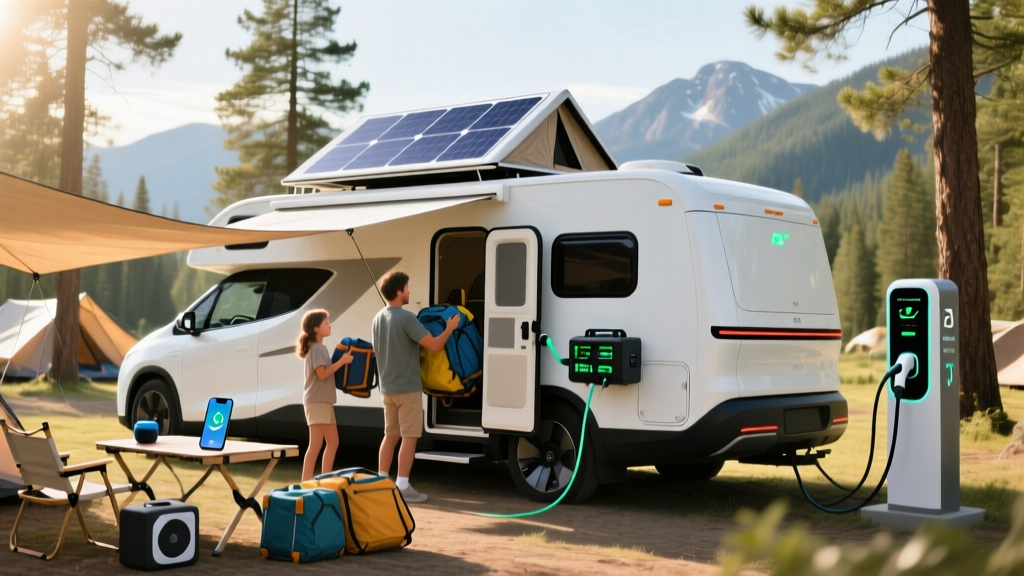
- Winnebago e-RV: Built on the Ford E-Transit chassis, 108-mile EPA range, 68 kWh usable battery (LFP chemistry), priced around $125,000. Best suited for campground-to-campground trips with shore power.
- Grounded G1/G2: Electric camper van conversions on commercial chassis, 150–250 mile range depending on configuration, priced $130,000–$180,000.
- Lightship L1 (announced): A solar-equipped electric travel trailer with its own battery pack that maintains tow-vehicle range, expected pricing around $125,000. Not yet in customer hands as of early 2026 — specs are preliminary.
The Towing Range Problem: Real Numbers
This is the single most important factor in deciding whether an EV RV setup works for you. Towing a travel trailer dramatically increases energy consumption due to added weight (3,000–7,000 lbs typical) and aerodynamic drag.
| Vehicle (Towing ~5,000 lb Trailer) | EPA Range (Unloaded) | Est. Range (Towing) | Energy Use (Towing) | Miles Per $10 (Home Charge) |
|---|---|---|---|---|
| Ford F-150 Lightning Ext. Range | 320 mi | 150–190 mi | ~600 Wh/mi | ~55 mi |
| Rivian R1T Max Pack | 420 mi | 200–260 mi | ~550 Wh/mi | ~60 mi |
| Chevrolet Silverado EV 4WT | 492 mi | 240–300 mi | ~520 Wh/mi | ~63 mi |
| Ford F-150 Gas 3.5L EcoBoost | ~480 mi (26 gal tank) | ~280–340 mi | ~10–12 MPG | ~28 mi (at $3.50/gal) |
| Ram 1500 5.7L HEMI | ~450 mi (26 gal tank) | ~260–310 mi | ~10–11 MPG | ~30 mi (at $3.50/gal) |
Real-World Range Reality: When towing a 5,000-pound travel trailer at 65 mph on a flat highway in 70°F weather, expect roughly 50% of your EV's EPA sticker range. In cold weather (below 35°F) or mountainous terrain, that figure drops to 35–40%. A Ford F-150 Lightning Extended Range that shows 320 miles on the dash unloaded may deliver only 130–150 miles of real towing range in winter conditions. Plan charging stops accordingly — and always carry a buffer.
Charging an EV RV on the Road
Charging logistics define the EV RV experience more than any other factor. Here is what you need to know about the three charging levels you will encounter:
| Charging Level | Power (kW) | Miles Added per Hour (Towing Estimate) | Where You Find It |
|---|---|---|---|
| Level 1 (120V outlet) | 1.2–1.4 kW | ~2 mi/hr | Standard campground outlet |
| Level 2 (240V, 40A) | 9.6 kW | ~16 mi/hr | Campground 50-amp pedestal (with adapter), RV parks |
| DC Fast Charge | 150–250 kW peak | ~150–250 mi/hr (peak) | Highway corridors, Electrify America, Tesla Superchargers |
The Campground Charging Reality
Most RV parks and campgrounds offer 30-amp or 50-amp 240V shore power connections. A 50-amp pedestal can deliver up to 12 kW — enough for meaningful Level 2 overnight charging. However, you are sharing that pedestal with your RV's house loads (air conditioning, refrigerator, water heater). Real-world Level 2 charging at a campground typically delivers 6–9 kW to the vehicle, adding roughly 12–16 miles of towing range per hour. An overnight stop (10 hours) recovers 120–160 miles of range — sufficient for next-day driving if your itinerary is planned.
Highway DC Fast Charging While Towing
This is where the EV RV experience gets complicated. Most DC fast charging stations are designed for cars, not trucks with 25-foot trailers attached. Key challenges:
- Pull-through availability: Very few charging stations offer pull-through spots. You will often need to unhitch your trailer in a parking area, drive to the charger, charge, then re-hitch. This adds 15–20 minutes to every stop.
- Charging curve taper: EVs charge fastest between 10–80% State of Charge (SoC). The Ford F-150 Lightning peaks at roughly 150 kW on a capable DC fast charger, reaching 10–80% in about 40 minutes (unloaded). While towing, your battery depletes faster but the charge curve remains the same — plan for 35–45 minute stops every 150 miles.
- Network reliability: As of 2026, Tesla Superchargers (now open to NACS-equipped non-Tesla EVs via adapter) report the highest uptime at ~95%. CCS networks like Electrify America and EVgo average 80–88% functional availability according to J.D. Power EV Experience Index data.
Cost Breakdown: EV RV vs Gas RV Ownership
Let us compare the five-year cost of ownership for two realistic setups: an electric truck towing a travel trailer versus a gas truck towing the same trailer, assuming 12,000 miles driven annually (6,000 loaded, 6,000 unloaded).
| Cost Category | F-150 Lightning + Travel Trailer | F-150 Gas 3.5L + Travel Trailer |
|---|---|---|
| Vehicle Purchase (MSRP) | $69,995 | $58,995 |
| Federal Tax Credit (§30D) | Up to $7,500 (subject to income/MSRP/sourcing rules — see IRS.gov) | $0 |
| Effective Purchase Price | $62,495 | $58,995 |
| Annual Fuel/Energy (5,000 mi towing + 7,000 mi unloaded) | ~$1,400 (home charging at $0.14/kWh, some DCFC) | ~$3,800 (at $3.50/gal, 10 MPG towing, 20 MPG unloaded) |
| 5-Year Fuel/Energy Total | $7,000 | $19,000 |
| Maintenance (5 years) | ~$1,200 (tire rotation, cabin filter, brake inspection — regen saves pads) | ~$3,500 (oil changes, transmission fluid, spark plugs, brake pads) |
| Insurance (annual avg) | $2,400/yr ($12,000 total) | $1,800/yr ($9,000 total) |
| 5-Year Total Cost | $82,695 | $90,495 |
Net savings over five years: approximately $7,800 with the EV setup, driven primarily by fuel and maintenance savings that offset the higher purchase price and insurance premiums. Your actual savings depend heavily on electricity rates, driving patterns, and whether you qualify for the §30D federal tax credit.
Common EV RV Misconceptions
| Myth | Fact |
|---|---|
| "You can't tow with an EV." | Modern electric trucks tow 10,000–11,000 lbs. The limitation is range, not capability. A 5,000-lb trailer is well within safe limits. |
| "Electric RVs don't exist." | Fully electric motorhomes like the Winnebago e-RV exist but are niche and expensive. The practical path is EV truck + conventional trailer. |
| "You'll be stranded with no chargers." | Interstate highway corridors have DC fast chargers at 50–100 mile intervals in most states. The gap is in rural and remote recreation areas — plan ahead using apps like A Better Routeplanner. |
| "Towing destroys the battery." | Towing increases cycle count and heat generation, but modern thermal management systems keep batteries in safe temperature ranges. Ford's 8-year/100,000-mile battery warranty covers the Lightning regardless of towing use. |
| "Campgrounds don't have charging." | Most developed campgrounds with 50-amp shore power can deliver Level 2 charging overnight. The issue is speed, not availability — you will not "fill up" in an hour, but an overnight stop recovers meaningful range. |
| "The tax credit makes EVs cheaper than gas trucks." | The §30D credit has income caps ($150K single/$300K joint), MSRP caps ($80K for trucks/vans), and battery-sourcing requirements that disqualify some trims. Always verify eligibility on IRS.gov before assuming the full $7,500. |
Decision Framework: Is an EV RV Right for You?
Choose an EV RV Setup If:
- Your typical camping trips are under 250 miles one-way — a single DC fast charge stop gets you there with a buffer.
- You have home Level 2 charging (240V, 40A+ circuit) — this eliminates daily fuel cost and ensures a full battery every morning.
- You camp at developed campgrounds with shore power — overnight Level 2 charging at 50-amp pedestals recovers 120–160 miles.
- You already need a truck for daily use — the Lightning and R1T are excellent daily drivers that happen to tow well on weekends.
- Your electricity rate is below $0.18/kWh — this is where the per-mile cost advantage over gasoline is strongest.
Stick with Gas or Diesel If:
- You regularly boondock in remote areas — BLM land, national forests, and off-grid sites rarely have charging infrastructure within range.
- Your trips exceed 400 miles one-way — multiple 45-minute charge stops while towing adds significant travel time.
- You tow in extreme cold — below 20°F, expect 35–40% of EPA range while towing. A gas truck's range degrades far less in cold.
- You need a full Class A or Class C motorhome — no electric options exist in these categories at production scale.
- You cannot install home charging — relying solely on public DC fast charging erases the cost advantage and adds daily inconvenience.
What First-Time EV RV Buyers Should Know
If you are considering this path, here are the practical steps that separate a successful EV RV experience from a frustrating one:
- Install a 240V/50A outlet in your garage or driveway. A NEMA 14-50 outlet costs $500–$1,500 to install (depending on panel capacity and run length) and delivers roughly 9.6 kW of Level 2 charging. This is non-negotiable for EV RV ownership. Consult a licensed electrician to confirm your panel has capacity — a 200-amp panel is typically sufficient; a 100-amp panel may require an upgrade ($1,500–$3,000).
- Test your tow route before committing. Rent an electric truck (via services like Turo or fleet rentals) and drive your planned camping route with a loaded trailer. Log your actual energy consumption using the vehicle's trip computer. This real-world data is worth more than any EPA estimate.
- Plan charging with A Better Routeplanner (ABRP). This app lets you input your exact vehicle, trailer weight, route elevation, and weather to predict energy consumption and charging stops. Cross-reference with PlugShare to verify charger availability at your destination.
- Buy a quality weight-distribution hitch. Electric trucks are heavy (the F-150 Lightning weighs over 6,000 lbs unloaded). Proper hitch setup reduces sway and improves efficiency by 5–8% — meaningful when your range margin is tight.
- Verify tax credit eligibility before purchasing. The §30D credit requires meeting battery-sourcing and critical-mineral thresholds that change annually. Check the fueleconomy.gov tax credit lookup for your specific model year and trim.
The Bottom Line on EV RVs
An EV RV is not a fantasy, but it is not a drop-in replacement for a diesel pusher either. The realistic 2026 EV RV is an electric pickup towing a travel trailer on planned routes with charging infrastructure at both ends. It works beautifully for weekend trips, regional camping, and owners who value low operating costs and quiet campsite arrival. It struggles for cross-country travel, remote boondocking, and anyone who cannot charge at home.
The technology is improving rapidly. The Lightship L1 trailer with its own battery pack, solid-state battery advances expected later this decade, and expanding NACS Supercharger access will all make EV RVing more practical. But today, in 2026, honest route planning and realistic range expectations are your most important tools.
Can I tow a 30-foot travel trailer with an electric truck?
Yes, if the trailer's loaded weight is within the truck's rated towing capacity. The Ford F-150 Lightning (10,000 lbs), Rivian R1T (11,000 lbs), and Chevrolet Silverado EV (10,000+ lbs) can all handle a 30-foot trailer weighing 6,000–8,000 lbs loaded. However, expect towing range to drop to 120–180 miles depending on weight, speed, and terrain.
How long does it take to charge an EV truck at a campground overnight?
On a 50-amp 240V shore power connection, you can expect 6–9 kW of effective charging (after house loads). Over 10 hours, that adds roughly 120–160 miles of towing range — enough for a moderate next-day drive but not a full battery recovery from empty.
Do electric trucks lose range in cold weather while towing?
Yes, significantly. Cold temperatures reduce battery efficiency and increase cabin heating demand. Expect a 15–25% range reduction in temperatures below 35°F, on top of the 40–60% towing reduction. In deep cold (below 20°F), your total towing range may be only 35% of the EPA sticker.
Are there any electric motorhomes I can buy today?
The Winnebago e-RV is available in limited production at approximately $125,000, offering 108 miles of range on a 68 kWh LFP battery. Grounded offers electric camper van conversions at $130,000–$180,000. These are niche products best suited for short hops between campgrounds with shore power. No electric Class A or large Class C motorhomes are in production.
Is it cheaper to tow with an EV or a gas truck?
Per mile, EV towing costs roughly $0.08–$0.12 (at residential electricity rates of $0.12–$0.18/kWh and ~550 Wh/mi towing consumption). Gas towing at 10 MPG and $3.50/gallon costs roughly $0.35 per mile. Over 6,000 towing miles annually, that is a $1,620 annual fuel savings with the EV. However, the EV truck costs $10,000–$15,000 more upfront, and insurance premiums run 20–35% higher.