Quick Answer: Can You Bring an Electric Razor on the Plane?
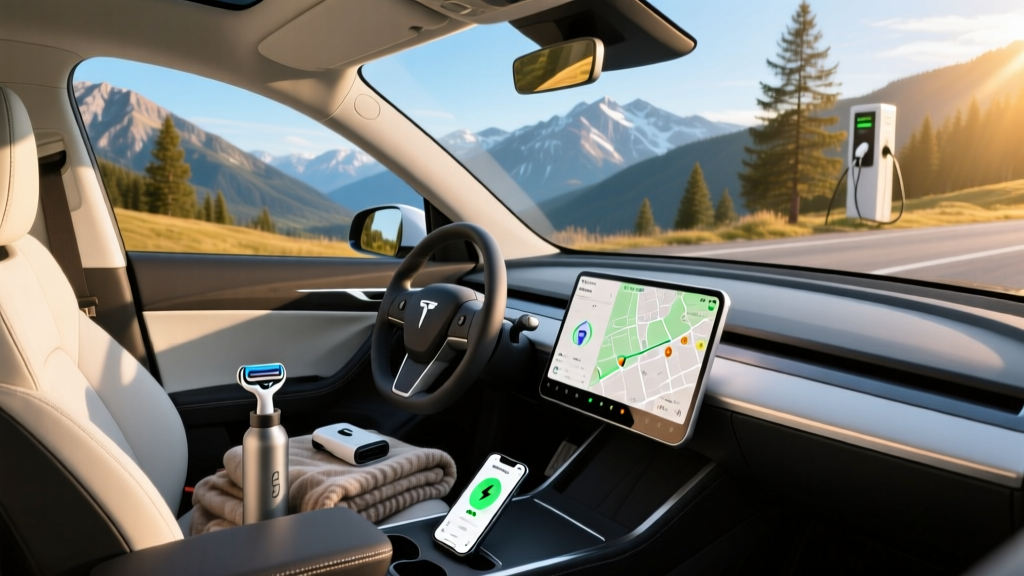
Yes. The TSA permits electric razors in both carry-on and checked luggage. However, because most modern electric razors contain lithium-ion batteries, the FAA strongly recommends packing them in your carry-on bag. If the razor has a removable lithium battery, the spare battery must go in carry-on. This is the same lithium-battery safety logic that governs EV traction packs — thermal runaway risk is managed more safely in the cabin than in the cargo hold.
If you're flying to pick up an EV rental or heading out on an EV road trip, keep reading. Below we break down the real costs, charging logistics, and ownership considerations that matter once you land.
Why EV Owners Ask About Travel Gadgets and Trip Costs
The question about electric razors on planes often comes from EV owners planning road trips that involve a flight leg — perhaps flying to a city, renting an EV, and driving a scenic route. In 2026, EV rentals are mainstream at major airport locations through Hertz, Avis, and Sixt, with models like the Tesla Model 3, Hyundai Ioniq 5, and Chevrolet Equinox EV widely available. Understanding both the airline rules for your gadgets and the real economics of an EV trip is essential for smart planning.
For current EV owners considering a long trip, the calculus has shifted dramatically. With the DC fast-charging network surpassing 80,000 public ports across the U.S. (per the U.S. Department of Energy AFDC), and vehicles routinely achieving 250-350 miles of EPA range, the trip math is fundamentally different than it was even three years ago.
EV vs Gas Road Trip: The Real Cost Comparison
Let's compare a 1,200-mile round trip — say, Los Angeles to San Francisco and back — in a 2026 Tesla Model 3 Long Range versus a comparable 2026 Toyota Camry LE (gas). These numbers reflect real-world conditions, not idealized sticker claims.
| Factor | 2026 Tesla Model 3 LR (AWD) | 2026 Toyota Camry LE (Gas) |
|---|---|---|
| EPA Range / MPG | 363 mi (EPA); ~290 mi real highway | 32 MPG combined; ~29 MPG highway |
| Battery / Tank | 82 kWh usable (NMC) | 13.2 gal tank |
| Energy Cost per Mile | $0.07 (home L2) / $0.14 (public DCFC) | $0.12 (at $3.80/gal) |
| Trip Fuel/Energy Cost | $84 (home) / $168 (all DCFC) | $144 |
| Stops Required | 3-4 DCFC stops (~20 min each) | 2-3 gas stops (~8 min each) |
| Maintenance Allocation | ~$0.01/mi | ~$0.04/mi |
| Total Trip Cost | $96-$180 | $192 |
The takeaway: If you charge primarily at home before departure and at destination, the EV saves $50-$100 per trip. If you rely entirely on DC fast charging at $0.40-$0.50/kWh (common on Electrify America and EVgo networks in 2026), costs roughly equal gas. The EV advantage grows with home charging access.
First-Time EV Buyer: What to Know Before You Commit
If that road trip scenario appeals to you and you're considering purchasing an EV rather than renting, here are the concrete numbers and realities that should drive your decision.
The Federal Tax Credit: Current 2026 Rules
The IRS §30D clean vehicle credit offers up to $7,500, but eligibility is a multi-layer filter. Per IRS guidelines, you must satisfy all of the following:
- Income caps: AGI ≤ $150,000 (single) / $225,000 (head of household) / $300,000 (joint)
- MSRP caps: ≤ $55,000 for sedans; ≤ $80,000 for SUVs, trucks, vans
- Battery sourcing: Critical minerals and battery components must meet escalating domestic/free-trade-partner thresholds — this eliminates some models entirely
- Point-of-sale transfer: You can apply the credit as a down-payment reduction at the dealer, or claim it on your tax return
- VIN verification: Confirm the specific vehicle's battery qualifies at fueleconomy.gov
Real-world impact: A 2026 Chevrolet Equinox EV LT (MSRP ~$33,600, 319 mi EPA range) qualifies for the full $7,500 via point-of-sale transfer for eligible buyers, dropping effective cost to ~$26,100. A 2026 Tesla Model Y Long Range (~$44,990 MSRP) currently qualifies for $3,750 (partial critical-minerals compliance). Always verify before purchasing — sourcing rules shift with supply chains.
5-Year Total Cost of Ownership: EV vs Gas vs Hybrid
Beyond the sticker price, here's what ownership actually costs over 60 months at 12,000 miles/year, comparing three popular 2026 models:
| Cost Category | 2026 Chevy Equinox EV 2LT ($36,100) | 2026 Toyota RAV4 Hybrid XLE ($33,500) | 2026 Toyota RAV4 LE Gas ($29,500) |
|---|---|---|---|
| Purchase (after incentives) | $28,600 (w/ $7,500 credit) | $33,500 | $29,500 |
| Fuel/Energy (5 yr) | $3,600 (home L2) | $6,750 (38 MPG @ $3.80/gal) | $8,550 (30 MPG @ $3.80/gal) |
| Maintenance (5 yr) | $1,200 | $3,200 | $3,800 |
| Insurance (5 yr avg) | $9,500 | $7,800 | $7,200 |
| Depreciation (est.) | $11,200 | $9,800 | $10,500 |
| 5-Year Total | $54,100 | $61,050 | $59,550 |
The EV wins on 5-year total cost if you qualify for the tax credit and have home charging. Insurance premiums remain 15-30% higher for EVs due to repair-cost data. Depreciation has stabilized for mainstream models but remains a concern for luxury EVs.
Common EV Misconceptions: Myth vs Fact
| Myth | Fact (with data) |
|---|---|
| "EV batteries need replacing every 5 years" | Federal warranty mandates 8 years/100,000 miles minimum. Real-world degradation averages 8-12% over 100k miles for NMC chemistry; LFP packs (Tesla Model 3 RWD, Ford Mustang Mach-E Select) show 5-8% loss. Replacement cost: $8,000-$18,000 depending on pack size — but rarely needed within typical ownership. |
| "You can't road-trip an EV" | The Tesla Supercharger network (now NACS-open to Ford, Rivian, GM, and others via adapter or native port) offers 30,000+ stalls. A 1,000-mile trip in an Ioniq 5 (peak 240 kW DCFC, 10-80% in ~18 min) adds roughly 90 minutes of total charging time vs. a gas car. |
| "EVs are worse in cold weather" | Range loss of 20-35% is real at 20°F (per AAA cold-weather testing). A 300-mi EPA vehicle delivers ~200-240 mi in deep cold. However, preconditioning while plugged in and using a heat pump (standard on most 2026 models) mitigates this significantly. |
| "Home charging installation costs a fortune" | A basic Level 2 (240V/48A) install on an existing 200A panel: $800-$2,000 including equipment (ChargePoint Home Flex, Wallbox Pulsar Plus) and electrician labor. Panel upgrade to 200A adds $1,500-$3,500 — needed in ~25% of older homes. |
| "Charging takes too long" | Home Level 2 adds 25-44 miles per hour of charging (7.7-11.5 kW). Overnight (10 hours) replenishes 250-440 miles — more than most drivers use in a day. DC fast charging: 10-80% in 18-35 minutes for most 2026 models. |
Decision Framework: Is an EV Right for Your Situation?
Choose a BEV (battery electric vehicle) if:
- You have reliable home charging (garage or driveway with 240V access)
- Your daily driving is under 80 miles round-trip (covers 90%+ of U.S. commutes)
- You qualify for the §30D tax credit (check income and vehicle eligibility)
- You want minimum maintenance and lowest per-mile energy cost
- You take 1-3 road trips per year and can plan DCFC stops
Choose a PHEV (plug-in hybrid) if:
- You have home charging but apartment/condo access is unreliable
- You regularly drive 200+ miles in areas with sparse charging (rural routes, national parks)
- You want electric-only commuting (25-50 mi range) with gas backup for road trips
- Examples: 2026 Toyota RAV4 Prime (42 mi electric, 94 MPGe), 2026 Jeep Wrangler 4xe (22 mi electric)
Stick with a hybrid (HEV) or gas vehicle if:
- You have zero home charging access and public charging is sparse in your area
- You frequently tow heavy loads (trailers, boats) where EV range drops 40-60%
- Your budget is under $28,000 and you cannot wait for used-EV credit eligibility
- You live in extreme cold climates (-20°F regular) and lack garage parking
Real-World Ownership: What No Spec Sheet Tells You
After multiple EV ownership cycles and thousands of DCFC sessions, here are the practical realities that shape daily life:
Charging curves matter more than peak kW. A vehicle advertising "350 kW peak" may sustain that rate for only 2-3 minutes before tapering. The Hyundai Ioniq 5 and Kia EV6 (800V architecture) sustain 200+ kW from 10-55% SoC, making them genuinely fast. Others peak at 250 kW but average 130 kW across the 10-80% session. Always check the full curve, not the headline number.
NACS vs CCS in 2026. The Tesla NACS connector is now the de facto standard. Ford, GM, Rivian, Volvo, and others ship with native NACS ports. CCS vehicles (older VWs, some Hyundais) can use Tesla Superchargers via a $200-$300 adapter. CHAdeMO is effectively dead for new vehicles — only legacy Nissan Leafs use it.
Insurance shopping is essential. EV insurance varies wildly. Get quotes from GEICO, Progressive, State Farm, and EV-specialty insurers before purchasing. A Tesla Model Y might cost $2,200/year with one carrier and $3,800 with another — a $1,600 swing for identical coverage.
Tire costs are higher. EVs are 15-25% heavier than gas equivalents and deliver instant torque. Expect tire replacement at 25,000-35,000 miles (vs. 40,000-50,000 for gas cars). Budget $800-$1,400 per set for EV-optimized tires (Michelin Pilot Sport EV, Hankook iON).
Frequently Asked Questions
Can you bring an electric razor on the plane in 2026?
Yes. TSA allows electric razors in carry-on and checked bags. Lithium-ion battery models are safest in carry-on per FAA guidance. No watt-hour restrictions apply to razors (they're well under the 100 Wh spare-battery limit).
What's the cheapest EV to own in 2026?
The 2026 Chevrolet Equinox EV LT ($33,600 MSRP, $26,100 after tax credit, 319 mi EPA) offers the lowest effective entry price for a 300+ mile BEV. The 2026 Nissan Leaf S ($28,140, 149 mi range) is cheapest outright but limited range and CHAdeMO connector reduce practicality.
How much does home Level 2 charging cost to install?
Expect $800-$2,000 for a standard install (240V/48A circuit, hardwired or NEMA 14-50 outlet) on a modern 200A panel. Older homes needing a panel upgrade should budget an additional $1,500-$3,500. Always hire a licensed electrician and pull permits — unpermitted work can void home insurance.
Do EVs lose range in winter?
Yes. Expect 20-35% range reduction at 20°F, and up to 40% at 0°F with cabin heating. A 300-mi EPA vehicle delivers ~200-240 mi in typical winter conditions. Preconditioning while plugged in and heat-pump-equipped models (Tesla, Hyundai/Kia, most 2026 EVs) reduce this penalty significantly.
Is a PHEV better than a full EV for road trips?
For frequent long-distance drivers in charging-sparse regions, yes. A PHEV like the RAV4 Prime gives 42 miles of electric commuting and unlimited gas range for trips. For drivers with home charging who take 1-3 road trips yearly, a BEV with 300+ mi range and DCFC capability is more cost-effective overall.