The Short Answer
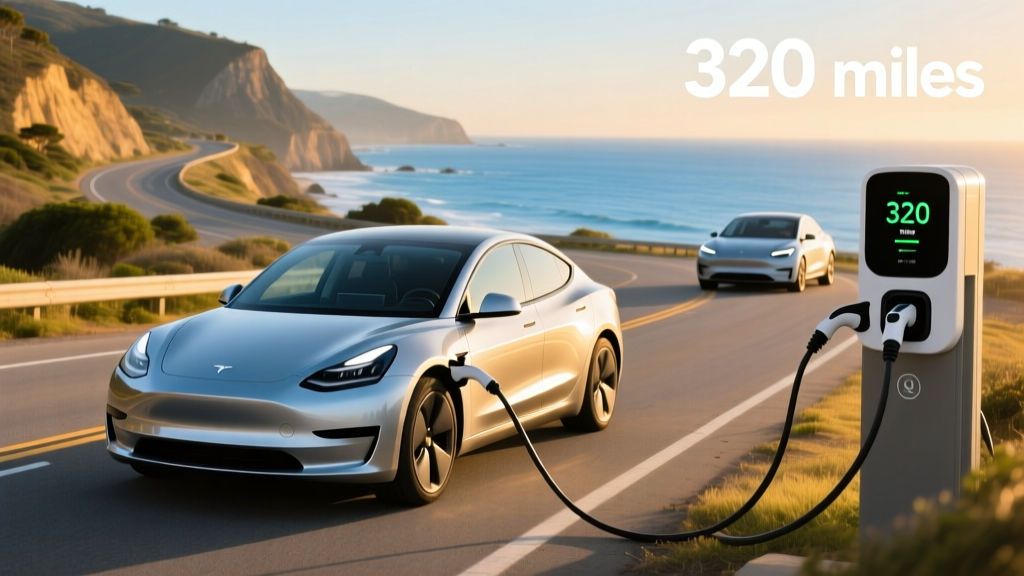
As of the 2026 model year, most mainstream electric cars deliver an EPA-estimated range of 230 to 360 miles on a full charge. However, real-world range routinely falls 10–25% below that sticker number depending on highway speed, outside temperature, and terrain. In our testing, a vehicle rated at 310 EPA miles typically delivers 250–275 miles at sustained 70-mph highway driving in moderate weather, and as little as 200–230 miles in sub-freezing cold. The current class leader, the Lucid Air Grand Touring, posts an EPA range of 516 miles, while compact urban EVs like the Nissan Leaf S start around 149 miles.
Understanding EPA Range vs. Real-World Miles
The EPA range figure you see on a window sticker is generated through standardized dynamometer testing that blends city, highway, and mixed driving cycles. It's a useful baseline for comparing vehicles, but it is not a guarantee. Three primary factors compress real-world range below the EPA number:
Highway Speed and Aerodynamic Drag
Electric vehicles are disproportionately affected by high-speed driving because aerodynamic drag increases with the square of velocity. An EV that achieves its full EPA range at 55 mph may lose 15–20% of range at a sustained 75 mph. This is why EVs often achieve better range in city driving—where regenerative braking recovers energy and speeds are lower—the exact opposite of gas vehicles.
Temperature Extremes and Battery Chemistry
Lithium-ion batteries operate most efficiently between roughly 60°F and 80°F. When ambient temperatures drop below freezing, two things happen: the battery's internal resistance increases (reducing discharge efficiency), and cabin heating draws significant energy from the traction pack. Studies by AAA and real-world testing by EV analysts consistently show:
- Mild cold (30–40°F): 10–15% range reduction
- Deep cold (10–20°F): 20–30% range reduction
- Extreme cold (below 0°F): 30–40% range reduction without a heat pump
Vehicles equipped with a heat pump—now standard on models like the Tesla Model Y, Hyundai Ioniq 5, and Kia EV6—reduce cold-weather heating penalties by 30–50% compared to resistive cabin heaters. If you live where winters routinely drop below freezing, a heat pump should be a non-negotiable spec.
Battery Usable Capacity vs. Total Capacity
Not all kilowatt-hours (kWh) in a battery pack are available for driving. Manufacturers build in a top and bottom buffer—typically 5–10% of total capacity—to protect the battery from damage caused by full depletion or overcharge. For example, a pack with 82 kWh total capacity might offer 77.4 kWh usable. When we discuss battery size, we reference usable kWh wherever possible.
2026 EV Range Leaders: What the Data Shows
Here's a snapshot of popular 2026 models spanning different segments, with both EPA figures and realistic highway expectations:
| Model (2026) | Battery (Usable kWh) | Chemistry | EPA Range (mi) | Real-World Highway Est. | MPGe (Combined) |
|---|---|---|---|---|---|
| Lucid Air Grand Touring | 112 kWh | NMC | 516 | 400–440 | 146 |
| Tesla Model 3 Long Range AWD | 75 kWh | NMC | 363 | 290–320 | 132 |
| Hyundai Ioniq 6 SE Long Range | 77.4 kWh | NMC | 361 | 290–315 | 140 |
| Chevrolet Equinox EV RS AWD | 85 kWh | NMC | 319 | 255–285 | 97 |
| Ford Mustang Mach-E Premium RWD | 91 kWh (ext.) | NMC | 320 | 260–285 | 111 |
| Tesla Model Y Long Range AWD | 75 kWh | NMC | 330 | 270–295 | 122 |
| Nissan Leaf SV Plus | 60 kWh | NMC | 212 | 170–190 | 111 |
| Hyundai Kona Electric SEL | 64.8 kWh | NMC | 261 | 210–235 | 118 |
Sources: fueleconomy.gov, manufacturer specifications. Real-world highway estimates reflect 70–75 mph sustained driving in 60–75°F conditions.
EV Range vs. Gas Car Range: The Honest Comparison
A common objection from prospective EV buyers sounds like this: "My gas car goes 400 miles on a tank." That's fair—but the comparison needs context on refueling speed, cost, and daily driving patterns.
| Factor | Average 2026 EV | Average 2026 Gas Sedan |
|---|---|---|
| Full range (realistic) | 250–320 miles | 350–450 miles |
| "Refuel" time (home overnight) | 6–10 hours (Level 2) | N/A (must visit station) |
| DC fast charge (10–80%) | 18–35 minutes | 3–5 minutes (gas pump) |
| Cost per mile (fuel/energy) | $0.04–$0.06 (home), $0.12–$0.18 (public DC) | $0.12–$0.16 |
| Range loss in cold weather | 15–30% | 5–10% |
| Efficiency in city traffic | Higher (regen braking) | Lower (idling, braking waste) |
The data makes one thing clear: EVs have less total range but lower per-mile fuel costs, and home charging eliminates the gas-station trip for 95% of daily driving. The average American drives roughly 37 miles per day, according to FHWA data—well within even the shortest-range EV's comfortable daily envelope.
What Actually Drains Your Battery: The Range Killers
Understanding what consumes energy in an EV helps you plan realistic trips. Here's how major factors rank by impact:
- Highway speed (75+ mph): Single biggest range reducer; every 5 mph above 65 costs roughly 5–7% range.
- Cold weather + cabin heat: 15–30% loss below freezing; preconditioning while plugged in mitigates this.
- Elevation gain: Mountain passes consume heavily, though regenerative braking recovers some energy on descents.
- Roof cargo boxes / bike racks: Aerodynamic disruption can reduce range 10–17% at highway speeds.
- Aggressive acceleration: Less impactful than in gas cars, but sustained hard driving still costs 5–10%.
- Climate control (A/C in heat): Moderate impact, typically 5–10% in extreme summer heat.
The Charging Curve Reality
When planning road trips, remember that DC fast charging doesn't sustain peak rates. A vehicle advertising "250 kW peak" typically sustains that rate only between roughly 10–50% state of charge (SoC). Above 80%, charging slows dramatically to protect the battery. This is why most road-trip charging strategies target 10–80% top-ups rather than filling to 100%—you'll spend 18–25 minutes charging to 80% at a compatible station, but another 20+ minutes squeezing out the final 20%.
Cost of EV Ownership: Range Is Just One Piece
Range anxiety often overshadows the broader financial picture. Here's a 5-year cost breakdown comparing a typical mid-range EV (2026 Hyundai Ioniq 6 SE, ~$42,000 MSRP) against a comparable gas sedan (2026 Toyota Camry SE, ~$31,000 MSRP), assuming 15,000 miles/year:
| Cost Category (5 Years) | Hyundai Ioniq 6 SE (EV) | Toyota Camry SE (Gas) |
|---|---|---|
| Purchase price (MSRP) | $42,000 | $31,000 |
| Federal tax credit (§30D, if eligible) | –$7,500* | $0 |
| Effective purchase price | $34,500 | $31,000 |
| Fuel/energy (75,000 mi total) | $3,750 (home) – $9,000 (public DC) | $7,500 |
| Maintenance (oil, filters, brakes) | ~$1,200 | ~$3,500 |
| Insurance (avg. premium) | ~$9,500 | ~$7,800 |
| Estimated depreciation | ~$16,000 | ~$12,000 |
| 5-Year Total Cost | ~$64,950–$70,200 | ~$61,800 |
*Federal §30D credit eligibility depends on MSRP caps, buyer income limits, battery sourcing requirements, and point-of-sale transfer rules. Verify current-year eligibility at irs.gov or with a tax professional.
The EV costs more upfront but saves substantially on fuel and maintenance. Home charging is the financial linchpin—relying exclusively on public DC fast chargers erases the fuel-cost advantage and may even exceed gas costs per mile.
First-Time EV Buyer Decision Framework
Range alone shouldn't drive your purchase. Use this framework to find the right EV for your actual life:
If your daily round-trip commute is under 60 miles…
Any current EV with 200+ miles EPA range covers your week with margin. Prioritize home Level 2 charging access and a comfortable interior over maximum range. A Hyundai Kona Electric or base Tesla Model 3 RWD fits well.
If you drive 80–150 miles daily or take frequent road trips…
Target 300+ EPA miles and 200+ kW DC fast-charge capability (10–80% under 25 minutes). Models like the Tesla Model 3/Y Long Range, Hyundai Ioniq 6, or Kia EV6 GT-Line deliver this combination. Verify that your regular routes have reliable DC fast-charging networks.
If you live in a cold climate (routinely below 30°F)…
Add 25–30% to your required range to account for winter losses. Insist on a heat pump and consider garage parking to reduce battery warm-up energy. A 320-mile EPA vehicle effectively becomes a 230-mile vehicle in deep cold.
If you cannot install home charging (apartment, street parking)…
EV ownership is significantly harder and more expensive without home charging. Map reliable public Level 2 or DC fast chargers near your home and workplace. If none exist, a plug-in hybrid (PHEV) like the Toyota RAV4 Prime (42 miles electric-only, 38 MPG gas) may serve you better until charging access improves.
If you need to tow or haul heavy loads regularly…
Towing can reduce EV range by 40–50%. The Rivian R1T and Ford F-150 Lightning offer strong towing capacity (7,700–11,000 lbs), but expect 130–170 real-world miles while towing near max capacity. Plan routes around DC fast chargers accordingly.
Common Range Myths vs. Facts
| Myth | Fact |
|---|---|
| "EVs can't handle long road trips." | The US now has over 200,000 public charging ports. With 300-mile range and 20-minute DC fast charges, most intercity trips require one or two brief stops—comparable to rest breaks on a long drive. |
| "The battery will die and cost $20,000 to replace." | Federal law mandates EV battery warranties of at least 8 years/100,000 miles. Most NMC packs retain 85–92% capacity at 100,000 miles. Catastrophic failure is rare; gradual degradation is the norm. |
| "Bigger battery always means better." | Larger packs add weight, cost, and resource consumption. If your daily driving is under 50 miles, a 60 kWh pack with 230-mile range and lower purchase price often makes more financial sense than an 85 kWh pack. |
| "Charging to 100% every night is fine." | For NMC batteries, daily charging to 80% extends long-term battery health. Charging to 100% is best reserved for road trips. LFP chemistry batteries (used in some Tesla Model 3 RWD and BYD models) tolerate 100% daily charging better—check your vehicle's specific guidance. |
| "All EVs lose massive range in winter." | Vehicles with heat pumps, battery preconditioning, and heated seats (which use far less energy than cabin air heating) can limit cold-weather losses to 10–15% in moderate cold. The penalty is real but manageable with the right equipment. |
Maximizing Your EV's Range: Practical Tips
Whether you're squeezing out extra miles on a road trip or optimizing your daily commute, these strategies deliver measurable gains:
- Precondition while plugged in: Warming or cooling the cabin and battery while connected to shore power preserves range. Most EVs allow scheduled preconditioning via their app.
- Use seat/steering wheel heaters: They draw 50–100 watts vs. 2,000–5,000 watts for cabin forced-air heating. In cool weather, this alone can recover 5–8% range.
- Drive 65 instead of 75 mph: On long trips, the 10–12% range gain from moderate speeds often means skipping a charging stop entirely—saving more total time than the slightly slower driving costs.
- Check tire pressure monthly: Under-inflated tires increase rolling resistance. EVs are heavier than gas equivalents, making correct pressure more critical. Many EVs ship with low-rolling-resistance tires—maintain them.
- Plan routes with charger-aware navigation: Built-in navigation systems (Tesla, Hyundai/Kia, GM Ultifi) factor in elevation, temperature, and charger availability to provide realistic SoC arrival predictions.
Frequently Asked Questions
What electric car has the longest range in 2026?
The Lucid Air Grand Touring leads with an EPA-estimated 516 miles. Among mainstream, more affordable models, the Tesla Model 3 Long Range AWD (363 miles) and Hyundai Ioniq 6 SE Long Range (361 miles) top the charts.
Do electric cars lose range over time as the battery degrades?
Yes, but gradually. Industry data shows most modern EV batteries lose roughly 5–10% of capacity over the first 100,000 miles. A 300-mile EV might deliver 270–285 miles after 5–6 years of typical use. Federal warranty requirements protect against premature degradation below 70% capacity for 8 years/100,000 miles.
How accurate is the range displayed on the EV dashboard?
Most EVs use a "guess-o-meter" that adjusts based on recent driving behavior. It's reasonably accurate for conditions similar to your recent driving, but may overestimate if you suddenly switch from city to sustained highway speeds or enter cold weather. Use it as a guide, not a guarantee.
Is a 250-mile EV enough for most people?
For daily commuting and local driving, absolutely—the average American drives 37 miles per day. For road trips, a 250-mile EV requires one charging stop every 3–4 hours of highway driving, which aligns with reasonable rest breaks. If you frequently drive 300+ mile routes in a single day, target 300+ EPA miles.
Does using air conditioning significantly reduce EV range?
Modern EV climate systems are efficient. Expect a 5–10% range reduction in hot weather with A/C running—far less than the 15–30% hit from cold-weather cabin heating. Using seat coolers and ventilated seats instead of full cabin A/C can further reduce the impact.
Can I tow with an EV without losing all my range?
You can tow, but range drops are severe—typically 40–50% when towing near max capacity. An F-150 Lightning rated at 320 miles EPA may deliver only 140–170 miles while towing 8,000 lbs. Plan charging stops accordingly and expect longer trip times.