What Is an EV Raffle and Should You Enter?
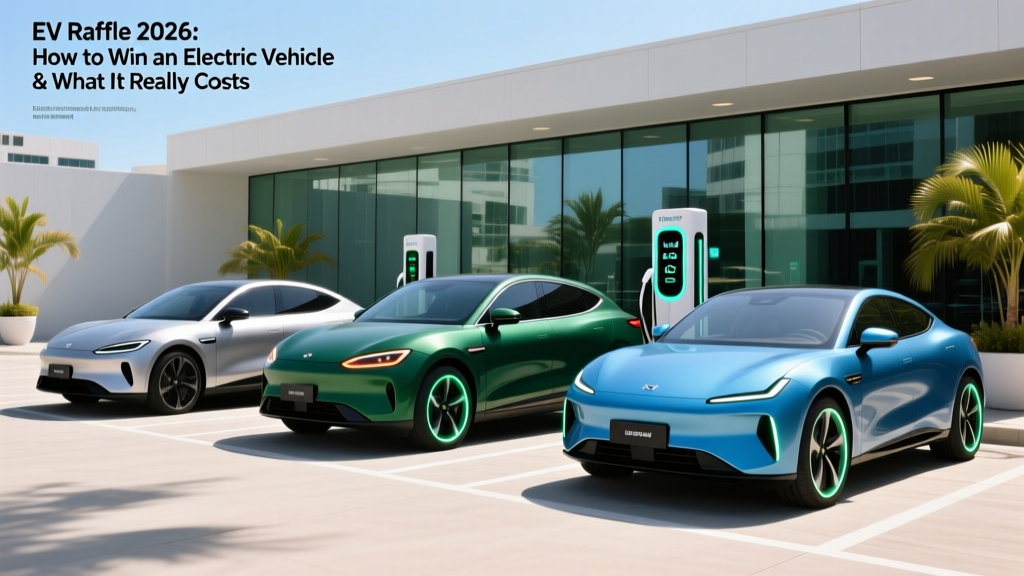
Quick answer: An EV raffle is a prize draw—usually run by a nonprofit, school, auto show, or dealership—where the winner receives a new electric vehicle (often a Tesla Model 3, Hyundai IONIQ 5, or Chevrolet Equinox EV). Tickets typically cost $25–$150. Before entering, understand that winning an EV means taking on real ownership costs: insurance ($1,800–$2,600/year), home charging setup ($600–$2,200), and electricity ($500–$900/year). You may also owe state income tax on the prize's fair market value. If you can't install a home charger or don't drive enough to offset higher insurance, selling the prize and buying a hybrid may be smarter.
EV raffles have surged in popularity as organizations use high-value electric vehicles to drive fundraising. A single ticket might cost $50 for a chance at a $42,000 SUV. But winning isn't free—and the gap between "free car" and "free ownership" catches many winners off guard. This guide breaks down exactly what happens after you hold up that oversized check, including the numbers most raffle organizers don't mention.
How EV Raffles Actually Work
Most EV raffles follow a standard model: a sponsoring organization purchases or leases a vehicle, sells numbered tickets (online or in person), and holds a public drawing. The winner receives the title or a dealership voucher. Here's what varies:
- Ticket price: $25–$150 per entry; bundles like "5 for $100" are common
- Odds: A 5,000-ticket raffle for a $40,000 EV gives you 0.02% odds—better than Powerball, worse than you'd hope for the money
- Prize structure: Some raffles award the exact vehicle; others offer a cash equivalent or dealership credit
- Tax treatment: The IRS considers raffle winnings taxable income at fair market value. If you win a $42,000 EV, that's $42,000 added to your taxable income for the year
Before buying a ticket, confirm the raffle is registered with your state's attorney general or charitable gaming commission. Legitimate raffles publish their permit numbers and odds of winning.
The Real Cost of Owning a Raffle-Won EV
Winning an EV doesn't mean zero transportation costs. Here's a realistic 5-year cost breakdown for a typical raffle prize—a 2026 Hyundai IONIQ 5 SEL (MSRP ~$46,500, 84 kWh NMC battery, EPA-estimated 303 miles range):
| Cost Category | 5-Year Total (EV) | 5-Year Total (Gas Equivalent) | Notes |
|---|---|---|---|
| Vehicle purchase | $0 (won) | $38,000 | Gas baseline: 2026 Toyota RAV4 XLE |
| State income tax on prize | $2,100–$4,200 | $0 | Varies by state; 5–10% of FMV typical |
| Home Level 2 charger install | $800–$2,200 | $0 | 240V/40A circuit; panel upgrade adds $1,500+ |
| Electricity (charging) | $2,500–$4,500 | $0 | 12,000 mi/yr at $0.14/kWh avg; 3.5 mi/kWh |
| Gasoline | $0 | $7,500–$9,000 | 28 MPG combined at $3.40/gal |
| Insurance | $9,000–$13,000 | $6,500–$8,500 | EV premiums 15–25% higher on average |
| Maintenance | $1,200–$1,800 | $3,000–$4,500 | No oil changes; tire wear higher on EVs |
| Federal tax credit (§30D) | $0–$7,500 | $0 | Only if you buy, not if you win a prize |
| Total 5-year net cost | $13,500–$23,200 | $55,000–$60,000 | EV wins on operating cost, but startup costs are real |
Key insight: You cannot claim the §30D federal clean vehicle credit on a raffle-won EV. The credit requires a purchase from a dealer, and the vehicle must meet MSRP caps ($55,000 for cars, $80,000 for SUVs/trucks), buyer income limits ($150K single / $300K joint), and battery-sourcing requirements. If you win an EV you don't want, selling it privately won't transfer the credit to the buyer either—§30D applies only to the original retail purchaser.
EV vs. Gas vs. Hybrid: What Should You Actually Drive?
Not every raffle winner should keep the EV. Your ideal powertrain depends on your driving pattern, housing situation, and climate. Here's a data-driven comparison using a 2026 model-year lens:
| Factor | Battery EV (IONIQ 5) | PHEV (Toyota RAV4 Prime) | Gas (RAV4 XLE) |
|---|---|---|---|
| EPA range / MPG | 303 mi / 114 MPGe | 42 mi electric + 38 MPG gas | 30 MPG combined |
| Fuel cost per mile | $0.040 (home charging) | $0.035 electric / $0.12 gas | $0.12 |
| Home charging needed? | Yes—strongly recommended | Helpful but not required | No |
| Cold-weather range loss | 20–30% below 32°F | Minimal (gas engine supplements heat) | Negligible |
| Road-trip charging | DC fast charge: 10–80% in ~18 min at 240 kW peak | No DC charging needed | 5 min at any gas station |
| Annual maintenance | ~$300 (cabin filter, tire rotation) | ~$500 (oil + EV system) | ~$700 (oil, filters, brakes) |
| Best for | Home chargers, daily commutes <150 mi | Short commutes + frequent long trips | No home charging, rural areas |
Real-world range reality: The IONIQ 5's EPA-estimated 303 miles assumes moderate temperatures and mixed driving. Expect 240–270 miles on sustained highway driving at 75 mph, and 200–230 miles in sub-freezing weather. The heat pump (standard on 2026 models) helps, but battery chemistry limits cold-weather performance. For context, fueleconomy.gov lists the IONIQ 5 AWD at 3.5 miles per kWh combined.
First-Time EV Buyer: What Raffle Winners Must Know
If you've never owned an EV, the learning curve is manageable but real. Here's what matters most:
Home Charging Is Non-Negotiable for Most Owners
Over 80% of EV charging happens at home. A Level 2 charger (240V, 32–48 amps) adds roughly 25–35 miles of range per hour of charging—enough to fully replenish overnight. Without home charging, you'll rely on public DC fast chargers, which cost $0.30–$0.50/kWh (versus $0.12–$0.16/kWh at home) and require 20–40 minute stops. If you live in an apartment without charging access, a PHEV or gas car may be more practical.
Understand kW vs. kWh
This is the most common confusion for new EV owners:
- kWh (kilowatt-hours) = energy capacity. The IONIQ 5's battery holds 84 kWh usable. Think of it like a gas tank size.
- kW (kilowatts) = power or rate. A 48-amp Level 2 charger delivers ~11.5 kW. A DC fast charger might peak at 240 kW. Think of it like the flow rate of a gas pump nozzle.
The Charging Curve Taper Is Real
DC fast chargers don't sustain peak speed. The IONIQ 5 peaks at ~240 kW from 10–55% state of charge, then tapers to ~150 kW by 70%, and drops below 50 kW above 85%. That's why manufacturers quote 10–80% times (~18 minutes) rather than 0–100%. Plan road-trip stops around 10–80% charges for maximum efficiency.
Insurance Costs More
EV insurance premiums run 15–25% higher than comparable gas vehicles due to higher repair costs (battery replacement, specialized body shops, ADAS sensor recalibration). Get a quote before taking title on a raffle prize—some insurers offer EV-specific discounts.
Should You Keep the Raffle EV or Sell It?
Not every winner should drive the car home. Here's a decision framework:
Keep the EV if:
- You can install a Level 2 home charger (owned home, garage/driveway access, 200-amp electrical panel)
- Your daily driving is under 150 miles round-trip
- You live in a moderate or warm climate (or accept 20–30% winter range loss)
- You're willing to pay state income tax on the prize value
- You want lower per-mile fuel costs ($0.04/mile vs. $0.12/mile for gas)
Sell the EV and buy a hybrid/gas car if:
- You rent or live in an apartment without charging access
- You regularly drive 300+ miles in a single day (rural areas, frequent road trips)
- The state tax bill on the prize exceeds your savings from not buying a car
- You live in an area with limited public DC fast-charging infrastructure
- Insurance quotes are 30%+ higher than your current policy
Consider a PHEV if:
- You want electric-only commuting (30–42 miles) but gas flexibility for road trips
- You can charge at home but don't want to plan around charging stations
- Models like the 2026 Toyota RAV4 Prime (42 mi electric, 38 MPG gas, ~$45,000 MSRP) offer the best of both worlds
Common EV Raffle Myths vs. Facts
| Myth | Fact |
|---|---|
| "Winning an EV means free transportation" | You still pay state tax on the prize ($2,000–$4,000+), insurance ($1,800–$2,600/year), charging ($500–$900/year), and home charger installation ($800–$2,200). |
| "I can claim the $7,500 federal tax credit on a won EV" | No. The §30D credit requires a qualifying purchase, not a prize. Raffle winners cannot claim it. |
| "EV batteries need replacement every few years" | Modern NMC and LFP batteries are warrantied for 8 years/100,000 miles (10 years/150,000 miles in CARB states) to retain at least 70% capacity. Real-world degradation averages 1–2% per year. |
| "I'll be stranded if I run out of charge" | With 300+ mile EPA ranges and DC fast-charging networks (Tesla Supercharger, Electrify America, EVgo), range anxiety is manageable with basic trip planning. Apps like PlugShare and A Better Routeplanner show real-time charger availability. |
| "EVs don't work in cold weather" | EVs work in cold weather but lose 20–30% range below freezing due to battery chemistry and cabin heating demands. Preconditioning the battery while plugged in mitigates this. Norway, with harsh winters, has the highest EV adoption rate in the world. |
| "Charging takes too long" | Home Level 2 charging replenishes overnight while you sleep. DC fast charging adds 150–200 miles in 15–20 minutes. Most EV owners charge at home and only use fast chargers on road trips. |
Frequently Asked Questions
Do I owe taxes if I win an EV raffle?
Yes. The IRS treats raffle prizes as ordinary income at fair market value. If you win a $42,000 EV and you're in the 22% federal tax bracket, you'd owe roughly $9,240 in federal tax plus any state income tax. The sponsoring organization will issue a 1099-MISC. Some raffles offer a cash alternative (typically 70–80% of vehicle value) to help winners cover tax obligations.
Can I transfer the raffle EV title to someone else?
Generally yes, but the tax liability follows the original winner. If you win and immediately gift the car to a family member, you still owe income tax on the prize value. Consult a tax professional before making transfer decisions.
What if I win an EV I can't charge at home?
You have options: (1) Install a Level 2 charger if your electrical panel supports it—a licensed electrician can assess your 120/240V panel capacity for $150–$300. (2) Use workplace charging if your employer offers it. (3) Rely on public Level 2 and DC fast chargers, though this increases per-mile fuel costs by 2–3x. (4) Sell the EV and purchase a hybrid or gas vehicle better suited to your situation.
Are EV raffles legal in my state?
Raffle laws vary by state. Most states permit charitable raffles with proper registration, but some restrict ticket sales to state residents or cap prize values. Check with your state's attorney general office or charitable gaming division before purchasing tickets from an out-of-state organization.
What's the best EV to hope for in a raffle?
For most winners, a 2026 Tesla Model 3 Long Range (EPA 363 miles, ~$42,000 MSRP, access to the Supercharger network) or Hyundai IONIQ 5 (EPA 303 miles, 240 kW peak DC charging, spacious interior) offers the best combination of range, charging speed, and resale value. Avoid raffles offering discontinued models or vehicles with limited charging network access.
Bottom Line: EV Raffles Are a Gamble—Plan for the Win
An EV raffle ticket is a low-cost entry to a high-value prize, but winning comes with real financial obligations. Before you buy that $50 ticket, run the numbers: Can you install a home charger? Can you absorb the state tax hit? Does your driving pattern suit an EV's range and charging profile?
If the answer is yes, an EV raffle could hand you a vehicle that costs $0.04/mile to fuel and requires minimal maintenance for years. If the answer is no, there's no shame in selling the prize and putting the proceeds toward a hybrid that fits your life. The best EV is the one you can actually charge, insure, and drive without stress.
For current federal tax credit rules, consult the IRS §30D guidance. For EPA range and efficiency data, check fueleconomy.gov. And for safety ratings on any vehicle you might win, visit NHTSA.gov or the IIHS.