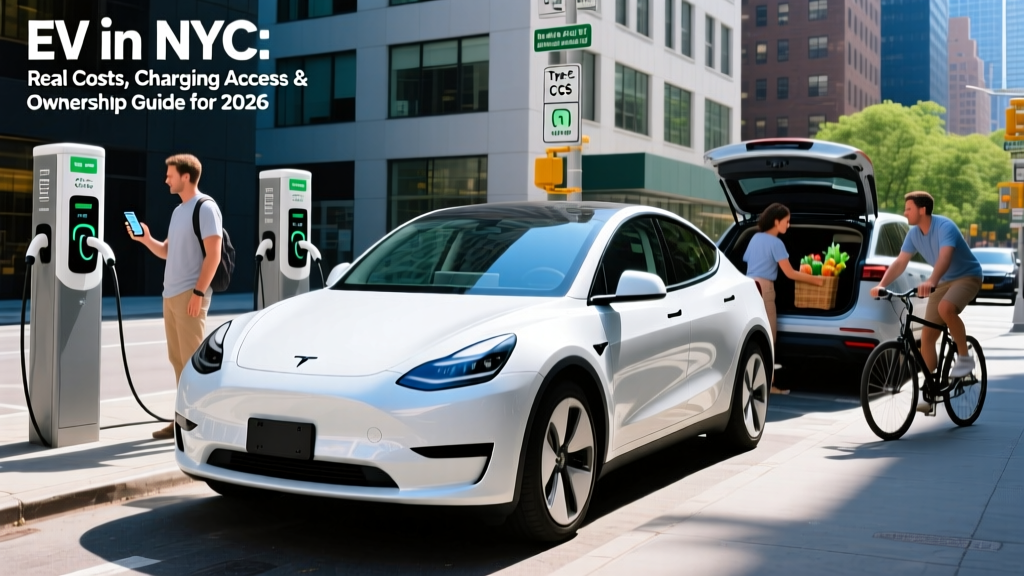
Owning an EV in New York City is entirely viable in 2026 — but it is not viable for everyone. The short answer: if you have reliable off-street parking with access to a Level 2 charger (home garage, workplace, or a subscribed curbside charger), an EV will likely save you $1,200–$2,400 per year in fuel and maintenance versus a comparable gas car. If you rely exclusively on street parking and public fast chargers, your costs and inconvenience will often exceed those of a hybrid. Below is the data-driven breakdown.
Quick Verdict: Should You Buy an EV in NYC?
Yes, if: you have a home/work Level 2 charger, drive <150 miles/day, and can absorb a higher upfront price.
Consider a PHEV instead if: you park on the street, take frequent weekend trips upstate, or your building lacks charging infrastructure.
Wait if: you live in a dense Manhattan or outer-borough neighborhood with no reliable overnight charging options.
The Real Economics of EV Ownership in NYC
New York City's electricity rates are among the highest in the nation — Con Edison's residential rate in early 2026 averages around $0.32/kWh, with commercial/public charging often running $0.40–$0.60/kWh. That sounds punishing until you compare it to NYC gas prices, which routinely hover near $4.00–$4.50/gallon (regular) and higher in Manhattan.
Let's compare two realistic commuter vehicles for a 10,000-mile/year NYC driver: a 2026 Hyundai Ioniq 6 SE (BEV, 361 mi EPA, 140 MPGe combined, ~$39,000 MSRP) versus a 2026 Toyota Prius LE (HEV, 57 MPG combined, ~$29,000 MSRP). Source: fueleconomy.gov.
| Cost Category | Hyundai Ioniq 6 (BEV) | Toyota Prius (HEV) | Difference |
|---|---|---|---|
| Energy/Fuel | $762 (home L2 @ $0.32/kWh) | $789 (57 MPG @ $4.50/gal) | ~$27 |
| Public DCFC top-ups (20%) | +$192 (avg $0.50/kWh) | $0 | +$192 |
| Oil changes | $0 | $180 (2x/yr) | -$180 |
| Brake wear (regen extends life) | ~$80/yr avg | ~$200/yr avg | -$120 |
| Insurance (NYC avg) | ~$3,400/yr | ~$2,900/yr | +$500 |
| Total annual | ~$4,434 | ~$4,069 | +$365 |
The BEV only wins on pure operating cost if you charge mostly at home. Street-parkers forced onto DC fast chargers actually lose the fuel-cost battle in NYC. Insurance premiums for EVs in New York run 15–25% higher than equivalent gas cars due to higher repair costs — a meaningful offset buyers routinely underestimate.
Charging Access: The Deciding Factor in NYC
The five boroughs have roughly 3,400 public charging ports as of early 2026 (per DOE AFDC data), concentrated in Manhattan garages, select retail lots, and a growing curbside network. But with over 2 million registered vehicles in the city, public charging is a supplement, not a primary strategy.
| Charging Type | Speed | Typical Cost | Best For |
|---|---|---|---|
| Level 1 (120V household) | ~1.4 kW / 3–5 mi/hr | $0.32/kWh | Overnight trickle, PHEVs |
| Level 2 home (240V) | 7–11.5 kW / 25–40 mi/hr | $0.32/kWh | Primary charging, garage owners |
| Level 2 public (garage/curbside) | 7–19 kW | $0.40–$0.60/kWh | Top-ups while parked 2+ hours |
| DC Fast Charge (Tesla Supercharger, EVgo, EA) | 50–250 kW | $0.48–$0.65/kWh | Road trips, emergency fill-ups |
Garage vs Street Parking Reality
If you rent or own a parking spot with 240V access, home Level 2 charging costs about $2,500–$5,500 to install (equipment $500–$800, electrician $1,500–$4,000, potential panel upgrade $1,500–$3,000 in older NYC buildings). Payback versus public charging typically hits in 18–30 months.
If you park on the street, your options are: (1) curbside Level 2 chargers from providers like FLO and Revel, which charge $0.40–$0.55/kWh plus idle fees; (2) garage Level 2 chargers at $0.50–$0.75/kWh plus parking fees that can reach $30–$60/session in Manhattan; or (3) DC fast chargers at $0.50–$0.65/kWh for 20–40 minute sessions. None of these approaches match the convenience or cost of home charging.
Cold Weather, Range, and NYC Winters
New York winters average 30–40°F December through February, with dips into the teens. EV batteries lose 20–30% of rated range in sustained cold, per AAA and Recurrent testing data. A vehicle rated at 300 miles EPA may deliver 210–240 real-world winter miles — still ample for NYC commuting, but a meaningful drop for weekend trips to the Hudson Valley or New England.
Preconditioning (warming the battery while plugged in) mitigates this. Vehicles with heat pumps — standard on most 2026 Hyundais, Kias, Teslas, and VW ID. models — recover 5–10% of that loss by using cabin heat more efficiently. If you're buying an EV in NYC, insist on a heat pump; it's the single most impactful cold-weather feature.
Federal and New York Incentives in 2026
The federal §30D tax credit offers up to $7,500 for qualifying new EVs, but eligibility hinges on MSRP caps ($55,000 sedans / $80,000 SUVs/trucks), buyer income caps ($150k single / $300k joint), and battery critical-mineral and component sourcing rules that shift yearly. As of 2026, many popular models qualify for only the partial $3,750 credit or none at all. Verify current eligibility on IRS.gov before signing a purchase agreement.
New York State's Drive Clean Rebate program has historically offered up to $2,000 for qualifying EVs, and the NYC Clean Trucks Program covers commercial vehicles. Con Edison's SmartCharge NY and EV Make-Ready programs have subsidized home charger installations. Check current availability — incentive budgets cycle annually.
Common NYC EV Myths, Addressed with Data
| Myth | Fact (with data) |
|---|---|
| "The grid can't handle EVs in NYC." | Con Edison's managed charging programs shift load to off-peak hours; a single EV charging at 7 kW overnight adds less load than a central AC unit. |
| "You'll get stranded without a charger." | NYC has 3,400+ public ports and dense Supercharger/EA coverage on I-87, I-95, and I-84 corridors. Stranding risk is low for planned trips. |
| "EVs are worse for the environment in NY." | New York's grid is ~60% zero-carbon (nuclear + hydro + wind + solar, per NYISO). An EV in NYC emits roughly 1/3 the lifecycle CO2 of a 30 MPG gas car. |
| "Battery replacement will bankrupt me." | 2026 BEV batteries carry 8-year/100,000-mile federal-mandated warranties. Degradation averages 1–2% per year; most batteries retain 85%+ capacity at 150k miles. |
| "Charging takes forever." | A 2026 Ioniq 6 on a 350 kW charger adds 180 miles in ~18 minutes (10–80%). Home Level 2 refills overnight while you sleep — zero time cost. |
Decision Framework: EV, PHEV, or HEV in NYC?
Choose a Battery EV (BEV) if:
- You have a garage or driveway with 240V outlet access
- Daily driving is under 100 miles (most NYC commutes are 20–40 miles)
- You qualify for the §30D credit or NY Drive Clean rebate
- You can absorb $35k–$55k upfront for a mainstream BEV
Choose a Plug-in Hybrid (PHEV) if:
- You have Level 1 (120V) overnight access — sufficient for 30–40 miles of electric range
- You take regular 200+ mile weekend trips upstate or to NJ/CT/PA
- You want EV-like commuting without range concerns
- Consider: 2026 Toyota RAV4 Prime (42 mi electric, 38 MPG gas), 2026 Chrysler Pacifica Hybrid (32 mi electric)
Choose a Hybrid (HEV) if:
- You park exclusively on the street with no reliable charging
- Your budget is under $30k and you need maximum MPG
- You drive 15,000+ miles/year in mixed city/highway
- Consider: 2026 Toyota Prius (57 MPG), 2026 Honda Accord Hybrid (48 MPG)
First-Time NYC EV Buyer Checklist
- Confirm charging access first. No charger, no EV. Get written permission from your building/landlord before purchasing.
- Check your electrical panel. Older NYC buildings often need 200A service upgrades ($1,500–$3,000) before installing a 40A+ Level 2 circuit.
- Get insurance quotes before signing. NYC EV insurance runs 15–25% higher than equivalent gas vehicles. Shop GEICO, Progressive, State Farm, and EV-specialty insurers.
- Verify §30D eligibility on IRS.gov for your specific VIN, income, and tax liability.
- Prioritize heat pump, DCFC speed, and real-world winter range over 0–60 times or infotainment features.
- Test the charging apps. Download ChargePoint, EVgo, Electrify America, Tesla, and FLO before buying — know which networks serve your neighborhood.
- Budget for tires. EVs wear tires 20–30% faster due to weight and instant torque; budget $1,200–$1,800 every 30k–40k miles.
NYC EV FAQ
Do I need a permit to install a home EV charger in NYC?
Yes. Level 2 installations require an electrical permit filed by a licensed electrician with the NYC Department of Buildings. Condo/co-op boards also have approval authority over shared electrical infrastructure.
Can I charge my Tesla at non-Tesla chargers in NYC?
All 2026 Teslas ship with NACS ports. Tesla's Supercharger network is the densest in the city, and since 2024, Tesla has opened many Superchargers to non-Tesla EVs via the NACS standard. For CCS-only chargers, a NACS-to-CCS adapter (included with recent Teslas) works at Electrify America and EVgo stations.
Are NYC EV parking and toll discounts still available?
NYC does not currently offer free parking for EVs at meters, but several private garages discount EV parking. The MTA's congestion pricing program in Manhattan does not exempt EVs, though New York State has discussed future clean-vehicle credits against tolls.
How does NYC congestion pricing affect EV ownership?
Manhattan's congestion pricing zone (below 60th Street) charges passenger vehicles $9 during peak hours as of 2026, with no EV exemption. This adds ~$2,250/year for daily Manhattan commuters regardless of powertrain — a cost to factor into both EV and gas budgets.
What's the best EV for NYC apartment dwellers without a garage?
Look at compact BEVs with fast DC charging (Hyundai Ioniq 5, Kia EV6, Tesla Model 3) that minimize time at public chargers, or a PHEV like the Toyota Prius Prime (44 miles electric) that can trickle-charge overnight on a 120V outlet.
Owning an EV in New York City in 2026 is a calculus problem, not an ideological one. Home charging access determines whether you save money or spend more. Cold weather, insurance premiums, and congestion pricing are real costs — but so is $4.50/gallon gas and stop-and-go brake wear. Run your own numbers, confirm your charging plan in writing, and let the math decide.