Quick Answer: Is an EV Worth It in New York?
For most New York drivers, an EV saves money over gas — but the math depends on where you live. A typical New York EV owner driving 12,000 miles/year pays roughly $540–$780/year in electricity (at $0.18–$0.26/kWh on Con Edison or upstate rates) versus $1,500–$1,900/year in gasoline at $3.40/gal and 28 MPG combined. New York's $2,000 NYSERDA Drive Clean Rebate (stackable with the federal §30D credit up to $7,500) brings a $38,000 EV down to roughly $28,500 effective cost. The catch: apartment dwellers in NYC without home charging access face higher public-charging costs ($0.35–$0.55/kWh at DC fast stations), and cold January temperatures can reduce range by 20–30%. If you can install a Level 2 home charger, an EV is a strong financial and practical choice in New York.
New York EV Incentives: Federal, State, and Local Breakdown
New York is one of the more incentive-rich states for EV buyers, but stacking credits requires understanding each program's rules. Here's what's available in 2026:
| Incentive | Amount | Key Requirements |
|---|---|---|
| Federal §30D Tax Credit | Up to $7,500 | MSRP caps ($55K cars, $80K SUVs/trucks); buyer AGI limits ($150K single / $300K joint); battery sourcing rules apply. Point-of-sale transfer available. Source: IRS |
| NYSERDA Drive Clean Rebate | Up to $2,000 | Income-based: full $2,000 for households under $138,560 (2025 threshold, adjusted annually); reduced amount for higher incomes. Must purchase/lease from participating NY dealer. |
| NYC Clean Vehicle Bonus (fleet) | Varies | Primarily for commercial/ride-hail fleets; not typically available to individual consumers. |
| Utility Make-Ready Programs | Up to $1,000+ off charger install | Con Edison, National Grid, NYSEG offer rebates for Level 2 home charger installation; varies by utility territory and panel capacity. |
| E-ZPass Green Discount | 10% toll discount | BEV-only vehicles registered in NY; applies to Thruway and MTA bridges/tunnels. |
Critical caveat on the federal credit: Not every EV qualifies for the full $7,500. Battery component and critical-mineral sourcing requirements under the Inflation Reduction Act have disqualified several popular models or reduced their credit to $3,750. Always verify a specific vehicle's eligibility on fueleconomy.gov before signing a purchase agreement, and confirm your AGI falls under the IRS income caps.
EV vs. Gas in New York: A Real Cost Comparison
New York's electricity rates vary dramatically between Con Edison territory (NYC/Westchester) and upstate utilities. This comparison uses a realistic mid-range EV (Hyundai Ioniq 6 SE, 361 mi EPA range, 3.6 kWh/mile efficiency) versus a comparable gas sedan (Toyota Camry LE, 32 MPG combined).
| Scenario | EV (Home L2 Charging) | EV (Public DC Fast Only) | Gas Sedan (32 MPG) |
|---|---|---|---|
| Upstate NY (National Grid, $0.15/kWh) | $605 | $1,620 | $1,275 |
| NYC (Con Edison, $0.26/kWh) | $1,049 | $2,160 | $1,275 |
| Time-of-Use rate (off-peak, $0.10/kWh) | $404 | N/A | $1,275 |
The numbers make the case clear: home charging is the economic linchpin. On an upstate utility's standard rate, the EV saves $670/year over gas. On Con Edison's standard rate without time-of-use optimization, the EV actually costs slightly less or roughly equal to gas. But on a time-of-use plan with overnight charging, savings jump to $871/year.
If you rely entirely on public DC fast charging at $0.40–$0.50/kWh (typical Electrify America or EVgo pricing in the NYC metro), you'll spend more than gas. This is the reality many NYC apartment dwellers face, and it's the single biggest factor that should shape your EV purchase decision in New York.
Charging Infrastructure: What New York Actually Looks Like
New York's charging landscape splits sharply between urban and rural, and between downstate and upstate.
NYC and Downstate
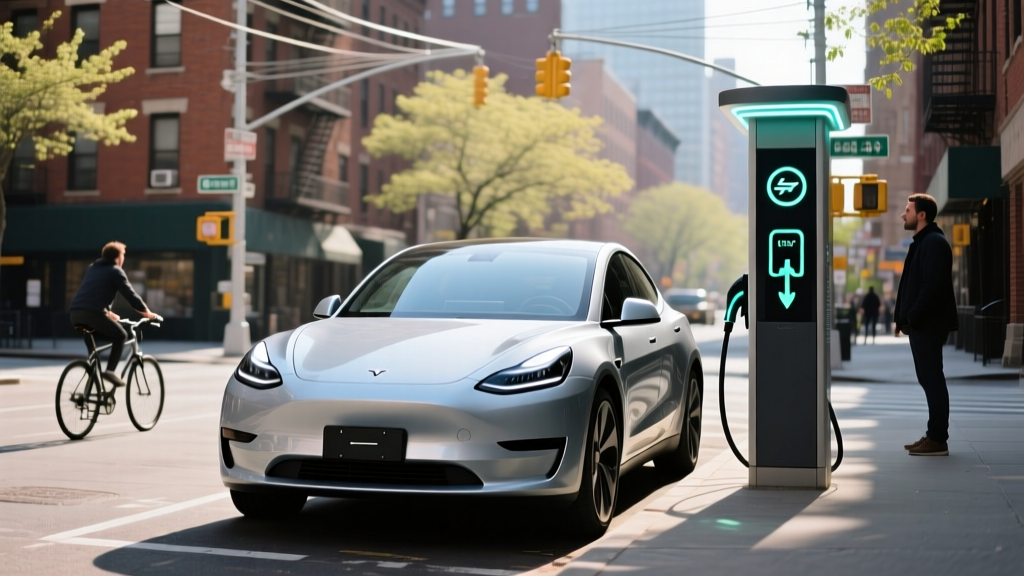
Manhattan has the lowest home-charging access rate in the country — only about 10–15% of residents have a dedicated parking spot with outlet access. The city has deployed curbside Level 2 chargers through the NYC Curbside Charging program, and networks like EVgo, Electrify America, and Tesla Superchargers are dense in the five boroughs. However, expect to pay $0.35–$0.55/kWh for DC fast charging and $0.25–$0.40/kWh for public Level 2.
Upstate and Suburban
Homeowners in Westchester, Long Island, the Hudson Valley, and upstate metros (Albany, Syracuse, Rochester, Buffalo) typically have garages or driveways, making Level 2 installation straightforward. The I-87, I-90 (Thruway), and I-81 corridors have adequate DC fast-charging coverage, though rural areas in the Adirondacks and Southern Tier remain thin. Plan road trips to the North Country with a charging stop buffer.
Home Charger Installation Costs
For New York homeowners, a Level 2 (240V, 32–48 amp) home charger installation typically runs:
- Equipment (charger unit): $400–$750 (e.g., ChargePoint Home Flex, Emporia Level 2)
- Electrician labor + wiring: $800–$2,500 depending on panel proximity
- Panel upgrade (if needed): $1,500–$3,500 for 100A→200A service upgrade
- Permit fees: $50–$200 depending on municipality
- Total typical range: $1,250–$3,250 without panel upgrade; $3,000–$6,500 with panel upgrade
Check your utility's make-ready program before scheduling — Con Edison's SmartCharge NY and National Grid's EV Make Ready program can offset $500–$1,500 of installation costs.
Cold Weather Reality: New York Winters and EV Range
This is where New York EV ownership diverges from California or Texas. Buffalo averages 100+ inches of lake-effect snow and January temperatures in the teens. Even downstate, NYC sees weeks of 25–35°F winters. Cold weather impacts EVs in three measurable ways:
- Battery chemistry slowdown: Lithium-ion cells have higher internal resistance below 40°F, reducing usable capacity by 10–15%.
- Cabin heating: Unlike a gas car that uses waste engine heat, an EV must generate cabin heat from the battery. Resistive heaters consume 3–5 kW; heat pumps (standard on most 2025–2026 models) reduce this to 1–2 kW but still draw from the pack.
- Regenerative braking reduction: Cold batteries limit regen, so you'll use friction brakes more and recapture less energy in the first 15–20 minutes of driving.
Real-world impact: A 300-mile EPA-rated EV in a Buffalo January will deliver roughly 210–240 miles of real range with cabin heat on and highway speeds. That's a 20–30% reduction. For daily commutes under 60 miles round-trip, this is manageable. For Adirondack ski trips or long I-90 winter drives, plan charging stops more conservatively than the EPA number suggests.
Mitigation strategies:
- Precondition the battery and cabin while plugged in (uses grid power, not battery)
- Use seat/steering wheel heaters instead of cabin air when possible (draws ~100W vs 3,000W)
- Garage parking keeps the battery 10–20°F warmer than outdoor parking
- Choose a model with a heat pump — it's a meaningful efficiency upgrade in NY winters
Popular EVs for New York Buyers: Spec Comparison
These are among the most practical EVs for New York's mix of urban density, highway corridors, and cold winters. All prices are base MSRP before incentives.
| Model | EPA Range | Battery (kWh) | Peak DC Charge (kW) | 10–80% Time | Heat Pump? | Base MSRP |
|---|---|---|---|---|---|---|
| Honda Prologue EX (AWD) | 296 mi | 85 kWh (NMC) | 150 kW | ~34 min | Yes | $48,795 |
| Hyundai Ioniq 5 SE (AWD) | 290 mi | 77.4 kWh (NMC) | 240 kW | ~18 min | Yes | $47,850 |
| Tesla Model Y (Long Range AWD) | 320 mi | 78.1 kWh (NMC) | 250 kW | ~20 min | Yes | $46,630 |
| Chevrolet Equinox EV LT (AWD) | 285 mi | 85 kWh (NMC) | 150 kW | ~34 min | Yes | $41,995 |
| Volkswagen ID.4 Pro S (AWD) | 291 mi | 82 kWh (NMC) | 175 kW | ~28 min | Yes | $47,990 |
AWD is recommended for upstate and Hudson Valley buyers — it adds traction for lake-effect snow and icy Thruway on-ramps, though it costs roughly 10–15 miles of EPA range versus the RWD equivalent. For NYC-only driving, FWD or RWD is adequate and more efficient.
Common New York EV Misconceptions: Fact-Checked
| Myth | Fact |
|---|---|
| "EVs can't handle New York winters." | Modern EVs with heat pumps and preconditioning handle sub-freezing temps well. You'll lose 20–30% range, but a 300-mi EV still delivers 210+ real winter miles — more than enough for 95% of daily driving. Norway, colder than any NY winter, has the world's highest EV adoption rate. |
| "Charging takes too long." | A 240 kW-capable EV like the Ioniq 5 charges 10–80% in ~18 minutes at a compatible DC fast station. Home Level 2 charging adds 25–35 miles per hour — most owners wake up to a full battery every morning without visiting a station. |
| "The battery will need replacing in 5 years." | Federal law mandates EV battery warranties of 8 years / 100,000 miles minimum. Real-world degradation data shows most NMC packs retain 85–92% capacity after 100,000 miles. LFP chemistry packs often retain even more. Replacement is rare and typically covered under warranty within the warranty period. |
| "EVs are worse for the environment in New York because of the grid." | New York's grid is ~60% zero-emission (hydro, nuclear, wind, solar) and getting cleaner annually. Per EPA lifecycle analysis, even on a mixed grid, EVs produce fewer lifetime emissions than comparable gas vehicles. |
| "I can't get the $7,500 tax credit." | Many buyers can — but eligibility depends on your income, the vehicle's MSRP, and battery sourcing. Point-of-sale transfer (effective 2024) lets you apply the credit as an immediate discount at the dealer, even if you don't itemize. Check IRS.gov for current rules. |
Your New York EV Decision Framework
Should You Buy an EV in New York?
Buy an EV if:
- You have a garage, driveway, or dedicated parking spot where a Level 2 charger can be installed
- Your daily round-trip commute is under 100 miles (covers 90%+ of NY drivers)
- You can access your utility's time-of-use rate for overnight charging at $0.08–$0.12/kWh
- You want to reduce fuel costs by $600–$1,200/year and qualify for the NYSERDA + federal incentives
- You drive the I-87, I-90, or I-95 corridors regularly (well-served by DC fast charging)
Consider a PHEV (plug-in hybrid) instead if:
- You live in an apartment without charging access and public charging is sparse in your neighborhood
- You frequently drive 300+ miles into the Adirondacks, Catskills, or rural Southern Tier in winter
- Your budget is under $35,000 and you want to minimize range-related stress without full EV commitment
- Examples: Toyota RAV4 Prime (42 mi electric, 94 MPGe, $44,590 MSRP), Hyundai Tucson PHEV (33 mi electric, 80 MPGe, $39,590 MSRP)
Wait on EVs if:
- You rely exclusively on street parking in Manhattan or dense Brooklyn with no curbside charger nearby
- Your building's electrical panel cannot support a charger and the co-op board won't approve an upgrade
- You're waiting for solid-state batteries or NACS adoption to mature — more models gain NACS ports in 2026–2027, expanding Supercharger access
5-Year Total Cost of Ownership: EV vs. Gas in New York
| Category | Ioniq 5 SE (EV) | RAV4 LE AWD (Gas) |
|---|---|---|
| Purchase price (MSRP) | $47,850 | $32,350 |
| Federal + NYSERDA incentives | −$9,500 | $0 |
| Effective purchase cost | $38,350 | $32,350 |
| 5-year fueling (12K mi/yr, home L2) | $3,025 | $6,375 |
| 5-year maintenance | $1,200 | $3,500 |
| 5-year insurance (est.) | $8,500 | $6,750 |
| E-ZPass toll savings (5 yrs) | −$600 | $0 |
| 5-Year Total | $50,475 | $48,975 |
The EV costs roughly $1,500 more over 5 years in this scenario, primarily because of the higher purchase price and insurance premiums. However, the gap narrows significantly with time-of-use charging rates (saving an additional ~$1,000 over 5 years) and as gas prices fluctuate upward. At 7 years, the EV typically breaks even and pulls ahead. Factor in the smoother ride, instant torque, one-pedal driving in stop-and-go traffic, and zero tailpipe emissions in your neighborhood, and many New York owners find the non-financial benefits tip the scale.
Insurance note: EV insurance premiums in New York run 15–25% higher than equivalent gas vehicles due to higher repair costs and battery replacement expense. Get quotes from GEICO, Progressive, and State Farm before purchasing — the spread varies significantly by model and zip code.
Frequently Asked Questions
Do I qualify for the New York NYSERDA Drive Clean Rebate?
The rebate is income-tiered. Households earning under approximately $138,560 (2025 threshold, adjusted periodically) receive the full $2,000 point-of-sale rebate. Higher-income buyers receive a reduced amount or none. The vehicle must be purchased or leased from a participating New York dealer, and the rebate is applied at the time of sale — you don't need to file for it separately. Check NYSERDA's current eligibility page before visiting the dealer.
Can I charge an EV in a NYC apartment building?
It depends on your building. Some newer condos and rentals in Brooklyn, Queens, and Manhattan now offer EV charging in parking garages. If you own in a co-op or condo, you'll need board approval to install a charger, and the building's electrical capacity must support it. NYC's Local Law 120 (2021) requires new and substantially renovated parking garages to be EV-ready, but existing buildings vary widely. If home charging isn't feasible, map nearby curbside chargers and public Level 2 stations before committing to an EV.
How does the E-ZPass Green Discount work?
New York offers a 10% toll discount on the Thruway and MTA crossings for registered BEV (battery electric) vehicles. You must apply through your E-ZPass account with your vehicle registration proving zero-emission status. PHEVs do not qualify. The savings are modest — roughly $30–$80/year depending on your commute — but they stack with other incentives.
Is a Tesla the best EV for New York?
Tesla's Supercharger network remains the most reliable DC fast-charging option in New York, particularly on I-90 and I-87 corridors where non-Tesla chargers are sparser. The Model Y Long Range (320 mi EPA, $46,630 MSRP) is a strong all-around choice. However, the Hyundai Ioniq 5, Kia EV6, and Ford Mustang Mach-E now access Tesla Superchargers via NACS adapters (included with most 2025+ models), narrowing Tesla's charging advantage. Compare specs and service-center proximity — Tesla service in upstate NY can mean a long drive to Albany or Rochester.
What happens if I need to drive 300+ miles in a New York winter?
Plan for one DC fast-charging stop. A 300-mile EPA EV delivering 210–230 real winter miles can cover Albany-to-Buffalo (290 mi) with a 15–20 minute charge stop at a Thruway service area. Precondition your battery before arriving at the charger for faster charge speeds. Apps like A Better Routeplanner (ABRP) factor in temperature, elevation, and speed to give realistic winter range estimates for New York routes.