Quick Answer: An EV motor converts electrical energy from the battery into mechanical motion to drive the wheels — with zero combustion, fewer moving parts, and typical drivetrain efficiency of 85–95% compared to 20–35% for a gasoline engine. The two dominant motor types in 2026 production EVs are Permanent Magnet Synchronous Motors (PMSM), used in vehicles like the Tesla Model Y and Hyundai Ioniq 5 for peak efficiency, and AC Induction Motors, favored in some applications for durability and rare-earth-free supply chains. Motor type directly affects your real-world range, regenerative braking strength, and long-term maintenance costs.
What Is an EV Motor and How Does It Differ from a Gas Engine?
A gasoline engine relies on controlled explosions — igniting a fuel-air mixture inside cylinders to push pistons, spin a crankshaft, and eventually turn the wheels through a multi-speed transmission. The process involves hundreds of moving parts, significant friction losses, and thermal waste. Typical thermal efficiency for a modern internal combustion engine (ICE) hovers around 25–35%, meaning 65–75% of the energy in every gallon of gas is lost as heat, noise, and friction.
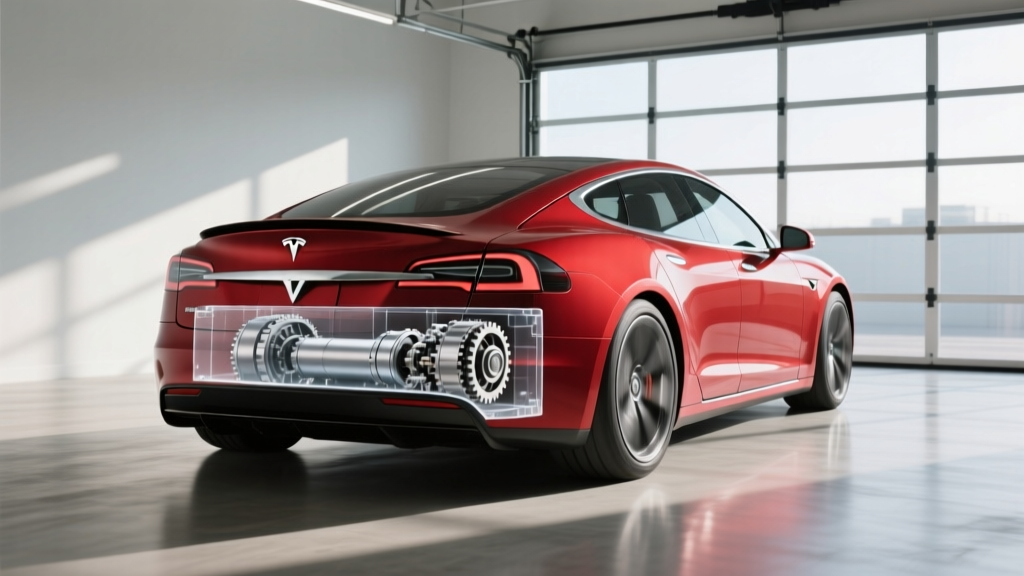
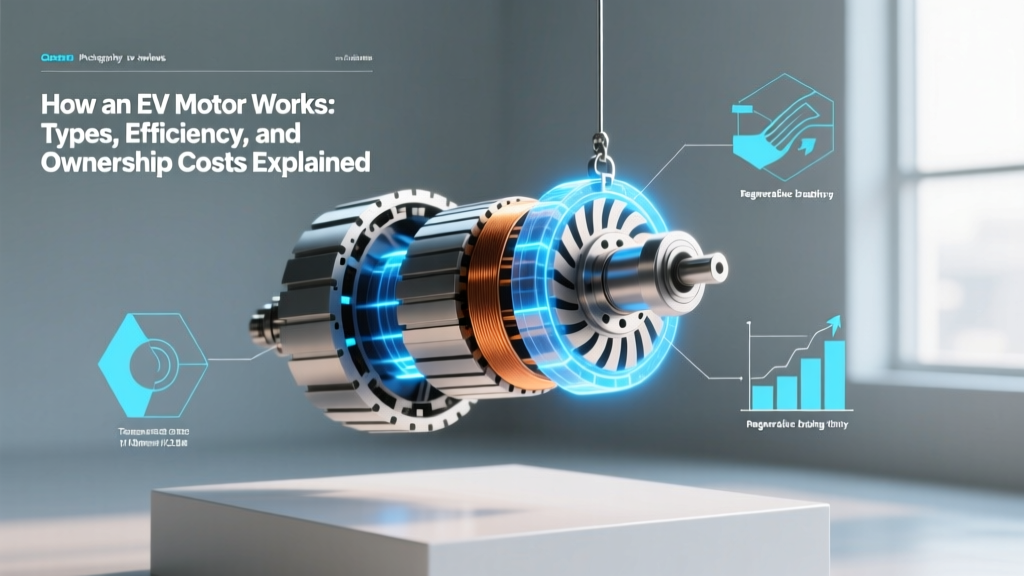
An electric vehicle motor operates on an entirely different principle: electromagnetism. When current flows through copper windings inside the stator (the stationary outer ring), it generates a rotating magnetic field. This field interacts with magnets or induced currents in the rotor (the spinning inner core), creating torque that drives the wheels directly — often through a single-speed reduction gear. There are no pistons, no spark plugs, no timing belts, no exhaust valves, and no multi-speed transmission to service.
The result is a drivetrain that converts 85–95% of stored electrical energy into forward motion, according to fueleconomy.gov. That fundamental efficiency gap is why a 75 kWh battery can propel a midsize crossover roughly 270–310 miles, while a 15-gallon gas tank (holding roughly 500 kWh of chemical energy) delivers a similar range in a comparable ICE vehicle.
The Three Main EV Motor Types in 2026 Production Vehicles
Not all EV motors are the same. Automakers select motor architectures based on cost, efficiency targets, supply chain constraints, and performance goals. Here are the three types you'll encounter in current-production EVs:
1. Permanent Magnet Synchronous Motor (PMSM)
The most common motor type in modern EVs. PMSMs embed rare-earth magnets (typically neodymium-iron-boron) directly in the rotor. Because the magnetic field is always present, PMSMs achieve superior efficiency — particularly at low and mid-range speeds where most daily driving occurs. Vehicles using PMSMs include the Hyundai Ioniq 5 (rear motor: 168 kW / 225 hp), Tesla Model Y Long Range, and BMW iX. The trade-off is reliance on rare-earth minerals, which introduces supply chain and cost volatility.
2. AC Induction Motor (ACIM)
Induction motors generate the rotor's magnetic field by inducing current through electromagnetic induction — no permanent magnets required. They are robust, tolerant of high temperatures, and free of rare-earth materials. Tesla historically used induction motors on the front axle of dual-motor vehicles (enabling true freewheeling when not needed to reduce drag), and BMW employs externally excited synchronous motors (EESM) in several i-series models as a rare-earth-free alternative. Induction motors are slightly less efficient at partial load but excel at high-speed sustained operation and can produce strong power bursts.
3. Axial Flux Motor (Emerging)
A newer architecture gaining traction in high-performance and space-constrained applications. Axial flux motors arrange the stator and rotor discs face-to-face rather than concentrically, producing high torque in a compact, lightweight package. Companies like Mercedes-Benz (via subsidiary YASA) use axial flux designs in AMG performance models. Expect broader adoption as manufacturing scales, though cost remains a barrier for mainstream vehicles.
| Attribute | PMSM | AC Induction | Axial Flux |
|---|---|---|---|
| Peak Efficiency | 95–97% | 90–93% | 95–97% |
| Rare-Earth Magnets | Required | None | Required (typically) |
| Low-Speed Torque | Excellent | Good | Excellent |
| Weight/Size | Compact | Larger | Very compact |
| Cost (Relative) | Mid-High | Lower | High (low volume) |
| Example Vehicles | Ioniq 5, Model Y RWD | Model S/X front axle | Mercedes-AMG EQG |
EV Motor Efficiency vs. Gasoline Engine: The Real Numbers
The efficiency advantage of an electric motor is not marginal — it is the single largest mechanical reason EVs cost less to operate per mile. Here is a direct comparison using EPA data and real-world figures:
| Metric | EV (PMSM, 2026 midsize crossover) | Gas Vehicle (2026 midsize crossover) |
|---|---|---|
| Drivetrain Efficiency | 85–95% (battery to wheels) | 20–35% (tank to wheels) |
| Energy per 100 miles | 28–34 kWh (~$4.20–$5.10 at $0.15/kWh home rate) | 3.3–4.0 gallons (~$10.50–$12.80 at $3.20/gal) |
| MPGe (EPA Combined) | 110–134 MPGe | 25–30 MPG |
| Moving Parts in Drivetrain | ~20 (motor + reduction gear) | ~200+ (engine + transmission) |
| Energy Lost as Heat | 5–15% | 65–80% |
| Regenerative Braking | Recaptures 15–25% of kinetic energy | None (friction brakes waste 100%) |
Source: U.S. Department of Energy / fueleconomy.gov
The regenerative braking advantage deserves emphasis. Every time you lift off the accelerator in an EV, the motor reverses its role — acting as a generator to convert kinetic energy back into electrical energy and store it in the battery. This is impossible in a gasoline vehicle, where braking converts motion entirely into wasted heat through friction pads. In stop-and-go city driving, regen can extend effective range by 10–20% compared to highway-only driving, which is why EPA city MPGe ratings for EVs are often higher than their highway ratings — the exact opposite of gas vehicles.
Real Costs: EV Motor Ownership vs. Gasoline Drivetrain
The motor itself is virtually maintenance-free. Unlike a gasoline engine, there is no oil to change, no timing belt to replace, no spark plugs to swap, no catalytic converter to fail, and no transmission fluid to flush at 60,000 miles. The reduction gear (single-speed) typically requires a fluid check or change at 100,000+ miles. Here is a five-year ownership cost comparison for a midsize crossover driven 15,000 miles per year:
| Cost Category | EV (Motor + Battery) | Gasoline (Engine + Transmission) |
|---|---|---|
| Fuel / Electricity | $3,375 (home charging at $0.15/kWh, 30 kWh/100mi) | $10,500 (30 MPG, $3.20/gal) |
| Engine/Transmission Maintenance | $0 (no scheduled motor service) | $1,800 (oil changes, filters, belts, plugs) |
| Brake Pad Replacement | $0–$200 (regen saves pads; last 100k+ mi) | $600–$900 (2–3 sets over 75k mi) |
| Coolant / Fluids | $150 (battery thermal loop check) | $400 (transmission flush, coolant, differential) |
| Drivetrain Failure Risk | Low (fewer components) | Moderate (turbo, transmission, head gasket) |
| Total Drivetrain Cost (5 yr) | ~$3,525–$3,725 | ~$13,300–$13,600 |
Over five years, the EV drivetrain saves roughly $9,500–$10,000 in fuel and maintenance — though this must be weighed against higher upfront purchase price (typically $3,000–$8,000 more before incentives), potentially higher insurance premiums (5–15% more, per insurer), and home charger installation costs ($500–$2,000 for a Level 2 setup depending on panel capacity and run length).
Should You Care Which Motor Type Your EV Uses?
- If you prioritize maximum range and city efficiency → PMSM vehicles (Ioniq 5, Model Y, most Korean/Japanese EVs) deliver the best kWh/mi figures.
- If you want rare-earth-free supply chain ethics → Look for induction or externally excited motors (BMW iX xDrive50 front motor, Tesla dual-motor front axle).
- If you tow frequently or drive sustained highway speeds → Dual-motor AWD setups combining PMSM + induction give you low-speed efficiency and high-speed durability.
- If you track or drive high-performance → Axial flux motors in AMG and supercar applications offer extreme power density.
Common EV Motor Misconceptions — Separating Myth from Fact
| Myth | Fact |
|---|---|
| "EV motors wear out like gas engines." | EV motors have no piston rings, valves, or bearings under the same thermal stress. Most are rated for 300,000+ miles. The motor is the component least likely to fail in an EV. |
| "All EV motors are the same." | PMSM, induction, and axial flux designs have measurably different efficiency curves, torque delivery, and material requirements. Motor choice affects your real-world range by 5–12%. |
| "EV motors can't handle cold weather." | The motor itself operates fine in sub-zero temperatures. Range loss in cold weather comes from battery chemistry slowing down and cabin heating demand — not the motor. A heat pump (standard on most 2026 EVs) mitigates heating losses by 30–40%. |
| "More horsepower means a bigger motor." | Not necessarily. Motor output is governed by inverter current limits and thermal management. A compact PMSM can produce 300+ hp with aggressive cooling, while a larger induction motor may peak lower without adequate thermal headroom. |
| "Regenerative braking eliminates brake service entirely." | Regen dramatically reduces pad wear (many owners report original pads at 100,000 miles), but brake calipers still need periodic inspection, and rotors can develop surface rust in low-use scenarios. Budget $0–$200 over 5 years instead of $600–$900. |
Real-World Ownership: What First-Time EV Buyers Should Know About the Motor
The motor is the least of your worries as a new EV owner — it is the most reliable component in the vehicle. The ownership considerations that actually matter are:
Home charging access. If you can install a Level 2 charger (240V, 32–48A, delivering 7.7–11.5 kW), you will wake up every morning with a full battery and rarely visit a public charger. Installation runs $500–$2,000 depending on electrical panel proximity and local permit requirements. Without home charging, you will depend on public DC fast charging (typically $0.30–$0.50/kWh) or workplace charging — which raises your per-mile cost and adds time.
Cold-weather range loss. At 20°F, expect 20–30% range reduction compared to the EPA sticker. A vehicle rated at 310 miles EPA may deliver 220–250 miles in freezing highway driving. This is a battery and heating issue, not a motor issue. Preconditioning the battery (a feature on virtually all 2026 EVs) while plugged in mitigates this significantly.
Federal tax credit eligibility. Under current IRS §30D rules, qualifying new EVs may be eligible for up to $7,500 in federal tax credits, but eligibility depends on MSRP caps ($55,000 for sedans, $80,000 for SUVs/trucks), buyer income limits ($150,000 single / $300,000 joint AGI), battery component sourcing requirements, and critical mineral thresholds. The credit can now be transferred to the dealer as a point-of-sale discount. Verify current-year eligibility at irs.gov before purchasing.
Maintenance reality. Beyond the motor (which needs essentially nothing), budget for cabin air filter replacement ($30–$60 annually), tire rotation (every 6,000–8,000 miles — EVs are heavier and tire wear is accelerated), windshield washer fluid, and wiper blades. Total annual maintenance for a typical EV: $200–$400. For a comparable gas vehicle: $800–$1,200.
Frequently Asked Questions About EV Motors
How long does an EV motor last?
EV motors are engineered for 300,000+ miles with minimal degradation. Unlike internal combustion engines, there are no piston rings to wear, no valves to burn, and no timing chains to stretch. The most common failure points are bearings (after very high mileage) and the inverter (which manages power delivery to the motor) — and both are covered under the powertrain warranty, typically 8 years / 100,000 miles on 2026 models.
Do EV motors need oil changes?
No. The electric motor itself requires no lubrication. The single-speed reduction gear contains a small volume of gear oil, but this is typically a sealed, lifetime-fill unit or requires service only at 100,000+ miles. There is no equivalent to the 5,000–7,500-mile oil change cycle of a gas engine.
Why do some EVs have two different motor types?
Dual-motor AWD vehicles sometimes pair a PMSM on one axle with an induction motor on the other. This lets the vehicle use the efficient PMSM for normal driving and engage the induction motor only when AWD traction is needed — or disconnect it entirely during cruising to eliminate drag losses. Tesla and BMW have used this strategy to optimize efficiency across diverse driving conditions.
Can an EV motor be repaired or does it need full replacement?
In most cases, EV motors are serviced as a unit — if an internal fault occurs, the motor is replaced rather than rebuilt. However, motor failures are extremely rare compared to engine or transmission failures in ICE vehicles. The inverter (a separate component) is more likely to require service, and it can typically be replaced independently of the motor. Warranty coverage for the motor and inverter falls under the federally mandated 8-year / 100,000-mile powertrain warranty for EVs.
Does motor type affect which EV I should buy?
For most buyers, motor type is a secondary consideration behind range, price, charging speed, and body style. But if you drive predominantly in city stop-and-go traffic, a PMSM-equipped vehicle will give you measurably better efficiency (2–5% more miles per kWh) than an induction-motor vehicle. If ethical sourcing of rare-earth minerals is a priority, BMW's externally excited synchronous motor and Tesla's induction front motor are alternatives worth researching.