The Short Answer on Mini EVs
Mini and subcompact EVs — like the Chevrolet Equinox EV (base trim), Nissan LEAF, MINI Cooper SE, and the upcoming affordable models from Hyundai and Kia — offer real city-commute practicality at lower entry prices (roughly $28,000–$38,000 MSRP before incentives). They typically deliver 150–250 miles of EPA range, charge to 80% in 25–35 minutes on DC fast chargers, and cost 3–5 cents per mile to fuel at home. They make excellent second cars, urban commuters, and first EVs — but they fall short for road-trip-heavy households, cold-climate drivers without garage parking, and anyone who regularly needs to carry more than two passengers with cargo.
What Qualifies as an "EV Mini" in 2026?
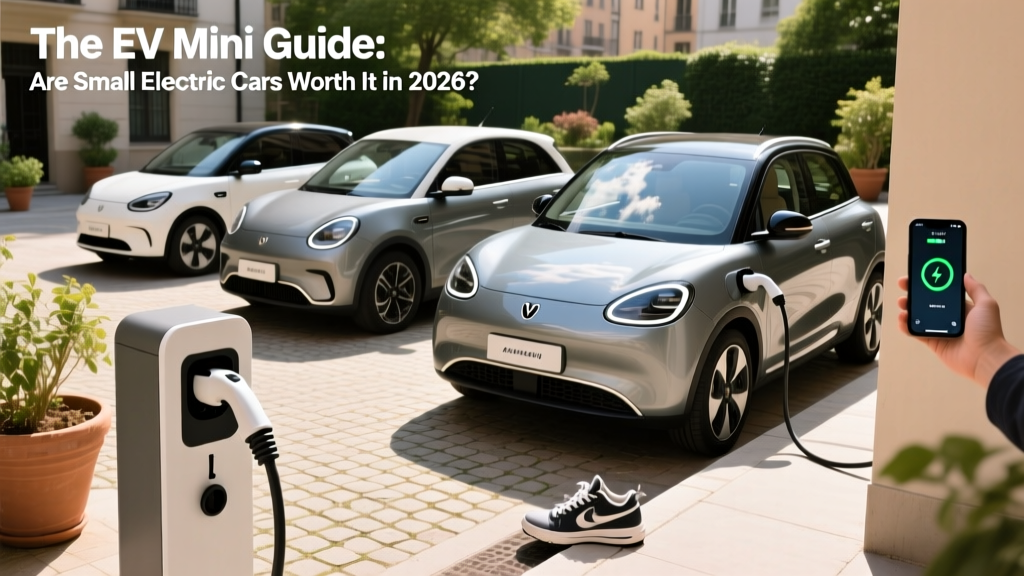
The term "EV mini" covers a growing segment of small-footprint electric vehicles that prioritize affordability, efficiency, and urban maneuverability over maximum range or performance. This includes:
- Subcompact hatchbacks: MINI Cooper SE, Nissan LEAF, Hyundai Kona Electric
- Compact crossovers with affordable base trims: Chevrolet Equinox EV (2LT starting ~$33,000), Volvo EX30
- Neighborhood and low-speed EVs: Though technically a different regulatory class, some buyers cross-shop these
What they share: smaller battery packs (typically 40–65 kWh), lower curb weights (under 4,000 lbs), and MSRPs that — after the federal §30D tax credit where eligible — can dip below $25,000 net. They are the gateway vehicles for buyers transitioning from gas compacts like the Honda Civic or Toyota Corolla.
Spec Snapshot: Top Mini EVs Compared
| Model | Battery (kWh) | EPA Range | Real-World Range* | Peak DC Charge (kW) | 10–80% Time | 0–60 mph | Base MSRP |
|---|---|---|---|---|---|---|---|
| MINI Cooper SE (2025/2026) | 54 (NMC) | ~200 mi | ~165 mi | 95 kW | ~28 min | 6.7 sec | $33,900 |
| Hyundai Kona Electric | 64.8 (NMC) | 261 mi | ~215 mi | 100+ kW | ~43 min | 7.8 sec | $32,975 |
| Nissan LEAF (SV Plus) | 60 (NMC) | 212 mi | ~175 mi | 100 kW (CCS adapter req.) | ~35 min | 7.4 sec | $36,540 |
| Chevy Equinox EV (2LT) | 85 (NMC) | 319 mi | ~265 mi | 150 kW | ~25 min | 7.9 sec | $33,600 |
| Volvo EX30 | 69 (NMC) | 265 mi | ~220 mi | 153 kW | ~26 min | 3.4 sec (Twin Motor) | $36,150 |
*Real-world range reflects mixed highway/city driving at 65–75 mph. Subtract 15–30% in freezing temperatures without preconditioning.
Mini EV vs. Gas Compact: The Real Cost Breakdown
Most mini-EV shoppers are comparing against a $25,000–$30,000 gas compact. Here's a five-year ownership cost model assuming 12,000 miles/year, $3.50/gallon gas, and $0.14/kWh home electricity:
| Cost Category | Mini EV (e.g., Kona Electric) | Gas Compact (e.g., Civic) | 5-Year Difference |
|---|---|---|---|
| Purchase price (MSRP) | $32,975 | $27,000 | EV +$5,975 |
| Federal tax credit (§30D) | −$7,500 (if eligible) | $0 | EV −$7,500 |
| Net purchase after credit | $25,475 | $27,000 | EV −$1,525 |
| Fuel/electricity (5 yr) | $2,520 (12k mi × 5yr × $0.042/mi) | $6,300 (60k mi ÷ 33 MPG × $3.50) | EV −$3,780 |
| Maintenance (5 yr) | ~$1,200 | ~$3,000 | EV −$1,800 |
| Insurance (5 yr avg) | ~$9,000 | ~$7,200 | EV +$1,800 |
| 5-Year Total Cost | $38,195 | $43,500 | EV saves ~$5,300 |
Key takeaways from this comparison:
- The tax credit flips the purchase equation. A $33,000 mini EV can net under $26,000 — cheaper than many gas compacts. However, §30D eligibility depends on battery sourcing, MSRP caps ($55,000 for cars), and buyer income limits ($150K single / $300K joint). Check current rules at IRS.gov §30D.
- Fuel savings compound. At national average electricity rates, mini EVs cost roughly $0.03–$0.05 per mile versus $0.10–$0.12 for a 30-MPG gas car.
- Insurance is higher. EV insurance premiums run 15–25% more due to higher repair costs and battery replacement exposure. Get quotes before buying.
- Maintenance is minimal. No oil changes, no spark plugs, no transmission fluid. Brake pads last 100,000+ miles thanks to regenerative braking.
Home Charging Reality: What Mini EV Buyers Must Plan For
The economic case for a mini EV depends heavily on home charging access. Without it, you're paying public DC fast-charging rates of $0.35–$0.55/kWh — which erases most fuel savings versus gas.
Charging Level Options for Mini EVs
| Level | Power | Miles Added/Hour | Best For | Install Cost |
|---|---|---|---|---|
| Level 1 (120V outlet) | 1.4 kW | ~4–5 mi/hr | Overnight top-ups, under 40 mi/day | $0 (included cord) |
| Level 2 (240V home) | 7.2–11.5 kW | ~25–40 mi/hr | Daily charging, full battery overnight | $500–$2,000 |
| DC Fast Charging | 50–150 kW | ~150–300 mi/hr | Road trips, emergency top-ups | N/A (public use) |
Most mini EVs accept 7.2–11 kW on Level 2, meaning a full charge from 10–100% takes 5–9 hours at home — perfect for overnight. A Level 2 home charger (like a ChargePoint Home Flex or Emporia Level 2) costs $300–$700 for the unit, plus $500–$1,500 for a licensed electrician to run a 240V/50A circuit. If your electrical panel is maxed out, a panel upgrade adds $1,500–$3,000.
If you live in an apartment or lack dedicated parking: You'll rely on workplace charging or public Level 2/DC stations. Check PlugShare or your employer's benefits — many workplaces now offer free or subsidized Level 2 charging. Some cities also offer curbside Level 2 installations.
Common Mini EV Misconceptions — Fact-Checked
| Myth | Fact |
|---|---|
| "Mini EVs can't handle highway driving" | Modern mini EVs like the Kona Electric and EX30 sustain 75–80 mph with no issue. Highway range drops ~15–20% vs. city (regen braking helps in town), but 200+ EPA miles covers most highway commutes comfortably. |
| "The battery will need replacing in 5 years" | EPA data and manufacturer warranties guarantee 70%+ capacity retention at 8 years/100,000 miles. Real-world degradation for NMC packs is typically 10–15% over 8 years. A fueleconomy.gov search shows most EVs retain 85%+ SoH at 100K miles. |
| "Small EVs are unsafe" | The Volvo EX30 earned IIHS Top Safety Pick. Low center of gravity from floor-mounted batteries reduces rollover risk. Check IIHS.org for model-specific crash ratings. |
| "I'll be stranded without enough range" | With 200+ EPA miles and DC fast charging adding 80–150 miles in 20 minutes, range anxiety is mostly solved for drivers with home charging. The real risk is for apartment dwellers in charging-desert areas without workplace access. |
| "Cold weather destroys EV range" | It reduces it — by 15–30% in sub-freezing temps without preconditioning. But most 2026 mini EVs include battery preconditioning (via navigation to a charger or scheduled departure). A 200-mile EV still delivers ~150–170 real winter miles with preconditioning active. |
Who Should Buy a Mini EV — and Who Shouldn't
Buy a Mini EV If:
- Your daily commute is under 60 miles round-trip — even the shortest-range mini EVs handle this with massive buffer, even in winter.
- You have home Level 1 or Level 2 charging access — this is the single biggest factor in EV satisfaction.
- You're a two-car household — a mini EV as the commuter car paired with a gas/hybrid for road trips is a cost-optimal strategy.
- You qualify for the §30D tax credit — the credit can drop a $33,000 EV below $26,000, making it the cheapest new car option in many segments.
- You prioritize low running costs over cargo space — mini EVs offer 15–25 cu ft of cargo behind rear seats, adequate for groceries and carry-ons but tight for furniture runs.
Consider a Larger EV or PHEV Instead If:
- You regularly drive 200+ miles between charges — road-trip-heavy drivers should look at 300+ mile EVs (Chevy Equinox EV, Tesla Model Y) or a PHEV like the Toyota RAV4 Prime.
- You lack any form of home or workplace charging — exclusive reliance on public DC fast charging costs $0.35–$0.55/kWh and requires time commitment.
- You live in extreme cold (regularly below 10°F) — without a garage and preconditioning, winter range loss on a 200-mile mini EV can leave you with 130–140 real miles.
- You need to tow or carry 4+ passengers with cargo regularly — mini EVs aren't rated for towing and have limited rear-seat and cargo space.
Battery, Warranty, and Long-Term Ownership
Every 2026 mini EV sold in the US carries a federally mandated battery warranty: at minimum, 8 years or 100,000 miles (whichever comes first) with a capacity retention threshold typically set at 70%. Some manufacturers exceed this — Hyundai/Kia offers 10 years/100,000 miles.
Key battery considerations for mini EVs:
- Chemistry: Most mini EVs use NMC (nickel manganese cobalt) cells for energy density. Some newer affordable models are adopting LFP (lithium iron phosphate), which trades ~10% range for longer cycle life (3,000+ cycles vs. ~1,500 for NMC) and better thermal stability.
- Degradation pattern: Expect 2–3% loss in Year 1, then ~1% per year after. By Year 8, most packs sit at 85–92% State of Health.
- Replacement cost: If a pack fails outside warranty, replacement runs $8,000–$15,000 depending on kWh. However, out-of-warranty failures are rare based on current fleet data.
- Best practice: For NMC packs, charge to 80% daily and only to 100% for road trips. For LFP packs, charge to 100% regularly — it's required for accurate SoC calibration.
Frequently Asked Questions
What is the cheapest mini EV available in 2026?
The Chevrolet Equinox EV 2LT starts at approximately $33,600 MSRP, making it one of the most affordable EVs with 300+ miles of range. The Hyundai Kona Electric starts at $32,975 with 261 EPA miles. After the §30D credit (where eligible), effective prices can drop to $25,000–$26,000 — competitive with gas compacts.
Can I charge a mini EV on a regular 120V outlet?
Yes. Level 1 charging at 1.4 kW adds roughly 4–5 miles of range per hour. If you drive 30–40 miles per day, plugging in overnight (10–12 hours) restores most or all of your daily usage. It's slow but viable for low-mileage commuters and eliminates the need for a Level 2 install.
Do mini EVs qualify for the $7,500 federal tax credit?
It depends on three factors per current IRS §30D rules: (1) the vehicle's battery must meet critical-mineral and battery-component sourcing requirements, (2) MSRP must be under $55,000 for cars, and (3) buyer adjusted gross income must be under $150K (single) or $300K (joint). Eligible models can transfer the credit to the dealer at point of sale, reducing your purchase price immediately. Always verify current eligibility on IRS.gov before purchasing.
How long do mini EV batteries last?
Based on current fleet data, NMC batteries in mini EVs retain 85–92% of original capacity at 8 years/100,000 miles. The federally mandated warranty covers you to 70% minimum. Real-world replacements before 150,000 miles are uncommon. LFP-equipped models (where available) may last even longer due to superior cycle life.
Is a mini EV practical for a family?
For a two-adult household or a family with one small child, yes — models like the Kona Electric and EX30 offer adequate rear seating and 15–25 cu ft of cargo. For families regularly carrying two+ children with car seats and strollers, a compact SUV EV (Tesla Model Y, Hyundai Ioniq 5) or a PHEV minivan is more practical.
What happens if I run out of charge?
EV roadside assistance programs (included with most new EV purchases for 3–5 years) will tow you to the nearest charger. Some services offer mobile Level 2 charging trucks. The best prevention: set your nav to include charging stops on long trips, and keep a 20% buffer for unexpected detours. Most mini EV owners who charge at home never experience range depletion.