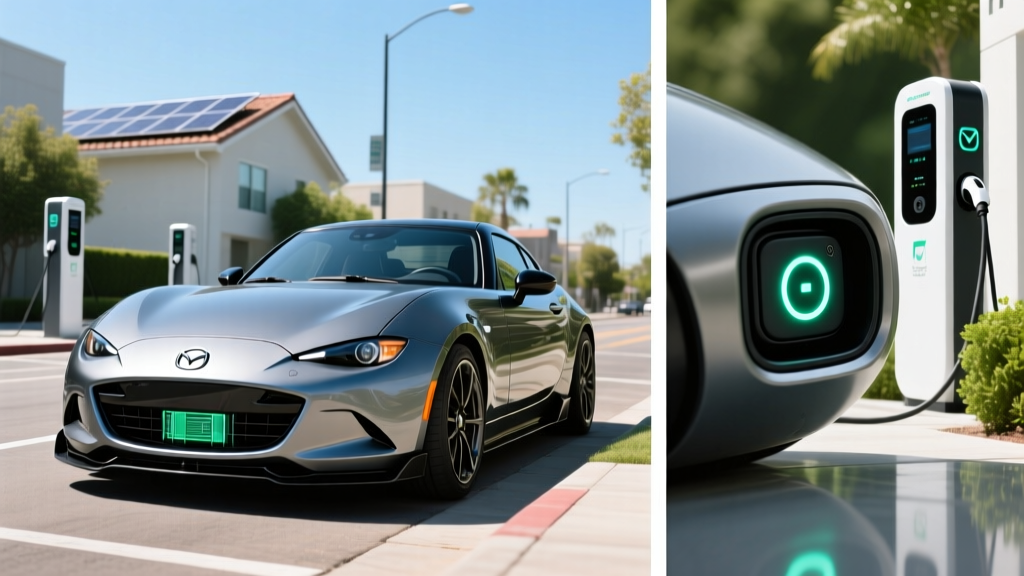
The Mazda MX-5 Miata is one of the most beloved sports cars ever built — lightweight, balanced, and analog in a world going digital. But with tightening emissions standards and rising fuel costs, a growing number of enthusiasts are asking: can you build or buy an EV Miata? The short answer is yes, but it requires careful planning, a realistic budget, and acceptance of significant trade-offs in range and practicality.
Quick Answer: The EV Miata Reality in 2026
There is no factory-built electric Mazda MX-5 Miata available new from Mazda as of 2026. The only paths to an EV Miata are: (1) a DIY or shop-built conversion of a used NA/NB/NC/ND Miata, typically costing $25,000–$55,000 on top of the donor car price, or (2) purchasing a purpose-built electric roadster like the upcoming Fiat 124-inspired aftermarket builds or the MG Cyberster (a modern electric roadster available in select markets). A well-executed Miata conversion typically yields 80–150 miles of real-world range, 150–300 horsepower, and 0–60 mph times of 4.5–7.0 seconds depending on the drivetrain package.
Why Enthusiasts Are Converting Miatas to Electric
The Miata's appeal for EV conversion comes down to physics. At roughly 2,300–2,400 lbs (curb weight for an NA/NB chassis), the Miata is one of the lightest production sports cars ever made. Less mass means less energy required to move it — a critical advantage when you're working with limited battery space in a compact chassis. The engine bay and fuel tank area together offer enough volume for a modest battery pack (typically 20–40 kWh usable) and an electric motor.
Beyond weight, the Miata's simplicity is a virtue. There's no complex transmission tunnel routing, no all-wheel-drive hardware, and the rear-wheel-drive layout maps cleanly to a single electric motor or a compact inverter/motor assembly mounted at the rear axle. The aftermarket support for Miata chassis is enormous, meaning fabrication resources, mounting solutions, and community knowledge are readily available.
The motivations vary: some builders want a zero-emissions daily driver that's cheap to fuel; others want instant electric torque in a lightweight chassis for autocross or track use; and some simply want to keep a beloved older car on the road as emissions regulations tighten in states like California.
EV Miata Conversion: Cost Breakdown and What You're Paying For
Converting a Miata to electric is not a budget project. Here's what a realistic build costs in 2026, whether you're doing it yourself or paying a conversion shop:
| Component | Budget Build | Mid-Range Build | High-Performance Build |
|---|---|---|---|
| Donor Miata (NA/NB/NC) | $3,000–$7,000 | $5,000–$12,000 | $8,000–$18,000 |
| Battery pack (LFP or NMC modules) | $6,000–$10,000 (20–25 kWh) | $10,000–$18,000 (30–40 kWh) | $15,000–$25,000 (40–55 kWh) |
| Electric motor + inverter | $3,000–$5,000 | $5,000–$9,000 | $8,000–$15,000 |
| Charger (Level 2 onboard) | $800–$1,500 | $1,200–$2,500 | $2,000–$3,500 |
| BMS, wiring, thermal management | $2,000–$4,000 | $3,000–$6,000 | $5,000–$8,000 |
| Fabrication, mounts, adapters | $2,000–$5,000 | $4,000–$8,000 | $6,000–$12,000 |
| DC fast charge capability (optional) | N/A | $2,500–$5,000 | $4,000–$7,000 |
| Labor (if using a shop) | $5,000–$10,000 | $10,000–$20,000 | $15,000–$30,000 |
| Total Estimated Cost | $22,000–$42,000 | $40,000–$80,000 | $63,000–$118,000 |
For context, a brand-new 2026 Mazda MX-5 Miata Sport starts at approximately $29,965 MSRP (per fueleconomy.gov). A mid-range EV conversion will cost roughly the same or more than a new gas Miata — but you end up with a one-of-a-kind vehicle with fundamentally different driving characteristics.
Range, Performance, and Battery Specs: What to Expect
Range is the single biggest compromise in an EV Miata conversion. The chassis was never designed to carry hundreds of pounds of battery cells, and space is severely limited. Here's what typical builds deliver:
| Spec | Budget EV Build (25 kWh) | Mid-Range EV Build (35 kWh) | 2026 MX-5 Miata (Gas) |
|---|---|---|---|
| Usable battery / fuel | 25 kWh (LFP) | 35 kWh (NMC) | 11.9-gallon tank |
| EPA-estimated / real-world range | ~70–90 mi real-world | ~110–150 mi real-world | ~306 mi (EPA: 26 city / 35 hwy) |
| Horsepower | 120–160 HP | 200–280 HP | 181 HP (2.0L Skyactiv-G) |
| Torque (lb-ft) | 150–200 (instant) | 220–320 (instant) | 151 lb-ft |
| 0–60 mph | 6.5–8.0 sec | 4.5–5.5 sec | 5.8 sec (manual) |
| Curb weight (est.) | ~2,600–2,800 lbs | ~2,800–3,100 lbs | ~2,341 lbs |
| "Fuel" cost per mile | ~$0.04–$0.06 | ~$0.04–$0.06 | ~$0.12–$0.16 |
| DC fast charging | Usually not available | Optional (50–80 kW peak) | N/A |
| Level 2 charge time (0–100%) | ~4–5 hours (6.6 kW) | ~5–7 hours (7.2 kW) | ~3 minutes at gas pump |
Critical note on range: These real-world range figures assume moderate temperatures (60–80°F), mixed driving, and a battery state of charge between 10–90%. In cold weather (below 32°F), expect 20–35% range loss due to increased battery internal resistance and cabin heating demand. At sustained highway speeds (75+ mph), range drops another 10–20% due to aerodynamic drag — the Miata's open-top design creates significant turbulence at speed.
Battery chemistry matters. Most conversion builders choose between LFP (lithium iron phosphate) and NMC (nickel manganese cobalt). LFP cells are heavier but safer, longer-lasting (3,000+ cycle life vs. ~1,000–2,000 for NMC), and can be charged to 100% daily without degradation concerns. NMC offers higher energy density — more kWh in the same physical space — which matters enormously in a Miata's cramped chassis. For a range-priority build, NMC is usually the pragmatic choice; for a daily-driver that'll last a decade, LFP has the edge.
EV Miata vs. Gas Miata vs. Alternatives: The Ownership Cost Reality
Let's compare five-year ownership costs for a typical EV Miata conversion (mid-range build) versus a new 2026 gas Miata. This assumes 10,000 miles/year, home charging at $0.14/kWh (national average), and gas at $3.50/gallon.
| Cost Category | EV Miata (Mid-Range Conv.) | 2026 Gas Miata Sport |
|---|---|---|
| Purchase / build cost | $55,000 (avg.) | $29,965 (MSRP) |
| Fuel / electricity (5 yrs, 50k mi) | $2,500 | $7,000 |
| Maintenance (5 yrs) | $1,500 (tires, brakes, coolant) | $4,500 (oil, filters, brakes, belts) |
| Insurance (5 yrs, avg.) | $9,000–$12,000 (specialty/kit car) | $6,500–$8,500 |
| Federal tax credit (§30D) | $0 (conversions don't qualify) | $0 (gas vehicle) |
| Resale value (est. after 5 yrs) | –$20,000–$30,000 (niche market) | –$10,000–$14,000 |
| Estimated 5-yr Net Cost | $47,000–$58,000 | $34,000–$39,000 |
The EV Miata conversion does not pencil out as a cost-saving measure. You're paying a significant premium for the novelty, the instant torque, and the zero tailpipe emissions. Where the EV build saves money is in per-mile fuel cost — roughly $0.05/mile on electricity versus $0.14/mile on gas (at 30 MPG combined). Over 50,000 miles, that's $4,500 in fuel savings, which partially offsets the higher upfront build cost.
Insurance is a real concern. Converted vehicles often require specialty insurance through providers like Hagerty or Grundy, which may classify the car as a kit or modified vehicle. Premiums can be 30–50% higher than a stock Miata, and some providers require appraisals. Factor this into your budget before committing.
Practical Ownership: Charging, Climate, and Daily Use
An EV Miata is a fundamentally different ownership experience than a stock gas Miata. Here's what first-time EV conversion owners need to plan for:
Home Charging Is Nearly Mandatory
With 80–150 miles of real-world range, public DC fast charging (if your build even supports it) is impractical as a primary charging strategy. You need a Level 2 home charger (240V, 32–48 amps) to reliably wake up to a full battery every morning. A Level 2 installation typically costs $800–$2,500 for the charger and electrical work, assuming your panel has capacity. If you live in an apartment or lack dedicated parking, an EV Miata conversion is a poor fit.
Cold Climate = Serious Range Penalty
If you live where winters drop below freezing, expect your 120-mile summer range to shrink to 75–90 miles. Most conversions use simple resistive cabin heaters that draw 2–4 kW — a significant drain on a small battery. Some builders integrate heat pump systems, but this adds cost and complexity. In extreme cold (below 10°F), lithium batteries also can't accept a full charge without preconditioning, meaning your morning charge may not complete as expected.
No DC Fast Charging on Most Builds
This is the biggest road-trip limitation. Adding CCS or CHAdeMO DC fast-charge capability to a conversion requires a compatible high-voltage charge port, additional contactors, and BMS communication protocols that most DIY setups don't support. A few shops offer 50–80 kW DC fast-charge integration for $3,000–$6,000, but it's the exception, not the norm. Plan your driving around your battery's real range.
Weight Distribution Changes the Car
A stock Miata is celebrated for its near-perfect 50/50 front-rear weight balance. A conversion typically adds 400–700 lbs, and the distribution depends on where batteries are mounted (commonly the engine bay and former fuel tank area). Many builders achieve a slightly nose-heavy or tail-heavy balance that alters the car's legendary handling. Upgraded springs, dampers, and sway bars are often necessary to restore the car's composure.
Common EV Miata Myths — Fact vs. Fiction
| Myth | Fact |
|---|---|
| "An EV Miata will have 250+ miles of range." | Realistic range for most builds is 80–150 miles. The chassis simply can't hold a large enough battery pack for long range without compromising weight and handling. |
| "Conversions qualify for the $7,500 federal EV tax credit." | They do not. The IRS §30D credit applies only to new, qualifying vehicles from OEMs meeting battery sourcing and MSRP requirements. Aftermarket conversions are ineligible. See IRS.gov §30D rules. |
| "Electric Miatas are lighter than gas Miatas." | Almost never. Even with the engine and fuel system removed, the battery pack typically adds 200–500 lbs net. Expect a converted Miata to weigh 2,600–3,100 lbs versus the stock ~2,340 lbs. |
| "You can use any EV motor and battery." | Motor and battery must be matched to the vehicle's voltage architecture, weight, and cooling capacity. Mismatched components lead to overheating, poor efficiency, or BMS faults. |
| "It's a simple weekend project." | A proper conversion requires high-voltage electrical work, fabrication, BMS programming, and safety systems. Expect 200–600+ hours for a DIY build or 4–12 weeks at a professional shop. |
Alternatives to an EV Miata Conversion
If the cost, complexity, or range limitations of a conversion give you pause, consider these alternatives that deliver a similar open-top electric experience:
- MG Cyberster (2025–2026): A production electric roadster with ~316 miles of range (WLTP), 536 HP (dual motor), and 0–60 in ~3.2 seconds. MSRP starts around $55,000 in markets where it's sold. US availability remains limited as of early 2026.
- Fiat 124 Spider EV conversions: Similar chassis to the ND Miata, some shops offer turnkey electric Fiat 124 builds with slightly more battery space due to the longer rear deck.
- Keep a gas Miata and add a cheap EV commuter: Buy a used Chevrolet Bolt EV ($12,000–$18,000 on the used market) for daily driving and keep the Miata for weekend fun. This combination often costs less than a single conversion and gives you both range and driving joy.
- Wait for OEM electric roadsters: Several manufacturers have hinted at lightweight electric sports cars. Nothing is confirmed for the US market as of 2026, but the segment is on OEM radars.
Decision Framework: Should You Build an EV Miata?
Choose an EV Miata Conversion If:
- You have home Level 2 charging and your daily commute is under 50 miles round-trip
- You're an experienced builder or have a trusted conversion shop and a budget of $40,000+
- You value instant torque, low running costs, and a unique vehicle over long-range road trips
- You live in a mild climate where cold-weather range loss is manageable
- You accept that this car will be difficult to insure, hard to resell, and ineligible for federal EV tax credits
Stick With a Gas Miata (or Choose an Alternative) If:
- You want to take road trips longer than 100 miles without meticulous planning
- Your total budget is under $35,000
- You lack reliable home charging access
- You live in a region with harsh winters and need year-out reliability
- You want a vehicle with strong resale value, standard warranty coverage, and easy insurance
Frequently Asked Questions
Is there a factory electric Mazda MX-5 Miata?
No. Mazda has not produced a factory-electric MX-5 Miata as of 2026. The MX-5 lineup continues with the 2.0L Skyactiv-G gasoline engine. Mazda's EV efforts are currently focused on the CX-70 PHEV, CX-90 PHEV, and the upcoming EZ-6 sedan. An electric Miata remains a conversion-only proposition.
How much does an EV Miata conversion cost in 2026?
A realistic budget is $25,000–$55,000 for the conversion itself, plus $3,000–$18,000 for the donor Miata. Turnkey builds from professional shops typically range from $45,000 to $80,000+ total. DIY builds can come in lower if you source used EV components (e.g., salvaged Tesla or Nissan Leaf battery modules), but this requires significant technical skill.
What's the real-world range of an EV Miata?
Most conversions deliver 80–150 miles of real-world range depending on battery size (20–40 kWh usable), driving style, and climate. Highway driving at 70+ mph and cold weather both reduce range significantly. This makes the EV Miata best suited as a local commuter or weekend car, not a road-trip vehicle.
Can I get the $7,500 federal tax credit for an EV Miata conversion?
No. The IRS §30D Clean Vehicle Credit applies only to new qualifying vehicles from recognized manufacturers that meet battery component sourcing, critical mineral, MSRP cap ($55,000 for cars), and buyer income requirements. Aftermarket conversions of existing vehicles do not qualify. Consult a tax professional for your specific situation.
Is an EV Miata faster than a gas Miata?
In straight-line acceleration, a well-built mid-range or high-performance EV conversion (200–300 HP, instant torque) will typically beat the stock 181 HP gas Miata to 60 mph. However, the EV build will be heavier, which affects cornering, braking, and the overall "tossability" that defines the Miata experience. Many enthusiasts argue the added weight compromises what makes a Miata special.
What battery chemistry is best for a Miata conversion?
NMC (nickel manganese cobalt) is preferred for range-priority builds because of its higher energy density — more kWh in the Miata's limited space. LFP (lithium iron phosphate) is preferred for daily-driver builds because of its longer cycle life (3,000+ cycles), superior thermal stability, and tolerance for daily 100% charging. LFP cells are heavier, which is the trade-off.
How long does a Miata EV conversion take?
A professional shop typically takes 8–16 weeks for a turnkey conversion. A DIY build by an experienced hobbyist can take 6–18 months depending on part-time availability, fabrication complexity, and troubleshooting. First-time builders should budget for significant learning curve time.