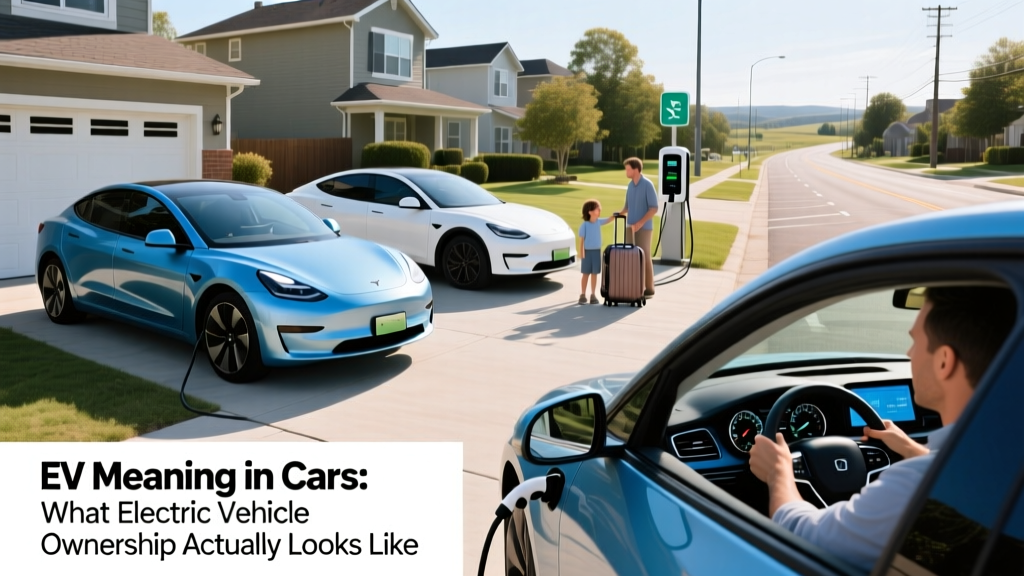
What Does "EV" Mean When Buying a Car?
EV stands for Electric Vehicle — a car powered entirely by a rechargeable battery pack and electric motor(s) instead of a gasoline engine. In 2026, the EV meaning for car shoppers goes well beyond the acronym: it represents a fundamentally different ownership experience involving home charging, battery management, federal tax incentives, and fuel-cost savings that typically offset a higher purchase price within 3–6 years.
A battery electric vehicle (BEV) like the Tesla Model Y or Hyundai Ioniq 5 stores energy in a lithium-based battery (measured in kWh, or kilowatt-hours — think of it as the "gallon" equivalent for electric cars). You recharge it by plugging in at home or at a public DC fast charger, and the electric motor delivers instant torque with zero tailpipe emissions.
EV vs. Gas Car: The Numbers That Matter
The EV meaning becomes clearer when you put real numbers side by side. Let's compare a popular 2026 BEV — the Hyundai Ioniq 5 SEL AWD — against a comparably equipped gas crossover, the Toyota RAV4 AWD.
| Metric | 2026 Hyundai Ioniq 5 SEL AWD (BEV) | 2026 Toyota RAV4 AWD (Gas) |
|---|---|---|
| Base MSRP | $47,400 | $33,425 |
| After §30D Federal Credit | ~$39,900 (if eligible) | N/A |
| EPA Range / Tank Range | 290 miles (EPA) | 448 miles (14.5 gal × 29 combined MPG) |
| Real-World Highway Range | ~240–260 miles | ~400 miles |
| Energy Efficiency | 114 MPGe combined / 29 kWh/100mi | 29 MPG combined |
| Cost Per Mile (Energy) | $0.045 (home charging @ $0.16/kWh) | $0.11 (gas @ $3.20/gal) |
| Annual Fuel/Energy (15k mi) | ~$675 | ~$1,655 |
| 0–60 mph | 5.1 seconds (320 hp) | 8.1 seconds (203 hp) |
| Maintenance (Annual Avg) | ~$300 | ~$650 |
| Powertrain Warranty | 10 yr / 100,000 mi (battery) | 5 yr / 60,000 mi |
The Ioniq 5 costs roughly $14,000 more at the sticker, but the U.S. Department of Energy estimates annual fuel savings of ~$980 for an average driver, plus ~$350 in reduced maintenance (no oil changes, fewer brake replacements thanks to regenerative braking, no transmission fluid). That puts break-even at roughly 5–6 years without the tax credit, or about 3 years with the full §30D federal EV credit applied at point of sale.
The Real Costs: Purchase, Charging, Insurance, and Maintenance
Understanding the EV meaning for your wallet requires looking at the full 5-year picture, not just the sticker price.
| Cost Category | EV (Ioniq 5 SEL AWD) | Gas (RAV4 AWD) | Notes |
|---|---|---|---|
| Purchase Price (after credit) | $39,900 | $33,425 | EV credit: income ≤$150k single / $300k joint; MSRP ≤$55k SUV |
| Home Charger Install (Level 2) | $800–$2,200 | $0 | 240V/48A circuit; panel upgrade adds $1,500–$3,000 if needed |
| 5-Year Energy/Fuel | $3,375 | $8,275 | Assumes 80% home / 20% public DC charging for EV |
| 5-Year Maintenance | $1,500 | $3,250 | EV: cabin filter, tire rotation, brake fluid. Gas: oil, filters, brakes, plugs |
| 5-Year Insurance (Avg) | $9,500 | $7,800 | EV premiums run ~15–25% higher on average |
| 5-Year Depreciation (Est.) | $18,000 | $14,500 | EV resale improving but still trails Toyota/Honda gas retention |
| 5-Year Total Cost | ~$73,075 | ~$67,250 | Gap narrows further with state rebates, utility off-peak rates |
The honest takeaway: EVs still carry a modest total-cost premium for many buyers, primarily driven by insurance and depreciation. But that gap is closing every year, and if you qualify for the full $7,500 federal credit plus any state incentives (which vary widely — check your local program), the EV can come out ahead. Your mileage, electricity rate, and driving pattern are the variables that swing the equation.
Charging Explained: kW, kWh, and What You Actually Need
The single most confusing aspect of the EV meaning for new buyers is the charging vocabulary. Here's the essential distinction:
- kWh (kilowatt-hours) = energy stored in the battery. Think of it as your "tank size." The Ioniq 5 has a 77.4 kWh usable battery.
- kW (kilowatts) = the rate at which energy flows into the battery. Think of it as the "pump speed" of your charger.
| Charging Level | Power (kW) | Miles Added Per Hour | Where You Find It | Typical Use |
|---|---|---|---|---|
| Level 1 (120V outlet) | 1.4 kW | ~4 mi/hr | Any standard household outlet | Overnight top-ups, PHEVs, emergencies |
| Level 2 (240V) | 7.2–11.5 kW | 25–44 mi/hr | Home wallbox, workplace, shopping centers | Daily charging — wake up with a full battery |
| DC Fast Charge | 50–350 kW | 180–900+ mi/hr | Highway rest stops, Electrify America, Tesla Superchargers | Road trips; 10–80% in 18–25 minutes |
For the Ioniq 5, DC fast charging peaks at 235 kW on a 350 kW-capable station, reaching 10–80% State of Charge (SoC) in approximately 18 minutes under ideal conditions. However, real-world charging involves a charge curve taper: the battery accepts peak power only in the lower SoC range and slows significantly above 80% to protect cell longevity. Plan road-trip stops around 10–80% charges — pushing to 100% on DC fast charging can double your stop time for the last 20%.
Preconditioning matters. Most modern EVs (Tesla, Hyundai/Kia, GM, Ford) can warm the battery before you arrive at a fast charger via navigation routing. A cold battery in winter may accept only 50–80 kW until it warms up, adding 10–15 minutes to your stop. Always route through the car's navigation to trigger preconditioning.
Real-World Range: What the EPA Sticker Doesn't Tell You
The EPA range figure is a blended estimate. Your actual miles will vary based on conditions you control:
Range Reality Check: 2026 Hyundai Ioniq 5 AWD (EPA 290 mi)
- Mild weather, mixed driving: 270–290 mi (close to EPA)
- Highway-only at 75 mph: 240–260 mi (aerodynamic drag dominates)
- Cold weather (below 30°F), mixed: 200–235 mi (battery chemistry slows, cabin heating draws energy)
- Cold + highway: 180–210 mi (worst-case — plan charging accordingly)
This is not a flaw — it's physics. Gasoline cars also lose efficiency in cold weather and at high speeds, but they start with a larger energy reserve (a 14-gallon tank holds roughly 460 kWh of chemical energy vs. 77 kWh in a battery). The EV meaning for road-trippers is: plan stops proactively, use apps like A Better Routeplanner, and build in a 15–20% buffer for weather.
Common EV Misconceptions: Myth vs. Fact
| Myth | Fact (with Data) |
|---|---|
| "EV batteries need replacing every few years." | Modern NMC and LFP batteries are warrantied for 8–10 years / 100,000–150,000 miles at 70%+ capacity retention. Data from fleet operators shows average degradation of 10–15% over 8 years. Full replacements (rare) cost $8,000–$18,000 depending on pack size. |
| "EVs are worse in cold weather." | EVs lose 15–30% range in sub-freezing temps — real, but manageable. They also start instantly (no cold cranking), can precondition the cabin while plugged in, and many offer heat pumps (standard on the Ioniq 5) that cut heating energy use by 40–50%. |
| "There aren't enough charging stations." | As of early 2026, the U.S. has over 70,000 public charging ports. The Tesla Supercharger network (now open to NACS-equipped non-Teslas) alone has 30,000+ stalls. However, charging deserts still exist in rural areas — check your regular routes before buying. |
| "EVs are worse for the environment because of electricity generation." | The Union of Concerned Scientists confirms that even on coal-heavy grids, EVs produce fewer lifecycle emissions than comparable gas cars. On the average U.S. grid, an EV is equivalent to a gas car getting 90+ MPG. |
| "You can't take an EV on a road trip." | A 300-mile trip in an Ioniq 5 requires one 20-minute DC fast-charge stop. Cross-country trips add roughly 30–45 minutes per day of driving vs. gas. It's a different rhythm, not a limitation. |
| "The $7,500 tax credit applies to every EV." | The §30D credit has strict rules: buyer income caps ($150k single / $300k joint), MSRP caps ($55k cars / $80k SUVs/trucks), and battery critical-mineral and component sourcing requirements. Many EVs qualify for partial or no credit. Always verify on IRS.gov before purchasing. |
EV vs. Hybrid: Which Electrified Car Is Right for You?
The EV meaning shifts depending on whether you're comparing against a conventional hybrid (HEV) or a plug-in hybrid (PHEV):
- HEV (e.g., Toyota RAV4 Hybrid): No plug. Small battery recaptures braking energy. Gets 39–41 MPG combined. No EV range, no tax credit, lowest upfront cost. Best for: buyers who want better fuel economy without changing habits.
- PHEV (e.g., Toyota RAV4 Prime): Plugs in. 42 miles EPA electric-only range, then operates as a hybrid. Qualifies for up to $7,500 credit (if eligible). Best for: short commutes on electricity with gas flexibility for long trips.
- BEV (e.g., Hyundai Ioniq 5): Fully electric. 290 miles EPA range. Lowest running cost, highest upfront cost, no gas backup. Best for: home-charging access, mostly predictable routes, willingness to plan road-trip charging.
Decision Framework: Should You Buy an EV?
Choose a BEV (full EV) if:
- You can install a Level 2 charger at home or have reliable workplace charging
- Your daily driving is under 200 miles (covers ~95% of U.S. drivers)
- You qualify for the §30D tax credit (check income and vehicle eligibility)
- You want the lowest per-mile energy cost and minimal maintenance
- You're willing to plan 20-minute stops on road trips
Choose a PHEV (plug-in hybrid) if:
- You have a short commute (under 40 miles) but take occasional long road trips
- You have home charging but want zero range anxiety
- You live in an area with sparse public DC fast-charging infrastructure
- You want some electric savings without fully committing
Stick with a gas car or HEV if:
- You have no access to home or workplace charging and can't install it
- You regularly drive 400+ miles in a day through charging-desert regions
- Your budget is strictly under $30,000 (used EV market aside)
- You live in extreme cold with no garage and drive long distances daily
First-Time EV Buyer Checklist
If the EV meaning has shifted from abstract acronym to concrete purchase for you, here's what to do before signing:
- Audit your electrical panel. A Level 2 home charger needs a 240V/40–60A circuit. If your panel is at capacity (common in older homes), budget $1,500–$3,000 for an upgrade. Get a quote from a licensed electrician before buying the car.
- Verify tax credit eligibility. Check the vehicle's battery sourcing compliance and your AGI on the IRS clean vehicle credit page. Credits can now be transferred to the dealer at point of sale as an instant discount.
- Test-charge before you buy. Visit a public DC fast charger near your home. Download the relevant app (Electrify America, EVgo, ChargePoint) and confirm it works for your area.
- Insurance-shop the specific model. EV insurance varies wildly. Get a quote on the exact trim before committing — some models cost 30% more to insure than their gas counterparts.
- Download A Better Routeplanner. Plug in your common road trips. See how many stops you'd need and how long they'd take. This is the best antidote to range anxiety: real data.
- Ask about battery chemistry. LFP (lithium iron phosphate) batteries are heavier and slightly less energy-dense but last longer and can be charged to 100% daily without degradation concerns. NMC offers more range per pound but prefers 80% daily charging limits. Know which your model uses.
Frequently Asked Questions
What does EV stand for in cars?
EV stands for "Electric Vehicle." In the automotive context, it typically refers to a Battery Electric Vehicle (BEV) — a car powered entirely by an electric motor and rechargeable battery pack, with no gasoline engine. The term is sometimes used loosely to include plug-in hybrids (PHEVs), but technically a PHEV is a separate category.
Is an EV cheaper to own than a gas car?
Over 5 years, an EV typically costs slightly more in total due to higher purchase price, insurance, and depreciation — but saves $5,000–$8,000 in fuel and maintenance. With the full $7,500 federal tax credit and favorable state incentives, many EVs break even or come out ahead. Your local electricity rate and annual mileage are the biggest swing factors.
How long do EV batteries last?
Most 2026 EV batteries are warrantied for 8–10 years or 100,000–150,000 miles at 70% or greater capacity retention. Real-world data from high-mileage fleets and owners shows typical degradation of 10–15% over the first 8 years. A battery replacement (rare before 150,000 miles) costs $8,000–$18,000 depending on pack size and chemistry.
Can I charge an EV at home?
Yes, if you have access to a garage, driveway, or dedicated parking with electrical access. A standard 120V outlet (Level 1) adds about 4 miles of range per hour — enough for PHEVs or low-mileage BEV drivers. A 240V Level 2 wallbox (installed by an electrician for $800–$2,200) adds 25–44 miles per hour, fully recharging most EVs overnight.
Do EVs work in cold weather?
Yes, but expect 15–30% range reduction below freezing due to battery chemistry limitations and cabin heating demand. EVs with heat pumps (standard on many 2026 models including Hyundai/Kia, Tesla, and GM vehicles) mitigate this significantly. Cold EVs also start more reliably than gas cars in extreme temperatures — there's no engine oil to thicken or battery to crank.
What's the difference between kW and kWh?
kW (kilowatts) measures power — the speed at which energy flows, like water pressure from a hose. A 250 kW DC fast charger delivers energy very quickly. kWh (kilowatt-hours) measures energy — the total amount stored or consumed, like gallons in a tank. A 77 kWh battery holds 77 kilowatt-hours of energy. This distinction is the most common point of confusion for new EV buyers.