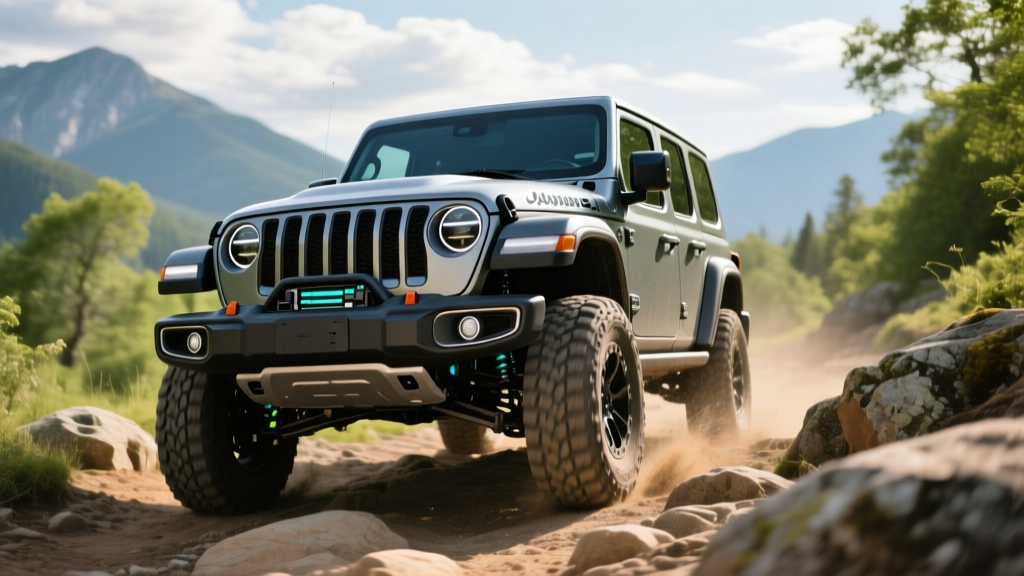
The Short Answer on the EV Jeep Wrangler
As of early 2026, Jeep has not yet released a fully electric (battery-electric) Wrangler to the U.S. market. The brand's electrified Wrangler offering remains the Wrangler 4xe plug-in hybrid, which pairs a 2.0L turbo engine with a 17.3 kWh battery for an EPA-estimated 22 miles of electric-only range and 49 MPGe combined. Jeep parent company Stellantis has confirmed a next-generation battery-electric Wrangler is in development, with an anticipated debut around the 2027–2028 model year. If you need an electrified Wrangler today, the 4xe PHEV is your only option — and it's a compelling one for buyers who want short electric commutes without sacrificing off-road capability.
Wrangler 4xe: The Electrified Jeep You Can Buy Right Now
Before speculating about a future BEV, let's ground ourselves in what's actually on dealer lots. The Wrangler 4xe has been in production since the 2021 model year and remains Jeep's best-selling plug-in hybrid. Here are the hard numbers for the current 4xe powertrain:
| Spec | Wrangler 4xe (Current) |
|---|---|
| Powertrain | 2.0L turbo I-4 + electric motor + 8-speed auto |
| Combined Output | 375 hp / 470 lb-ft torque |
| Battery Capacity | 17.3 kWh (NMC lithium-ion) |
| EPA Electric-Only Range | 22 miles |
| EPA MPGe (Elec + Gas) | 49 MPGe combined |
| Gas-Only MPG (after battery depleted) | 20 MPG combined |
| Level 2 Charge Time (0–100%) | ~2 hours at 7.2 kW |
| 0–60 mph | ~6.0 seconds |
| Starting MSRP (2025 Willys 4xe) | $51,790 (before destination) |
| Battery/Powertrain Warranty | 8 years / 100,000 miles |
The 4xe qualifies for a partial federal tax credit under IRS §30D rules — currently $3,750 for eligible buyers, depending on battery critical-mineral and component sourcing requirements that shift annually. Income caps apply ($150,000 single / $300,000 joint filers), and the credit can be applied as a point-of-sale discount at participating dealers. Always verify current-year eligibility on IRS.gov before relying on the credit in your budget.
What a Fully Electric Wrangler Would Need to Deliver
Based on Jeep's stated EV roadmap, concept vehicles, and the competitive landscape, a battery-electric Wrangler (BEV) would need to hit several benchmarks to succeed with the Wrangler's loyal buyer base. Here's what the data suggests is required:
Range and Battery
Wrangler buyers drive in diverse conditions — highway commutes, mountain trails, and rural areas with sparse charging. A competitive BEV Wrangler would likely target 280–320 miles of EPA range, requiring a battery in the 90–110 kWh range. Jeep's parent company Stellantis has been developing its STLA Large platform, which supports battery packs up to 118 kWh and ranges exceeding 300 miles. However, the Wrangler's boxy aerodynamics (a drag coefficient around 0.45–0.50, far worse than a crossover's ~0.30) will penalize highway efficiency significantly. Expect real-world highway range to drop 15–25% below the EPA sticker, and cold-weather driving could cut that by another 20–30%.
Charging Speed
For trail use and road trips, DC fast charging matters. A competitive spec would be peak 200–250 kW DC fast charging, delivering a 10–80% charge in roughly 20–25 minutes. The Wrangler's off-road audience frequently travels to remote areas, so access to NACS (Tesla Supercharger) compatibility — which Jeep has committed to adopting across its lineup — would be essential. Level 2 home charging at 11.5 kW would add roughly 25–30 miles of range per hour, sufficient for overnight replenishment.
Off-Road Capability
This is where the EV Wrangler concept gets interesting. Electric motors deliver instant torque at zero RPM, which is ideal for rock crawling. Jeep's Wrangler 4xe already demonstrated that electrification enhances low-speed trail control, and a full BEV could offer even finer throttle modulation. Key off-road specs buyers will scrutinize: ground clearance (current Wrangler Rubicon: 10.8 inches), approach/departure/breakover angles, water fording depth, and underbody battery protection. A skateboard-style battery pack would need substantial armor plating to survive trail abuse without compromising the vehicle's center of gravity.
EV vs. 4xe vs. Gas Wrangler: The Ownership Cost Comparison
If a BEV Wrangler arrives around 2028, how will it stack up against the current lineup? Let's compare the five-year total cost of ownership across three hypothetical scenarios, using a 15,000-mile annual driving pattern and national average energy costs.
| Cost Factor (5 Years) | Gas Wrangler (3.6L V6) | Wrangler 4xe PHEV | Hypothetical EV Wrangler (BEV) |
|---|---|---|---|
| Purchase Price (est.) | $42,000 | $52,000 | $60,000 (projected) |
| Federal Tax Credit | $0 | $3,750 | $7,500 (if eligible) |
| Net Purchase | $42,000 | $48,250 | $52,500 |
| Fuel/Energy (75,000 mi) | $11,250 (20 MPG, $3.00/gal) | $7,500 (mix of elec + gas) | $4,500 ($0.12/kWh home charging) |
| Maintenance | $3,500 | $3,000 | $1,500 |
| Insurance (est. avg) | $8,500 | $9,000 | $9,500 |
| 5-Year Total (excl. depreciation) | $65,250 | $67,750 | $68,000 |
Key takeaway: The BEV Wrangler's higher upfront cost means it takes years of fuel and maintenance savings to break even against the gas model — and the 4xe sits in between. The math improves substantially if you can charge at home on off-peak electricity rates ($0.08–0.10/kWh) and drive mostly within the EV's range. But if you rely exclusively on public DC fast charging at $0.35–0.50/kWh, the BEV's energy cost advantage shrinks dramatically.
Real-World Ownership: What First-Time Electrified Jeep Buyers Must Know
Home Charging Is Non-Negotiable for Most Owners
Whether you buy the 4xe today or a BEV Wrangler tomorrow, home charging access is the single biggest factor in satisfaction. The 4xe's 17.3 kWh battery charges fully overnight on a standard 120V outlet (Level 1, ~1.4 kW) in about 12 hours — feasible because the battery is small. A future BEV Wrangler with a 100 kWh battery would take over 70 hours on Level 1, making a 240V Level 2 home charger (costing $500–$1,500 for equipment plus $800–$2,500 for electrician installation, per Energy.gov) an absolute necessity.
If you live in an apartment, lack a garage, or can't install a Level 2 charger, the 4xe's smaller battery is far more manageable on public infrastructure than a full BEV would be.
Cold Weather Hits Range Hard — Especially on a Boxy SUV
The Wrangler's flat windshield, exposed hinges, and removable panels create aerodynamic drag that worsens in cold, dense air. In sub-freezing temperatures, expect an EV Wrangler to lose 25–40% of its EPA-rated range at highway speeds, based on real-world testing data from similar body-on-frame EVs. The 4xe's electric-only range drops from 22 miles to roughly 14–16 miles in winter — still usable for short commutes, but a reminder that PHEVs hedge this risk with their gas engine.
Insurance Costs Trend Higher for Electrified Vehicles
EVs and PHEVs typically carry insurance premiums 10–20% higher than their gas counterparts, driven by higher repair costs for battery packs and specialized powertrain components. Get quotes before purchasing — the difference can be $100–$200+ per year depending on your state, driving record, and coverage level.
Common Misconceptions About an Electric Wrangler
| Myth | Fact |
|---|---|
| "The EV Wrangler is available now" | As of 2026, no fully electric Wrangler exists. The 4xe is a plug-in hybrid, not a BEV. |
| "An electric Wrangler can't off-road" | Electric motors deliver instant, precise torque at zero RPM — ideal for rock crawling. The 4xe is already a capable trail vehicle. |
| "I'll get the full $7,500 tax credit" | Credit eligibility depends on MSRP caps ($80,000 for SUVs), buyer income limits, and battery sourcing rules that change yearly. Many buyers qualify for $3,750 or $0. |
| "The 4xe runs on electricity alone forever" | The 4xe has only 22 miles of electric range. After that, it operates as a conventional hybrid at 20 MPG combined. |
| "A BEV Wrangler will tow just as much as gas" | Electric towing range is typically 40–50% less than EPA ratings due to the extreme energy demands of pulling a trailer. Gas and PHEV Wranglers won't face this limitation. |
Decision Framework: Which Electrified Wrangler Is Right for You?
Buy the Wrangler 4xe PHEV if:
- You want an electrified Wrangler today, not in 2–3 years
- Your daily commute is under 20 miles and you can charge at home
- You frequently drive to remote trailheads or rural areas with limited charging
- You want to eliminate range anxiety while still reducing fuel consumption
- You tow a trailer regularly (gas engine handles long towing without range collapse)
Wait for the EV Wrangler BEV if:
- You have reliable home Level 2 charging and mostly drive under 250 miles/day
- You want near-zero routine maintenance (no oil changes, no spark plugs, fewer moving parts)
- You prioritize instant electric torque for technical trail crawling
- You can wait until 2027–2028 for a new model with unproven long-term reliability data
- Lower per-mile energy cost is a top priority and you have access to cheap home electricity
Stick with the gas Wrangler if:
- You have no home charging access and live in an area with sparse public charging
- Your budget is under $45,000
- You regularly take multi-hundred-mile highway trips in extreme cold
- You want the widest selection of aftermarket parts and simpler mechanical repairs
What to Watch: Jeep's EV Roadmap and Timeline
Stellantis has committed to offering battery-electric options across its lineup, and the Wrangler is too important to the brand to be left behind. Key milestones to watch:
- STLA Large platform rollout: This architecture underpins Jeep's next generation of midsize and large SUVs. It supports up to 118 kWh battery packs and 800V charging architecture, both of which would benefit a BEV Wrangler.
- NACS adoption: Jeep has confirmed future EVs will use the Tesla North American Charging Standard connector, granting access to the Supercharger network — critical for Wrangler owners who adventure off the beaten path.
- Wrangler generation timeline: The current JL-generation Wrangler debuted for 2018 and received a mid-cycle refresh for 2024. A next-generation model (potentially with a BEV variant) is expected around 2027–2028, though Stellantis has not confirmed an exact date.
For the latest official updates, monitor Jeep's official site and watch for concept reveals at major auto shows.
Frequently Asked Questions
Is there a fully electric Jeep Wrangler available to buy in 2026?
No. The only electrified Wrangler currently on sale is the Wrangler 4xe, a plug-in hybrid with 22 miles of electric-only range and a gasoline engine for extended driving. A fully battery-electric Wrangler is in development but has not been released or officially dated.
How much does the Wrangler 4xe cost after tax credits?
The 2025 Wrangler Willys 4xe starts at $51,790 before destination. Eligible buyers may receive a $3,750 federal tax credit under current §30D rules (subject to income caps and battery-sourcing requirements), bringing the effective price to approximately $48,040. Always verify eligibility on IRS.gov or with a tax professional.
Can the Wrangler 4xe drive on electricity alone for my commute?
If your one-way commute is under 22 miles and you charge at home overnight, yes. The 4xe operates as a pure EV until the battery is depleted, then seamlessly switches to hybrid mode using the 2.0L turbo engine. In practice, expect 16–20 miles of electric range in mixed driving, or 14–16 miles in cold weather.
Will an electric Wrangler be good for off-roading?
Early indicators are very positive. The 4xe's electric motor provides precise, instant torque at low speeds — an advantage in rock crawling and technical trail situations. A full BEV Wrangler would amplify this benefit. The main concern for BEVs is underbody battery protection and range loss during extended low-speed trail use with auxiliary loads (lights, winch, HVAC).
What's the difference between the Wrangler 4xe and a fully electric Wrangler?
The 4xe is a plug-in hybrid (PHEV): it has both a gasoline engine and a small battery/motor, giving you 22 electric miles plus unlimited gas range. A full BEV Wrangler would have no gas engine — only a large battery and electric motors — offering 280+ miles of range but requiring charging stops on longer trips. The 4xe eliminates range anxiety; a BEV eliminates tailpipe emissions and gasoline entirely.
How much does it cost to charge the Wrangler 4xe at home?
Fully recharging the 4xe's 17.3 kWh battery from empty costs roughly $2.08 at the national average residential electricity rate of $0.12/kWh. That's about $0.09 per electric mile — roughly one-third the cost of gasoline per mile in the same vehicle.