The Short Answer
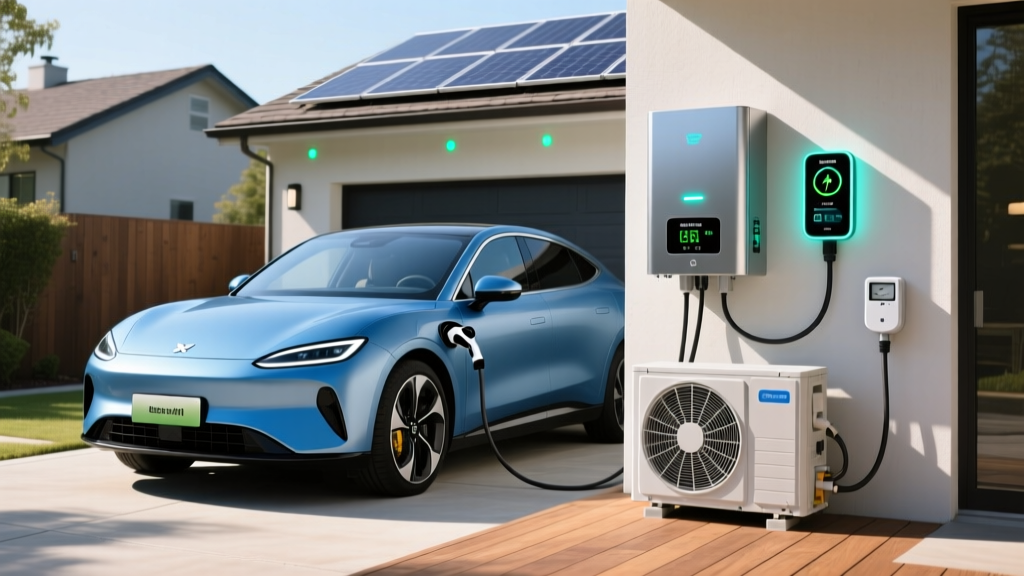
If you are buying an EV and also evaluating home heating upgrades, the critical shared constraint is your electrical panel. A Level 2 home charger (7–11.5 kW) plus a modern heat pump (3–5 kW running, up to 7 kW peak) can consume 15+ kW simultaneously on the coldest nights. Most 100-amp panels cannot support both without load management. The electric boiler market is expanding with smarter, lower-wattage models, but for most US homes, a cold-climate heat pump delivers 2–3x the heating efficiency per kWh compared to resistive electric boilers — and pairs far better with an EV charging setup on a single 200-amp service.
When shoppers research their first EV purchase, the conversation rarely stops at the car itself. Home charging installation forces a hard look at total household electrical demand, and that is where heating systems enter the picture. The global electric boiler market has drawn renewed attention as regions push to decarbonize residential heating, but EV owners face a specific calculus: every kilowatt-hour diverted to resistive heating is a kilowatt-hour that is not charging your car — and every kilowatt of panel capacity claimed by an electric boiler is one your Level 2 charger cannot use at full speed.
This guide breaks down the real numbers behind EV charging energy demand, how that intersects with home heating choices in 2026, and what you should budget for when both systems share one electrical service.
EV Charging Energy Demand: The Real Numbers
Before comparing heating systems, let us establish what an EV actually consumes. The 2026 Hyundai Ioniq 5 (84 kWh usable battery, NMC chemistry) carries an EPA efficiency rating of 118 MPGe combined, translating to roughly 29 kWh per 100 miles. A driver covering 12,000 miles annually needs approximately 3,480 kWh per year just for driving — about 290 kWh per month.
| Vehicle | Battery (kWh) | EPA Efficiency (kWh/100mi) | Annual kWh | Monthly kWh |
|---|---|---|---|---|
| 2026 Tesla Model 3 LR | 79 (NMC) | 25 | 3,000 | 250 |
| 2026 Hyundai Ioniq 5 | 84 (NMC) | 29 | 3,480 | 290 |
| 2026 Ford F-150 Lightning | 131 (NMC) | 48 | 5,760 | 480 |
| 2026 Chevrolet Equinox EV | 85 (NMC) | 31 | 3,720 | 310 |
At the US average residential electricity rate of $0.17/kWh (EIA, early 2026 data), fueling an Ioniq 5 at home costs roughly $592 annually. That same driver in a 28 MPG gas car at $3.40/gallon spends $1,457. The fueling savings are real — but they only materialize with consistent home charging access.
The Electric Boiler Market vs. Heat Pumps: What EV Owners Need to Know
The electric boiler market encompasses resistive heating units that convert electricity to heat at near 100% efficiency — meaning 1 kWh of electricity produces roughly 3,412 BTU of heat. Modern electric boilers range from 4 kW compact units to 18+ kW whole-home systems. Their appeal is simplicity: no refrigerant lines, no outdoor compressor, minimal maintenance.
However, cold-climate air-source heat pumps operate at 200–350% efficiency (COP of 2.0–3.5), producing 6,800–11,900 BTU per kWh. For EV owners managing a shared electrical panel, this efficiency gap is decisive.
| System | Peak Draw (kW) | Efficiency (COP) | kWh for 40,000 BTU/hr | Panel Impact |
|---|---|---|---|---|
| Electric Boiler (resistive) | 12–18 kW | ~1.0 | 11.7 | Requires 60–80A dedicated circuit |
| Cold-Climate Heat Pump | 3–7 kW | 2.0–3.5 | 3.3–5.8 | Requires 30–40A dedicated circuit |
| Natural Gas Furnace (95% AFUE) | ~0.5 kW (blower only) | N/A | ~0.5 (electricity) | Minimal panel impact |
On a 200-amp residential panel (providing roughly 38 kW of continuous usable capacity after the 80% NEC derating), running an 11.5 kW Level 2 charger and a 12 kW electric boiler simultaneously would consume 23.5 kW — feasible on paper, but it leaves only ~14 kW for all other household loads: kitchen, laundry, water heater, lighting, electronics. On a 100-amp panel, the math simply fails.
A heat pump drawing 4 kW during heating operation leaves far more headroom for your EV charger and avoids a costly panel upgrade that typically runs $2,000–$4,500 depending on your utility's service drop capacity.
Real-World Panel Planning: EV Charger + Heating on One Service
A licensed electrician will perform a NEC Article 220 load calculation before approving a Level 2 charger installation. Here is what that looks like for a typical 2,200 sq ft home with an EV and electric heating:
Electrical Panel Decision Framework
If you have a 200-amp panel + heat pump: A 48A Level 2 charger (11.5 kW) typically fits without upgrade. Budget $600–$1,500 for charger equipment and installation on an existing panel with spare breaker slots.
If you have a 200-amp panel + electric boiler: You will likely need an automatic load management device ($300–$600 installed) that throttles the charger when the boiler activates, or a panel upgrade to 320A/400A service ($3,000–$6,000+).
If you have a 100-amp panel: Plan for a 200-amp upgrade ($2,000–$4,500) before installing any Level 2 charger above 16A (3.8 kW). This is the most common surprise cost for first-time EV buyers in older homes.
If you rely on public charging only: No panel work needed, but expect $0.30–$0.50/kWh at DC fast chargers (Electrify America, EVgo), roughly doubling your fueling cost vs. home. Factor in time cost: a 10–80% session at a 150 kW station takes 20–35 minutes depending on the vehicle's charge curve.
Cost Breakdown: EV + Home Heating Over 5 Years
The following comparison models a homeowner driving 12,000 miles/year in a mixed climate (think Philadelphia or Denver) who is also replacing an aging heating system.
| Cost Category | EV + Heat Pump | EV + Electric Boiler | Gas Car + Gas Furnace |
|---|---|---|---|
| Vehicle purchase (after §30D credit) | $38,000 | $38,000 | $32,000 |
| Heating system install | $8,500 | $4,200 | $5,800 (furnace replacement) |
| Panel upgrade (if needed) | $0 | $3,500 | $0 |
| 5-year fueling (vehicle) | $2,960 | $2,960 | $7,285 |
| 5-year heating energy | $5,100 | $10,200 | $6,800 (natural gas) |
| 5-year vehicle maintenance | $1,800 | $1,800 | $3,500 |
| 5-Year Total | $56,360 | $60,660 | $55,385 |
The EV + heat pump combination edges out the gas baseline over five years when the federal §30D tax credit applies. The EV + electric boiler path costs roughly $5,300 more due to the resistive heating penalty and potential panel upgrade. Note: the §30D credit for 2026 carries income caps ($150K single / $300K joint), MSRP caps ($55K cars / $80K SUVs and trucks), and battery critical-mineral sourcing requirements. Verify eligibility at IRS.gov or consult a tax professional before purchasing.
Common Misconceptions: EVs, Heating, and Electrical Demand
| Myth | Fact |
|---|---|
| "Electric boilers are the cheapest all-electric heating option." | Lower upfront cost, yes — but 2–3x the operating cost vs. a heat pump. Over 10 years, a heat pump saves $6,000–$12,000 in electricity depending on climate and rates. |
| "My 100-amp panel can handle an EV charger." | Only at Level 1 (1.4 kW on a 120V outlet) or a severely limited 16A Level 2 (3.8 kW). A full-speed 48A Level 2 charger requires 60A breaker headroom that most 100A panels lack alongside existing loads. |
| "EV charging will spike my electric bill beyond savings." | Adding 290 kWh/month for an Ioniq 5 costs ~$49/month at $0.17/kWh. That same distance in a 28 MPG gas car costs ~$121/month. Net savings: ~$72/month even before any solar offset. |
| "The electric boiler market is growing because boilers are the future." | Market growth is driven largely by regions with cheap electricity and existing hydronic (radiator) infrastructure, particularly in Europe. In the US, cold-climate heat pumps dominate new electrification incentives under the Inflation Reduction Act. |
| "I need a panel upgrade no matter what." | Not necessarily. Load-management devices like the Emporia Smart Panel or Span Drive can dynamically share capacity between your charger and other circuits, avoiding an upgrade on marginal panels. |
Climate and Driving Pattern Considerations
Where you live changes both the heating equation and EV range reality. Cold-climate EV owners in Minneapolis or Buffalo should expect 20–35% EPA range reduction in sustained sub-freezing temperatures. A 2026 Ioniq 5 with a 290-mile EPA rating may deliver 195–230 miles on a 15°F January highway commute, depending on cabin heat usage and whether the vehicle's heat pump (standard on many 2026 models) is preconditioning the battery.
This same cold climate is where heat pumps prove their value over electric boilers. Modern cold-climate units from Mitsubishi (Hyper-Heating INVERTER) and Daikin maintain a COP above 2.0 down to -13°F (-25°C). An electric boiler's COP remains fixed at ~1.0 regardless of outdoor temperature, meaning your most expensive heating days are also your least efficient ones.
For driving patterns: if your daily commute is under 40 miles round-trip, a Level 1 charger (1.4 kW, adding ~4–5 miles of range per hour) may suffice without any panel work. Drivers regularly covering 60+ miles daily or taking periodic road trips need Level 2 (adding 25–44 miles per hour depending on vehicle acceptance rate and charger output). The EPA's fueleconomy.gov database provides model-specific MPGe and kWh/100mi figures to calculate your exact needs.
The 2026 Smart-Panel and V2H Frontier
Vehicle-to-Home (V2H) bidirectional charging is beginning to shift the EV-and-heating conversation. The 2026 Ford F-150 Lightning and Hyundai Ioniq 5 (with updated firmware) can discharge up to 9.6 kW back to your home during an outage, effectively serving as a backup power source that could run a heat pump through a winter storm. This capability makes the EV itself part of the home energy infrastructure — a factor that does not exist in the electric boiler market conversation.
Smart electrical panels from Span.IO and Schneider Electric now offer circuit-level control, allowing homeowners to prioritize EV charging over non-essential loads (pool pump, second oven) during peak demand without a full service upgrade. These panels cost $3,000–$5,000 installed but can defer or eliminate the need for a utility service upgrade.
Frequently Asked Questions
Will an electric boiler work if I also charge an EV at home?
It can, but only with sufficient panel capacity. A 12 kW electric boiler plus an 11.5 kW Level 2 charger draws 23.5 kW combined. On a 200-amp panel (38.4 kW usable after NEC 80% derating), this leaves roughly 15 kW for all other loads — tight but possible with load management. On a 100-amp panel, simultaneous operation will trip the main breaker. A heat pump drawing 4–5 kW is far easier to integrate.
Is the electric boiler market relevant to US EV owners?
Marginally. The electric boiler market growth is concentrated in Europe and Asia where hydronic radiator systems are common and natural gas infrastructure is being phased out. In the US, cold-climate heat pumps are the dominant electrified heating choice, supported by IRA tax credits up to $2,000 under §25C. EV owners benefit more from the heat pump's lower electrical demand.
How much does it cost to upgrade my panel for EV charging?
A 100A-to-200A panel upgrade typically costs $2,000–$4,500 including permits and utility coordination. A 200A-to-320A/400A upgrade runs $3,500–$7,000+. These costs vary significantly by region, utility requirements, and whether your service drop from the street needs replacement. Always get a quote from a licensed electrician who will perform a proper NEC load calculation.
Can I use solar to offset both EV charging and electric heating?
Yes, but size the system carefully. An EV consuming 3,480 kWh/year plus a heat pump consuming 6,000–8,000 kWh/year (in a cold climate) requires a 10–15 kW solar array in most US locations. An electric boiler consuming 12,000–15,000 kWh/year for heating pushes the required array to 18–22 kW, which exceeds the roof space on many homes. Solar makes the heat pump path dramatically more viable than the boiler path.
What is the cheapest way to start EV home charging without a panel upgrade?
Use a Level 1 charger (included with most new EVs) on a dedicated 120V/15A circuit. It adds 4–5 miles of range per hour — sufficient for drivers covering under 40 miles daily. Alternatively, a 16A Level 2 charger on a 20A/240V circuit draws only 3.8 kW and adds ~15 miles per hour, fitting most 100A panels without modification. Equipment costs $200–$400; installation on an existing 240V outlet (like a dryer circuit) can be under $300.
The intersection of EV ownership and home energy decisions is where real-world costs are won or lost. The electric boiler market may be growing globally, but for the US homeowner adding an EV to the garage, a cold-climate heat pump paired with a properly sized Level 2 charger on a managed electrical panel delivers the lowest total cost of ownership and the most resilient setup for the next decade.