Quick Answer: What Are EV Graveyards?
"EV graveyards" refers to salvage yards, auction lots, and recycling facilities where electric vehicles end up prematurely scrapped — often because a battery replacement ($10,000–$22,000+) exceeds the car's residual value, or because flood/fire-damaged EVs are deemed too risky to resell. The vast majority of modern EVs (2020+) do not end up in graveyards under normal ownership. Battery degradation averages just 8–12% over 100,000 miles for liquid-cooled packs, and federal warranty mandates require 8-year/100,000-mile coverage. The real graveyard risk falls on older first-generation EVs (2011–2017 Nissan Leaf, early Chevy Spark EV), flood-damaged vehicles from hurricanes, and collision-salvage cars with compromised battery enclosures. If you're buying a used EV, a pre-purchase battery health check is your single best defense against owning a future scrapyard candidate.
The Real Story Behind the "EV Graveyard" Headlines
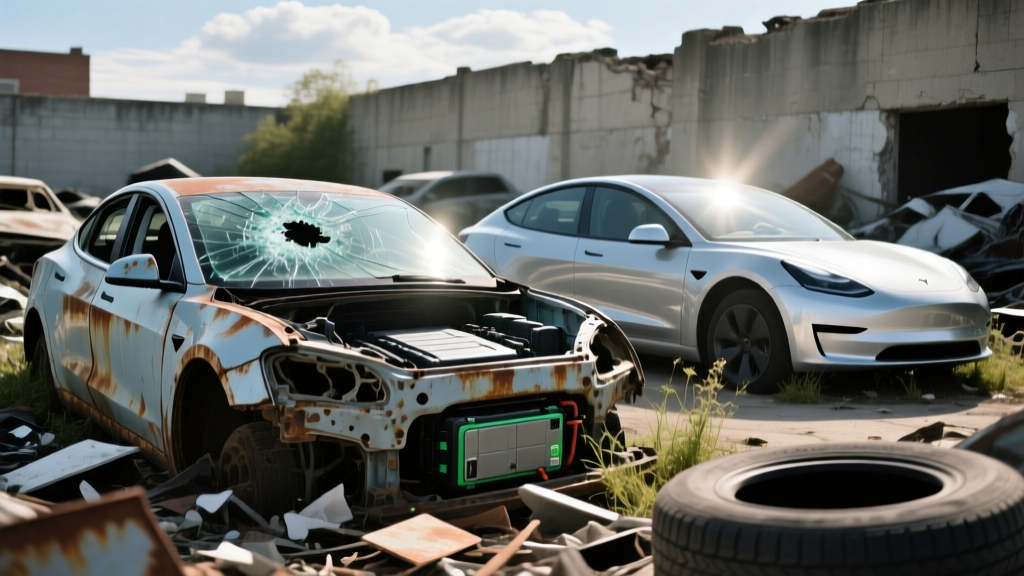
Social media and legacy auto forums periodically surface photos of dozens of abandoned Nissan Leafs or Chevy Bolts sitting in lots. These images fuel narratives about EVs being disposable. The reality is more nuanced and largely traceable to three specific scenarios:
1. The Battery-Economics Cliff (Older, Out-of-Warranty EVs)
A 2013 Nissan Leaf with a 24 kWh battery that has degraded to 70% state of health (SoH) might be worth $5,000–$7,000 on the used market. A replacement battery pack, if available, costs $8,000–$12,000 installed. When repair exceeds value, insurers total the car or owners simply abandon it. This is the same economics that sends a $4,000 Honda Civic with a blown transmission to the scrapyard — it's not unique to EVs, but it's more visible because the battery is the single dominant cost component.
2. Flood and Fire Salvage (Hurricane Aftermath)
After Hurricane Ian (2022) and Hurricane Helene (2024), thousands of flooded EVs were written off by insurers. Saltwater intrusion into high-voltage battery enclosures creates corrosion and short-circuit risks that are expensive to fully remediate. These vehicles legally receive salvage titles and many end up in recycling streams. According to IIHS and industry salvage data, flooded EVs represent a disproportionate share of EV graveyard inventory — not because EVs are fragile, but because water damage to a 400V+ system carries safety liabilities that gas cars don't face.
3. the Chevy Bolt Recall Effect (2022–2024)
When GM recalled approximately 140,000 Chevy Bolts (2017–2022) over battery fire risk and ultimately bought back thousands of vehicles, many of those buybacks were crushed or stripped for parts rather than resold. This single recall event generated a visible cluster of "abandoned EVs" that skewed public perception, even though it was a manufacturer-driven action, not a market failure.
EV vs. Gas Car: Which Actually Hits the Junkyard Faster?
The average age of a vehicle scrapped in the U.S. is roughly 15–17 years, per Bureau of Transportation Statistics data. EVs are too new as a mass-market product to have equivalent lifecycle data, but we can compare key longevity factors:
| Factor | Modern EV (2020+) | Gas Vehicle |
|---|---|---|
| Powertrain complexity | ~20 moving parts in drivetrain | ~2,000+ moving parts in ICE + transmission |
| Major failure risk | Battery degradation (gradual) | Engine/transmission failure (catastrophic) |
| Routine maintenance cost (5-yr) | $1,500–$2,500 (tires, cabin filter, fluid top-offs) | $3,500–$5,500 (oil, belts, plugs, filters, brakes) |
| Expected powertrain life | 200,000–300,000 mi (battery dependent) | 150,000–250,000 mi (with maintenance) |
| Warranty coverage (federal mandate) | 8 yr / 100,000 mi (battery + powertrain) | Typically 5 yr / 60,000 mi (powertrain) |
| Scrapped prematurely due to | Battery out-of-warranty + low residual value | Engine/transmission repair exceeding vehicle value |
Key takeaway: EVs have fewer catastrophic failure points, but their single expensive component (the battery) creates a different end-of-life dynamic. A gas car with a $5,000 transmission replacement on a $4,000 car meets the same economic fate as an EV needing a $12,000 battery on a $10,000 car.
The Real Cost of EV Ownership (And What Sends Cars to the Yard)
Understanding total cost of ownership helps you see exactly when and why an EV becomes uneconomical to keep on the road.
| Cost Category | 2025 Hyundai Ioniq 6 SE (EV) | 2025 Toyota Camry LE (Gas) | 2025 Toyota Camry Hybrid LE |
|---|---|---|---|
| MSRP (before incentives) | $38,650 | $28,700 | $30,045 |
| Federal tax credit (§30D) | Up to $7,500 (if eligible*) | $0 | $0 |
| Effective purchase price | ~$31,150 | $28,700 | $30,045 |
| 5-year fuel/energy cost** | $3,600 (electricity, $0.14/kWh avg) | $8,200 ($3.40/gal, 32 MPG combined) | $5,500 ($3.40/gal, 52 MPG combined) |
| 5-year maintenance | $1,800 | $4,200 | $3,800 |
| 5-year insurance (avg) | $8,500 | $6,800 | $6,800 |
| 5-year total cost of ownership | ~$45,050 | ~$47,900 | ~$46,445 |
| Cost per mile (5 yr / 75,000 mi) | $0.60 | $0.64 | $0.62 |
*§30D credit eligibility requires meeting income caps ($150K single / $300K joint), MSRP caps ($55K sedans), and battery sourcing requirements. Check current rules at IRS.gov. Credit may be transferred to dealer at point of sale.
**Based on 15,000 miles/year. Electricity costs vary significantly by state ($0.10–$0.30/kWh residential).
The EV wins on 5-year total cost primarily through fuel and maintenance savings, but insurance runs ~25% higher on average. The real graveyard trigger comes at year 10–12: if the Ioniq 6 battery degrades to 70% SoH and the car is worth $12,000, a $14,000 battery replacement totals it economically. For the Camry, a $4,500 transmission replacement on a $8,000 car does the same.
What First-Time EV Buyers Must Know to Avoid Graveyard Risk
Battery Chemistry Matters More Than You Think
Not all EV batteries age the same way. The two dominant chemistries in 2025–2026 models have different longevity profiles:
| Factor | LFP (Lithium Iron Phosphate) | NMC/NCA (Nickel-based) |
|---|---|---|
| Typical cycle life | 3,000–5,000+ cycles | 1,000–2,000 cycles |
| Expected degradation at 100K mi | 5–8% | 8–12% |
| Can charge to 100% daily? | Yes (recommended by most OEMs) | No (80% daily, 100% for trips only) |
| Cold-weather range loss | Greater (~35–40% at 20°F) | Moderate (~25–30% at 20°F) |
| Energy density | Lower (heavier pack for same range) | Higher (lighter, more range per kg) |
| Found in (2025–2026 examples) | Tesla Model 3 RWD, base BYD models, Ford Mustang Mach-E Select (some) | Hyundai Ioniq 5/6, Tesla Long Range, Rivian, most premium EVs |
| Long-term graveyard risk | Lower (battery outlasts vehicle) | Moderate (may need replacement at 150K–200K mi) |
If longevity is your priority and you live in a mild climate, LFP-equipped EVs offer the lowest risk of becoming economically totaled by battery costs.
Battery Warranties Are Your Safety Net
Every EV sold in the U.S. carries a federally mandated minimum battery warranty of 8 years / 100,000 miles. This warranty covers capacity loss below a specified threshold — typically 70% state of health. Some manufacturers go further:
- Hyundai/Kia: 10 years / 100,000 miles
- Tesla: 8 years / 120,000 miles (Long Range) or 100,000 miles (RWD)
- Rivian: 8 years / 175,000 miles (Max Pack)
If your battery drops below the threshold within the warranty period, the manufacturer replaces it at no cost. This dramatically reduces graveyard risk during the first decade of ownership.
The Used EV Minefield: Where Graveyard Cars Are Born
The highest-risk scenario for creating an "EV graveyard" vehicle is buying a used EV without checking battery health. Here's what to verify before purchase:
- State of Health (SoH) reading: Many EVs display this in the settings menu, or a dealer can pull it via OBD-II. Anything below 85% SoH on a vehicle with under 60,000 miles is a red flag.
- Salvage/rebuilt title: A salvaged EV may have hidden battery enclosure damage. Insurers write off EVs more aggressively because high-voltage safety inspections are costly.
- Recall completion: Verify any battery recalls (Bolt, early Taycan) were completed. An un-repaired Bolt is uninsurable in many states.
- Warranty transferability: The federal 8/100K battery warranty transfers to subsequent owners — but only if the car has a clean title.
Decision Framework: Is an EV Right for Your Situation?
Choose an EV If:
- You have access to Level 2 home charging (garage, driveway, or employer-provided) — this eliminates 80% of ownership friction
- Your daily commute is under 80 miles round-trip (covers 90%+ of U.S. drivers)
- You live in a moderate-to-warm climate (extreme cold reduces range 25–40%)
- You plan to keep the vehicle 5+ years (amortizes the higher upfront cost)
- You qualify for the §30D tax credit (check income, MSRP, and sourcing rules at IRS.gov)
- You drive 12,000+ miles/year (higher mileage = greater fuel savings)
Choose a Hybrid (HEV/PHEV) Instead If:
- You have no access to home or workplace charging
- You regularly drive 300+ miles between charging stations (rural routes, road-trip-heavy lifestyle)
- You live in extreme cold (Alaska, northern Minnesota) where range loss is severe
- Your budget is under $28,000 and you can't wait for the used market
- You need to tow heavy loads (5,000+ lbs) frequently — EVs lose 30–50% range while towing
Avoid the EV Graveyard — Never Buy Without:
- A battery SoH report (below 85% = negotiate hard or walk away)
- Confirming clean title status (salvage titles void battery warranties)
- Verifying all recalls are completed
- Checking remaining warranty coverage (years and miles left)
Common EV Graveyard Myths — Fact-Checked
| Myth | Fact (With Data) |
|---|---|
| "EV batteries all die after 5 years" | Average degradation is 8–12% over 100,000 miles for NMC, 5–8% for LFP. Most packs retain 85%+ SoH at 100K miles. (fueleconomy.gov) |
| "Replacing a battery costs $30,000" | Full pack replacement ranges from $10,000 (Nissan Leaf 40 kWh) to $22,000 (large NMC packs). Individual module repair can cost $2,000–$5,000. Prices are declining ~8–10%/year. |
| "EVs are worse for the environment because of battery waste" | Over 95% of lithium-ion battery materials are recyclable. Companies like Redwood Materials and Li-Cycle recover cobalt, nickel, and lithium for new batteries. Very few EV batteries end up in landfills. |
| "EVs get totaled in minor accidents" | Insurance data shows EVs are totaled at slightly higher rates in severe collisions due to battery safety protocols, but not in minor accidents. Many insurers now have EV-specific repair protocols. |
| "Nobody wants used EVs" | Used EV sales grew ~28% year-over-year through 2025. The Used Clean Vehicle Credit (§25E) offers up to $4,000 for qualifying used EVs under $25,000, boosting demand. |
What Happens to EVs That Do End Up in Graveyards?
Even when EVs reach end-of-life, they don't simply rot. The EV recycling ecosystem in 2025–2026 includes:
- Second-life battery storage: Packs at 70–80% SoH are repurposed for stationary grid storage (solar farms, commercial backup). A "degraded" EV battery still holds 50–70 kWh — enough to power a home for 2–3 days.
- Material recovery: Redwood Materials (Nevada), Li-Cycle (New York), and BlueOval SK (Kentucky) recover 95%+ of critical minerals. Recycled cobalt and nickel re-enter the supply chain.
- Component resale: Motors, inverters, onboard chargers, infotainment, and glass are stripped and resold. Electric motors, with virtually no wear components, command strong aftermarket prices.
- Structural recycling: Aluminum and steel bodies enter standard automotive recycling streams.
The "EV graveyard" is better understood as an EV recycling pipeline — and it's far more environmentally managed than the imagery suggests.
Frequently Asked Questions
Are EV graveyards a real problem in 2026?
Not at scale. The viral images of abandoned EVs largely trace to specific events (Chevy Bolt recall buybacks, hurricane flood salvage). Modern EVs (2020+) with liquid-cooled batteries and 8–10 year warranties are not filling junkyards. The risk is concentrated in 2011–2017 first-generation EVs with air-cooled or small batteries that are now out of warranty.
How long does an EV battery actually last?
Data from fueleconomy.gov and fleet studies show liquid-cooled NMC batteries typically retain 85–90% capacity at 100,000 miles and 75–85% at 150,000 miles. LFP batteries degrade even slower, often retaining 90%+ at 100,000 miles. Most EVs will reach end-of-life from body/chassis wear before the battery fails completely.
Should I avoid buying a used EV because of graveyard risk?
No — but buy smart. Check battery SoH (aim for 85%+), confirm clean title, verify warranty remaining, and check recall status. A 2021 Tesla Model 3 with 45,000 miles and 92% SoH is a far safer bet than a 2014 Nissan Leaf with 80,000 miles and 72% SoH. The §25E used EV credit (up to $4,000) makes qualifying used EVs under $25,000 especially compelling.
What's the single biggest factor that sends an EV to a graveyard?
Economic totaling: when a needed repair (usually battery replacement at $10,000–$22,000) exceeds the vehicle's market value. This primarily affects out-of-warranty EVs aged 10+ years. It's the same dynamic that scraps gas cars needing engine replacements — not an EV-specific problem.
Do EVs hold their resale value?
EV depreciation has been steeper than gas cars in recent years, partly due to Tesla price cuts, rapid technology improvement, and high lease volumes flooding the used market. Expect 45–55% depreciation over 3 years for mainstream EVs vs. 35–45% for comparable gas cars. This gap is narrowing as the market matures and as federal used-EV credits support demand.