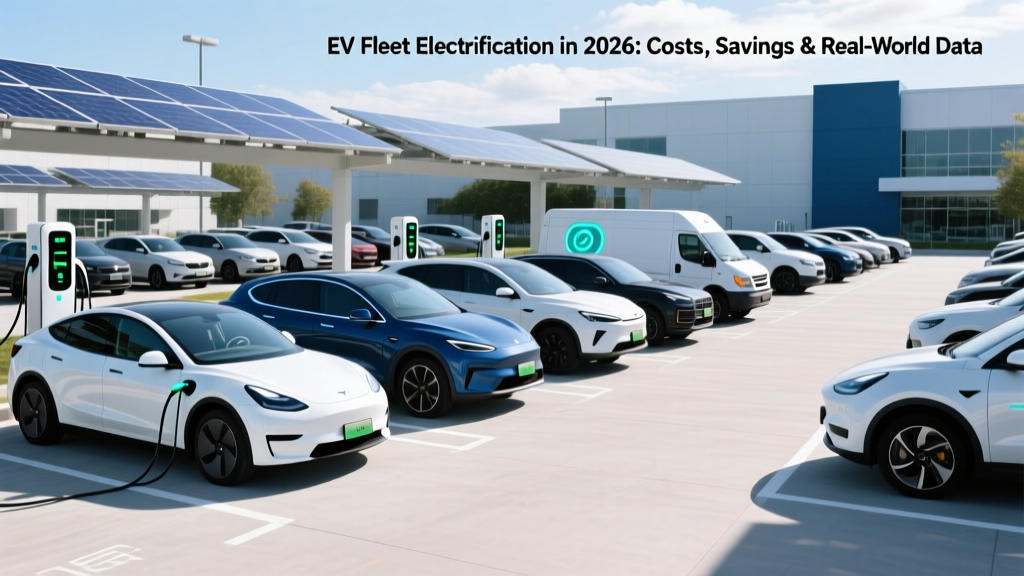
Quick Answer: EV fleet electrification makes financial sense for most light-duty commercial fleets in 2026 when vehicles are charged at depot Level 2 chargers, driven under 200 miles daily, and eligible for the federal §30D clean vehicle credit or the Commercial Clean Vehicle Credit (§45W). Typical per-vehicle fuel savings run $1,500–$2,800 annually depending on local electricity rates, and maintenance savings add another $800–$1,200 per year versus gas equivalents. The catch: upfront acquisition costs remain 15–35% higher, depot charging infrastructure requires $3,000–$15,000 per stall to install, and cold-climate fleets must plan for 20–30% winter range loss.
Why Fleets Are Switching to Electric in 2026
Commercial fleet electrification has moved past early-adopter status. The total cost of ownership (TCO) for electric commercial vehicles now undercuts internal combustion engine (ICE) equivalents within 3–5 years for most duty cycles, driven by three converging factors: declining battery pack prices (averaging $115/kWh at the cell level in early 2026, per BloombergNEF data), expanding availability of purpose-built commercial EVs, and federal incentive structures that directly reduce acquisition cost.
For fleet managers, the calculus is straightforward. A Ford E-Transit (the best-selling electric commercial van in the US) carries a 2026 base MSRP of approximately $47,895 for the low-roof cargo variant with a 126-mile EPA range and a 68 kWh usable lithium iron phosphate (LFP) battery. Compare that to a gas Ford Transit T-150 cargo van at roughly $48,500 MSRP — the EV version is now nearly price-competitive at sticker before any incentives.
But the real savings emerge over time. Let's look at the numbers that matter.
Fleet EV vs Gas: Total Cost of Ownership Breakdown
The following comparison models a 5-year ownership cycle for a light-duty commercial van driven 15,000 miles annually — a typical last-mile delivery duty cycle. Electricity cost assumes $0.14/kWh (commercial average); gasoline assumes $3.45/gallon.
| Cost Category (5-Year) | Ford E-Transit (EV) | Ford Transit T-150 (Gas) |
|---|---|---|
| Base MSRP | $47,895 | $48,500 |
| Federal Tax Credit (§45W commercial) | −$7,500 | $0 |
| Net Acquisition Cost | $40,395 | $48,500 |
| Fuel/Energy (75,000 mi total) | $4,725 (2.1 kWh/mi × $0.14) | $12,938 (18 MPG avg × $3.45) |
| Maintenance (oil, filters, brakes, etc.) | $1,800 | $5,200 |
| Depot Charger Install (amortized per vehicle) | $4,500 | $0 |
| Insurance (est. 5-yr total) | $8,250 | $7,000 |
| Total 5-Year Cost | $59,670 | $73,638 |
| Cost Per Mile | $0.795 | $0.982 |
Net 5-year savings per vehicle: ~$13,968. For a 20-vehicle fleet, that's roughly $279,000 over five years — enough to justify the infrastructure investment and operational changes required.
Key caveat: these figures assume depot charging (vehicles return to base nightly). Fleets relying on public DC fast charging will see energy costs rise 2–3× due to higher per-kWh rates ($0.35–$0.55/kWh at Electrify America or EVgo stations), which erodes the fuel advantage significantly.
Choosing the Right Electric Fleet Vehicles
Not every fleet duty cycle suits electrification. Here's a practical decision framework based on real operational data:
IF your vehicles drive under 150 miles/day AND return to a depot nightly:
→ Strong EV candidate. Depot Level 2 charging (7.7–19.2 kW) fully replenishes most commercial EVs overnight. LFP batteries (as in the E-Transit and BrightDrop Zevo) tolerate daily 100% charging without accelerated degradation.
IF your vehicles drive 150–250 miles/day with predictable routes:
→ Conditional EV candidate. Consider higher-range options like the Chevrolet Silverado EV Work Truck (EPA est. 440 mi, 200+ kWh Ultium battery, ~$60,000+ MSRP) or plan mid-day DC fast charging top-ups. Budget for 20–30% cold-weather range loss in northern climates.
IF your vehicles drive 250+ miles/day with variable routes:
→ Likely not an EV candidate in 2026. Current battery energy density and charging infrastructure make pure BEV impractical. Consider PHEV options or defer electrification to lighter-duty vehicles in your fleet first.
IF your fleet operates in extreme cold (below 10°F regularly):
→ Plan for 25–35% range reduction. A vehicle rated at 250 miles EPA may deliver only 165–190 miles in sustained sub-zero operation. Heat pump-equipped models (like the Ford F-150 Lightning and Hyundai Ioniq 5-based commercial upfits) mitigate this to ~20% loss.
2026 Commercial EV Options: Specs That Matter
Here are the most common light- and medium-duty commercial EVs available in the US market for 2026, with the specifications fleet managers actually need for route planning:
| Model | EPA Range | Battery (kWh, Chemistry) | Peak DC Charge | 10–80% Time | Level 2 Rate | Base MSRP |
|---|---|---|---|---|---|---|
| Ford E-Transit (low-roof cargo) | 126 mi | 68 kWh, LFP | 115 kW | ~45 min | 10.5 kW | $47,895 |
| BrightDrop Zevo 600 | 250 mi | 165 kWh, NMC | 120 kW | ~90 min | 11.5 kW | $75,000 (est.) |
| Ford F-150 Lightning Pro | 240 mi (std) / 320 mi (ext) | 98 kWh (std) / 131 kWh (ext), NMC | 150 kW | ~41 min | 19.2 kW (optional) | $54,995 |
| Chevrolet Silverado EV 4WT | 440 mi | 200+ kWh, NMC (Ultium) | 350 kW | ~20 min | 19.2 kW | $62,000 (est.) |
| Rivian EDV (Amazon delivery van) | 150 mi (est.) | ~105 kWh, NMC | 125 kW | ~50 min | 11 kW | Fleet-only pricing |
Real-world range note: EPA figures assume mixed driving at moderate temperatures. Fleet operators running stop-and-go urban delivery routes in summer heat may see 10–15% better range than EPA (regen braking recovers energy). Highway-heavy routes at 70+ mph will see 15–20% below EPA. Always plan routes against 80% of EPA range as a safety margin.
Depot Charging Infrastructure: What It Actually Costs
The most overlooked expense in fleet electrification is charging infrastructure. Here's a realistic breakdown for installing Level 2 depot chargers:
| Component | Per-Stall Cost Range | Notes |
|---|---|---|
| Level 2 charger hardware (commercial-grade, 19.2 kW) | $1,200–$3,500 | ChargePoint CT4000, EVBox BusinessLine, or similar |
| Electrical panel upgrade (if needed) | $2,000–$8,000 | Required if existing service can't handle added load |
| Wiring, conduit, and labor | $1,500–$5,000 | Varies heavily with distance from panel to parking area |
| Permits and utility interconnection | $500–$2,500 | Some utilities offer make-ready incentives |
| Networked charging software (annual) | $200–$500/yr | For load management, scheduling, and billing |
| Total per stall (typical) | $5,400–$19,500 | Average: ~$9,000 per stall installed |
For a 20-vehicle fleet, expect $100,000–$200,000 in total depot charging infrastructure costs. Many utilities offer commercial EV make-ready programs that cover 50–100% of wiring and panel costs — check with your local utility before budgeting.
DC fast charging on-site (50–150 kW chargers for mid-day top-ups or high-utilization fleets) runs $40,000–$120,000 per charger installed, plus potential demand charges from your utility that can add $1,000–$5,000/month to your electric bill. Most light-duty fleets do not need on-site DCFC if vehicles can charge overnight.
Federal Incentives for Fleet Electrification
The IRS Commercial Clean Vehicle Credit (§45W) provides up to $7,500 for light-duty vehicles (under 14,000 lbs GVWR) and up to $40,000 for heavier commercial EVs. Unlike the consumer §30D credit, the commercial credit does not have buyer income caps, MSRP caps, or critical-mineral sourcing requirements — making it far more accessible for fleet purchases.
Eligibility requirements for §45W:
- Vehicle must be purchased for business use (not personal)
- Vehicle must meet the same battery-component and critical-mineral standards as §30D for the $7,500 tier (light-duty)
- Must be placed in service during the tax year
- Credit is non-refundable but can offset tax liability dollar-for-dollar
- Heavy-duty vehicles (over 14,000 lbs GVWR) can qualify for up to $40,000 with fewer sourcing restrictions
Additionally, the §48C Advanced Energy Project Credit can cover up to 30% of qualifying charging infrastructure investment for fleets in designated energy communities.
Important: Tax credit eligibility rules evolve. Consult a tax professional and verify current-year requirements on IRS.gov before making purchase decisions based on incentive assumptions.
Common Fleet Electrification Misconceptions
| Myth | Fact |
|---|---|
| "EV batteries need replacing every 5 years" | Modern LFP batteries (E-Transit, BrightDrop) are warrantied for 8 years/100,000 miles at 70%+ capacity retention. Real-world degradation data from early commercial fleets shows 8–12% capacity loss at 100,000 miles with daily Level 2 charging. |
| "Charging takes too long for fleet operations" | Overnight depot charging at 19.2 kW adds ~55 miles of range per hour. A 126-mile E-Transit fully replenishes in under 7 hours — well within a standard overnight layover. DCFC at 115 kW restores 10–80% in ~45 minutes for mid-day top-ups. |
| "EVs don't work in cold weather" | Range drops 20–35% in sustained sub-zero temperatures, but modern thermal management systems (heat pumps, battery preconditioning) mitigate this. Fleets in Minnesota and Michigan report successful winter operations by planning routes against 70% of EPA range. |
| "Electricity costs more than gas" | At the US commercial average of $0.14/kWh, electricity costs the equivalent of ~$1.15/gallon gasoline for an EV getting 2.5 kWh/mile. Even at public DCFC rates of $0.45/kWh, the equivalent is ~$3.70/gallon — comparable to gas but without the maintenance savings. |
| "Our electrical service can't handle fleet chargers" | Most commercial properties with 400A–800A service can support 10–20 Level 2 chargers with smart load management software that staggers charging sessions. A utility interconnection study ($1,000–$5,000) will determine exact capacity. |
Maintenance and Long-Term Ownership Realities
EVs eliminate the largest recurring maintenance expenses in fleet operations: oil changes, transmission fluid, spark plugs, timing belts, and exhaust system repairs. Regenerative braking reduces brake pad wear by 50–70%, extending pad replacement intervals from ~30,000 miles to 80,000+ miles in stop-and-go delivery use.
What EV fleets do need:
- Tire replacement: EVs are 15–25% heavier than gas equivalents, accelerating tire wear by roughly 20%. Budget for tire replacement every 25,000–35,000 miles instead of 40,000–50,000.
- Cabin air filters: Every 15,000–20,000 miles ($30–$60 each).
- Brake fluid flush: Every 2–3 years ($80–$150).
- Coolant system service: Every 5 years or 100,000 miles for battery thermal management loops ($200–$400).
- 12V auxiliary battery: Still present in EVs; replace every 3–5 years ($150–$250).
Net maintenance savings of $800–$1,200 per vehicle per year are well-documented across fleet telematics data from operators like fueleconomy.gov and fleet management companies.
Fleet Electrification FAQ
How do I know which vehicles in my fleet to electrify first?
Start with vehicles that have the most predictable routes, lowest daily mileage, and most consistent depot return patterns. Last-mile delivery vans, service trucks with under 120 miles/day, and campus/shuttle vehicles are ideal first candidates. Use your fleet telematics data to identify vehicles averaging under 150 miles/day with 90%+ depot return rates.
What happens if an EV breaks down far from the depot?
Roadside assistance coverage from manufacturers (Ford includes 5 years/60,000 miles) covers towing to the nearest qualified service center. Unlike gas vehicles, EVs cannot receive emergency fuel delivery — a depleted battery requires a tow or mobile charging unit. Plan routes with a 20% range buffer and ensure drivers know the locations of compatible DC fast chargers along their routes.
Do commercial EVs qualify for the same $7,500 tax credit as consumer EVs?
Commercial fleets use the §45W Commercial Clean Vehicle Credit rather than the consumer §30D credit. The §45W credit offers up to $7,500 for light-duty and up to $40,000 for heavy-duty vehicles, without the consumer income caps or MSRP price limits. However, battery sourcing requirements still apply for the full credit amount on light-duty vehicles. Verify current eligibility on irs.gov.
How long does depot charger installation take?
Typical timelines run 3–6 months from project kickoff to energized chargers, including utility interconnection applications, permitting, electrical work, and inspections. Start infrastructure planning 6–12 months before your target vehicle delivery date. Some utilities have interconnection queues that can extend timelines in high-demand areas.
Will EV resale values hurt my fleet's total cost?
Commercial EV resale values in 2026 remain uncertain due to limited secondary market data. Early indicators suggest 35–50% retention at 5 years/75,000 miles for light-duty commercial EVs, compared to 40–55% for gas equivalents. However, the lower TCO during ownership typically offsets any resale disadvantage. Factor in a conservative 35% residual value when modeling your fleet's financials.