Quick Answer: Is an EV Fleet Worth It in 2026?
For most commercial operations running predictable daily routes under 200 miles, an EV fleet delivers 40–60% lower fuel costs and 30–50% lower maintenance costs compared to gas equivalents. A mid-size fleet (10 vehicles) can save $18,000–$32,000 annually on energy alone. However, upfront vehicle costs run 15–30% higher, depot charging infrastructure requires $15,000–$80,000+ in capital investment, and operations exceeding 250 daily miles or operating in extreme cold need careful route planning. The IRS §30D and §45W commercial clean vehicle credits can offset $7,500–$40,000 per vehicle depending on weight class, fundamentally changing the ROI timeline from 6–8 years down to 3–5 years for most fleet profiles.
The Real Economics: EV Fleet vs. Gas Fleet Cost Breakdown
The decision to electrify a fleet comes down to total cost of ownership (TCO), not sticker price. Below is a data-driven comparison based on a 10-vehicle light-duty fleet (think cargo vans or compact SUVs used for deliveries, service calls, or sales routes) over a 5-year/75,000-mile horizon.
| Cost Category | EV Fleet (e.g., Ford E-Transit / Chevy Equinox EV) | Gas Fleet (e.g., Ford Transit / Chevy Equinox AWD) | Difference |
|---|---|---|---|
| Purchase price (10 vehicles, base MSRP) | $520,000 ($52,000 avg) | $400,000 ($40,000 avg) | +$120,000 EV |
| Federal commercial clean vehicle credit (§45W) | −$75,000 ($7,500 per light-duty) | $0 | −$75,000 EV |
| Depot Level 2 charging (10 chargers, install) | $85,000 ($8,500 avg per stall) | $0 | +$85,000 EV |
| Energy/fuel (75,000 mi/vehicle, 5 yr) | $56,250 ($0.15/mi at $0.15/kWh, 4 mi/kWh) | $131,250 ($0.35/mi at 25 MPG, $3.50/gal) | −$75,000 EV |
| Maintenance (5 yr) | $37,500 ($0.10/mi) | $75,000 ($0.20/mi) | −$37,500 EV |
| Insurance (5 yr, 10 vehicles) | $112,500 ($2,250/yr per vehicle) | $97,500 ($1,950/yr per vehicle) | +$15,000 EV |
| Residual value (after 5 yr/75k mi) | −$225,000 (est. 43% retained) | −$180,000 (est. 45% retained) | +$45,000 EV cost |
| Net 5-Year Cost | $511,250 | $523,750 | EV saves ~$12,500 |
The crossover point where EV TCO undercuts gas typically arrives between year 3 and year 4 for fleets driving 15,000+ miles per vehicle annually. Below 10,000 miles/year, the infrastructure investment and higher purchase price may not justify electrification unless state or utility incentives stack on top of federal credits.
Choosing the Right EV for Your Fleet: Range, Charging, and Specs That Matter
Fleet vehicles live and die by uptime. Here are the specs that determine whether an EV fits your operation, using popular 2026 fleet models as benchmarks.
| Spec | Ford E-Transit (Cargo Van) | Chevy Silverado EV WT (Light Truck) | Hyundai Ioniq 5 (Fleet Sedan/Crossover) |
|---|---|---|---|
| EPA range | 159 mi (real-world: ~130–140 mi loaded) | 370 mi (real-world: ~310–340 mi) | 318 mi (real-world: ~265–290 mi highway) |
| Battery (usable kWh / chemistry) | 68 kWh / NMC | 200 kWh / NMC | 84 kWh / NMC |
| Peak DC fast charge rate | 115 kW | 350 kW | 240 kW |
| 10–80% DC charge time | ~45 min | ~30 min | ~18 min |
| Level 2 onboard charger | 10.5 kW | 19.2 kW | 10.9 kW |
| Overnight Level 2 full charge | ~7 hours | ~10.5 hours | ~8 hours |
| Cargo volume | 246.7 cu ft (low roof, long wheelbase) | 57.0 cu ft (bed, 5'11") | 27.2 cu ft (rear seats up) |
| Towing capacity | N/A | 10,000 lbs | 2,300 lbs (with tow pkg) |
| Base MSRP | $55,995 | $57,900 | $44,950 |
| Battery warranty | 8 yr / 100,000 mi (≥70% capacity) | 8 yr / 100,000 mi (≥70% capacity) | 10 yr / 100,000 mi (≥70% capacity) |
Real-World Range Reality Check
EPA range figures assume ideal conditions: moderate temperatures, flat terrain, no cargo. In fleet operations, expect 15–25% range reduction when vehicles carry full payloads, and an additional 20–30% loss in sustained sub-30°F weather due to battery chemistry and cabin heating demands. An E-Transit rated at 159 miles EPA may realistically deliver only 95–110 miles on a cold winter route with a loaded cargo bay. Always spec your daily route at no more than 70% of the worst-case range estimate to maintain operational buffer.
Depot Charging Infrastructure: What It Actually Costs and Requires
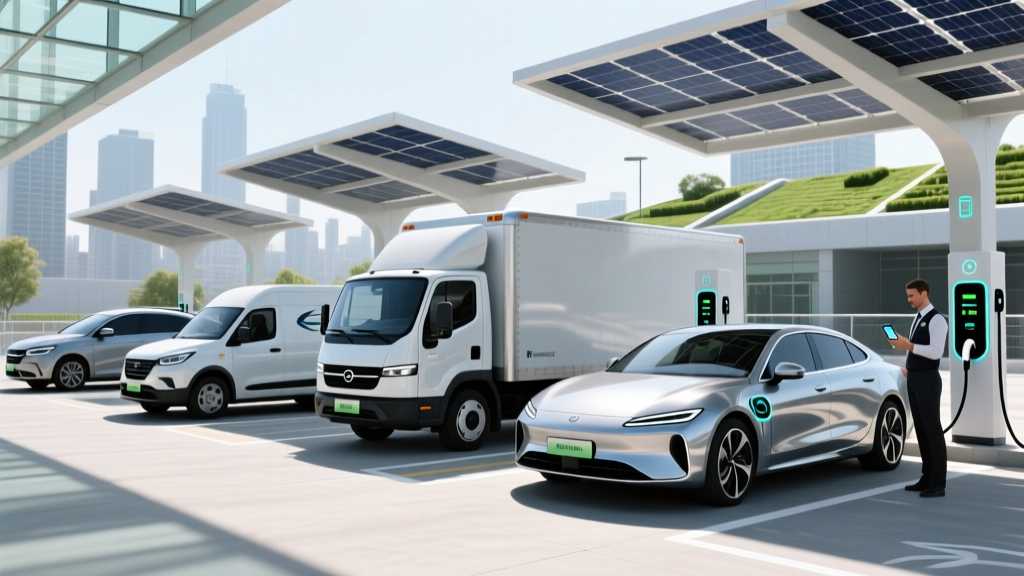
Charging infrastructure is the single largest variable in EV fleet planning. Unlike consumer EVs that charge at home overnight, fleet vehicles need depot charging — Level 2 or DC fast chargers installed at your business location. Here's what that investment looks like.
| Component | Level 2 (40–80A / 10–19 kW) | DC Fast Charger (50–150 kW) |
|---|---|---|
| Charger hardware | $600–$2,500 | $25,000–$80,000 |
| Electrical panel upgrade (if needed) | $2,000–$10,000 | $10,000–$50,000 |
| Wiring, conduit, trenching | $1,500–$5,000 | $5,000–$25,000 |
| Electrician labor | $2,000–$6,000 | $8,000–$20,000 |
| Permits and utility interconnection | $500–$2,000 | $3,000–$15,000 |
| Networked software / load management | $300–$800/yr per charger | $1,000–$3,000/yr per charger |
| Total per stall | $6,900–$26,300 | $52,000–$193,000 |
Most fleet operations with predictable overnight dwell times (8+ hours) can rely entirely on Level 2 charging. A 10.5 kW Level 2 charger adds roughly 35–42 miles of range per hour, fully replenishing an E-Transit's 68 kWh battery in about 7 hours. This is sufficient for any route under 130 daily miles.
DC fast chargers at the depot make sense only for multi-shift operations where vehicles return mid-day and need a rapid turnaround. At 50–150 kW, you can add 100+ miles in 20–30 minutes. However, the electrical service requirements are substantial — a single 150 kW charger may require a dedicated 480V three-phase supply and a utility transformer upgrade, adding months to the permitting timeline.
Utility Demand Charges: The Hidden Fleet Charging Cost
Commercial electricity billing includes demand charges based on your peak kW draw during a billing period. If 10 vehicles plug in simultaneously at 10.5 kW each, your peak demand spikes to 105 kW — potentially adding $1,000–$3,000/month in demand charges depending on your utility's rate structure. Solutions include:
- Load management software (e.g., AmpControl, ChargePoint): Staggers charging sessions to keep peak demand below utility thresholds, often reducing demand charges by 40–60%.
- Time-of-use (TOU) scheduling: Programming chargers to activate during off-peak hours (typically 10 PM–6 AM) when energy rates drop from $0.15/kWh to $0.06–$0.09/kWh.
- Utility EV fleet rate programs: Many utilities now offer commercial EV tariffs with reduced demand charges or dedicated TOU rates. Check with your local utility for fleet-specific programs.
Federal Tax Credits and Incentives: What Fleet Buyers Can Actually Claim
Fleet electrification qualifies for several federal incentives, but the rules differ from consumer credits. Understanding the distinction is critical for accurate ROI projections.
- §45W Commercial Clean Vehicle Credit: For vehicles purchased for business use. Up to $7,500 for vehicles under 14,000 lbs GVWR (light-duty vans, sedans, small trucks) and up to $40,000 for vehicles over 14,000 lbs (box trucks, step vans, heavy-duty pickups). No buyer income cap, no MSRP cap, but battery sourcing requirements still apply. (Source: IRS)
- §30D New Clean Vehicle Credit: Available if the vehicle is used primarily for personal purposes (not applicable to most fleet purchases). Up to $7,500 with strict MSRP, income, and sourcing caps. Most fleet buyers will use §45W instead.
- §179 Expensing and Bonus Depreciation: EVs and charging equipment may qualify for accelerated depreciation under §179 (up to $1,220,000 in 2026) and 60% bonus depreciation in 2026, allowing you to deduct a significant portion of the purchase price in year one.
- Alternative Fuel Infrastructure Tax Credit (§30C): Up to 30% of charging equipment and installation costs, capped at $100,000 per item, if installed in qualifying census tracts. This can offset a substantial portion of your depot charging investment.
- State and utility incentives: Vary widely by jurisdiction. Many states offer per-vehicle rebates ($2,000–$7,500), charging infrastructure grants (up to 80% of install costs), or reduced utility rates for EV fleets. Check your state energy office and local utility for current programs.
Fleet EV Misconceptions: Myth vs. Fact
| Myth | Fact |
|---|---|
| "EV batteries need replacing every 5 years at $20,000+." | Modern NMC and LFP batteries show 8–15% degradation over 100,000 miles based on fleet data from Geotab and Recurrent. Most manufacturers warrant ≥70% capacity retention for 8 years/100,000 miles. Full replacements are rare and typically covered under warranty within that period. |
| "EVs can't handle cold weather." | Range drops 20–30% in sustained sub-30°F conditions. However, fleet routes under 100 miles still work fine with proper planning. Preconditioning (warming the battery while plugged in) recovers 10–15% of that loss. Heat pump-equipped models (standard on most 2026 EVs) reduce cabin heating energy draw by 30–50%. |
| "Charging infrastructure takes years to install." | Level 2 depot installations typically take 2–4 months from site assessment to energization, assuming no utility transformer upgrade. DC fast chargers can take 6–12 months due to utility interconnection studies. Start planning 6 months before vehicle delivery. |
| "EV maintenance savings are overstated." | Fleet data from fueleconomy.gov and Argonne National Laboratory confirms EVs eliminate oil changes, transmission fluid, spark plugs, and exhaust system repairs. Regenerative braking extends brake pad life 2–3×. Average maintenance cost per mile drops from $0.10–$0.15 (gas) to $0.05–$0.08 (EV). |
| "EVs are unreliable for daily commercial use." | Fleet operators like Amazon (Rivian EDVs), FedEx (BrightDrop Zevo 600s), and numerous municipal governments have accumulated millions of commercial EV miles. Uptime rates consistently match or exceed gas fleet averages when depot charging is properly configured. |
Decision Framework: Should Your Fleet Go Electric?
Choose an EV Fleet If:
- Daily routes are predictable and under 180 miles (after cold-weather and payload derating).
- Vehicles return to a central depot with 8+ hours of overnight dwell time for Level 2 charging.
- Your annual mileage per vehicle exceeds 12,000 miles — the fuel savings scale with usage, and high-mileage fleets hit TCO parity fastest.
- Your facility has or can obtain 200A+ electrical service to support multiple Level 2 chargers without a costly panel upgrade.
- You plan to hold vehicles 4+ years, allowing the TCO advantage to compound past the upfront cost premium.
- Your state or utility offers fleet electrification incentives that stack with federal credits to close the purchase-price gap.
Stick With Gas or Hybrid If:
- Daily routes regularly exceed 250 miles with no opportunity for mid-day charging — the range and charging-time penalty becomes an operational bottleneck.
- Vehicles operate in remote areas without reliable public DC fast charging access (charging deserts still exist in parts of the Mountain West, rural South, and Alaska).
- Your electrical service is maxed out and a utility transformer upgrade would cost $50,000+ with a 12–18 month lead time.
- Annual mileage per vehicle is under 8,000 miles — the fuel savings are too small to offset the higher purchase price within a reasonable payback period.
- Your fleet relies on heavy towing (8,000+ lbs daily), which can cut EV range by 35–50%, making gas or diesel more practical until battery energy density improves.
Consider a Hybrid (PHEV) Fleet If:
- Routes are mixed — short urban stops (under 30 miles) where PHEVs run on electric, plus longer highway segments where the gas engine takes over.
- Depot charging is available but you can't guarantee every vehicle returns nightly (PHEVs don't strand when the battery depletes).
- Charging infrastructure investment is prohibitive — PHEVs can charge on standard 120V outlets (Level 1, ~4 mi/hr), requiring no electrical upgrades.
First-Time Fleet EV Buyer Checklist
If this is your organization's first EV fleet procurement, follow this sequence to avoid costly surprises:
- Audit your routes: Pull GPS telematics data for the past 90 days. Identify the 95th-percentile daily mileage (not the average — you need to plan for your longest days, not typical ones). This determines minimum range requirements.
- Assess your electrical service: Contact a licensed commercial electrician to evaluate your panel capacity, available amperage, and whether a service upgrade is needed. Get a written estimate before committing to vehicles.
- Engage your utility early: Many utilities offer free site assessments for commercial EV charging and can advise on rate structures, demand charge mitigation, and available rebates. Some require interconnection applications for loads over 50 kW.
- Model your TCO honestly: Use the cost comparison table above as a starting point, but plug in your actual local electricity rate, fuel cost, insurance quotes, and mileage. Spreadsheet the 5-year projection for both EV and gas scenarios.
- Verify tax credit eligibility: Work with your tax professional to confirm §45W eligibility for your specific vehicle selections. Battery sourcing requirements change annually — a vehicle that qualifies in January may not qualify by December if supply chains shift.
- Pilot before scaling: Order 1–2 vehicles first. Run them on real routes for 90 days. Measure actual energy consumption, charging behavior, driver satisfaction, and any range shortfalls. Use this data to refine your full-fleet order.
- Plan for driver training: EV driving dynamics (one-pedal driving via regen, instant torque, different brake feel) require a 30–60 minute orientation. Drivers who understand preconditioning and efficient driving techniques can improve real-world range by 8–12%.
Frequently Asked Questions
How long does it take to charge a fleet EV overnight?
On a Level 2 charger at 10–11 kW (typical 48A commercial unit), most light-duty EVs (68–84 kWh batteries) fully charge in 6–8 hours. This is ideal for vehicles that return to a depot by 6 PM and depart by 7 AM. Heavy-duty models with larger batteries (e.g., Silverado EV at 200 kWh) may require 19.2 kW chargers or 10+ hours; plan accordingly.
What happens if an EV fleet vehicle runs out of charge on a route?
The same contingency planning you'd apply to a gas vehicle running out of fuel. However, unlike a gas can rescue, a depleted EV requires a flatbed tow to a charger (towing an EV with wheels down can damage the motor). Proper route planning with a 20–30% range buffer and access to public DC fast charging networks (Tesla Supercharger, Electrify America, EVgo) virtually eliminates this risk.
Can I use public charging networks for my fleet instead of building depot chargers?
It's possible but not recommended as a primary strategy. Public DC fast charging costs $0.30–$0.55/kWh (vs. $0.08–$0.15/kWh at depot rates), erasing most of the fuel-cost advantage. Availability is unreliable in some areas, chargers may be occupied or out of service, and drivers lose 20–45 minutes per session. Public charging should be a backup for unexpected route extensions, not the primary fueling strategy.
Do EV fleet vehicles cost more to insure?
Yes, typically 10–20% more than gas equivalents, primarily because EV repair costs are higher (specialized labor, expensive battery components, and fewer certified body shops). However, this gap has narrowed significantly since 2023 as more shops gain EV certification and parts availability improves. Get fleet insurance quotes before finalizing your TCO model.
What's the resale value outlook for fleet EVs?
EV depreciation has been steeper than gas vehicles in recent years, with 3-year residual values averaging 40–50% vs. 50–60% for gas. However, this is stabilizing as the used EV market matures and battery health data becomes more transparent. For fleet planning, model a conservative 40–45% residual value at 5 years/75,000 miles.
How do I monitor battery health across a fleet?
Most modern fleet telematics platforms (Geotab, Samsara, Motive) include EV-specific battery health dashboards showing State of Health (SoH), degradation trends, and charging patterns. This data is essential for warranty claims, resale valuation, and identifying vehicles that may need battery service before the warranty expires.