The Short Answer on EV Electric Motors
EV electric motors convert battery energy into wheel motion at 85–95% efficiency — roughly triple the 25–35% thermal efficiency of a gasoline engine. Most 2026 EVs use either permanent-magnet synchronous motors (PMSM) for maximum range or AC induction motors for high performance and durability. Dual-motor AWD setups pair both types. Motor choice directly affects your EPA range, 0–60 time, regenerative braking strength, and long-term maintenance costs — but unlike a gas engine, an EV motor has no oil, no spark plugs, and typically outlasts the vehicle itself.
How EV Electric Motors Actually Work
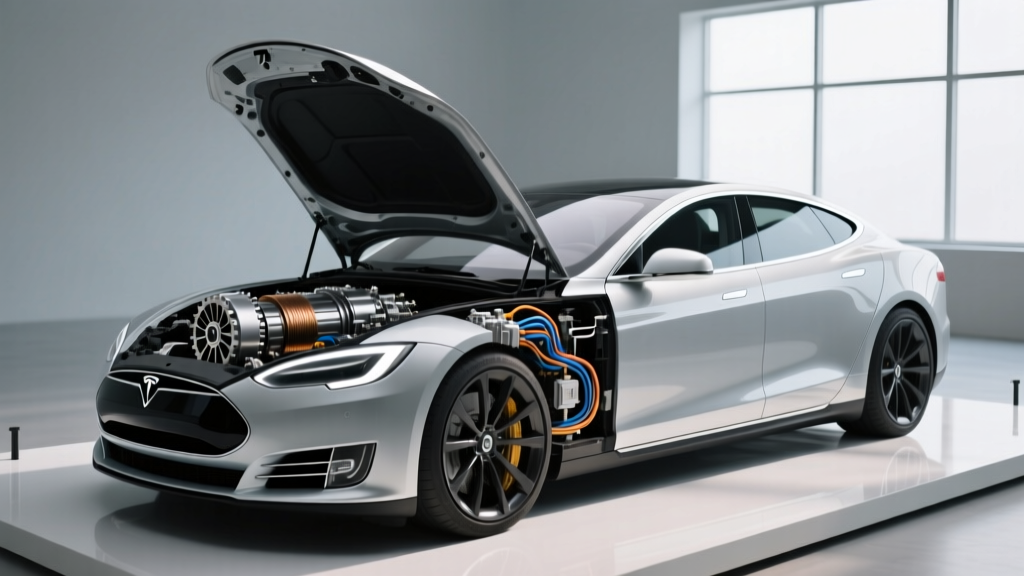
An EV electric motor operates on electromagnetic principles: current flowing through stator windings creates a rotating magnetic field that turns the rotor, which connects to the wheels through a single-speed reduction gear (typically 9:1 to 10:1 ratio). There is no multi-gear transmission, no clutch, and no combustion cycle. The result is instant torque from 0 RPM — which is why even a modest 200-hp EV feels quicker off the line than a similarly rated gas car.
Two metrics define motor performance for buyers:
- Power (kW or hp): How fast the motor can do work — determines top speed and highway passing ability. A 150 kW motor produces roughly 201 hp.
- Torque (lb-ft or Nm): Rotational force — determines acceleration feel and towing capability. Most EVs deliver peak torque from standstill.
Unlike a gas engine that needs to rev to a power band, an EV motor delivers maximum torque instantly. This is why the EPA's EV listings often show 0–60 times that rival much more powerful combustion cars.
The Three Motor Types in Today's EVs
Not all EV electric motors are the same. Automakers choose motor architecture based on cost, performance targets, and supply-chain constraints. Here are the three types you'll encounter in 2026 model-year vehicles:
| Motor Type | Efficiency | Rare-Earth Magnets | Best For | Example Vehicles |
|---|---|---|---|---|
| Permanent-Magnet Synchronous (PMSM) | 93–97% | Yes (neodymium) | Maximum range, efficiency | Hyundai Ioniq 5, Tesla Model 3 RWD, Ford Mustang Mach-E |
| AC Induction (Asynchronous) | 85–92% | No | High peak power, AWD secondary axle | Tesla Model S (front), older Model 3 AWD (front) |
| Externally Excited Synchronous (EESM) | 90–95% | No | Balanced efficiency, magnet-free supply chain | BMW iX, BMW i4, Renault Megane E-Tech |
Permanent-Magnet Synchronous Motors (PMSM)
PMSM dominates the 2026 EV market because it delivers the highest efficiency across the broadest speed range. Neodymium magnets embedded in the rotor create a constant magnetic field, so the motor wastes less energy generating that field from electricity. The trade-off: rare-earth mining carries environmental and geopolitical supply-chain risks, primarily from China. Most single-motor, range-focused EVs use PMSM on the rear axle.
AC Induction Motors
Induction motors have no permanent magnets — the rotor field is created entirely by electromagnetic induction. They are slightly less efficient at low loads but can sustain very high peak power without magnet overheating. Tesla popularized them for high-performance applications and often pairs an induction motor on the front axle with a PMSM on the rear. When cruising, the front induction motor can freewheel with zero drag, improving highway efficiency.
Externally Excited Synchronous Motors (EESM)
BMW and Renault have championed EESM, which uses copper windings on the rotor fed by a small current via slip rings (or inductive coupling) instead of rare-earth magnets. Efficiency sits between PMSM and induction, but the motor eliminates rare-earth dependency entirely. Expect more automakers to adopt EESM as supply-chain diversification becomes a priority through the late 2020s.
Motor Choice and Real-World Range: The Numbers
Motor efficiency directly shapes how far a given battery capacity takes you. Here's how motor type translates to real-world consumption across popular 2026 models:
| Vehicle | Motor Type | Drivetrain | Battery (kWh usable) | EPA Range | Efficiency (kWh/100 mi) |
|---|---|---|---|---|---|
| Hyundai Ioniq 5 SE RWD | PMSM (rear) | RWD | 77.4 kWh (NMC) | 303 mi | 27 |
| Tesla Model 3 Long Range AWD | PMSM rear + Induction front | AWD | 75 kWh (NMC) | 363 mi | 24 |
| BMW iX xDrive50 | EESM (front + rear) | AWD | 105.2 kWh (NMC) | 324 mi | 36 |
| Ford Mustang Mach-E Select RWD | PMSM (rear) | RWD | 70 kWh (NMC/LFP) | 250 mi | 31 |
| Tesla Model Y LR AWD | PMSM rear + Induction front | AWD | 75 kWh (NMC) | 330 mi | 26 |
Real-world caveat: EPA range assumes mixed driving at moderate temperatures. On a 70°F day with 70-mph highway driving, expect to lose 10–15% from the EPA figure. In sub-30°F winter conditions, range drops 20–35% due to battery chemistry resistance and cabin heating load — regardless of motor type. A 303-mi Ioniq 5 RWD realistically delivers ~220–240 mi in a Midwest January.
EV Motors vs. Gas Engines: A Cost and Capability Comparison
The fundamental advantage of EV electric motors isn't just efficiency — it's mechanical simplicity. A gasoline powertrain contains hundreds of moving parts (pistons, valves, camshafts, timing chains, oil pumps, exhaust aftertreatment). An EV motor has essentially one: the rotor. This translates directly into ownership costs.
| Factor | EV Electric Motor | Gasoline Engine |
|---|---|---|
| Energy conversion efficiency | 85–97% | 25–35% |
| Moving parts in drivetrain | ~5–10 | 200+ |
| Routine maintenance items | Coolant flush (every ~5 yr), cabin filter | Oil changes, spark plugs, timing belt, transmission fluid, O2 sensors |
| Estimated 5-year maintenance cost | $500–$900 | $2,500–$4,000 |
| Expected lifespan | 300,000+ mi (motor itself) | 150,000–250,000 mi before major service |
| Instant torque from 0 RPM | Yes | No (requires RPM build) |
| Regenerative braking | Yes — recovers energy, reduces brake wear | No — all braking is friction |
| Noise and vibration | Near-silent | Combustion noise, vibration |
According to fueleconomy.gov, EVs convert over 77% of grid electricity to wheel power, while gasoline vehicles convert only 12–30% of fuel energy to the wheels. The motor is where most of that advantage lives.
Total Cost of Ownership: Motor Efficiency in Your Wallet
Motor efficiency isn't an abstract engineering choice — it shows up in your monthly budget. A more efficient motor means fewer kWh consumed per mile, which means lower charging costs whether you're on a home Level 2 charger or paying public DC fast-charging rates.
| Cost Category | 2026 Hyundai Ioniq 5 SE RWD (PMSM) | 2026 Toyota Camry LE (Gas Baseline) |
|---|---|---|
| Base MSRP | $42,600 | $29,500 |
| Federal tax credit (§30D, if eligible) | –$3,750 to –$7,500* | $0 |
| Fuel/energy (5 yr, 75,000 mi) | $3,400 (home L2 at $0.14/kWh) | $7,875 (gas at $3.50/gal, 30 MPG) |
| Maintenance (5 yr) | $700 | $3,200 |
| Insurance (5 yr avg) | $9,500 | $7,200 |
| Estimated depreciation (5 yr) | $18,000 | $12,500 |
| 5-Year Total Cost | ~$34,450–$38,200 | ~$40,775 |
*Federal §30D tax credit eligibility depends on MSRP caps, buyer income limits, battery critical-mineral sourcing, and point-of-sale transfer availability. Verify current rules at IRS.gov. Credit amounts vary by vehicle and buyer — never assume a flat $7,500.
The EV's motor efficiency (27 kWh/100 mi) saves roughly $4,475 in energy costs over five years compared to a 30-MPG gas sedan, and $2,500 in maintenance. Insurance runs higher for EVs — typically 15–30% more — due to higher repair costs after collisions and pricier parts.
Single Motor vs. Dual Motor: Do You Need AWD?
Many 2026 EVs offer single-motor (RWD or FWD) and dual-motor (AWD) configurations. The motor count affects price, range, and capability:
| Factor | Single Motor (RWD/FWD) | Dual Motor (AWD) |
|---|---|---|
| Typical price premium | Base price | +$3,000–$5,000 |
| EPA range impact | Baseline | –15 to –40 mi |
| 0–60 mph (typical midsize SUV) | 6.5–8.0 sec | 4.0–5.5 sec |
| Traction in snow/rain | Adequate with winter tires | Superior, torque-vectoring |
| Weight added | — | +100–200 lbs |
| Efficiency (kWh/100 mi) | 25–30 | 28–36 |
The key insight: many dual-motor AWD EVs use a PMSM on the primary axle and an AC induction motor on the secondary axle. During steady-state highway cruising, the induction motor disconnects electronically (zero cogging drag), preserving efficiency. This is why the Tesla Model Y Long Range AWD achieves 330 mi EPA despite having two motors — the front induction motor freewheels most of the time.
If you live in a region with mild winters and dry roads, a single-motor RWD EV with quality all-season or winter tires usually provides sufficient traction. Reserve dual-motor AWD for mountain commutes, heavy snow regions, or if you need the acceleration for highway merging with a full cargo load.
Motor Longevity and What Can Go Wrong
The EV electric motor itself is one of the most reliable components in the vehicle. With no combustion, no oil degradation, and no friction-dependent parts, the motor windings and rotor are designed for 300,000+ miles. The surrounding systems, however, can need attention:
- Inverter: Converts DC battery power to AC for the motor. Failures are rare but expensive ($2,000–$5,000 out of warranty). Covered under the powertrain warranty (typically 8 years/100,000 mi).
- Reduction gear: The single-speed gearbox connecting motor to wheels. Requires minimal service; some manufacturers specify a fluid change at 100,000–150,000 mi.
- Cooling system: Motors and inverters are liquid-cooled. Coolant should be flushed per the maintenance schedule (typically every 5 years or 60,000–100,000 mi) to prevent corrosion.
- Bearings: Motor shaft bearings can wear after 200,000+ mi, producing a whining noise. Replacement is typically $500–$1,500.
Most manufacturers cover the motor and inverter under the federal-mandated EV powertrain warranty: minimum 8 years / 100,000 miles. Some extend to 10 years/150,000 mi. Check your specific vehicle's warranty documentation — it varies by brand and state (California's PZEV rules mandate longer coverage).
Common Misconceptions About EV Motors
| Myth | Fact |
|---|---|
| "EV motors wear out like gas engines" | EV motors have one moving part (rotor). No pistons, valves, or timing chains. Expected lifespan exceeds 300,000 mi with basic cooling-system maintenance. |
| "More horsepower always means less range" | Not necessarily. A dual-motor AWD EV with a freewheeling front induction motor can match or beat a single-motor RWD vehicle in real-world efficiency. Motor type and software tuning matter more than peak hp. |
| "EV motors need regular maintenance" | No oil changes, no spark plugs, no timing belts. The only motor-adjacent service is coolant replacement every ~5 years and cabin air filter swaps. |
| "All EV motors are the same" | PMSM, induction, and EESM motors have different efficiency profiles, rare-earth requirements, and performance characteristics. Motor choice affects range by 5–15% across comparable vehicles. |
| "Regenerative braking wears out the motor" | Regen actually reduces wear. The motor acts as a generator, slowing the car electromagnetically. This reduces friction-brake usage — many EV owners report 80,000+ mi on original brake pads. |
Decision Framework: Which Motor Setup Is Right for You?
Choose Based on Your Driving Reality
- Choose single-motor RWD (PMSM) if: You prioritize maximum range, drive mostly in dry or mild-winter climates, commute under 60 miles daily, and want the lowest purchase price. Best for: Hyundai Ioniq 5 SE RWD, Tesla Model 3 RWD.
- Choose dual-motor AWD (PMSM + induction) if: You regularly drive in snow, mountain passes, or wet conditions; need sub-5-second 0–60 for highway merging; or tow occasionally. The range penalty (15–40 mi) is worth the traction. Best for: Tesla Model Y LR AWD, Ford Mustang Mach-E GT.
- Choose EESM (BMW-style) if: You value supply-chain ethics (no rare-earth magnets) and want strong efficiency without PMSM's magnet dependency. Slightly lower peak efficiency than PMSM but zero rare-earth content. Best for: BMW i4, BMW iX.
- Don't over-spec motor power if: You primarily drive in cities under 45 mph. A 200-hp single-motor EV delivers more than enough urban torque. Paying for a 480-hp dual-motor setup you'll never use wastes money and reduces range.
Frequently Asked Questions
Do EV electric motors need oil changes?
No. EV motors have no engine oil. The reduction gearbox may require a fluid inspection or change at 100,000+ miles depending on the manufacturer, but this is a minor service compared to gas-engine oil changes every 5,000–10,000 miles.
Can an EV motor be repaired or does it need full replacement?
Most EV motor issues involve peripheral components (inverter, sensors, cooling lines) rather than the motor itself. Bearing replacements and winding repairs are possible at specialized EV shops, but in practice, many dealerships opt for full motor assembly swaps under warranty. Out-of-warranty motor replacement runs $4,000–$9,000 depending on the vehicle.
Why do some EVs use two different motor types?
Pairing a PMSM on the rear axle with an AC induction motor on the front axle gives engineers the best of both worlds: high efficiency from the PMSM during normal driving, and the ability to disconnect the front induction motor (zero drag) during highway cruising. This is the architecture Tesla, Hyundai, and others use on AWD models to minimize the range penalty of dual motors.
Does motor type affect regenerative braking strength?
Yes, indirectly. PMSM motors generally support stronger regenerative braking because their permanent magnets create a stronger back-EMF (electromotive force) during deceleration. This is why PMSM-based EVs often offer more aggressive one-pedal driving modes. Induction motors can regenerate effectively but with slightly lower peak recovery rates.
What happens to an EV motor at very high mileage?
At 200,000+ miles, the most common motor-related issues are bearing wear (audible whine), cooling-system degradation (corroded coolant passages), and inverter capacitor aging. The motor windings themselves rarely fail. Real-world fleet data from high-mileage Teslas and Nissan Leafs shows motors routinely surpassing 300,000 miles without major service.
Are rare-earth-free motors the future?
Likely yes, for at least one axle in dual-motor setups. BMW's EESM technology is proven, and Tesla has announced plans to reduce rare-earth content in next-generation motors. However, PMSM's efficiency advantage is substantial enough that it will remain dominant for range-critical single-motor applications through at least 2030. Solid-state battery adoption may eventually reduce the pressure to maximize motor efficiency, but that technology remains in early production as of 2026.