The Quick Answer: EVs and Jumper Cables
Yes, electric vehicles have a conventional 12V auxiliary battery that can die — and yes, you can jump-start an EV's 12V system using standard jumper cables or a portable lithium jump-starter pack. However, you are only reviving the 12V system (lights, computers, contactors) — not the high-voltage traction battery (the 60–100+ kWh pack that actually drives the wheels). A dead traction battery cannot be "jumped" by any consumer product; it requires a tow to a charger. If your EV won't start because the 12V battery is depleted, a $50–$120 portable jump-starter or traditional jumper cables connected to a donor vehicle will get the car's computers booted so the DC-DC converter can take over and recharge the 12V battery from the main pack.
Why Does an EV Even Have a 12V Battery?
It surprises many first-time EV buyers: beneath the hood (or frunk liner) of a Tesla Model Y, Hyundai Ioniq 5, Ford Mustang Mach-E, or BMW i4 sits a small 12V lead-acid or lithium-iron-phosphate (LiFePO4) auxiliary battery. This battery powers the vehicle's low-voltage electronics — the body control module, infotainment, door locks, hazard lights, and critically, the high-voltage contactors that connect the main traction battery to the drivetrain.
Here's the sequence that matters: when you press the start button (or sit in the driver's seat with your phone key), the 12V battery energizes the contactors that close the circuit between the ~400V or ~800V traction battery and the rest of the car. If the 12V battery is dead, those contactors never close, and the car is effectively bricked — even if the main battery is at 80% state of charge.
This architecture is universal across modern BEVs and PHEVs. According to NHTSA documentation and manufacturer service manuals, the 12V system is a safety requirement: it ensures that high-voltage circuits remain isolated when the vehicle is off, reducing shock risk during maintenance or after a collision.
How the 12V Battery Fails in an EV (and Why It's More Annoying Than in a Gas Car)
In a conventional gas car, a dead 12V battery usually means the starter motor won't crank the engine. You jump it, the alternator takes over, and you're driving in minutes. The symptoms are obvious: slow cranking, dim lights, clicking sounds.
In an EV, a dead 12V battery is sneakier and more debilitating:
- No dashboard, no screens, no door unlock via app. The car appears completely dead even with a full traction battery.
- No way to shift into neutral for a flatbed tow without 12V power (many EVs require the 12V system active to release the parking pawl or shift by wire).
- Phantom drain accelerates the problem. Modern EVs run background telematics, battery thermal management checks, and OTA update readiness even when "off." A weak 12V battery can drain to zero in 2–4 weeks of non-use, especially in cold weather below 20°F (-7°C).
- Lithium 12V batteries (used in some 2025–2026 Teslas and Rivians) fail suddenly rather than showing gradual cranking weakness — one day it works, the next it doesn't.
Real-world data from EV owner forums and roadside assistance logs suggests that 12V battery failure is the single most common EV roadside-assistance call, surpassing traction-battery depletion. Tesla acknowledged this pattern by switching from lead-acid to a lithium-ion 12V battery in 2021, though early versions had firmware-related drain issues that were patched via OTA updates.
How to Jump-Start an EV: Step-by-Step
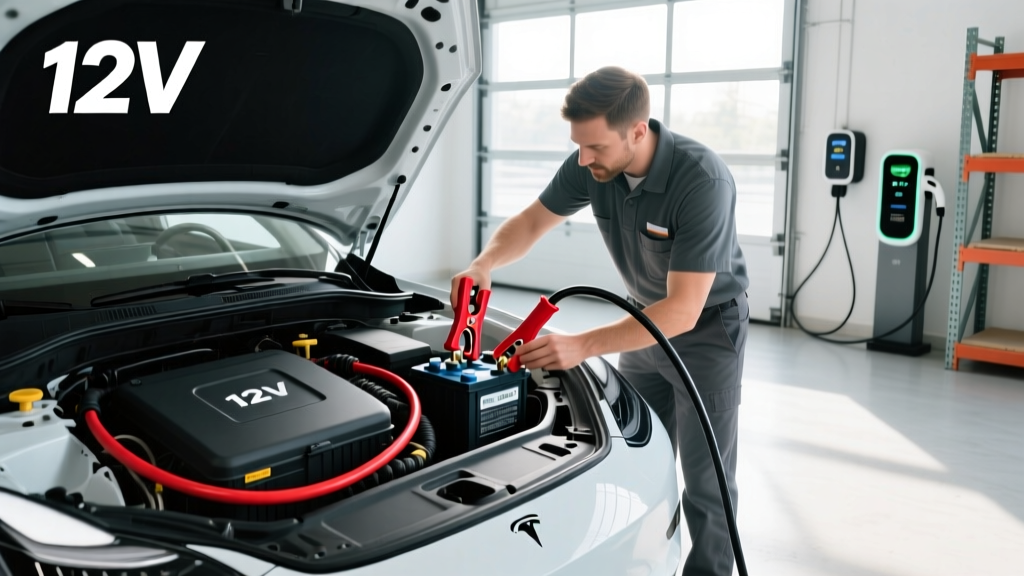
Jump-starting an EV's 12V system is mechanically identical to jumping a gas car — but with critical precautions:
- Locate the 12V battery terminals. In a Tesla Model 3/Y, they're behind the front bumper tow-eye cover (positive) and a grounding bolt (negative). In the Hyundai Ioniq 5 and Kia EV6, they're under the frunk liner. Consult your owner's manual — locations vary significantly.
- Use a portable lithium jump-starter pack (recommended) or traditional jumper cables from a donor vehicle. A compact lithium jump pack ($50–$120) is ideal because it eliminates the risk of voltage spikes from a donor car's alternator.
- Connect positive (red) first, then negative (black) to a ground point. Never connect negative to the 12V battery's negative terminal directly if your manual specifies a chassis ground — this reduces spark risk near the battery.
- Wait 2–3 minutes for the 12V system to boot. You should see the dashboard illuminate and hear the contactors click closed.
- Power the vehicle ON (foot on brake, press start or select Drive). Once the car is "ON" (READY indicator lit), the DC-DC converter takes over, maintaining the 12V battery from the traction pack — just like an alternator in a gas car.
- Leave the vehicle ON for at least 30 minutes or drive it to allow the DC-DC converter to recharge the 12V battery.
Common Myths About EV Jumper Cables — Busted
| Myth | Fact |
|---|---|
| "You can jump-start a dead EV main battery." | False. The traction battery (400V–800V) can only be recharged via an AC or DC charger. No jumper cable or consumer device can do this. |
| "EVs don't have 12V batteries." | Every production EV sold in the US has a 12V auxiliary battery. It's required for safety systems and computer boot-up. |
| "Jump-starting an EV will damage the electronics." | If done correctly (proper polarity, no high-amperage donor truck), jump-starting a 12V system is safe. Use a lithium jump pack for the lowest risk. |
| "I should jump-start my EV from another EV." | Not recommended. Most EV owner's manuals (including Tesla's) explicitly warn against using an EV as a donor vehicle — the DC-DC converter isn't designed to supply the surge current another car needs, and you risk damaging the donor EV's electronics. |
| "The 12V battery charges from regenerative braking." | Indirectly, yes — regen charges the traction battery, and the DC-DC converter steps that down to maintain the 12V. But if the car is off, regen isn't happening. |
EV vs. Gas Car: 12V Battery Ownership Compared
Understanding the 12V system is one piece of the broader EV ownership picture. Here's how the costs and maintenance realities compare between a battery-electric vehicle and a comparable gas-powered car over 5 years:
| Category | Tesla Model Y LR AWD | Toyota RAV4 AWD (Gas) |
|---|---|---|
| Base MSRP | $44,990 | $33,500 |
| Fed. Tax Credit (§30D) | Up to $7,500 (eligibility varies by sourcing/income — see IRS.gov) | $0 |
| Effective Purchase Price | ~$37,490 (if full credit applies) | $33,500 |
| Fuel / Charging (5 yr, 75k mi) | ~$3,200 (home L2 at $0.14/kWh, 28 kWh/100mi) | ~$8,600 (28 MPG combined at $3.20/gal) |
| Maintenance (5 yr) | ~$1,200 (cabin filter, wipers, tire rotation, brake fluid check) | ~$4,500 (oil changes, filters, spark plugs, brake pads, transmission fluid) |
| 12V Battery Replacement | ~$300–$450 (every 4–6 years; lithium versions may last longer) | ~$200–$300 (every 3–5 years) |
| Insurance (avg. 5 yr total) | ~$12,500 (EV premiums run 15–25% higher) | ~$10,200 |
| Estimated 5-Year Total Cost | ~$54,390 | ~$56,800 |
Source: EPA efficiency data via fueleconomy.gov. Electricity rate based on US residential average ~$0.14/kWh (EIA 2025). Insurance estimates based on national averages; actual premiums vary by state, driver profile, and insurer. Tax credit eligibility per IRS §30D rules — income caps, MSRP caps, and critical-mineral/battery-sourcing requirements apply. Always consult a tax professional.
Portable Jump-Starter Packs: What to Buy and What to Avoid
If you own an EV, carrying a compact lithium jump-starter pack is one of the smartest $50–$120 investments you can make. Here's what matters:
Specs That Matter
- Peak current: 600A minimum, 1000A+ preferred. EV 12V batteries are small (typically 12–16 Ah), so you don't need the massive cranking amps required by a diesel truck. But having overhead ensures reliable boot-up.
- Battery chemistry: Lithium iron phosphate (LiFePO4) preferred over lithium-polymer for longevity and thermal stability. LiFePO4 packs tolerate being stored in a hot glovebox better.
- Capacity: 8,000–12,000 mAh. Sufficient for 20–40 jump-starts per charge. Recharge the pack every 3–6 months to keep it ready.
- Built-in USB-C PD output (bonus). Doubles as an emergency phone/laptop charger — useful on road trips where you're DC fast-charging at a rest stop.
- Safety features: Reverse-polarity protection, spark-proof clamps, over-current protection. These are non-negotiable when working near EV electronics.
What to Avoid
- Cheap, no-name packs under $30. Undersized cells and missing safety circuits can damage your EV's 12V bus or fail when you need them.
- Heavy lead-acid jump boxes. Unnecessary weight (15–30 lbs vs. 1–2 lbs for lithium) and they self-discharge faster in storage.
- Packs without a voltmeter display. You want to confirm the pack itself has adequate charge before relying on it in an emergency.
Preventing 12V Battery Failure: Real-World Ownership Tips
The best "jumper cable" is the one you never need. Here's how experienced EV owners prevent 12V failures:
- Keep your EV plugged in when parked for extended periods. When connected to a Level 1 (120V) or Level 2 (240V) charger, the vehicle's onboard charger powers the DC-DC converter periodically to top off the 12V battery. This is the single most effective prevention measure.
- Don't leave your EV unplugged for more than 2–3 weeks, especially in cold weather. Phantom drain from Sentry Mode (Tesla), telematics, and thermal management can deplete the 12V battery in as little as 10–14 days in sub-freezing temperatures.
- Disable or reduce Sentry Mode / always-on dashcam if you park for multi-day stretches without charging. Sentry Mode on a Tesla can consume 200–300 Wh/day from the traction battery, with periodic DC-DC converter cycles that stress the 12V battery.
- Check 12V battery health via the vehicle's service menu (available on Tesla, Rivian, and some Hyundai/Kia models). If voltage consistently reads below 12.2V at rest, replacement is due.
- Replace proactively at the 4-year mark if you have a lead-acid 12V battery. The $300–$450 cost is trivial compared to a tow and the inconvenience of a bricked vehicle. Lithium 12V batteries (as used in newer Teslas and Rivians) typically last 6–8 years.
When You Need a Tow Instead of a Jump
There are scenarios where jumper cables won't help:
- Traction battery depleted to 0%: The DC-DC converter needs the main battery to maintain the 12V system. If the traction battery is fully depleted, even a jumped 12V battery won't keep the car running once the jump pack is disconnected. You need a flatbed tow to the nearest charger. (Note: Tesla's "tow mode" and similar features in other EVs require 12V power to activate — another reason to carry a jump pack.)
- DC-DC converter failure: If the converter that steps down high voltage to 12V has failed, the 12V battery will drain rapidly even after a jump. This requires a service center visit.
- 12V battery physically damaged or leaking: Jump-starting a damaged battery is a safety hazard. Replace it.
Always request a flatbed tow for an EV — never a wheel-lift or dolly tow. Most EVs lack a true neutral disconnect, and towing with drive wheels on the ground can spin the electric motors and generate uncontrolled voltage, potentially damaging power electronics. This is documented in service manuals across Tesla, Ford, Hyundai, and BMW EVs.
Decision Framework: What to Do When Your EV Won't Start
If the dashboard is completely blank and no lights come on:
→ The 12V battery is likely dead. Use a portable jump pack or jumper cables from a gas-car donor. Once the car boots, leave it ON for 30+ minutes. If the 12V battery dies again within a day, replace it.
If the dashboard lights up but the car shows "Traction Battery Low" or won't shift into Drive:
→ The main traction battery is depleted. You need to plug into a charger or call for a flatbed tow to the nearest DC fast charger. A 12V jump won't solve this.
If the car starts but the 12V warning light stays on:
→ The DC-DC converter may have failed, or the 12V battery is beyond recovery. Drive directly to a service center (if the car allows it) or call for a tow.
If you're parking for 2+ weeks without charging access:
→ Carry a charged lithium jump pack. Disable Sentry Mode and energy-consuming standby features. If possible, ask someone to plug the car in periodically, even to a standard 120V outlet.
Can I use my EV to jump-start someone else's gas car?
Generally, no. Most EV owner's manuals explicitly prohibit using the EV as a donor vehicle. The DC-DC converter (which replaces the alternator) is rated for the EV's own 12V loads — typically 100–200 amps continuous — and the surge current demanded by a gas car's starter motor (300–600A) can overload it. Some newer EVs with vehicle-to-load (V2L) capability, like the Hyundai Ioniq 5 or Ford F-150 Lightning, offer 120V AC outlets that could theoretically power a battery tender on another car, but this is slow and not a true jump-start. Use a dedicated jump pack or a gas-car donor instead.
How often should I replace my EV's 12V battery?
For lead-acid 12V batteries (most EVs built before 2023): plan on replacement every 3–5 years, at a cost of $200–$450 depending on the battery group size and whether you DIY or go through the dealer. For lithium 12V batteries (2022+ Tesla, Rivian, some 2025–2026 Hyundai/Kia models): expect 6–8 years of service life. The lithium batteries cost more upfront ($400–$600) but last longer and resist cold-weather voltage sag better.
Does the federal EV tax credit cover 12V battery replacement?
No. The IRS §30D clean vehicle credit applies only to the purchase of a new qualifying EV or PHEV — not to maintenance or replacement parts. However, some states and utilities offer rebates for EV maintenance or battery recycling. Check fueleconomy.gov for current federal incentive details and your state energy office for local programs.
My EV's app says the 12V battery is "low" — should I worry?
Yes, but don't panic. This warning means the 12V battery voltage has dropped below a threshold (typically ~12.0V). Plug the car into a charger immediately — the DC-DC converter will recharge the 12V battery within a few hours. If the warning recurs frequently despite regular charging, the 12V battery is likely nearing end-of-life and should be tested and replaced.
Are "electric jumper cables" different from regular jumper cables?
The term "electric jumper cables" typically refers to standard jumper cables or portable lithium jump-starter packs used on EVs — there's no special EV-only jumper cable product. The same quality copper-clad aluminum or pure copper jumper cables (10-gauge or thicker, 12-foot minimum length) that work on gas cars work on an EV's 12V system. The key distinction is that you're only jump-starting the 12V auxiliary system, not the high-voltage traction battery. Never attempt to connect any cable to the orange high-voltage wiring under the hood — those circuits carry 400–800V and are lethal.