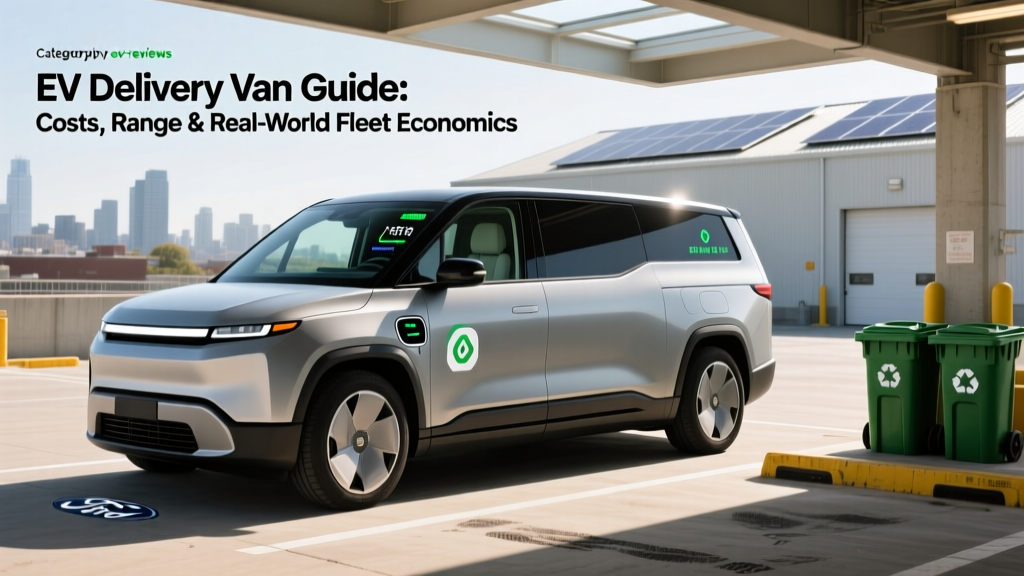
Quick Answer: Is an EV Delivery Van Worth It in 2026?
For last-mile and urban delivery routes under 150 miles per day with depot charging, an EV delivery van typically cuts per-mile energy costs by 50–65% versus a gas equivalent and reduces scheduled maintenance spend by roughly 30–40%. The trade-off: higher upfront purchase price ($45,000–$75,000 base MSRP depending on model and battery), the need for depot Level 2 or DC fast-charging infrastructure, and real-world range that can drop 20–35% in cold climates or under heavy payload. Federal §30D commercial clean vehicle credits (up to $7,500 for vans under 14,000 lbs GVWR, up to $40,000 for heavier classes under §45W) can narrow the price gap substantially—but eligibility depends on battery sourcing, MSRP caps, and buyer tax liability.
The 2026 EV Delivery Van Landscape: What's Actually Available
The commercial electric van market has consolidated around a handful of proven platforms after several high-profile startup exits (Arriva, Lordstown). Fleet buyers in 2026 are primarily choosing among these models:
| Model | Battery (kWh usable) | EPA Range | Peak DC Charge (kW) | 10–80% Time | Payload (lbs) | Cargo (cu ft) | Base MSRP |
|---|---|---|---|---|---|---|---|
| Ford E-Transit (2026, extended-range battery) | 89 kWh (NMC) | 196 mi | 125 kW | ~41 min | 3,300 | 487 | ~$53,000 |
| Mercedes-Benz eSprinter (2500, high roof) | 113 kWh (NMC) | 247 mi | 115 kW | ~42 min | 2,830 | 533 | ~$62,000 |
| BrightDrop Zevo 400 | 140 kWh (NMC) | 250 mi | 120 kW | ~45 min | 2,500 | 412 | ~$68,000 |
| Rivian EDV 700 (Amazon-exclusive, limited fleet) | ~105 kWh (NMC) | ~161 mi | ~150 kW | ~35 min | ~2,500 | ~660 | Fleet-only |
Real-world range caveat: EPA range figures assume moderate temperatures, partial payload, and mixed driving. In practice, fleet telematics data shows loaded urban routes with frequent stops typically achieve 75–85% of EPA range. In sub-freezing climates (below 32°F), expect an additional 15–25% reduction due to cabin heating and battery thermal management demands. A Ford E-Transit rated at 196 miles EPA may realistically deliver 140–155 miles on a cold winter route with a full load.
EV Delivery Van vs. Gas Van: Total Cost of Ownership
The purchase price of an electric delivery van runs $10,000–$25,000 higher than an equivalent internal-combustion model. But total cost of ownership (TCO) over a 5-year, 100,000-mile fleet lifecycle tells a different story for routes that fit the electric profile.
| Cost Category (5 yr / 100k mi) | Ford E-Transit (EV) | Ford Transit 250 (Gas, 3.5L V6) |
|---|---|---|
| Purchase price (base MSRP) | $53,000 | $43,500 |
| Federal tax credit (§45W commercial) | –$7,500 | $0 |
| Net acquisition cost | $45,500 | $43,500 |
| Energy/fuel cost | $4,800 (13¢/kWh avg, 2.5 kWh/mi) | $14,300 (15 mpg, $3.50/gal) |
| Maintenance (scheduled) | $2,200 | $4,800 |
| Insurance (commercial fleet avg) | $9,500 | $8,200 |
| Depot charging infrastructure (amortized) | $3,500 | $0 |
| Total 5-Year Cost | $65,500 | $70,800 |
| Cost per mile | $0.655 | $0.708 |
Key takeaway: The EV delivery van breaks even around year 3–4 for a fleet driving 20,000 miles/year with access to low-cost depot charging (under 15¢/kWh). The savings widen further if your utility offers commercial off-peak EV rates or demand-management incentives. However, if your routes regularly exceed 170 miles/day, require mid-shift fast-charging in areas with unreliable public DC infrastructure, or operate in extreme cold without heated depot parking, the gas van retains a TCO advantage.
Efficiency Head-to-Head
| Metric | EV Delivery Van (typical) | Gas Delivery Van (typical) |
|---|---|---|
| Energy consumption | 2.2–2.8 kWh/mi | 13–16 mpg |
| Cost per mile (energy only) | $0.28–$0.42 (depot rate) | $0.85–$1.10 |
| Regenerative braking benefit | High (stop-and-go recovers 15–25% energy) | None (brake wear cost) |
| Idle cost | Near zero (no motor running) | 0.3–0.5 gal/hr idling |
| Emissions (tailpipe) | Zero | ~400 g CO₂/mi |
Charging Infrastructure: The Make-or-Break Factor
The single biggest ownership variable for an EV delivery van isn't the van—it's the charging setup. Fleet operators need to plan depot charging carefully.
Charging Speeds and What They Mean for Fleet Operations
| Charging Level | Power (kW) | Miles Added per Hour | Typical Use Case | Install Cost per Stall |
|---|---|---|---|---|
| Level 1 (120V) | 1.4 kW | ~3 mi/hr | Not viable for fleet | $0 (existing outlet) |
| Level 2 (240V, 40A) | 9.6 kW | ~22 mi/hr | Overnight depot (8–10 hr window) | $2,500–$5,000 |
| Level 2 (240V, 80A) | 19.2 kW | ~44 mi/hr | Depot with shorter turnaround | $4,000–$8,000 |
| DC Fast (50 kW) | 50 kW | ~110 mi/hr | Mid-shift top-up | $25,000–$45,000 |
| DC Fast (150 kW) | 150 kW | ~280 mi/hr (peak) | Rapid fleet turnaround | $50,000–$100,000 |
Practical fleet planning: For a van consuming 2.5 kWh/mi on a 120-mile daily route, you need to replenish roughly 300 kWh. A 9.6 kW Level 2 charger delivers that in about 31 hours—too slow for daily turnover. A 19.2 kW Level 2 unit handles it in roughly 16 hours, which works for overnight-plus-daytime parking. Most fleet operators install 19.2 kW Level 2 stalls (or 48–80 kW DC units) to ensure vans are fully charged by morning shift start.
Charge curve reality: DC fast-charging specs quote peak kW, but the charge rate tapers significantly above 80% state of charge. A van rated at 125 kW peak may sustain that rate only between 10–50% SoC, then drop to 40–60 kW through the 80–100% range. This means the 10–80% time is the operationally meaningful metric, not the peak number.
Electrical infrastructure costs vary enormously based on your depot's existing panel capacity, trenching distance, and local utility interconnection requirements. A 4-stall Level 2 depot installation might run $15,000–$35,000 total (equipment, electrician, permits, utility service upgrade), while a single 150 kW DC fast charger can exceed $100,000 installed. Consult a licensed electrician and your utility's commercial EV rate program before committing.
Tax Credits and Incentives for Commercial EV Vans
Federal incentive rules for commercial electric vehicles differ from consumer passenger-vehicle credits. Here's the current framework under IRS §45W (Clean Commercial Vehicle Credit) and related provisions:
- Credit amount: Up to $7,500 for vehicles under 14,000 lbs GVWR; up to $40,000 for vehicles at or above 14,000 lbs GVWR
- Calculation: The lesser of 15% of vehicle cost basis (30% for qualifying commercial vans) or the incremental cost over a comparable gas vehicle
- Battery sourcing: Battery components and critical minerals must meet phased domestic-content thresholds (check IRS §45W guidance for current-year requirements)
- No MSRP cap: Unlike the consumer §30D credit, the commercial credit has no MSRP ceiling
- No income cap: Business income and tax liability apply—consult a tax professional for your entity's eligibility
- Not transferable at point of sale: The §45W commercial credit is claimed on your tax return, not transferred to the dealer (unlike consumer §30D)
Many states and utilities layer additional incentives: commercial EV rebates ($2,500–$10,000 per vehicle in states like California, New York, and Colorado), charging infrastructure grants, and reduced commercial electricity rates for EV fleet charging. Check AFDC's state incentive database for programs in your jurisdiction.
Real-World Ownership: What Fleet Managers Actually Report
Beyond the spec sheets, here's what matters when you're running EV delivery vans daily:
Route Fit Is Everything
EV delivery vans excel on predictable, depot-based routes under 150 miles with stop-and-go urban driving (where regenerative braking recovers significant energy). They struggle on long rural routes, highway-heavy inter-city runs (aerodynamic drag at 70 mph cuts range by 20–30% vs. city driving), and operations without reliable depot charging.
Cold Climate Realities
Battery chemistry (NMC in all current vans) loses efficiency in freezing temperatures. Fleet telematics from northern US and Canadian operators shows 20–30% range loss at 20°F with cabin heating active. Preconditioning the battery while still plugged in at the depot mitigates this partially but doesn't eliminate the penalty. If your routes run in Minnesota, Maine, or similar climates, spec your battery with 30% more range buffer than your route requires.
Maintenance Savings Are Real but Not Zero
EV delivery vans eliminate oil changes, transmission service, spark plugs, and exhaust system repairs. Brake pad life extends 2–3x due to regenerative braking. But you still need tire rotations (EVs are heavier and eat tires faster), cabin air filters, coolant system service for battery thermal management, and software updates. Budget roughly 55–65% of a gas van's maintenance spend, not zero.
Insurance Premiums Run Higher
Commercial EV van insurance typically runs 10–20% higher than equivalent gas models due to higher repair costs (specialized high-voltage training, battery replacement risk, limited collision-repair networks). Get fleet insurance quotes before purchasing—the difference can add $1,000–$2,500 per vehicle annually.
Common EV Delivery Van Misconceptions
| Myth | Fact |
|---|---|
| "EVs don't have enough range for delivery routes" | Current vans offer 160–250 mi EPA. US Census data shows 78% of commercial fleet vehicles travel under 100 mi/day. Most urban last-mile routes fit easily. |
| "Batteries will need expensive replacement within a few years" | All major manufacturers warrant battery packs for 8 years/100,000 miles at 70%+ capacity retention. Degradation data from 3+ year fleet operations shows ~8–12% loss at 100k miles. |
| "Charging takes too long for commercial use" | Overnight depot charging on Level 2 fully replenishes a daily route. Mid-shift DC fast-charging adds 100+ miles in 30–40 minutes. Most fleets charge overnight and never need mid-day charging. |
| "EV vans can't handle heavy payloads" | Payload capacity (2,500–3,300 lbs) matches gas equivalents. The battery adds curb weight but manufacturers engineer GVWR to maintain competitive cargo ratings. |
| "The grid can't handle fleet charging" | Managed charging (staggered start times, utility demand-response programs) allows most depots to charge 10–20 vans on existing commercial service. Utility coordination is essential but solvable. |
Decision Framework: Should Your Fleet Go Electric?
Choose an EV Delivery Van If:
- Your daily routes are under 150 miles (with 30% buffer for cold weather: under 110 miles in freezing climates)
- Vans return to a depot nightly where Level 2 charging can be installed
- Your routes are urban/suburban with frequent stops (regenerative braking maximizes efficiency)
- Your utility offers commercial EV charging rates below 15¢/kWh
- You plan to keep vans 5+ years (TCO breakeven requires time)
- Your fleet qualifies for §45W commercial clean vehicle credits
- Sustainability reporting or zero-emission zone compliance matters to your business
Stick with Gas (or Consider PHEV) If:
- Daily routes regularly exceed 170 miles or vary unpredictably
- You lack depot access or cannot install charging infrastructure (street parking, leased lot without landlord approval)
- Operations are primarily highway-speed inter-city routes (efficiency drops sharply at sustained 65+ mph)
- Your fleet operates in extreme cold (below 0°F) without heated parking
- You turn over vehicles every 2–3 years (upfront premium won't be recouped)
- Your utility commercial electricity rates exceed 25¢/kWh with no EV-specific tariff
First-Time EV Fleet Buyer Checklist
If this is your first electric delivery van purchase, here's the operational sequence that avoids costly mistakes:
- Audit your routes: Pull GPS telematics for 30 days. Record daily miles, stop counts, payload weights, and ambient temperatures. If 90th-percentile daily mileage is under 130 miles, you're a strong EV candidate.
- Assess your depot electrical capacity: Have a licensed electrician evaluate your panel. A 200A commercial service can typically support 4–6 Level 2 chargers at 9.6 kW each. You may need a panel upgrade ($5,000–$20,000) for larger fleets.
- Contact your utility: Ask about commercial EV rate schedules, demand charges, and make-ready infrastructure programs. Many utilities cover a portion of wiring and conduit costs for fleet charging.
- Get insurance quotes before ordering: Commercial EV insurance varies significantly by carrier. Some specialty fleet insurers now offer competitive EV rates.
- Verify tax credit eligibility: Confirm the specific VIN qualifies under current §45W battery-sourcing rules. Check IRS guidance and consult your tax professional.
- Start with a pilot: Order 1–2 vans before committing your entire fleet. Run them on your most demanding routes for 90 days and measure actual energy consumption, charging time, and driver feedback.
- Plan for charging management software: Fleet charging platforms (e.g., ChargePoint Fleet, EV Connect) optimize charging schedules to minimize demand charges and ensure morning readiness.
Frequently Asked Questions
What happens if an EV delivery van runs out of charge on a route?
Unlike a gas van where a 5-minute fuel stop solves the problem, a depleted EV van requires a tow or mobile charging unit. This is why route planning with a 25–30% range buffer is critical. Most fleet management systems include real-time SoC monitoring and will alert dispatch if a van's remaining range won't cover its route plus return to depot.
How long do EV delivery van batteries last before replacement?
Current NMC battery packs are warranted for 8 years/100,000 miles with guaranteed 70% capacity retention. Real-world fleet data from early-adopter operators (FedEx, Amazon, DHL) shows approximately 8–12% degradation at 100,000 miles. Full battery replacement costs $15,000–$25,000 out of warranty, but most packs are lasting well beyond warranty periods. Plan for 150,000–200,000 miles of usable battery life before capacity drops below 70%.
Can I charge an EV delivery van on a standard household outlet?
Technically yes (Level 1 at 1.4 kW), but it's not viable for fleet operations. At 3 miles of range per hour of charging, it would take over 60 hours to fully recharge a depleted 196-mile van. Commercial fleet charging requires Level 2 (240V, 19.2 kW) or DC fast-charging infrastructure.
Do EV delivery vans qualify for the $7,500 federal tax credit?
Commercial EV vans may qualify under the §45W Clean Commercial Vehicle Credit (up to $7,500 for vans under 14,000 lbs GVWR). However, eligibility depends on battery component and critical-mineral sourcing requirements that change annually. The credit is claimed on your business tax return—it cannot be transferred to the dealer at point of sale like the consumer §30D credit. Always verify the specific vehicle's eligibility with the IRS and your tax professional before purchasing.
How does payload affect EV delivery van range?
Every 1,000 lbs of additional payload reduces range by approximately 8–12%. A fully loaded van at max payload will achieve 10–15% less range than the EPA sticker. Combined with cold weather and highway speeds, a worst-case scenario can cut EPA range by 35–40%. Always spec your route buffer for worst-case conditions, not ideal ones.
What's the charging connector standard for commercial EV vans?
All current US-market EV delivery vans use the CCS1 (Combined Charging System) connector for DC fast charging and J1772 for Level 2 AC charging. Ford has announced future NACS adoption for its commercial lineup, but 2026 model-year E-Transit vans still ship with CCS1. Tesla Supercharger access for non-Tesla commercial vans requires a CCS-to-NACS adapter where available.