The EV Credit Lease Loophole Explained
If you've shopped for an electric vehicle recently, you've likely encountered a frustrating reality: the vehicle you want doesn't qualify for the full $7,500 federal tax credit under IRS §30D rules due to battery-sourcing requirements, MSRP caps, or your household income exceeding the limit. But there's a legal workaround that savvy EV shoppers have been using since 2023 — the EV credit lease loophole — and it remains viable in 2026.
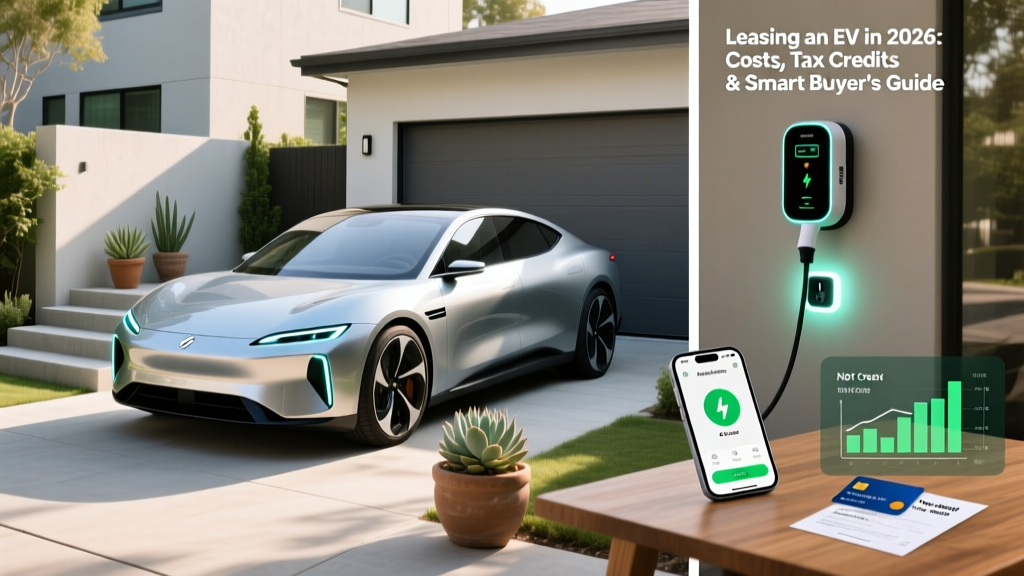
Here's how it works: When you lease an EV rather than purchase it outright, the federal tax credit technically goes to the leasing company (the legal owner of the vehicle). Under the commercial clean vehicle credit (§45W), the lessor can then pass that savings to you as a capitalized cost reduction — effectively lowering your lease payments or due-at-signing amount. The critical difference? The commercial credit has no MSRP caps, no buyer income limits, and more flexible battery-sourcing requirements.
§30D Purchase Credit Requirements (2026)
- Income caps: AGI ≤ $150,000 (single), $225,000 (head of household), $300,000 (joint)
- MSRP caps: ≤ $55,000 (sedans/wagons), ≤ $80,000 (SUVs/pickups/vans)
- Battery sourcing: Critical minerals and battery components must meet escalating domestic/FCA content thresholds
- Point-of-sale transfer: Eligible buyers can transfer the credit to the dealer for an immediate price reduction
- One vehicle per year: Per taxpayer, with VIN reporting to IRS
Source: IRS §30D Clean Vehicle Credit
The lease loophole sidesteps all of these restrictions — but it's not without trade-offs. Let's break down the full economics.
How Much Does It Really Cost to Own an EV Over 5 Years?
Total cost of ownership (TCO) is where EVs make their strongest case — or fall apart, depending on your situation. The table below models a realistic 5-year TCO for a 2026 mid-range EV (e.g., Tesla Model Y Long Range or Hyundai Ioniq 5) versus a comparable gasoline crossover.
| Category | 2026 EV (Mid-Range AWD) | 2026 Gas Crossover (AWD) |
|---|---|---|
| Purchase/Lease Price (after incentives) | $42,500 | $36,000 |
| Fuel / Electricity (5 years) | $3,600 | $9,375 |
| Maintenance (5 years) | $1,800 | $3,750 |
| Insurance (5 years) | $10,200 | $7,500 |
| Depreciation (est.) | $18,500 | $14,200 |
| 5-Year Total | $76,600 | $70,825 |
| Cost per mile (total) | $1.02 | $0.94 |
The honest verdict: At current pricing, a mid-range EV still carries a modest TCO premium over a comparable gas crossover over 5 years — primarily due to higher purchase price, insurance costs, and steeper depreciation. However, the gap narrows significantly when you factor in the $7,500 federal credit (if eligible), state incentives, and if you charge primarily at home on off-peak rates. For high-mileage drivers (20,000+ mi/yr), the fuel savings can flip the equation entirely.
Charging vs. Gas: The Real $/Mile Math
The single largest operational savings for EV owners comes from fuel costs — but the math depends heavily on where and when you charge.
| Scenario | Rate / Price | Efficiency | Cost/Mile |
|---|---|---|---|
| Home Level 2 (off-peak) | $0.13/kWh | 3.5 mi/kWh | $0.037 |
| Home Level 2 (standard) | $0.18/kWh | 3.5 mi/kWh | $0.051 |
| Public DC fast charging | $0.40/kWh | 3.2 mi/kWh | $0.125 |
| Tesla Supercharger (avg) | $0.30/kWh | 3.3 mi/kWh | $0.091 |
| Gas crossover (25 MPG combined) | $3.50/gal | 25 MPG | $0.140 |
| Gas crossover (premium fuel) | $4.10/gal | 22 MPG | $0.186 |
Key takeaway: Home charging on standard residential rates delivers fuel costs 60-70% lower than gasoline. But if you rely exclusively on public DC fast charging at $0.40/kWh, your per-mile fuel cost approaches that of an efficient gas car. This is why home charging access is the single most important factor in EV ownership economics.
For the 5-year model above (15,000 mi/yr, 75,000 miles total):
- Home charging (off-peak): ~$2,775 total
- Mixed home + public: ~$4,200 total
- Gas crossover (25 MPG): ~$10,500 total
That's a potential savings of $6,300-$7,725 over 5 years — but only with reliable home charging.
Do I Qualify for the Federal Tax Credit?
The §30D clean vehicle credit offers up to $7,500 for qualifying new EV purchases, split into two halves:
- $3,750 for meeting critical-mineral sourcing requirements
- $3,750 for meeting battery-component manufacturing requirements
As of 2026, the battery-sourcing thresholds have tightened significantly compared to 2023-2024, meaning fewer models qualify for the full $7,500. Many popular EVs now qualify for only $3,750 or $0 depending on their supply chain. You can verify current eligibility for specific models at fueleconomy.gov.
This is where the EV credit lease loophole becomes valuable. When a vehicle is leased, it falls under the commercial clean vehicle credit (§45W), which:
- Has no MSRP cap (so luxury EVs like the BMW iX or Mercedes EQS qualify)
- Has no buyer income limit (high-earners aren't phased out)
- Has more flexible sourcing rules (the lessor claims the credit)
- Can be passed through as a cap-cost reduction by the leasing company
State, Local & Utility Incentives
Federal credits are only part of the picture. Depending on your location, you may also qualify for:
- State rebates: California (CVRP, up to $7,000 for income-qualified buyers), Colorado (up to $5,000), New York (up to $2,000), and others — amounts and eligibility vary by jurisdiction and change frequently. Check your state energy office for current programs.
- Utility rebates: Many electric utilities offer $500-$1,500 rebates for home Level 2 charger installation, plus off-peak charging rates that can cut your electricity cost by 40-60%.
- HOV lane access: Several states grant single-occupant carpool lane access for EVs — a significant time savings in metro areas.
Always verify current incentive availability with official state and utility sources before making a purchase decision.
Maintenance Savings: Where EVs Shine
EVs have dramatically fewer moving parts than internal-combustion vehicles — no engine, no transmission, no exhaust system, no spark plugs, no timing belts. This translates to meaningful maintenance savings over the vehicle's life.
| Service Item | EV Cost | Gas Car Cost |
|---|---|---|
| Oil changes | $0 | $750 (5 changes × $150) |
| Transmission fluid | $0 (most EVs) | $250 |
| Brake pads (front + rear) | $300 (regen extends life 2-3×) | $900 |
| Coolant flush | $200 | $300 |
| Air filters (engine) | $0 | $150 |
| Cabin air filter | $150 | $150 |
| Tire rotation/replacement | $1,200 (EVs wear tires faster due to weight/torque) | $900 |
| Total (5 years) | $1,850 | $3,400 |
Net savings: ~$1,550 over 5 years, or ~$310/year. Not trivial, but also not the primary economic driver for EVs. The real savings come from fuel. Note that EV tire costs are typically higher due to heavier vehicle weight and instant torque delivery — budget for this.
Insurance Cost Reality: The Uncomfortable Truth
Here's where many EV cost calculators gloss over reality: EV insurance premiums are typically 15-30% higher than equivalent gas vehicles. For our mid-range EV model, expect annual premiums of $1,800-$2,200 versus $1,300-$1,600 for a gas crossover.
Why the premium?
- Higher repair costs: EV battery packs are expensive to replace if damaged, and specialized training is required for high-voltage system repairs
- Higher vehicle values: EVs generally carry higher MSRPs, increasing comprehensive/collision exposure
- Limited repair network: Fewer body shops are certified for EV structural and battery repairs, driving up labor rates
- Total-loss thresholds: Even minor battery damage can trigger a total-loss declaration, increasing insurer risk
Mitigation strategies: Shop quotes from EV-friendly insurers (Tesla Insurance, Progressive, State Farm), maintain a clean driving record, and consider higher deductibles. Some manufacturers offer captive insurance programs with competitive rates for their EVs.
Depreciation and Resale Value: The Moving Target
EV depreciation has been volatile. In 2022-2023, some EVs held value exceptionally well due to high demand and limited supply. In 2024-2025, aggressive price cuts by Tesla and an influx of new models caused used EV values to drop significantly — some models losing 40-50% of value in the first two years.
As of 2026, EV depreciation is stabilizing but remains steeper than comparable gas vehicles for most models:
- Average 5-year depreciation (EV): 45-55% of MSRP
- Average 5-year depreciation (gas crossover): 38-45% of MSRP
Factors working against EV resale value:
- Rapid technology advancement (newer models charge faster, have more range)
- Battery degradation concerns among used buyers
- Manufacturer price cuts undermining used-market pricing
- Federal credit reducing effective new-vehicle cost (lowering the used-price ceiling)
Leasing advantage: If you lease, depreciation is the leasing company's problem, not yours. You walk away at lease-end regardless of market value. This can be a significant advantage during periods of high depreciation volatility — and it's one reason the EV credit lease loophole has gained traction among cost-conscious buyers.
Frequently Asked Questions
Is the EV credit lease loophole legal?
Yes. The commercial clean vehicle credit (§45W) explicitly allows leasing companies to claim the credit on vehicles they purchase for lease. Many major automakers' captive finance arms (BMW Financial, Hyundai Capital, etc.) pass the full $7,500 as a cap-cost reduction. This is not a gray-area loophole — it's how the tax code is written.
How much do I actually save by leasing vs. buying with the credit?
If you qualify for the full §30D credit on a purchase, the economics are similar — you get $7,500 either way. The lease advantage kicks in when you don't qualify for the purchase credit (income too high, MSRP too high, battery sourcing doesn't qualify) but can still capture the commercial credit through a lease. In those cases, the lease can save you $3,750-$7,500 that you'd otherwise forfeit.
Can I buy the EV at lease-end?
Most EV leases include a purchase option at a predetermined residual value. However, you cannot claim the §30D credit on a lease-end purchase — the credit applies only to new vehicles. If the residual is competitive with the used market, buying out the lease can make sense. If the EV has depreciated heavily, returning it and leasing a newer model may be smarter.
Do state incentives apply to leased EVs?
Varies by state. Some state rebates (like California's CVRP) apply to both purchases and leases, while others are purchase-only. Utility rebates for home chargers typically apply regardless of whether you own or lease the vehicle. Always check your specific state and utility programs.
What happens if battery-sourcing rules change mid-lease?
Nothing — the credit was claimed by the lessor at the time of vehicle acquisition. Your lease terms and cap-cost reduction are locked in. Future changes to §30D or §45W don't retroactively affect existing leases.