Quick Answer: What Are EV Coolers and Electric Cooling Systems?
EV coolers are electrically driven thermal management components — including electric compressors, coolant pumps, heat pumps, and refrigerant loops — that regulate battery, motor, and cabin temperatures in electric vehicles. Unlike gas cars that use engine-driven A/C compressors and waste heat for cabin warmth, EVs rely entirely on electric cooling and heating systems powered by the traction battery. In 2026, most mainstream EVs use integrated thermal management systems that can precondition the battery for faster DC charging, recover waste heat from motors, and heat the cabin via heat pumps that use 3–4× less energy than resistive heaters. These systems directly impact your real-world range (up to 30% more in cold weather with a heat pump), charging speed (preconditioning enables peak kW rates), and long-term battery health.
Why Electric Cooling Systems Matter More in EVs Than Gas Cars
In a conventional gas vehicle, the A/C compressor is belt-driven off the engine, and cabin heat is essentially free — it's waste heat from combustion diverted through the heater core. The thermal budget is an afterthought.
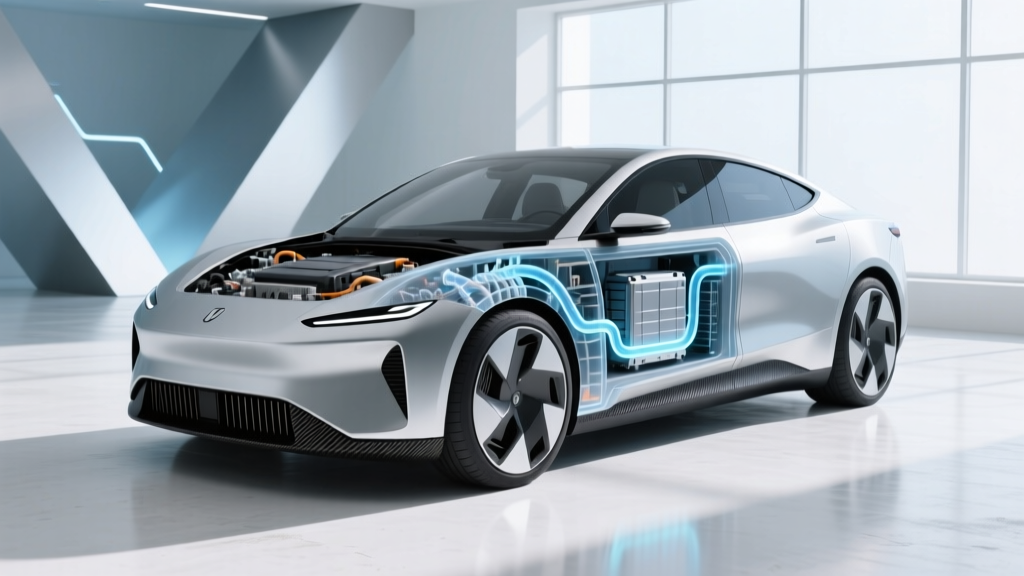
In an EV, every watt of cooling and heating comes directly from the traction battery. There is no "free" heat. This makes the electric cooling architecture one of the most consequential — and overlooked — systems in the vehicle. A 2026 EV's thermal management system typically includes:
- Electric A/C compressor (high-voltage, variable-speed) for cabin cooling and battery chiller circuits
- Electric coolant pumps (multiple, independently controlled loops for battery, motors, power electronics)
- Heat pump system (on most mid-range and premium models) that extracts ambient heat even at low temperatures
- Refrigerant-to-coolant heat exchangers that bridge the cabin HVAC loop with the battery thermal loop
- PTC (positive temperature coefficient) resistive heater as a backup or supplement to the heat pump in extreme cold
The quality and integration of these electric cooling components explains why two EVs with identical battery capacities (say, 77 kWh) can deliver vastly different real-world range, charging speeds, and cold-weather performance. The Tesla Model Y, Hyundai Ioniq 5, and BMW iX all use sophisticated integrated thermal systems, but their architectures and efficiencies differ meaningfully.
Heat Pump vs. Resistive Heating: The Range Difference in Numbers
The single biggest thermal-system decision affecting EV buyers in 2026 is whether a model uses a heat pump or relies solely on resistive (PTC) heating. The energy difference is substantial.
| System | Typical Power Draw | Energy per Hour (kWh) | Range Impact (est.) |
|---|---|---|---|
| Heat pump (COP ~3.0–4.0) | 1.5–2.5 kW | 1.5–2.5 kWh | ~5–8 miles lost/hr at 35°F |
| Resistive PTC heater | 4–6 kW | 4–6 kWh | ~15–22 miles lost/hr at 35°F |
| Gas car (waste heat) | ~0 kW (free) | 0 kWh (from engine waste) | Negligible direct impact |
A heat pump with a coefficient of performance (COP) of 3.5 moves 3.5 watts of heat for every 1 watt of electrical energy consumed. A resistive heater has a COP of exactly 1.0. Over a 2-hour winter commute, that difference can mean 5–7 kWh saved — roughly 15–25 miles of range preserved, depending on vehicle efficiency.
For 2026 models, heat pumps are standard on Tesla Model 3/Y, Hyundai Ioniq 5/6, Kia EV6/EV9, BMW i4/iX, and most Volkswagen ID.4 trims. Some budget-oriented EVs still use resistive-only heating, which is a meaningful disadvantage for buyers in cold climates (consistently below 45°F in winter).
How Electric Coolers Affect DC Fast Charging Speed
Thermal management is the hidden variable behind charging speed claims. A battery must be within a narrow temperature window — typically 25°C to 40°C (77°F–104°F) — to accept peak DC fast charge rates. Outside this window, the battery management system (BMS) throttles charge speed to protect cell health.
Here's how electric cooling systems directly impact your 10–80% charging time:
| Scenario | Battery Temp at Arrival | Peak Charge Rate | 10–80% Time |
|---|---|---|---|
| Preconditioned (nav routed to charger) | ~35°C (95°F) | Peak kW (e.g., 240 kW) | ~18–22 min |
| Cold-soaked, no preconditioning | ~5°C (41°F) | Throttled to 40–70 kW | ~45–60 min |
| Hot-soaked after highway driving | ~48°C (118°F) | Throttled to 80–120 kW | ~30–40 min |
When you navigate to a DC fast charger using the vehicle's built-in navigation (Tesla, Hyundai/Kia, Ford, BMW), the thermal system begins preconditioning — actively warming or cooling the battery 10–30 minutes before arrival using the electric compressor and coolant pumps. This is why routing through the car's nav system matters: third-party apps like PlugShare or A Better Routeplanner can't trigger preconditioning on most vehicles.
The Hyundai Ioniq 5's integrated thermal system, for example, can precondition its 77.4 kWh NMC battery to accept its peak 240 kW charge rate even on a 30°F morning, delivering a 10–80% charge in approximately 18 minutes. Without preconditioning, that same session could stretch past 40 minutes as the BMS limits current until the electric coolant loops bring cells into range.
Real-World Ownership: What Electric Cooling Means for Your Daily Driving
Home Charging and Preconditioning Strategy
If you have Level 2 home charging (240V, typically 7.6–11.5 kW), you can precondition your EV while it's still plugged in — drawing power from the grid rather than the battery. Most 2026 EVs allow scheduled preconditioning via the app or infotainment system. This means your cabin is warm and your battery is at optimal temperature before you leave, with zero range penalty. A typical preconditioning session from 30°F draws 3–5 kW for 15–20 minutes, costing roughly $0.04–$0.08 at the national average residential rate of $0.16/kWh (per EIA data).
Climate Considerations
Electric cooling system performance varies by climate in ways that affect purchase decisions:
Climate-Based Decision Framework
If you live where winters are consistently below 35°F: Prioritize a heat pump-equipped EV. Expect 20–30% range loss in deep cold (below 20°F) even with a heat pump, due to cabin heating, battery internal resistance, and denser air. Models with integrated thermal management (Tesla Model Y, Hyundai Ioniq 5, BMW iX) perform best here. Consider a larger battery pack (80+ kWh usable) to absorb the seasonal reduction.
If you live in a hot desert climate (Phoenix, Las Vegas, inland California): Battery cooling capacity matters more than heating. High ambient temps combined with DC fast charging generate significant cell heat. Look for EVs with robust liquid-cooling loops and active refrigerant-based battery chillers. Tesla and Hyundai/Kia platforms have demonstrated strong thermal management in sustained 110°F+ conditions. Garage parking and scheduled preconditioning before fast charging help preserve long-term battery health.
If you live in a moderate climate (Pacific Coast, Southeast): Thermal system differences are less impactful. Both heat pump and resistive heating EVs perform adequately. Focus more on range, charging speed, and price rather than thermal architecture specifics.
Long-Term Battery Health
The electric cooling system is the primary defense against battery degradation. Lithium-ion cells degrade fastest when held at high temperatures (above 45°C / 113°F) or high state of charge simultaneously. A well-designed thermal system keeps cells within the 20–35°C sweet spot during driving, charging, and parking. According to data aggregated by Recurrent Auto, EVs with active liquid cooling show measurably slower degradation curves than those with passive or air-cooled systems over a 5-year period.
Cost Breakdown: EV Thermal Systems vs. Gas Car HVAC
| Cost Category | EV (Heat Pump System) | Gas Car (Belt-Driven A/C + Heater Core) |
|---|---|---|
| Energy for cabin heating (5 winters, 12,000 mi/yr) | $600–$1,200 (electricity) | $0 (engine waste heat) |
| Energy for cabin cooling (5 summers) | $300–$500 (electricity) | $200–$400 (extra fuel from A/C load) |
| Compressor replacement risk | $800–$1,500 (electric compressor, rare under warranty) | $600–$1,200 (belt-driven compressor) |
| Coolant system maintenance | $0–$200 (sealed loops, minimal service) | $150–$400 (heater core flushes, hose replacements) |
| Refrigerant recharge | $0–$150 (sealed system, rarely needed) | $100–$250 (more common with age) |
| Total estimated 5-year thermal cost | $900–$2,050 | $1,050–$2,250 |
The EV's thermal system costs are front-loaded in the purchase price (heat pump systems add $500–$1,500 to MSRP depending on the model) but are generally cheaper to operate and maintain over time. The gas car's "free" cabin heat is offset by year-round efficiency losses from carrying and operating a belt-driven A/C compressor, plus more frequent coolant system service.
Common Misconceptions About EV Coolers and Thermal Systems
| Myth | Fact |
|---|---|
| "Running the A/C in an EV kills your range" | Modern electric A/C compressors draw 1–3 kW. At highway speeds, A/C typically reduces range by 5–10% — noticeable but manageable. Cabin cooling is far less impactful than cabin heating. |
| "EVs don't have coolant — they're all electric" | EVs have multiple coolant loops (typically 2–4) using glycol-based fluid to transfer heat between batteries, motors, inverters, and heat exchangers. Coolant level checks and occasional fluid exchanges are part of scheduled maintenance. |
| "Heat pumps don't work in very cold weather" | Modern automotive heat pumps (e.g., Hyundai/Kia's system, Tesla's octovalve-based system) extract heat down to approximately -10°F to -15°F, though COP drops significantly below 15°F. Below that threshold, the PTC resistive heater supplements or takes over. |
| "Battery cooling only matters during fast charging" | Thermal management operates continuously — during highway driving (cooling motors and battery), while parked (preventing heat soak), and in cold weather (warming cells for regen braking capability). Regenerative braking can be severely limited on cold batteries without preconditioning. |
| "All EVs precondition the battery the same way" | Preconditioning strategies vary significantly. Tesla and Hyundai/Kia precondition aggressively when navigating to a charger. Some brands only precondition in a narrow temperature window. Aftermarket preconditioning triggers (via apps or OBD-II tools) are available for some models. |
What First-Time EV Buyers Should Know About Thermal Systems
When evaluating a 2026 EV, the thermal management system should influence your decision in these concrete ways:
- Check whether a heat pump is included or optional. Some base trims omit it to hit a lower price point. On the Volkswagen ID.4, for example, the heat pump was an add-on in earlier model years but became standard on most 2025+ trims. Always verify by trim level.
- Ask about battery preconditioning behavior. Does the car precondition when you navigate to a charger? Does it work with third-party charging apps? Can you manually trigger it? This matters for daily fast-charging usability.
- Understand the warranty coverage. The electric compressor, heat pump, and coolant pumps are typically covered under the vehicle's powertrain or high-voltage component warranty — usually 8 years/100,000 miles per IRS and manufacturer requirements tied to federal credit eligibility. Confirm what's included.
- Factor in cold-weather range honestly. An EPA-rated 300-mile EV with a heat pump will realistically deliver 230–260 miles in sustained 20°F weather with cabin heating. Without a heat pump, expect 200–230 miles. Plan your battery size accordingly.
- Consider your charging patterns. If you rely heavily on DC fast charging (apartment dwellers, frequent road trippers), robust thermal management is critical. Repeated fast charging without adequate cooling accelerates battery degradation. Vehicles with active liquid cooling and refrigerant-based battery chillers (Tesla, Hyundai E-GMP, GM Ultium) handle repeated fast charging better than simpler thermal designs.
Electric Coolers in 2026: What's Changed
The 2026 model year has brought several thermal management improvements across the market:
- Wider heat pump adoption. Over 80% of new EVs priced above $35,000 now include a heat pump as standard equipment, up from roughly 50% in 2023.
- Integrated thermal architectures. Systems like Tesla's octovalve and Hyundai/Kia's integrated charging and cooling unit combine multiple coolant loops into a single manifold, reducing complexity, weight, and energy losses from pumping.
- Cold-climate heat pump improvements. Newer compressor designs and refrigerants (R-290 propane-based in some European-market models, R-1234yf in most US models) extend effective heat pump operation to lower ambient temperatures.
- Smarter preconditioning algorithms. Machine-learning-based thermal prediction now factors in elevation changes, traffic patterns, and charger availability to optimize battery temperature at arrival, rather than simple distance-based triggers.
For buyers, this means 2026 EVs are generally better-equipped for real-world thermal challenges than any previous model year. But the specifics still vary by brand and trim, so verify before purchasing.
Do EVs use electric coolers for the cabin like a refrigerator?
Yes, the principle is similar. An EV's A/C system uses an electric compressor to circulate refrigerant through an evaporation-condensation cycle, just like a refrigerator or household A/C. The difference is that the EV's system is high-voltage (typically 400V or 800V), variable-speed, and integrated with the battery thermal loop — meaning the same compressor can cool the cabin and chill the battery simultaneously.
Can I add an aftermarket heat pump to an EV that doesn't have one?
No. Heat pump systems require integrated refrigerant loops, additional heat exchangers, dedicated coolant pumps, and specific BMS/HVAC software calibration. This is not a feasible aftermarket modification. If a heat pump is important to you, choose a model and trim that includes it from the factory.
How much range do I lose running the A/C in summer?
Expect a 5–10% range reduction in typical summer conditions (85–95°F) with the A/C running. On a 300-mile EPA-rated EV, that translates to roughly 15–30 miles. At highway speeds, aerodynamic drag and tire rolling resistance consume far more energy than the electric A/C compressor. The range impact of cooling is much smaller than the impact of heating in winter.
Does the battery cooling system require regular maintenance?
EV coolant loops are sealed systems that require minimal maintenance. Most manufacturers recommend a coolant inspection at 30,000–50,000 miles and a fluid exchange at 100,000–150,000 miles, though intervals vary. The electric coolant pumps and compressor are generally maintenance-free and covered under the powertrain warranty. Check your owner's manual for the specific schedule.
Why does my EV limit regenerative braking when the battery is cold?
Cold lithium-ion cells have higher internal resistance and cannot safely accept high charge currents. Since regenerative braking sends energy back into the battery, the BMS limits regen power when cells are below approximately 50°F (10°C) to prevent lithium plating and cell damage. As the electric coolant loops warm the battery through driving or preconditioning, regen capability gradually returns. This is normal behavior, not a malfunction.